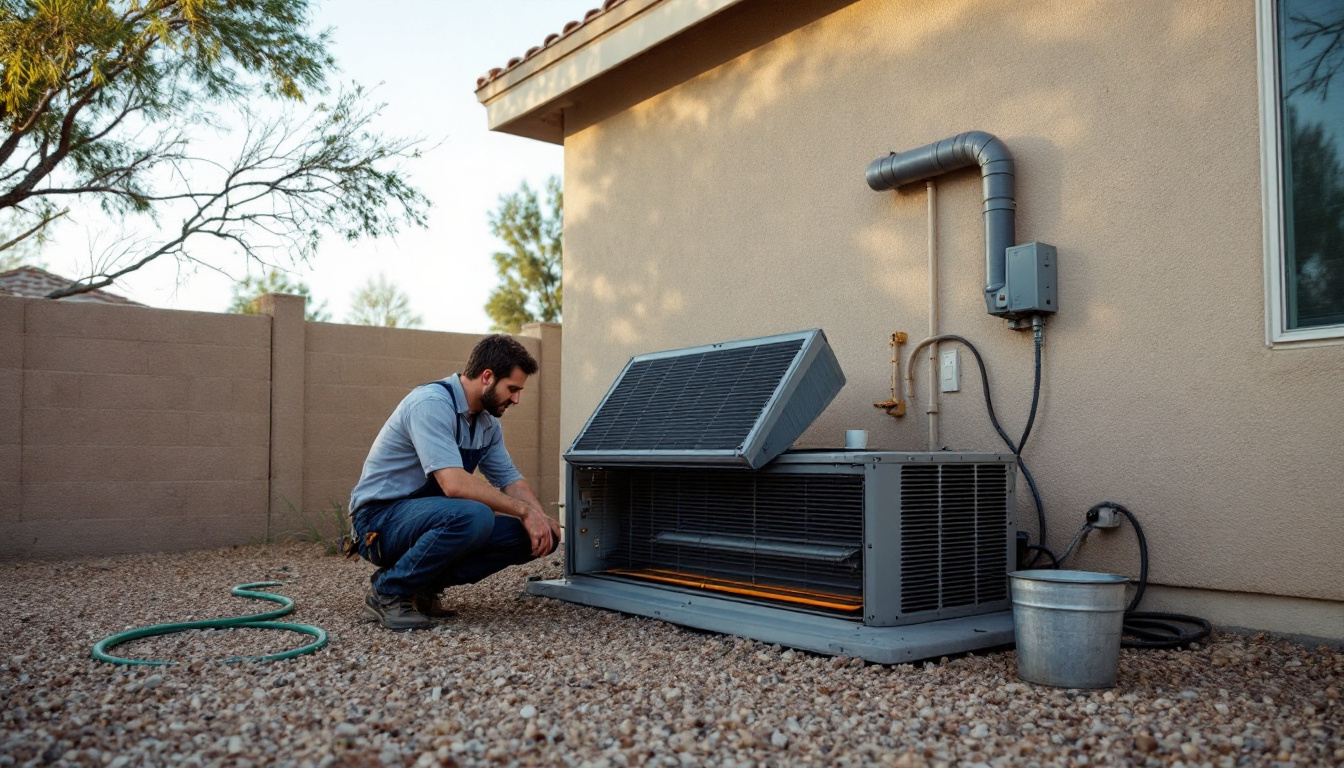
What does swamp cooler maintenance involve? Two full services a year, plus a monthly look in season. Spring startup covers pads, water line, float, pump, belt and blower. Winter shutdown means draining the pan and shutting the water line before the first freeze.
Key Takeaways
- An evaporative cooler needs service at least twice a year, at spring startup and at winter shutdown, per the DOE Building America Solution Center.
- DOE Energy Saver says to replace pads twice per cooling season, or monthly in continuous use.
- Annual water use for a 1,500 square foot home ran from 2,980 gallons in Santa Fe to 12,457 in Las Cruces, New Mexico (SWEEP 2007, via Building America).
- A bleed off valve raises water use 10% to 50%, and scale still forms on the media.
- These units draw about one quarter the energy of central air conditioning, per EIA pricing and DOE.
- Standing water left more than a few days breeds bacteria including Legionella, which CDC says grows at 77 to 113°F.
What does swamp cooler maintenance actually cover?
Swamp cooler maintenance is two scheduled services plus one running habit. The DOE Building America Solution Center puts it at “at least twice a year, when the unit is first started up in the spring and when it is shut down in the winter.” Between those, DOE Energy Saver asks for a monthly check of pads, filters, reservoir and pump.
A sealed condenser sits untouched between visits, which is why a written tune up report matters more there than owner habit. An evaporative cooler is an open water box in the weather, and its pads drop incoming air 15°F to 40°F only while clean and saturated.
Where a swamp cooler cannot work
No maintenance fixes a humidity problem. Building America says these units work best where the 1% summer design wet bulb temperature is below 70°F. At 95°F and 50% relative humidity the supply air leaves at 84°F, an 11°F drop. Our guide to where evaporative coolers work and where they fail covers the humidity map and the window rule.
How do you start a swamp cooler up in spring?
In a fixed order, because each step depends on the one before it. Building America lists spring service as replacing or cleaning the filter media, inspecting the belt for tension, and cleaning the cabinet. Below is that list in working order.
- Cut the power. DOE Energy Saver says to disconnect the electricity before servicing.
- Empty and inspect the pan. Scrape out sediment and scale, confirm the tray is water tight, repair cracks.
- Fit new pads. Replace torn, worn or mildewed pads, with rigid media seated so the flutes run as marked.
- Clean and aim the nozzles. Use vinegar to remove calcification. A dry stripe down one pad is usually a blocked nozzle, not a dead pump.
- Fill and set the float. It should shut the supply off below the overflow standpipe. Too high leaks; too low starves the pump
- Check belt tension and bearings. Tension the belt and lubricate the blower bearing motor. A loose belt is a quiet airflow problem before it becomes one of the louder ones.
- Run the pump, then the blower. Soak the pads for several minutes first. Confirm the purge line runs to a drain, then open the windows.
Why is mineral scale the central swamp cooler maintenance problem?
Because the machine works by leaving minerals behind. Water evaporates, dissolved calcium and magnesium do not, so the sump concentrates every cycle. USGS calls water above 180 milligrams per liter as calcium carbonate very hard, and reports hard water is prevalent across the east central and western United States, the same territory evaporative cooling suits.
Scale blocks nozzles so pads dry in patches, stiffens the media so airflow falls, and seizes float linkages and pump impellers. Building America is direct that even with a bleed off system, “scale still forms at the point of greatest evaporation.”
A bleed off or purge line drains a small stream from the recirculating loop so fresh water dilutes the sump, at a cost of 10% to 50% more water. Building America prefers an auto flush system, or dump pump, which empties and refills the pan every 8 to 12 hours.
Aspen or rigid media: which pads, and how often do you replace them?
Aspen pads are cheap and about 70% effective; rigid media costs more, lasts longer and rates 75% to 93%. DOE Energy Saver sets the replacement floor at twice per cooling season, or monthly in continuous operation, and says some paper and synthetic pads can be cleaned with a weak acid instead.
| Media type | Cooling effectiveness | Service interval | What goes wrong |
|---|---|---|---|
| Shredded aspen fiber pads | About 70% (DOE Building America) | Twice a season; monthly in constant use | Mats down, channels, sheds fiber |
| Rigid media, 8 to 12 inches thick | 75% to 93%; 12 inch media 90% or better | Clean each service, replace when flutes close | Scale bridges flutes, airflow collapses |
| Treated cellulose, fiberglass or foam panels | Within the 75% to 93% band | Clean or replace with the filter | Mildew if stored damp |
| Two stage indirect and direct units | 95% or greater (PG&E 2004, via Building America) | Per manufacturer, both stages | Second stage still scales |
What does a swamp cooler cost to run in water and electricity?
Water is the line item people forget. Building America cites SWEEP 2007 figures for a 1,500 square foot home: 2,980 gallons a year in Santa Fe, 7,261 in Albuquerque, 12,457 in Las Cruces, New Mexico. A bleed off valve adds 50%. DOE says the units draw about one quarter the energy of central air conditioners.
State prices decide how large that advantage is. EIA put June 2026 residential electricity at 15.18 cents per kilowatthour in Arizona, 15.06 in New Mexico and 13.11 in Nevada, against 34.74 in California. Our look at what air conditioning costs to run shows why no national figure works.
Which faults make a working swamp cooler look dead?
Most “broken” evaporative coolers are starved, not failed. The usual faults are dry pads, a slipping belt, a stuck float and too little open window. Building America gives the rule behind the last: 2 square feet of unrestricted air relief per 1,000 cfm delivered, citing PG&E 2004.
| Symptom | Usual cause | What to check first |
|---|---|---|
| Fan runs, air is not cool | Pads dry or scaled shut | Pump running, nozzle aim, pan water level |
| Cooler runs, house stays warm | Too little open window or relief vent | 2 square feet of relief per 1,000 cfm |
| Weak airflow at the registers | Slipping belt, clogged pads or filter | Belt tension, pad condition, blower debris |
| Musty or swampy smell indoors | Standing water and biofilm in the pan | Drain, scrub, restore bleed off or auto flush |
| Water on the floor or a ceiling stain | Cracked tray, stuck float, blocked overflow | Tray seams, float arm, overflow standpipe |
| No water reaching the pads | Supply valve shut, pump failed, line calcified | Supply valve, pump power, distribution tubing |
Two of those mislead people. Rising humidity with little temperature drop means the air has nowhere to go, the problem behind a house that is cold and clammy at once. A unit in vent only mode is not broken: DOE calls that running the cooler as a whole house fan. Ducted units using ceiling up ducts need extra attic ventilation, so check the roof vent area.
How do you winterize a swamp cooler and avoid freeze damage?
Drain it, dry it, cover it. Building America’s winter list: shut off the water line, drain and clean the pan, fit a winter cover against dirt and dust. Its repair guidance adds drying completely and removing mineral deposits at the fan, nozzles and tray.
Freeze damage is a plumbing failure, not a cooler failure. The supply line runs to an outdoor box, so anything holding water splits when the temperature drops. Close the valve inside conditioned space and drain the line at the cooler end. Close the dampers on a ducted unit; pull a window mounted cooler. Dry the cabinet before covering it, the mirror image of draining a whole house humidifier at winter’s end.
Is standing water in a swamp cooler a health risk?
It can be, and the fix is draining rather than dosing. Building America says the pan should be emptied whenever the cooler sits idle more than a few days, “as standing water left in the pan can become a breeding ground for mosquitos and bacteria, including Legionella (the cause of Legionnaires’ Disease).”
CDC’s device guidance puts the Legionella growth range at 77 to 113°F and asks that collection basins and condensate pans stay free of biofilm, corrosion and debris. A sump sitting warm and stagnant in July is inside that range. Treat a musty smell as a maintenance signal. If humidity is the complaint, what you want is a correctly sized dehumidifier, not a cooler that adds it.
How we researched this
Consulted and cited: the DOE Building America Solution Center guide on evaporative cooling systems (PNNL), the DOE Energy Saver page on evaporative coolers, EIA Electric Power Monthly Table 5.6.A for June 2026, CDC’s Legionella toolkit module on other devices, and the USGS page on water hardness. Research date: September 2026. The Energy Saver page 404s at its original address and is linked as an archived copy. Excluded: contractor blogs and manufacturer pad marketing, which publish no traceable basis for water or effectiveness figures. No installed or repair prices appear, because no federal series publishes them. Effectiveness figures are manufacturer bands: Building America notes no national body rates evaporative coolers. Reddit returned no usable threads and is not used.
Frequently asked questions
How often should swamp cooler pads be replaced?
DOE Energy Saver says to replace pads at least twice during the cooling season, or as often as once a month in continuous operation. Some paper and synthetic pads can be cleaned with a weak acid instead. In hard water, scale forces replacement before wear does.
What is the bleed off line on a swamp cooler for?
It drains a small stream from the recirculating line so fresh water dilutes the minerals concentrating in the sump. The DOE Building America Solution Center says this raises water use 10% to 50%, and that scale still forms on the cooling media anyway.
Why is my swamp cooler running but the house still hot?
Usually because the air has nowhere to go. Building America specifies 2 square feet of unrestricted air relief for every 1,000 cfm delivered, citing PG&E 2004. With windows barely cracked the house pressurizes and airflow stalls. Dry pads cause the same complaint.
How much water does a swamp cooler use in a season?
Building America cites SWEEP 2007 figures for a 1,500 square foot home: 2,980 gallons a year in Santa Fe, 7,261 in Albuquerque and 12,457 in Las Cruces, New Mexico. Add 50% on top of that if the unit has a bleed off valve.
Can Legionella grow in a swamp cooler?
Building America warns that standing water left in the pan can become a breeding ground for mosquitos and bacteria, including Legionella. CDC puts the growth range at 77 to 113°F. Empty the pan whenever the cooler will sit idle more than a few days.
How do I winterize a swamp cooler?
Shut off the water line, drain and clean the pan, dry the cabinet completely, remove mineral deposits at the fan, nozzles and tray, then fit a plastic or canvas cover. Close the dampers on a centrally ducted unit, and remove a window mounted cooler.
Sources
- US Department of Energy, Building America Solution Center. “Evaporative Cooling Systems.” https://basc.pnnl.gov/resource-guides/evaporative-cooling-systems. Accessed September 2026.
- US Department of Energy, Energy Saver. “Evaporative Coolers.” Archived copy: https://web.archive.org/web/2025id_/https://www.energy.gov/energysaver/evaporative-coolers. Accessed September 2026.
- US Energy Information Administration. “Electric Power Monthly, Table 5.6.A.” https://www.eia.gov/electricity/monthly/epm_table_grapher.php?t=epmt_5_6_a. Accessed September 2026.
- Centers for Disease Control and Prevention. “Controlling Legionella in Other Devices.” https://www.cdc.gov/control-legionella/php/toolkit/other-devices-module.html. Accessed September 2026.
- US Geological Survey, Water Science School. “Hardness of Water.” https://www.usgs.gov/special-topics/water-science-school/science/hardness-water. Accessed September 2026.
Leave a Reply