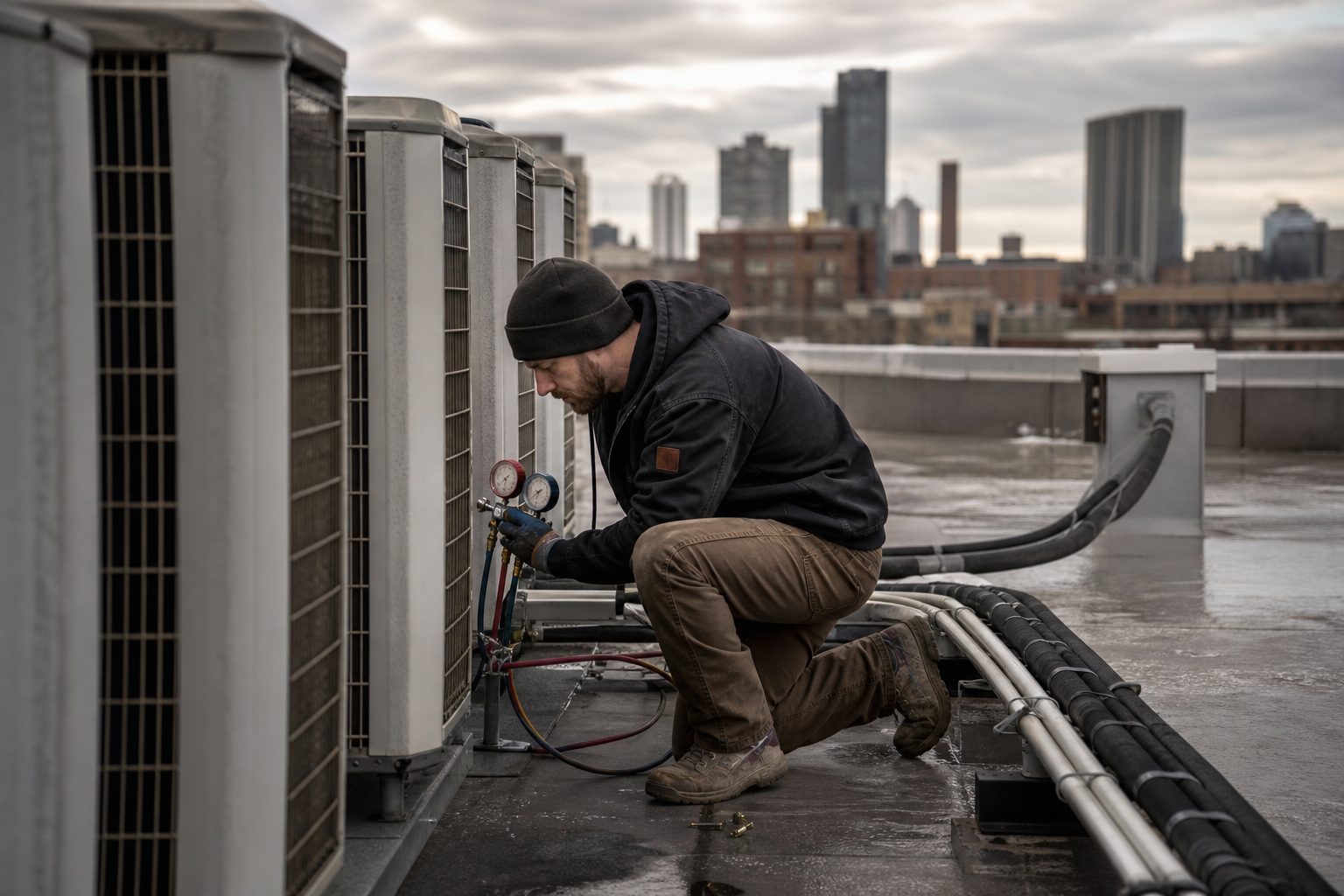
What is a VRF system? A VRF system is one or more outdoor condensing units serving many indoor units through a shared refrigerant loop, with inverter driven compressors modulating flow to each head instead of cycling on and off.
Key Takeaways
- 40 CFR 84.54(c)(2) restricts VRF systems at a GWP of 700 or greater effective January 1, 2026, one year after the rest of light commercial air conditioning.
- Under 10 CFR 431.97(g)(2), VRF above 65,000 Btu/h made on or after January 1, 2024 is rated in IEER, not EER.
- Air-cooled VRF from 135,000 to 240,000 Btu/h must hit 14.9 IEER; smaller three-phase VRF sits at 13.4 SEER2 from January 1, 2025.
- Components made or imported prior to January 1, 2026 may still be installed prior to January 1, 2027.
- Heat pump VRF runs one mode at a time; heat recovery VRF heats and cools at once through branch controllers.
- One compressor unit can serve 60 or more indoor units, per PNNL’s 2012 evaluation for GSA, which also flags the ASHRAE Standard 15 limit in small rooms.
What is a VRF system, and how does it move heat?
A VRF system is one or more outdoor condensing units feeding a shared refrigerant loop that serves many indoor fan coil units, each with its own thermostat. The compressors are inverter driven, so the system modulates refrigerant flow to each head rather than staging fixed capacity on and off.
No central air handler, no primary duct system: heat travels through copper rather than sheet metal. That is why VRF turns up where there is nowhere to put ducts, unlike a damper zoned system.
Scale separates VRF from the ductless equipment sold for homes. PNNL, writing for the General Services Administration in 2012, noted that small split systems “may serve a maximum of three indoor units without variable refrigerant flow,” while “a total of 60 or more indoor units can be served by a single compressor unit.”
Heat pump VRF or heat recovery VRF: which variable refrigerant flow system do you need?
A heat pump VRF system runs the whole circuit in one mode at a time: every head heats, or every head cools. A heat recovery VRF system adds branch controllers that let some heads cool while others heat, moving rejected heat into the heating zones instead of outdoors.
GSA described it as a system that “is capable of simultaneously cooling one area while heating another, and can transfer heat from spaces being cooled to spaces being heated and vice versa.” That is what a VAV system fakes with reheat.
The trade is capacity and hardware. PNNL put heat pump compressor units at 6 to 30 tons and heat recovery units at 6 to 24 tons, so simultaneous operation narrows the range while adding branch controllers, piping and commissioning to the ordinary reversing valve cycle.
| Configuration | Simultaneous heating and cooling | Compressor range (PNNL, 2012) | Best fit |
|---|---|---|---|
| Heat pump VRF | No. One mode at a time | 6 to 30 tons | Hotels, apartments, single exposure floors |
| Heat recovery VRF | Yes, via branch controllers | 6 to 24 tons | Core and perimeter offices, mixed use floors |
| Water-source VRF | Yes, on heat recovery models | Tower and boiler loop | High rise with no roof space |
Where do federal efficiency rules put a VRF system?
Federal law treats VRF as commercial equipment. 10 CFR 431.97, paragraph (g)(2), states that “each variable refrigerant flow air conditioner or heat pump (except air-cooled systems with cooling capacity less than 65,000 Btu/h) manufactured on or after January 1, 2024” must meet the listed minimums.
The metric changed with that date. Earlier units were rated in EER, at levels such as 11.2 EER for air-cooled equipment from 65,000 to 135,000 Btu/h effective January 1, 2010. The same classes are now rated in IEER, a part load weighted measure for modulating equipment, set by a DOE final rule with an effective date of May 30, 2023.
Smaller three-phase VRF is separate. Paragraph (i) sets 13.4 SEER2 for VRF air conditioners and 13.4 SEER2 with 7.5 HSPF2 for VRF heat pumps below 65,000 Btu/h, compliance January 1, 2025. Those are not the residential SEER2 minimums, a frequent confusion on small jobs.
When does the refrigerant rule hit variable refrigerant flow equipment?
VRF has its own date, later than the rest of the category. 40 CFR 84.54(c)(2) restricts, “effective January 1, 2026, variable refrigerant flow systems for use as residential or light commercial air-conditioning or heat pumps, using a regulated substance, or a blend containing a regulated substance, with a global warming potential of 700 or greater.” Paragraph (c)(1) put every other residential and light commercial system a year earlier, on January 1, 2025.
Two allowances extend the window. The EPA final rule that created them, effective January 13, 2025, says such systems “may be installed prior to January 1, 2027, where all specified components of that system are manufactured or imported prior to January 1, 2026,” and prior to January 1, 2028 “when an approved building permit issued prior to October 5, 2023, specifies the use of a restricted regulated substance.” Both are inventory clauses, and they set what can still be installed now.
The correction worth making
An R-410A VRF system installed under the inventory allowance is legal, not future proof. Pricing moves with supply, as the federal producer price series for refrigerant shows.
Ask which VRF lines use a lower GWP blend such as the A2L that replaced R-410A in most split equipment, and what service looks like in the A2L transition.
What do buyers underestimate about VRF system design?
Refrigerant volume, not equipment selection. A VRF system distributes refrigerant through occupied space. PNNL warned that “with long refrigerant lines passing through small spaces, the refrigerant-to-space volume could exceed the ASHRAE Standard 15 limit, triggering requirements for refrigerant mechanical rooms.” A small electrical room can fail that test on its own.
PNNL describes one project that connected the room to adjacent spaces with transfer grilles and fire smoke dampers. Other fixes: solenoid valves capping released charge, or more systems holding less.
- Run the concentration check room by room, on the smallest enclosed space served, before the equipment schedule is set.
- Check the manufacturer’s line length and elevation limits against the real riser layout; compressor energy rises as piping lengthens.
- Locate branch controllers where a technician can reach them, not above a fixed ceiling in a tenant suite.
- Plan a condensate route from every head. PNNL notes that “small condensate pumps are required, which need piping and wiring, typically over occupied spaces,” with pump noise “reported as a distraction.” Each condensate pump lifting water to a drain is a maintenance item and a leak path.
- Budget commissioning twice. PNNL states that “limited commissioning is required for warranty; additional commissioning is required to verify smooth control when switching between heating and cooling.”
None of it applies to a packaged rooftop replacement, which is one of the ways commercial work diverges from residential.
Where does a VRF system genuinely win, and where does it not?
It wins where zone count is high, heating and cooling are needed at once, and there is no room for duct shafts. GSA’s Green Proving Ground findings GPG-006, December 2012, projected “34% and higher HVAC energy savings relative to new systems that are code-compliant and older inefficient systems, in a range of building types and climates.”
Savings scale with what VRF replaces. GSA put projected energy cost savings at 34% against VAV with gas reheat or constant volume systems, and 45% against VAV with electric reheat. PNNL cited a study finding “up to a 70% reduction in HVAC energy is possible from a VRF system with exhaust air heat recovery when compared to a VAV system with electric reheat.”
It does not win everywhere. GSA put high-efficiency conventional equipment at 14 to 17 IEER against 16 to 20 or better for the majority of VRF, and heating COP at 3.2 to 3.3 against 3.2 to 3.5 or better. The bands overlap. PNNL added that components are not compatible across manufacturers and there is no secondary market, leaving the owner captive for parts.
Field evidence was thin: GSA recommended two or more pilot projects before deployment.
What does maintaining a VRF system with many heads cost?
Labor at every head, forever. PNNL’s 30 year life-cycle model for a 48,000 square foot retrofit priced two recurring tasks a central system does not have at that count: a fan coil filter change twice a year across 60 fan coil units, and an annual check and clean of the condensate system.
The compressor side goes the other way. PNNL notes that compressor unit maintenance is minimal, that air-cooled VRF has no central plant, and that it needs no building operator. Owners trade plant room labor for ceiling labor.
Access gets designed out and then regretted. Read why the highest MERV rating is not automatically right before standardizing one cartridge across 60 heads. Zone count also drives service agreement scope.
How we researched this
Research date: September 2026. Regulatory text was read from 40 CFR 84.54 and 10 CFR 431.97 via the Legal Information Institute, eCFR was unreachable, so the DOE date and both VRF installation dates were verified against the final rule texts on govinfo.gov. Technical material comes from PNNL-21548 and GSA GPG-006, both 2012.
Consulted and excluded: manufacturer application manuals, which publish line length and charge limits per model but are not comparable across brands; vendor price surveys, because no federal series publishes installed VRF pricing. Reddit was not mined: this is a commercial design and code topic.
Frequently asked questions
Is a VRF system the same as a ductless mini split?
No. PNNL noted that small split systems may serve a maximum of three indoor units without variable refrigerant flow, while one VRF compressor unit can serve 60 or more.
Can R-410A VRF still be installed in 2026?
Only under the inventory allowance. 40 CFR 84.54(c)(2) restricted VRF at a GWP of 700 or greater effective January 1, 2026, but permits installation prior to January 1, 2027 where components were manufactured or imported prior to January 1, 2026.
Why did VRF get a later refrigerant date than other systems?
EPA wrote the subsector separately. Paragraph (c)(1) of 40 CFR 84.54 set January 1, 2025 for residential and light commercial air conditioning and excludes VRF; paragraph (c)(2) sets January 1, 2026 for VRF.
What efficiency rating applies to a VRF system?
IEER for most of the category. Under 10 CFR 431.97(g)(2), VRF above 65,000 Btu/h made on or after January 1, 2024 is held to IEER, such as 14.9 IEER for air-cooled units from 135,000 to 240,000 Btu/h. Smaller three-phase VRF uses 13.4 SEER2 from January 1, 2025.
What is the ASHRAE Standard 15 problem with VRF?
Refrigerant charge relative to room volume. PNNL warned that long refrigerant lines passing through small spaces can push the refrigerant to space ratio past the ASHRAE Standard 15 limit, triggering refrigerant mechanical room requirements. Fixes include transfer grilles and solenoid valves.
Does a VRF system provide ventilation air?
No. The fan coil units recirculate room air. PNNL states that required outside air must be delivered through another mechanism, usually a dedicated outside air system, and that coordinating its controls with the VRF controls is problematic.
Sources
- Legal Information Institute. “40 CFR 84.54 Restrictions on use of regulated substances.” https://www.law.cornell.edu/cfr/text/40/84.54. Accessed September 2026.
- Legal Information Institute. “10 CFR 431.97 Energy efficiency standards and their compliance dates.” https://www.law.cornell.edu/cfr/text/10/431.97. Accessed September 2026.
- U.S. Government Publishing Office. “Energy Conservation Standards for Variable Refrigerant Flow Multi-Split Air Conditioners and Heat Pumps.” Federal Register, March 30, 2023. https://www.govinfo.gov/content/pkg/FR-2023-03-30/html/2023-06178.htm. Accessed September 2026.
- U.S. Government Publishing Office. “Restrictions on the Use of HFCs Under the AIM Act in Variable Refrigerant Flow Air Conditioning Subsector.” Federal Register, December 12, 2024. https://www.govinfo.gov/content/pkg/FR-2024-12-12/html/2024-29243.htm. Accessed September 2026.
- Pacific Northwest National Laboratory for GSA. “Variable Refrigerant Flow Systems.” PNNL-21548, 2012. https://www.pnnl.gov/main/publications/external/technical_reports/PNNL-21548.pdf. Accessed September 2026.
- U.S. General Services Administration. “Variable Refrigerant Flow.” Green Proving Ground GPG-006, December 2012. https://www.gsa.gov/system/files/GPG006-Variable%20Refrigerant%20Flow-Findings-508R.pdf. Accessed September 2026.
Leave a Reply