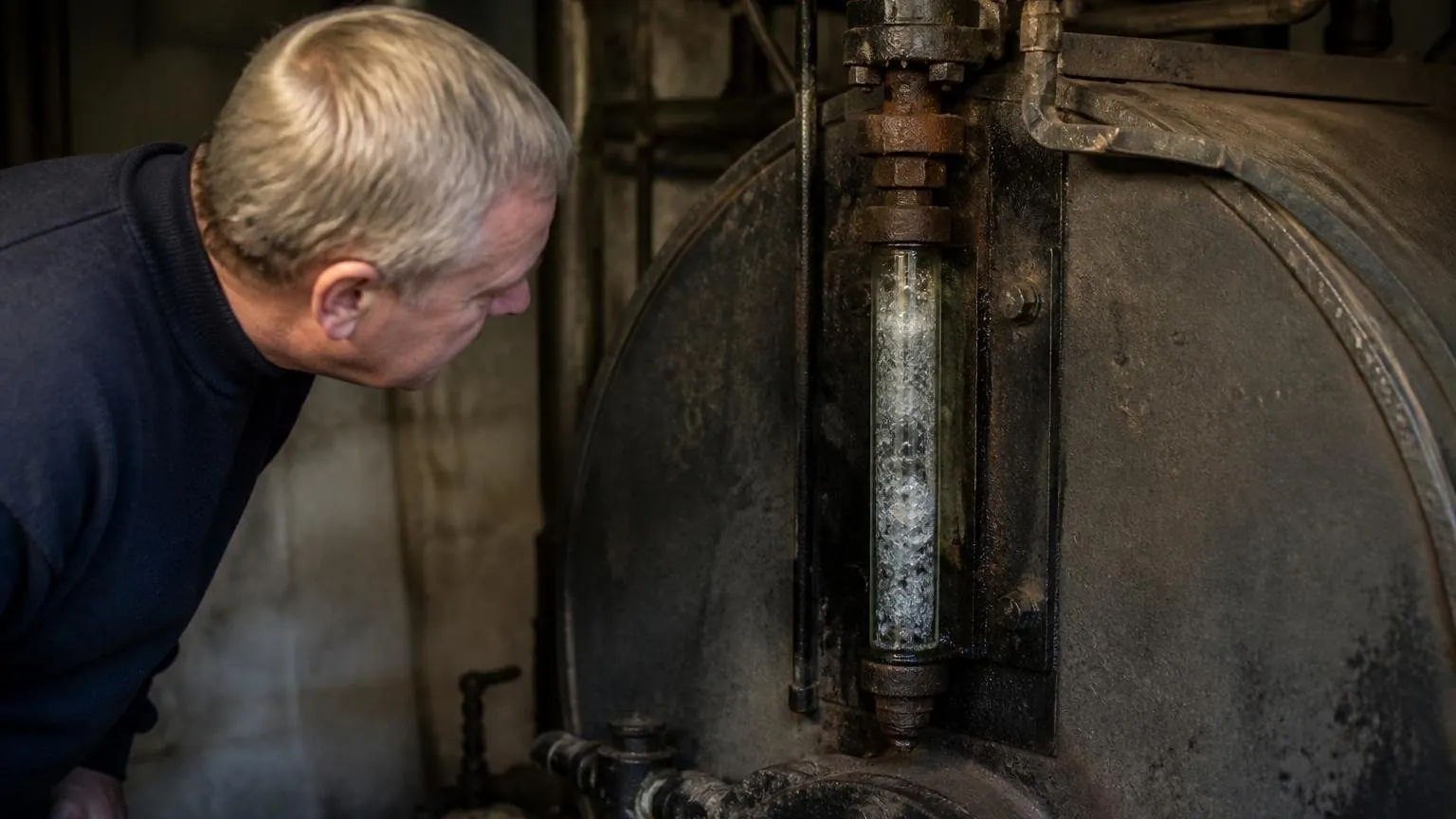
A steam boiler water level bouncing gently while the burner fires is normal. A water line that jumps hard or disappears from the gauge glass while the boiler makes steam is surging. Burnham’s manual 111043-01 blames oil first: skim the boiler, then check near-boiler piping, flame impingement and water pH.
Is a bouncing gauge glass normal, or is the steam boiler surging?
A ripple is normal; violent movement, or a glass that empties while making steam, is surging. Burnham’s SteamMax manual (111043-01) gives the working definition: “A boiler is surging when the water level in the gauge glass is bouncing or not visible while boiler is producing steam.” No maker document we read sets an inch figure for an acceptable ripple.
A slow drop is not a bounce. Peerless’s One-Pipe Steam Systems guide explains that during steady heating the boiler water level is lower because condensate is still out in the pipes, and that “in some cases the water level may go out of the gauge glass when the boiler shuts down” as steam bubbles collapse. A level that falls smoothly and recovers in the off cycle is water stored in the pipes, explained with the normal water line and when to add water.
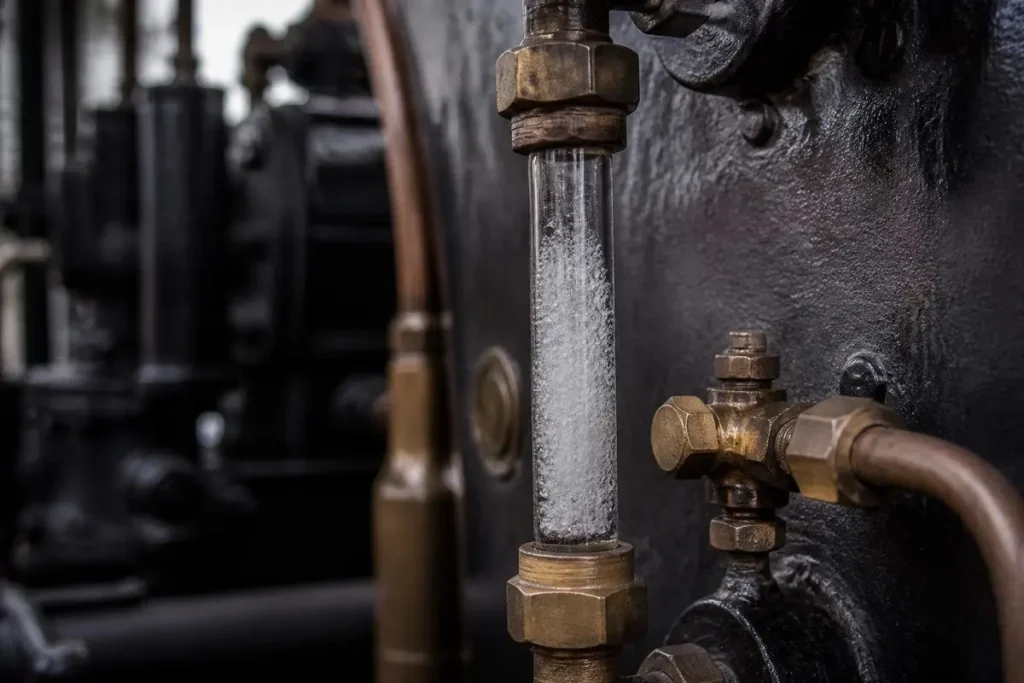
What does the bounce look like, and which cause does it point to?
Watch the glass for one full cycle from a cold start; the timing narrows the cause fastest.
| What you see | When | Likely cause | What to check or do |
|---|---|---|---|
| Violent bounce, water line hard to read | Days or weeks after a new boiler or piping work | Oil from black pipe, thread sealant or tapping lubricant (Burnham) | Skim; Weil-McLain says the process may need repeating after several weeks |
| Bounce plus wet steam and spitting vents | Every cycle, clean water | Near-boiler piping undersized or piped wrong (Burnham, Weil-McLain) | Compare risers, header and the 24 in. header height to the manual |
| Sloped water line, or hammering inside the boiler | Full fire | Too few risers, flame impingement or overfiring (Peerless) | Firing rate and flame pattern by a technician |
| Level collapses during a shower | Heavy hot water draw | Oversized tankless coil (Peerless) | Coil flow regulator and coil size |
| Bounce right after shutdown | Off cycle | Boiler room pipe insulation removed, vacuum forms (Peerless) | Reinsulate the near-boiler and boiler room piping |
| Glass reads normal but probe LWCO trips, or glass level lags | Any time | Plugged gauge glass or oily probe (Hydrolevel) | Flush the glass; clean probe and skim |
| Foam on the surface, surging returns after cleaning | After chemicals were added | Foaming treatment chemical or wrong pH (Weil-McLain, Burnham) | Boil a sample of the chemical; test pH |
Compiled by The HVAC Brief from Burnham SteamMax 111043-01 and Independence 103538-08, Weil-McLain EG/PEG 550-142-303, Peerless One-Pipe Steam Systems and Hydrolevel 400 Series instructions.
Why does a new steam boiler bounce for weeks after installation?
Usually oil. Burnham’s SteamMax manual says oil “can originate from the inside of black pipe, or from petroleum based thread sealant or from the lubricant used in the cast iron hole threading process,” and that it “can reduce steam generation and make the boiler surge.” Weil-McLain’s EG manual warns that an uncleaned boiler can show “violent fluctuations of water level, water passing into steam mains.” Burnham adds that solder and brazing flux left in copper near-boiler piping causes “surging, an unsteady water line and wet steam.”
Burnham step 24 adds that a new steam boiler “tends to break loose accumulated scale from system,” so it calls for skimming after several days of continuous operation, not on day one. The three maker procedures differ:
| Manual | Burner while skimming | Water outlet | Stop when | If it still surges |
|---|---|---|---|---|
| Burnham SteamMax 111043-01 | Make steam, then OFF for the whole skim | Horizontal nipple and full-port ball valve in a side tapping of at least 3/4 in.; stream no larger than a wooden pencil | Water is comfortable to the hand; about an hour, no chemicals | After two tries with no improvement, “the problem is not oil-related”: check piping, flame impingement, pH |
| Weil-McLain EG/PEG Series 6, 550-142-303 | Fired below steaming rate, cycled to prevent pressure rise | 1½ in. pipe from the skim tapping to a floor drain, waterline at the tapping midpoint | Discharge is clear; “may take several hours” | Drain, flush, refill, steam 15 minutes; repeat after several weeks if needed |
| Burnham Independence 103538-08 | Boil-out with compound, then about 5 hours without producing steam on the second pass | Surface blow-off tapping piped to drain with no shut-off valve | Surface blow-off water runs clear | Flush the system through a gate valve in the Hartford loop and a return drain |
Compiled by The HVAC Brief from the three manuals named. Burnham says to lift the valve and verify there is no steam pressure before opening a tapping.
Can the near-boiler piping make the water line bounce even when the water is clean?
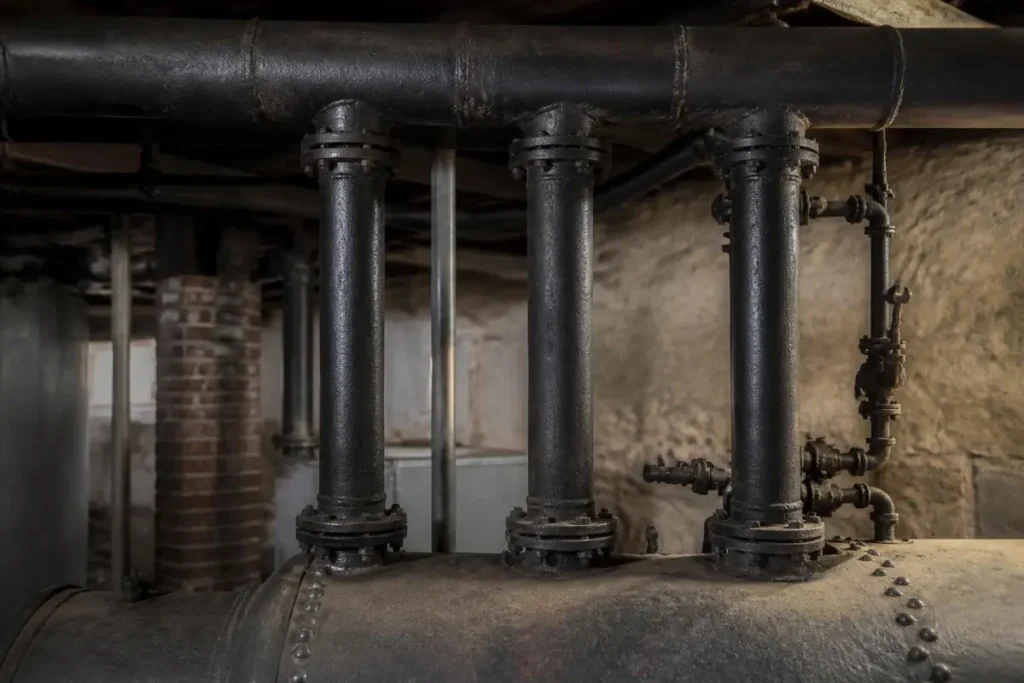
Yes. Burnham states the primary purpose of near-boiler piping is to “separate tiny water droplets from steam,” and its Independence manual 103538-08 warns that piping not done as specified “may result in excessive system noise, water line fluctuations and water carry over.” Peerless calls correct near-boiler piping a “moisture separator and boiler water level stabilizer.”
Weil-McLain’s Table 7 for the EG and PEG series lists minimum riser, header and equalizer sizes per model, for example a 3 in. header on EG-55 to EG-75, with a “24” minimum from waterline to bottom of header.” Burnham’s SteamMax manual shows three mistakes to fix even if the old boiler “appears to be working”: a take-off between risers, a take-off bullheaded into two mains, and a header bullheaded into the take-off and equalizer. Peerless adds that too few risers can cause “a sloped water line in the boiler and/or heavy carryover,” which can dry fire some sections.
Is the burner overfiring, or is the tankless coil collapsing the water line?
Either can, and both are technician checks. Peerless lists a boiler that is “oversized or overfired,” which “causes too much pressure drop in main, so condensate backs up in riser,” and flame impingement on the legs of wet-base boilers, which forms steam pockets that collapse. The technician will clock the gas meter against the rating label input (Burnham’s Independence manual prints the 30 to 80 second clocking table) and look at the flame pattern.
On a boiler that also makes domestic hot water, Peerless warns that “oversized tankless coils can cause the boiler water level to collapse during high potable water flow.” If the glass drops every time someone showers, check the coil and its flow regulator in our tankless coil guide.
Pressure is a smaller factor. Peerless says the boiler cut-out must stay below the vents’ drop-out pressure and that a one-pipe system “should operate around 2 psig at the boiler.” The settings themselves live on our steam boiler pressure page; none of the four manuals we read lists a high pressuretrol setting as a cause of surging.
Could the gauge glass itself be giving a false reading?
Yes, a plugged glass can sit still or lag while the boiler water moves. Hydrolevel’s 400 Series instructions list “Check for plugged gauge glass” as the first step when its probe cutoff shows low water but the glass looks normal. Weil-McLain’s EG manual flushes it by closing the lower gauge cock, opening the pet cock and briefly reopening the lower cock, with boiler pressure low. If the glass breaks, close both gauge cocks and replace it; the manual says “Do not replace with thin glass tubing.”
What does surging do to the low water cutoff, the feeder and the radiators?
It trips the cutoff, floods the boiler and wets the steam. Hydrolevel builds a 15 second delay into its 400 Series probe cutoff to prevent short cycling “during temporary low water levels common in turbulent steam boiler environments,” and notes the lamp “may begin to flicker with the bouncing water level.” Oil on the probe makes things worse: Hydrolevel’s fix is to clean the probe with steel wool “and skim boiler.” Testing and blowdown are in our low water cutoff guide.
A feeder reacting to a surge adds water the boiler does not need. Weil-McLain says cold make-up water “collapses the water level, causing false indications of need for make-up.” Hydrolevel’s VXT feeder has a selectable feed delay for that reason. Wet steam then reaches the radiators: Peerless lists dirty boiler water or wrong near-boiler piping as causes of mid-cycle water hammer, and the vents start spitting, as described in our page on steam radiator vents that hiss and spit.
Do steam boiler water treatment chemicals stop surging or cause it?
They can cause it. Weil-McLain’s EG manual says “some boiler water treatment chemicals can promote water level instability” and that foaming agents “cannot be tolerated in steam boilers.” Its test: bring a little of the chemical in water to a rolling boil in a pan; if it foams, do not use it. Burnham’s SteamMax manual adds that “low water pH or water treatment chemicals can also cause foaming and/or surging.”
The maker pH targets disagree, so use the one for your boiler. Weil-McLain recommends boiler water pH 7.0 to 8.5 for the EG series; Burnham’s SteamMax table allows 7.0 to 11.0.
Frequently asked questions
Why is my steam boiler filling up with water?
Usually the automatic feeder is adding water during a surge or before condensate returns. Weil-McLain says a feeder on a gravity return system can feed before condensate comes back, causing “overfill and flooding when the condensate does return.” A feeder valve that will not close is the other cause.
Why is my steam boiler losing water?
A closed steam system should need little make-up water. Weil-McLain lists leaking return lines, underground pipes, faulty steam traps and faulty air vents as the likely causes. Peerless adds that a new, small boiler holds less water than the one it replaced and “can usually only steam for about 15 minutes” before reaching the low water point, so a level that drops fast may be a storage problem, not a leak.
Why is my steam boiler banging?
Banging in the pipes is usually water hammer, and Peerless sorts it by timing: at start-up it points to sagging mains or a water line set too high, mid-cycle to dirty water, wrong near-boiler piping or overfiring, and at shutdown to a Hartford loop nipple less than 2 to 4 inches below the water line.
My steam boiler water level is too high. What should I do?
Turn the boiler off, let it cool and drain to the normal water line, which Weil-McLain puts about halfway up the gauge glass. Peerless warns that a water line set too high can turn dry returns into wet ones and cause start-up water hammer. Then find out why: a feeder reacting to surging, slow condensate return, or a cracked-open fill valve.
How we researched this
On 26 November 2026 we read the Burnham SteamMax (111043-01, 3/21) and Independence (103538-08, 3/18) installation manuals, the Weil-McLain EG/PEG Series 6 boiler manual (550-142-303), the Peerless One-Pipe Steam Systems training guide (CHOS396 R2), and Hydrolevel’s 400 Series low water cutoff and VXT feeder instructions. The three top-ranking articles cite no maker document and supply no figure here; forum threads and an unsourced “inch or so” bounce threshold were excluded. We did not test any boiler.
Sources
- Burnham (U.S. Boiler Company). “SteamMax Installation, Operating and Service Instructions, 111043-01.” https://fwwebbimage.fwwebb.com/ProductInfo/SteamMax-IO-Manual.pdf. Accessed November 2026.
- Burnham (U.S. Boiler Company). “Independence Gas-Fired Boiler Installation, Operating and Service Instructions, 103538-08.” https://res.cloudinary.com/dzhpkjoqj/TradeService/BURNHMINST00031.pdf. Accessed November 2026.
- Weil-McLain. “EG / PEG Series 6, EGH Series 5 Gas-Fired Boilers, Boiler Manual, 550-142-303.” https://www.weil-mclain.com/wp-content/uploads/EG-PEG-Series-6-Boiler-Manual-Web-Version.pdf. Accessed November 2026.
- Peerless (PB Heat). “One-Pipe Steam Systems: Piping and Troubleshooting.” https://www.peerlessboilers.com/wp-content/uploads/2018/01/OnePipeSteam.pdf. Accessed November 2026.
- Hydrolevel. “400 Series Low Water Cut-Offs for Steam Boilers, Installation Instructions.” https://pexuniverse.com/uploads/literature/hl-safgard-400-ins.pdf. Accessed November 2026.
- Hydrolevel. “VXT Water Feeder Installation Instructions.” https://pexuniverse.com/uploads/literature/hl-vxt-24-ins.pdf. Accessed November 2026.
Leave a Reply