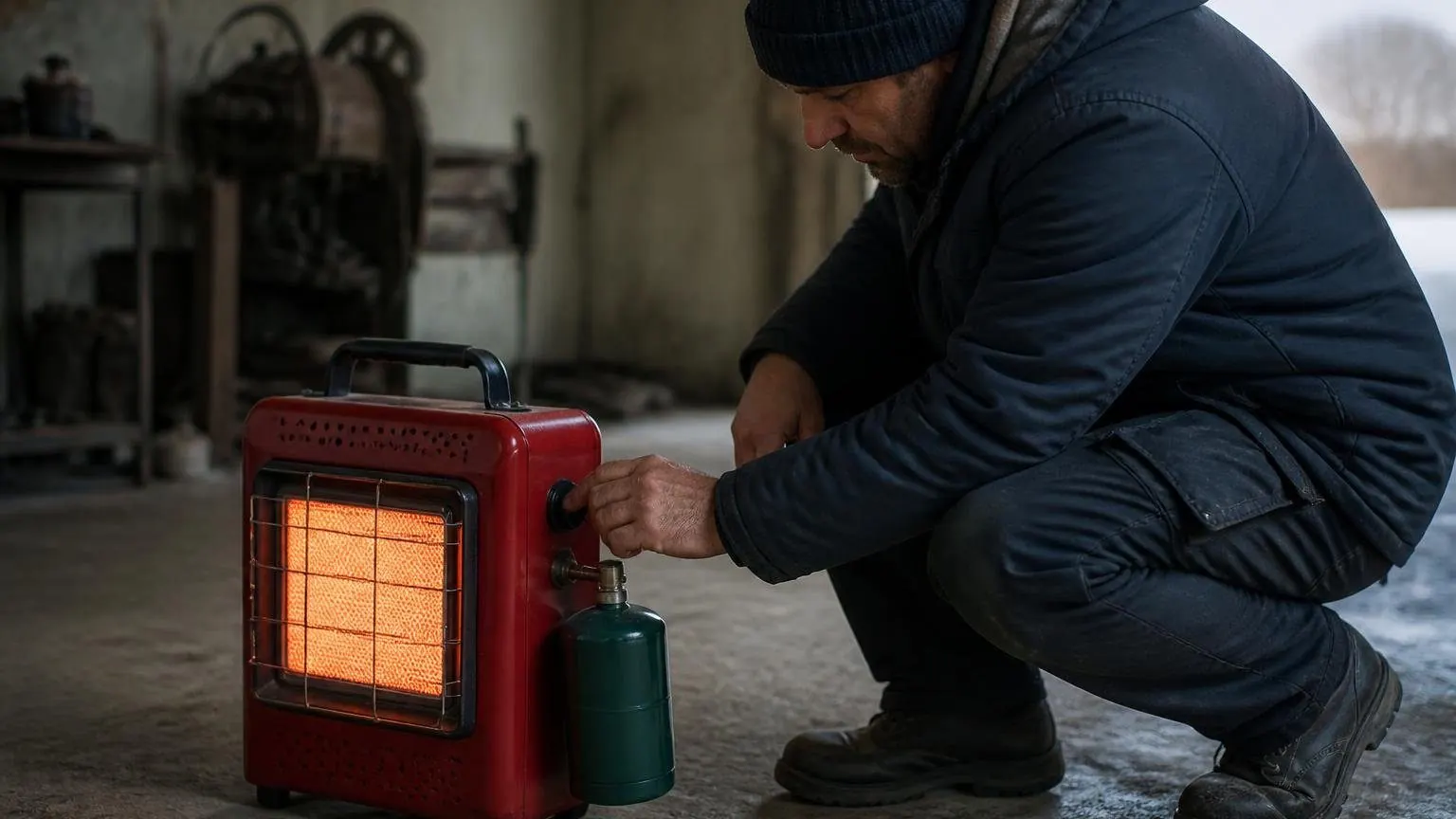
A Mr. Heater Big Buddy that won’t stay lit is failing at one of three points: the pilot dies when you release the knob (not held 30 seconds after lighting, or a dirty pilot missing the thermocouple), it shuts off after minutes (fresh air, tip switch, cold cylinders), or it never lights (air in the line, no spark).
At which step does your Big Buddy or Portable Buddy go out?
Name the moment it fails and the Mr. Heater charts narrow it to two or three causes. The Big Buddy (MH18B) and Portable Buddy (MH9BX) manuals differ mainly in vent size, hold time and cylinder count.
| Symptom | Cause listed by Mr. Heater | What to do | Model |
|---|---|---|---|
| No spark at the pilot | Electrode broken; igniter or ground wire loose or damaged; piezo defective | Reattach wires; replace failed parts | MH18B, MH9BX |
| Sparks, pilot will not light | No gas; knob not aligned at PILOT; pilot blocked by spider web or dirt | Fresh cylinder or open the tank valve; seat the knob at PILOT; clean the pilot | MH18B, MH9BX |
| Pilot goes out when the knob is released | Knob not held long enough to purge air; pilot not surrounding thermocouple; pilot assembly bad; tip switch wires off | Relight with full hold times; clean pilot; reconnect wires | MH18B, MH9BX |
| Pilot stays lit, burner will not ignite | Main burner orifice blocked | Clean burner orifice and venturi | MH18B, MH9BX |
| Shuts off during normal operation | Pilot blocked; fresh air opening too small; tip switch tripped by a bump | Clean pilot; open 18 sq in (Big Buddy) or 9 sq in (Buddy); relight | MH18B, MH9BX |
| Shuts off (added causes) | Regulator defective; internal contamination | Replace regulator or control valve | MH9BX only |
| Will not run on HI with 1 lb cylinders | Only one cylinder fitted | Fit two 1 lb cylinders; both tiles light only on HI | MH18B |
Compiled by The HVAC Brief from the troubleshooting charts and lighting instructions in the Big Buddy MH18B manual and the Portable Buddy MH9BX manual.
Why does the Big Buddy pilot go out the moment you let go of the knob?
Because the thermocouple never got hot enough to hold the gas valve open. The MH18B manual says to hold the control knob down “for an additional 30 seconds to heat the thermocouple” once the pilot lights; the MH9BX manual asks for 30 to 60 seconds.
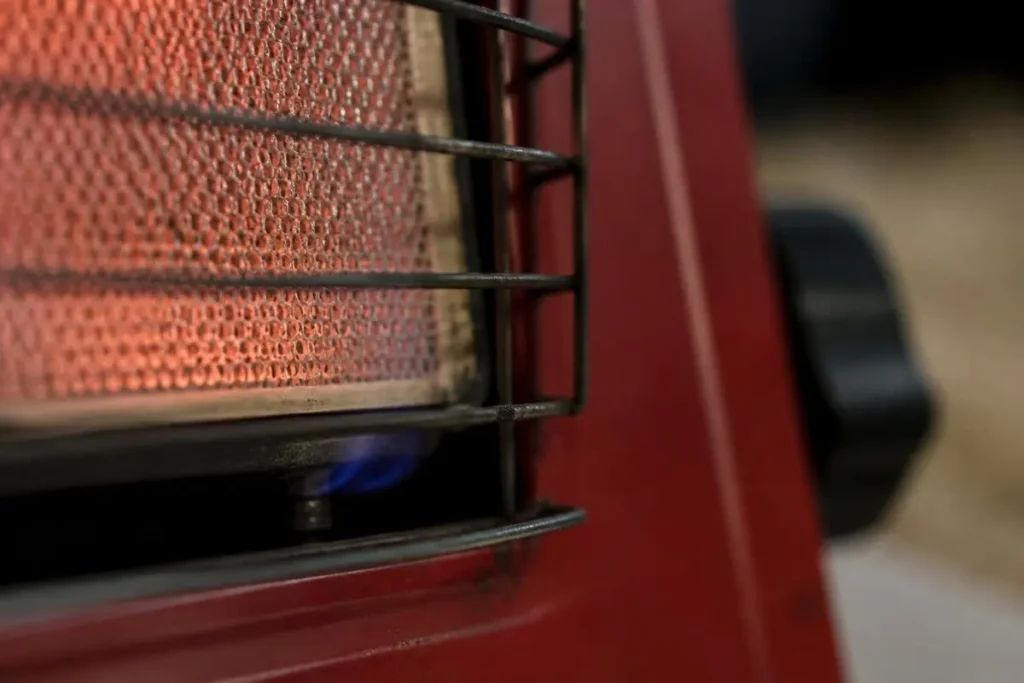
If you held the full 30 seconds and it still dies, look at the flame. Mr. Heater says the pilot should be blue, not yellow, and surround the thermocouple just below the tip; a yellow flame that misses it means a partly blocked pilot, and the fix is “clean pilot.” The thermocouple works like the one on a standing pilot fireplace, and our gas fireplace pilot guide explains why a weak one lets the valve drop.
The same MH18B chart row adds a defective pilot assembly and disconnected tip switch wires, so a loose connector behind the back cover can kill the pilot even when nothing was bumped.
Why won’t a Mr. Heater Big Buddy spark or light after a new cylinder?
Either the piezo circuit is not making a spark, or there is still air in the line between the cylinder and the pilot. The Big Buddy manual asks you to hold the knob down at PILOT for 30 to 40 seconds before sparking, then rotate it toward OFF and straight back to PILOT; that turn is what fires the piezo.
On a hose to a 20 lb tank the purge takes longer. The MH9BX manual says lighting “may take longer to purge air from the supply hose depending on the length of the hose being used,” and the chart lists “held in long enough to purge air from lines” as the first fix for a pilot that will not hold.
No click at all is a Mr. Heater ignition parts problem (electrode, igniter wire, ground wire or piezo). The four D cell batteries do not enter into it: the Big Buddy manual says they are “required for fan operation.”
Why does the Buddy shut off after 5 or 10 minutes of running?
Usually because its safety pilot sensed stale air, the tip switch was bumped, or the pilot is partly blocked. The MH18B chart lists exactly those three and asks for a fresh air opening of 18 square inches (4 1/4 in. square). The Portable Buddy needs 9 square inches at the ceiling and at floor level.
The oxygen depletion pilot and room ventilation rules are covered in our guide to indoor propane heater use. The MH9BX label sets the order: “If heater shuts off, do not relight until you provide fresh air. If heater keeps shutting off, have the heater serviced.” Outdoors, the MH9BX manual also warns of “nuisance shutoffs due to certain wind conditions.”
A Buddy that cuts out when carried lit or set down hard has tripped its tip over switch; Mr. Heater says to relight. A CO alarm is still needed, because the pilot sensor reads oxygen, not carbon monoxide; our CO alarm placement rules give the mounting heights.
Why won’t a Mr. Heater Big Buddy stay lit on high?
On 1 lb cylinders, the Big Buddy needs two of them for HI. The MH18B manual says “2) 1 LB. propane bottles are needed to use heater in (HI) position,” and that both tiles ignite only when the knob is on HI. With a single cylinder, stay on LO (4,000 Btu/h) or the middle setting (9,000 Btu/h); HI is 18,000 Btu/h.
Start the MH18B on LO or the middle setting until the first tile glows bright orange, then turn to HI; the MH9BX is the reverse, HI first, then down. A blue flame rolling off the top of the tile means dust, lint or spider webs in the burner, per both Mr. Heater manuals.
In deep cold, high fire is also where small cylinders run short. Both manuals warn that run times “can be significantly reduced when operating continuously at temperatures below 20º F” and recommend a 20 lb tank in those conditions. The MH9BX specification lists a minimum ambient temperature of 0°F.
How cold is too cold for the 1 lb cylinders on a Buddy heater?
Vapor pressure stays far above what the heater uses until the liquid nears minus 40°F, so cold failure is about the cylinder chilling itself. The heater’s own regulator delivers a fixed 11 in. w.c., which is 0.40 psi, while NIST data for propane at 0°F gives 23.7 psi gauge.
| Liquid propane temperature | Vapor pressure (psia) | Gauge pressure (psig) | Times the 0.40 psi regulator outlet | Heat to boil 1 lb (Btu) |
|---|---|---|---|---|
| 70°F | 124.9 | 110.2 | 277 | 147 |
| 40°F | 78.6 | 63.9 | 161 | 159 |
| 20°F | 55.8 | 41.1 | 104 | 165 |
| 0°F | 38.4 | 23.7 | 60 | 171 |
| minus 20°F | 25.4 | 10.7 | 27 | 177 |
| minus 40°F | 16.1 | 1.4 | 4 | 182 |
HVAC Brief calculation: pressure and latent heat from the NIST Chemistry WebBook propane saturation table; gauge = psia minus 14.696; 11 in. w.c. converted with NIST SP 811 factors. NIST puts propane’s boiling point at 1 atmosphere at minus 43.8°F.
Every pound that boils off pulls about 165 Btu out of the liquid at 20°F, so the cylinder runs colder than the air (the MH9BX manual notes condensation dripping off small tanks), and a 16.4 oz. cylinder has little surface to pull heat back in. Our propane tank freezing up explainer covers the vaporization physics for bigger tanks. Never warm a cylinder with a flame or heat gun.
Is the hose, filter or regulator starving a Buddy on a 20 lb tank?
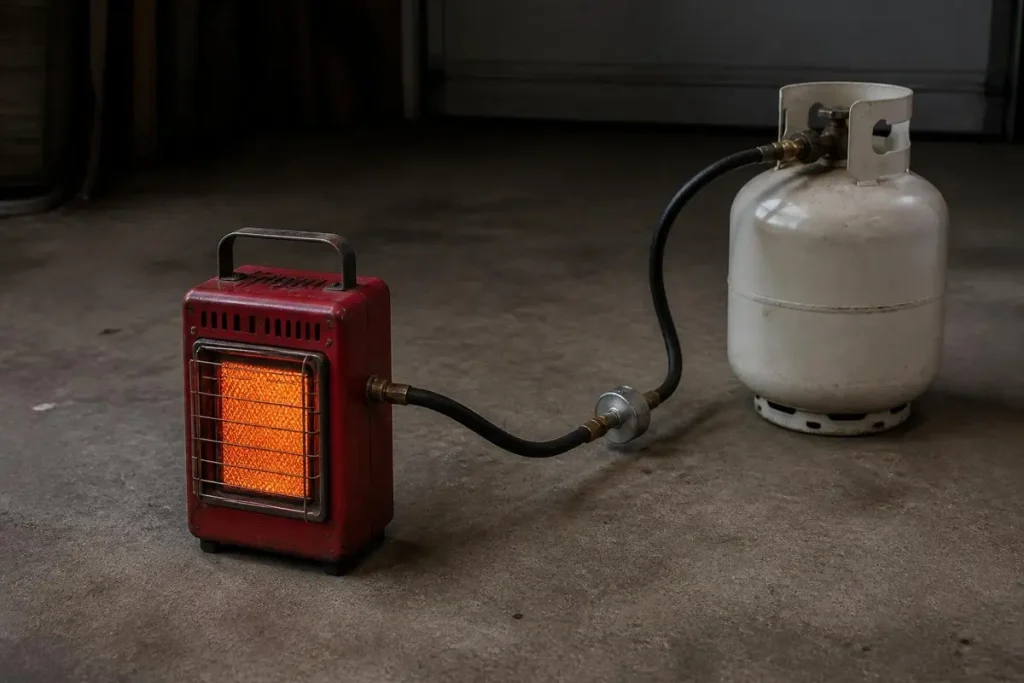
It can be, if the hose and filter do not match the manual. Mr. Heater pairs hoses F273701 (5 ft), F273702 and F272702 (12 ft) for use with the F273699 fuel filter, replaced annually, and says the filter traps “oil substances” from refillable tanks “that can make heater inoperable.” The F273704 Buddy series hose does not need the filter.
On the Big Buddy quick disconnect, the F271802 hose needs a source already regulated to 11 in. w.c.; the F271803 carries its own regulator. Do not set the heat with the cylinder valve, and soap test every connection each time. A heater that runs on 1 lb cylinders but fades on a 20 lb tank points at the hose or filter rather than the heater; for a home system that went dead after a delivery, see furnace problems after a propane refill.
Does a Mr. Heater Buddy shut off above 7,000 feet?
It may. Both manuals say that above 7,000 ft the tile “may not burn as bright” and the heater “may shut-off”; provide fresh air, wait 5 minutes and relight, though Mr. Heater adds it “may not re-light.” A shutoff at a high camp is not by itself a failed part.
When is a Buddy that won’t stay lit a parts job, not a cleaning job?
When air cleaning does not restore a blue flame on the thermocouple, or it keeps shutting off with the vent open. Mr. Heater allows a vacuum or air at no more than 30 psi through the pilot holes, and forbids needles or wire because they can damage “the calibrated ruby that controls the gas flow.”
Past that point the fixes are factory parts fitted by a qualified service agency: pilot assembly (item 78422 on the Big Buddy), tip switch, regulators, control valve. Stop if you smell gas, the tile shows flames, or any part has been under water. The written warranty is 1 year from purchase.
Frequently asked questions
Do the D batteries make a Big Buddy light?
No. The Big Buddy manual says the four D cell batteries are required for fan operation, and the fan has its own switch beside the control knob. Ignition comes from a piezo igniter on the control valve, fired by turning the knob from PILOT toward OFF and back. Dead batteries stop the fan, not the pilot.
Mr Heater portable buddy lights but won’t stay lit: is it different from the Big Buddy?
The steps are the same, the numbers are not. The MH9BX Portable Buddy wants the knob held 30 to 60 seconds after the pilot lights, runs on one 1 lb cylinder at 4,000 or 9,000 Btu/h, needs 9 square inch vents at ceiling and floor, and lists a minimum ambient temperature of 0°F.
How many years will a Mr. Buddy heater last?
Mr. Heater publishes no service life figure. The written limited warranty in the Big Buddy manual covers defects in material and workmanship for 1 year from purchase. Pilot assemblies, regulators and tip switches are listed as replacement parts, which the manual says must come from the factory and be fitted by a qualified service agency.
How we researched this
We read the Mr. Heater MH18B manual (2017 edition, retailer copy) and MH9BX manual in full and built the symptom table only from their charts and lighting pages, labelling rows found in one manual. Propane data come from the NIST Chemistry WebBook, conversions from NIST SP 811. Forum threads ranking for this query were read for symptoms only, never for facts, because none cite a maker document. We did not test a heater. Research date: November 26, 2026.
Sources
- Mr. Heater / Enerco Group. “Big Buddy MH18B Operating Instructions and Owner’s Manual.” https://images.homedepot-static.com/catalog/pdfImages/53/53c06813-2588-49a2-ad28-8bf3eb3a9ae7.pdf. Accessed November 2026.
- Mr. Heater / Enerco Group. “Portable Buddy Radiant Heater MH9BX Operating Instructions and Owner’s Manual.” https://images.toolsid.com/mr-heater/items/pdf/mh9bx-manual.pdf. Accessed November 2026.
- National Institute of Standards and Technology. “NIST Chemistry WebBook, Thermophysical Properties of Fluid Systems: Propane, saturation properties.” https://webbook.nist.gov/cgi/fluid.cgi?Action=Load&ID=C74986&Type=SatP&Digits=5&TLow=-40&THigh=80&TInc=10&RefState=DEF&TUnit=F&PUnit=psia. Accessed November 2026.
- National Institute of Standards and Technology. “NIST Guide to the SI, Appendix B.9: Factors for units listed by kind of quantity.” https://www.nist.gov/pml/special-publication-811/nist-guide-si-appendix-b-conversion-factors/nist-guide-si-appendix-b9. Accessed November 2026.
Leave a Reply