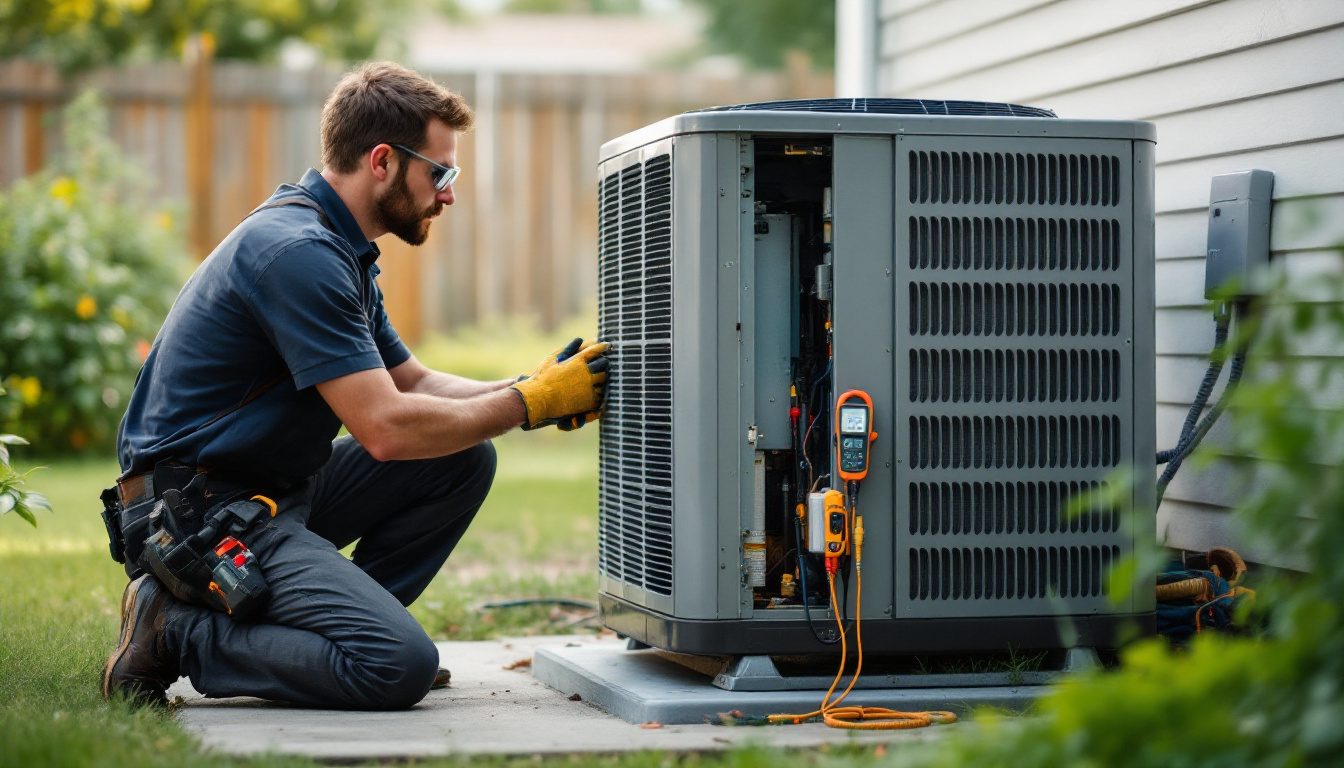
What is a hard start kit for AC? It is a start capacitor plus a relay (or a PTC thermistor) that gives a single phase compressor extra torque for a fraction of a second, then drops out. It helps a healthy compressor on weak voltage. It does not fix a failing one.
Key Takeaways
- Copeland says start assist devices are “usually not required” on its residential scrolls (Bulletin AE4-1331 R9, 2024).
- Copeland puts locked rotor current at “six or more times” running current, for 100 to 300 milliseconds (AE4-1331).
- Goodman’s 3 ton GLXS3B lists 13.4 RLA and 83.3 LRA; its 1.5 to 2.5 ton rotary models ship with a factory hard start kit (SS-GLXS3B-R32, 2024).
- Micro-Air claims its EasyStart Flex soft starter cuts start current “by up to 75%” (maker claim).
- A Goodman limited warranty excludes “Parts not supplied or designated by Goodman” (DSXC/DSZC certificate), so use the kit the maker lists.
- OSHA requires that “Capacitors shall be discharged” before electrical work (29 CFR 1910.333).
What does a hard start kit for an AC actually do?
It adds starting torque for the first moments of each start, then takes itself out of the circuit. A typical kit is a start capacitor wired alongside the run capacitor, plus a relay or thermistor that disconnects it once the motor turns.
The DOE Fundamentals Handbook describes single phase motors that use a starting winding for torque and disconnect it “when the motor reaches 70 to 80% of synchronous speed” (DOE-HDBK-1011/4-92). A hard start kit does that job with a relay outside the sealed compressor. The run capacitor stays in circuit throughout; our guide to run and dual run capacitors covers it.
What do RLA and LRA on the nameplate tell you about the starting surge?
RLA is rated running current; LRA, locked rotor amps, is what the compressor draws with the rotor stalled, as it is at every start. Copeland says LRA “is normally six or more times higher than the rated running amperage” and lasts “from 100 to 300 milliseconds until the rotor starts turning.”
The plate number is set by locking the compressor at the highest nameplate voltage and reading current “after four seconds,” Copeland says. Low voltage cuts starting torque, so the motor sits locked longer, and that stall dims the lights.
Real data plates, from Goodman’s 2024 GLXS3B specification sheet (ratio column is our arithmetic):
| Goodman model | Size and compressor | RLA | LRA | LRA ÷ RLA | Start help Goodman lists |
|---|---|---|---|---|---|
| GLXS3BN1810 | 1.5 ton, rotary | 8.2 | 41.2 | 5.0x | Factory installed hard start kit |
| GLXS3BN3010 | 2.5 ton, rotary | 11.2 | 52.5 | 4.7x | Factory installed hard start kit |
| GLXS3BN3610 | 3 ton, scroll | 13.4 | 83.3 | 6.2x | CSR-U-1 accessory kit |
| GLXS3BN4810 | 4 ton, scroll | 19.4 | 127.7 | 6.6x | CSR-U-2 or CSR-U-3 accessory kit |
| GLXS3BN6010 | 5 ton, scroll | 23.9 | 148.0 | 6.2x | CSR-U-2 or CSR-U-3 accessory kit |
The scrolls land at 6.2 to 6.6 times, in line with Copeland’s “six or more.” The rotaries run nearer 5 times. Our breakdown of air conditioner watts and amps covers running draw and circuit sizing.
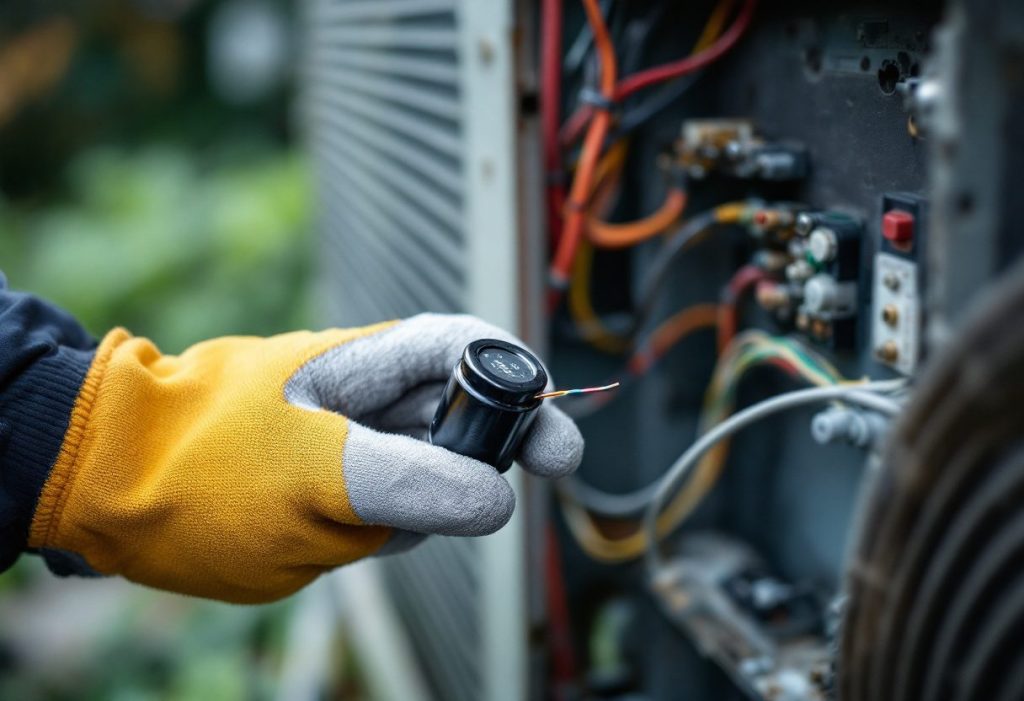
PTC, potential relay or soft starter: which hard start kit is which?
Three devices share the name. Two add torque; the soft starter limits the current peak instead.
| Device | How it drops out | What it changes at start | Where the maker or OEM points it |
|---|---|---|---|
| Start capacitor and potential relay (RectorSeal Kickstart KS-1, Goodman CSR-U kits) | Relay opens once the motor is up to speed | More torque, shorter locked rotor time | Low voltage, high head pressure, non-bleed TXV on rotary or reciprocating units |
| PTC start device | Resistance rises as it heats, choking off the start circuit | A smaller boost | Copeland: 10 to 25 ohm PTC “for less severe voltage drops” |
| Electronic soft starter (Micro-Air EasyStart Flex) | Electronic control of each start | Lower peak current, gentler ramp | Generators, inverters, limited utility power (Micro-Air) |
RectorSeal sells its KS-1, a two wire kit “with mechanical potential relay” for 3.5 to 5 ton units, on the claim that it drops out the start capacitor “at optimum time” to avoid “excessive heat build up” (maker claim). That names the real risk: a relay that sticks closed.
In short, a hard start kit makes the compressor start faster; Copeland says start components “will substantially reduce start time.” A soft starter makes it start gentler, by “gradually increasing the voltage to the compressor motor,” in Micro-Air’s words.
When is a hard start kit for a compressor worth it?
When the equipment maker calls for one or the power supply is the problem. Manufacturer literature names four cases:
- Weak supply. Copeland warns of voltage “sag” on “a poor power supply,” with “light dimming or a buzzing noise where wire is pulled through conduit.”
- Non-bleed metering on rotary or reciprocating units. Goodman’s GLXS3B sheet says units with reciprocating or rotary compressors “require the use of start-assist components” with a non-bleed thermal expansion valve or liquid line solenoid. Our TXV explainer covers non-bleed designs.
- Power blips. Copeland says interruptions under half a second can spin single phase scrolls backward, and calls a start kit “another effective means of mitigating” it.
- Factory spec. Goodman fits one at the factory on its 1.5 to 2.5 ton GLXS3B rotary models.
For scrolls, Copeland is blunt: start assist is “usually not required, even if a system utilizes non-bleed expansion valves,” because the scrolls “always start unloaded.” Check voltage first. Copeland guarantees its 208/230 volt PFV scrolls start at 187 volts or higher and wants no less than 197 volts once running. Goodman’s plate gives the same floor: 197/253 volts.
When is a hard start kit a band-aid on a dying compressor?
It is a band-aid when the compressor itself is why the start fails. A kit adds torque; it does not repair a shorted winding or worn parts, and it can mask the warning. A scroll that suddenly needs help signals that something changed.
Diagnose in this order; every step past the first is licensed work:
- Note the symptom: a hum then a click off, lights dimming at start, or a breaker that trips on startup rather than after running.
- Measure voltage during the start attempt against the 187 and 197 volt floors.
- Test the run capacitor and the contactor that switches the outdoor unit, two smaller parts that can mimic a weak compressor.
- Check windings and insulation against the maker’s service data.
- Count starts: a unit that is short cycling takes a locked rotor hit on every extra start. Goodman lists an ASC01A anti-short cycle kit for every GLXS3B.
If supply and parts check out and a rotary or reciprocating unit still struggles, the kit its maker lists is a legitimate repair. If the windings fail, the question becomes replacing the compressor or the outdoor unit.
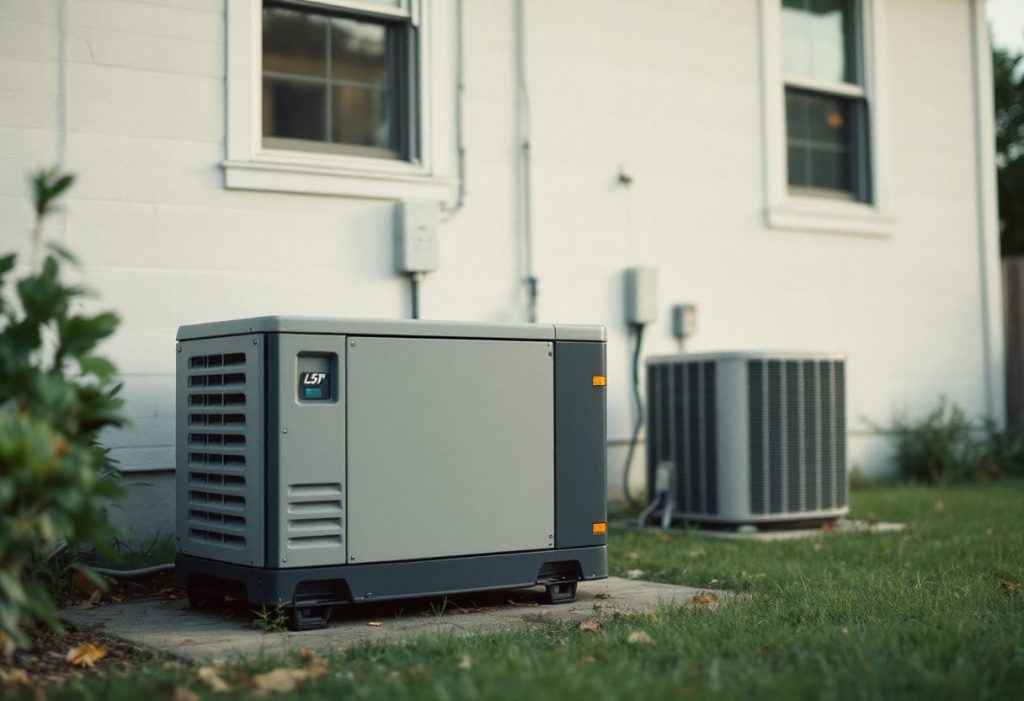
Can a soft starter let a generator run central air?
A soft starter can, where a hard start kit usually cannot. A generator stalls on peak current; a hard start kit shortens the stall but is not built to cap the peak.
DOE’s Building America Solution Center says a motor “often needs 100% to 300% more power” to start, and sizes a 1,500 to 3,000 watt generator for just a refrigerator plus a small AC under 1,000 watts (BASC).
Micro-Air says its EasyStart Flex handles home units up to 6 tons and “can reduce your start up current by up to 75%.” Applied to the 3 ton GLXS3B’s 83.3 amp LRA, that claim would mean a start near 21 amps. That is our arithmetic on a maker claim, not a test. These products target single phase fixed speed motors; a variable speed system is a different machine, so ask its maker first.
Does a hard start kit void the warranty, and who should fit one?
It can, if the maker did not designate the part. A 2009 to 2010 Goodman limited warranty for DSXC and DSZC models excludes “Parts not supplied or designated by Goodman” and “Use of components or accessories not compatible with this unit.” It also excludes “Failure to start due to interruption and/or inadequate electrical service.”
So fit the kit the maker names: Goodman lists CSR-U part numbers by model, and Copeland lists model specific start parts in its Online Product Information. Terms differ by brand and year; our guide to what HVAC warranties cover explains the common exclusions.
Safety: this is licensed work
A kit wires into the compressor circuit inside a cabinet fed at 208/230 volts. OSHA 1910.333(b)(2)(ii)(C) requires that stored energy be released: “Capacitors shall be discharged.” An owner can safely note symptoms, shut the system off at the thermostat and the outdoor disconnect, and call a technician. If the outdoor unit is silent, start with the checks for an AC that will not turn on.
How we researched this
Researched October 8, 2026. None of the top three ranking pages for “hard start kit for ac” cited a manufacturer for its numbers. Every figure here comes from the eight sources listed below, each opened for this article; maker pages are labeled as claims. The LRA ÷ RLA ratios and the 21 amp soft start figure are our arithmetic.
Excluded: kit and labor prices (no federal price series), a trade blog’s untraced “seven times” figure, retailer listings, and Reddit (electrical safety topic).
Frequently asked questions
Do I need a hard start kit for my AC?
Usually not, if it is a scroll compressor on good voltage; Copeland says start assist is “usually not required” on its scrolls. You may need one on a weak supply, on a rotary or reciprocating unit with a non-bleed TXV, or where the maker specifies one, as Goodman does on its 1.5 to 2.5 ton GLXS3B models.
Does a hard start kit save electricity?
We found no manufacturer or federal source showing running savings. Copeland describes start components only in terms of start time, light dimming and conduit buzzing, all effects of the 100 to 300 millisecond inrush, not of running draw. Treat any savings claim as unproven.
Will a hard start kit fix a compressor that hums but will not start?
Sometimes, if the cause is low voltage or high head pressure, the conditions RectorSeal names for its Kickstart. It will not fix a failed winding or run capacitor. A technician should check voltage against Copeland’s 187 volt starting floor and test the capacitor and windings first.
What is the difference between a hard start kit and a soft start?
A hard start kit adds torque so the compressor starts faster. A soft starter limits peak current so the start is gentler. Micro-Air claims its EasyStart Flex cuts start current by up to 75 percent, which is why soft starters suit generators and inverters.
Can I install a hard start kit myself?
Treat it as licensed work. The kit connects to the compressor circuit at 208/230 volts beside capacitors that hold charge, and OSHA 1910.333 requires that “Capacitors shall be discharged” before work. An owner can note symptoms and shut the unit off.
What size hard start kit do I need?
The one your equipment maker lists. Goodman names the CSR-U-1 for its 3 ton GLXS3B and the CSR-U-2 or CSR-U-3 for 4 and 5 tons; Copeland lists model specific parts online. Universal kits are sized by tonnage: RectorSeal’s KS-1 covers 3.5 to 5 tons.
Sources
- Copeland. “Application Engineering Bulletin AE4-1331 R9: ZP16 to ZP61K5E R-410A 1.5 to 5 Ton Copeland Scroll Compressors.” https://apps.copeland.com/Publications/AEB/AE4_1331_R9.pdf. Accessed October 2026.
- Goodman Manufacturing. “GLXS3B R-32 Split System Air Conditioner, Specification Sheet SS-GLXS3B-R32” (hosted copy). https://cdn.shopify.com/s/files/1/0748/4745/3475/files/Goodman-GLXS3B-specsheet_fc59d0b3-c33b-4712-828e-42b0b39d4e89.pdf. Accessed October 2026.
- Goodman Manufacturing. “Limited Warranty, Models DSXC, DSZC” (distributor hosted copy). https://resource.ecmdi.com/is/content/Watscocom/Gemaire/goodman_dsxc160241_article_1371468297440_en_war.pdf. Accessed October 2026.
- OSHA. “29 CFR 1910.333, Selection and use of work practices.” https://www.osha.gov/laws-regs/regulations/standardnumber/1910/1910.333. Accessed October 2026.
- U.S. Department of Energy. “DOE Fundamentals Handbook: Electrical Science, Volume 4 (DOE-HDBK-1011/4-92).” https://www.energy.gov/sites/default/files/2026-04/DOE-HDBK-1011-92_VOL4.pdf. Accessed October 2026.
- DOE Building America Solution Center (PNNL). “Emergency Air Conditioning and Food Refrigeration.” https://basc.pnnl.gov/resource-guides/emergency-air-conditioning-and-food-refrigeration. Accessed October 2026.
- Micro-Air. “EasyStart Flex Home AC Soft Starter” (maker claims). https://www.micro-air.com/products_easystart_368_softstarter_microair.cfm. Accessed October 2026.
- RectorSeal. “Kickstart Hard Start Device KS-1” (maker claims). https://rectorseal.com/kickstart-ks-1-for-3-5-5-0-ton/. Accessed October 2026.
Leave a Reply