Last reviewed: September 2026 · By the HVAC Brief Editorial Team · Our sourcing and editorial standards
A geothermal heat pump heats and cools a house by exchanging heat with the ground, which the Department of Energy describes as holding a relatively constant 40 to 70°F a few feet below the surface. Because the ground is warmer than winter air and cooler than summer air, the system works less hard than an air-source heat pump.
The federal 30% tax credit that covered these systems has ended. The IRS states the Residential Clean Energy Credit “is not available for any property placed in service after December 31, 2025.”
How geothermal heating and cooling works
It is a heat pump, the same refrigeration cycle as central air, that trades heat with the ground through buried pipe instead of with outdoor air.
- Water or a water and antifreeze mix circulates through a buried loop, picking up the ground’s heat in winter.
- A heat exchanger passes that heat to the refrigerant in the indoor heat pump unit.
- The compressor raises the refrigerant’s temperature and the heat is delivered to the house, usually through ducts.
- In summer the cycle reverses, pulling heat from the house and rejecting it into the ground.
DOE notes that geothermal units can also supply hot water if so equipped. For the underlying cycle, see how a heat pump works.
The four types of ground loop
DOE describes four basic loop types: three closed loops, horizontal, vertical and pond or lake, and one open loop. Climate, soil conditions, available land and local installation costs decide which fits a site.
| Loop | How it is installed | Where it fits |
|---|---|---|
| Horizontal, closed | Pipe laid in trenches at least four feet deep | DOE calls it generally most cost-effective for homes, especially new construction with enough land |
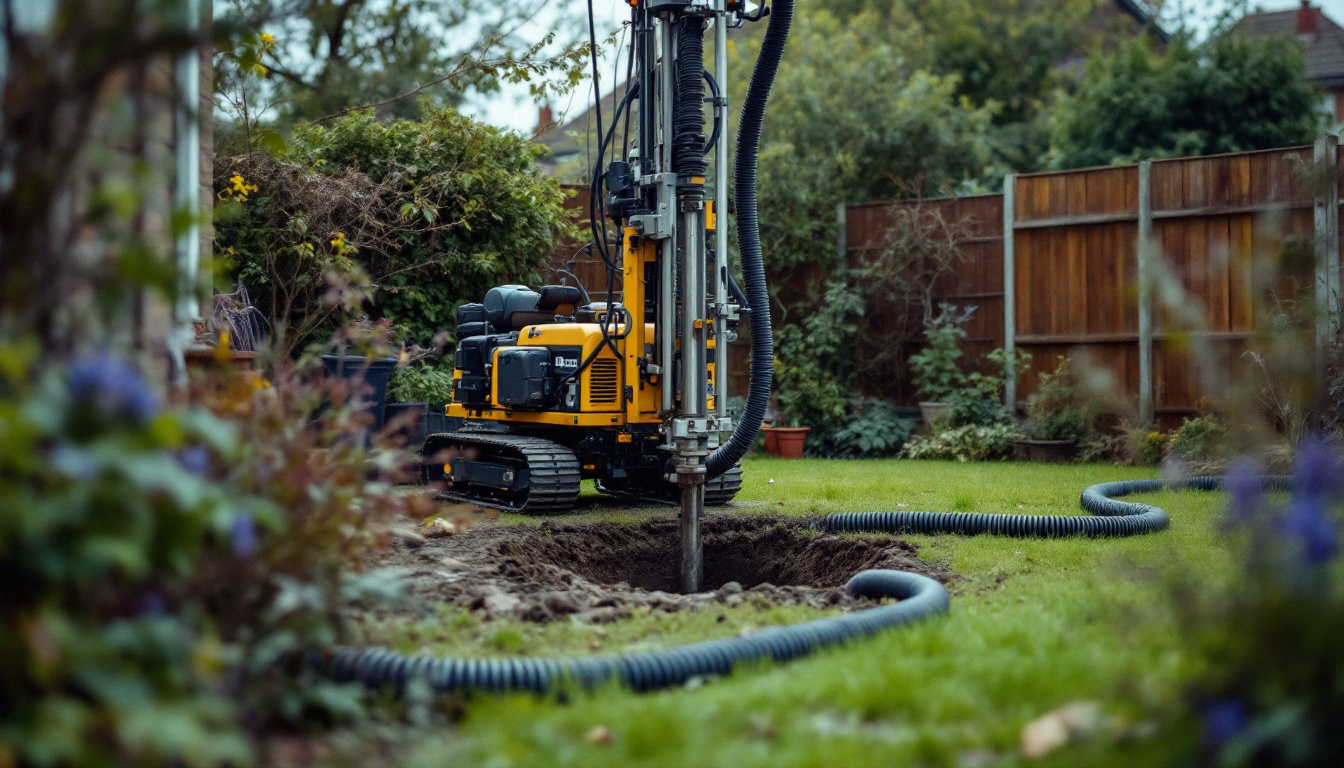
| Vertical, closed | Holes about four inches wide, about 20 feet apart and 100 to 400 feet deep | Sites where land for horizontal loops is limited |
| Pond or lake, closed | Loop submerged in a body of water | Properties with suitable water nearby |
| Open loop | Circulates water from a well or surface source instead of a sealed loop | Sites with adequate water supply and discharge options |
A variant called direct exchange skips the water loop and pumps refrigerant through buried copper tubing.
How efficient geothermal heat pumps are
ENERGY STAR certification sets minimum efficiency by product type. A closed loop water-to-air unit must reach an EER of 17.1 and a COP of 3.6.
| ENERGY STAR product type | Minimum EER | Minimum COP |
|---|---|---|
| Closed loop water-to-air | 17.1 | 3.6 |
| Open loop water-to-air | 21.1 | 4.1 |
| Closed loop water-to-water | 16.1 | 3.1 |
| Open loop water-to-water | 20.1 | 3.5 |
| Direct geoexchange (DGX) | 16.0 | 3.6 |
At a COP of 3.6 and the 2025/26 season’s average electricity price, heat from a geothermal unit works out to about $14.47 per million Btu, against $23.70 for a minimum-efficiency air-source heat pump and $18.81 for an 80% gas furnace. That COP is a rated value at test conditions, not a measured seasonal figure. The full comparison is in what heat costs by fuel.
What it costs and how long it lasts
No federal series measures installed geothermal prices. DOE’s guidance gives only a relative figure: installation “can be several times that of an air-source system of the same heating and cooling capacity.”
DOE’s guidance says the extra cost “may be returned in energy savings in 5 to 10 years, depending on the cost of energy and available incentives in your area.” That estimate was written while the 30% federal credit was available, so for a 2026 installation the incentive part of the calculation is smaller.
On lifespan, DOE estimates system life “up to 24 years for the inside components and 50+ years for the ground loop.” The loop is the expensive part, and it outlasts several indoor units.
The federal tax credit has ended
Geothermal heat pumps qualified for the Section 25D Residential Clean Energy Credit, worth 30% of costs, but only for property placed in service by December 31, 2025.
| Question | What the IRS says |
|---|---|
| Credit rate | 30% of the costs of new, qualified clean energy property |
| Efficiency requirement | “Geothermal heat pumps must meet Energy Star requirements in effect at the time of purchase.” |
| Deadline | “The credit is not available for any property placed in service after December 31, 2025.” |
| Timing rule | “You must claim the credit for the tax year when the property is installed, not merely purchased.” |
Some older pages, including government pages written before the change, still describe the credit running into the 2030s. The IRS page governs. State and utility incentives are separate and may still apply. The parallel expiry of the heat pump credit is covered in our 25C report.
Geothermal versus air-source heat pumps
DOE’s comparison is that geothermal units are quieter, more efficient, last longer and need little maintenance, and do not depend on outdoor air temperature. The trade-off is the loop: land or drilling, and a much higher installed price.
EIA’s Residential Energy Consumption Survey does not report ground-source heat pumps separately from other heat pumps, so there is no federal count of homes that use them. For the air-source comparison with gas, see heat pump versus gas furnace.
Frequently asked questions
How does geothermal heating and cooling work?
A heat pump circulates water or antifreeze through pipe buried in the ground or submerged in water, exchanging heat with earth that DOE says holds at roughly 40 to 70°F. In winter it moves ground heat into the house; in summer it moves house heat into the ground.
Is there still a tax credit for geothermal heat pumps in 2026?
Not federally. The IRS says the 30% Residential Clean Energy Credit “is not available for any property placed in service after December 31, 2025,” and the credit is claimed for the year the property is installed, not purchased. State and utility incentives may still be available.
How long do geothermal systems last?
DOE estimates system life at up to 24 years for the inside components and 50 years or more for the ground loop. No federal survey measures actual replacement ages.
Is geothermal more efficient than an air-source heat pump?
Generally yes, because ground temperature is more stable than air temperature. ENERGY STAR closed loop water-to-air units must reach a COP of 3.6, while the federal minimum for split air-source heat pumps, HSPF2 7.5, equates to a seasonal COP of about 2.2. The ratings use different test conditions.
Methodology and limitations
DOE statements are quoted from its Energy Saver guidance on geothermal heat pumps, which no longer resolves at energy.gov; we cite the archived copy. ENERGY STAR criteria and the IRS credit rules were checked in September 2026.
- We publish no installed prices or payback periods of our own, because no federal series measures them.
- The cost per million Btu uses a rated COP and a national average electricity price.
- Nothing here is tax advice.
Sources
- US Department of Energy, Energy Saver: Geothermal Heat Pumps, archived copy.
- ENERGY STAR, Geothermal Heat Pumps Key Product Criteria.
- Internal Revenue Service, Residential Clean Energy Credit.
- US Energy Information Administration, Residential Energy Consumption Survey 2020, table HC6.1.
The HVAC Brief is an independent trade publication. We do not sell equipment, take manufacturer advertising, or accept payment for placement in our research. Corrections welcome.
Leave a Reply