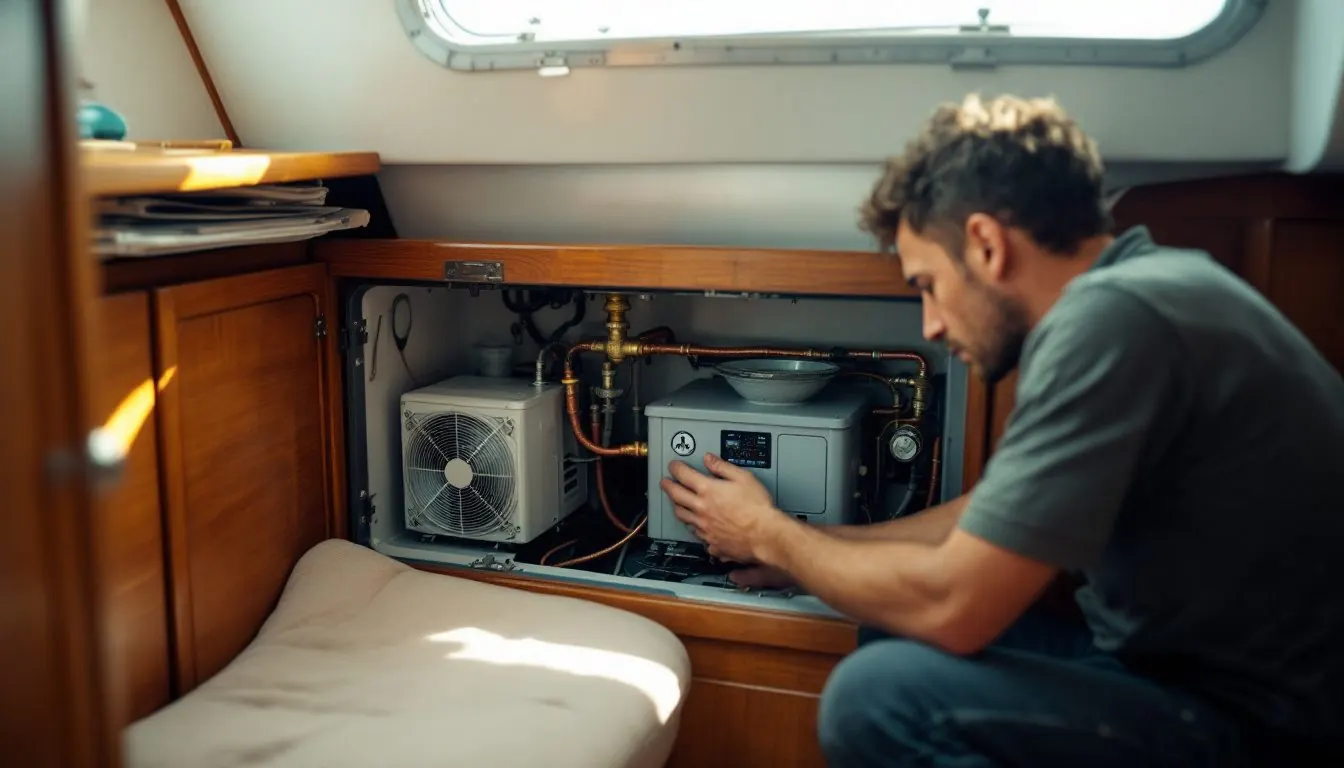
What is a marine air conditioner? A marine air conditioner is a cabin AC that dumps its heat into seawater instead of outdoor air: a pump pushes seawater through the condenser and back overboard. Dometic sizes one at 60 to 180 BTU/h per square foot, depending on deck level and climate.
Key Takeaways
- Dometic sizes temperate boats at 60, 90 and 120 BTU/h per square foot below, mid and above deck (Dometic guide, archived copy).
- Dometic’s seawater rule is 250 gallons per hour (4 gpm) per ton, but its own table lists 3 gal/min for 12,000 BTU/h (Dometic guide).
- Webasto rates cooling in seawater up to 90°F and heating down to 40°F (Webasto FCF manual).
- A Webasto FCF 16000 on 115 V draws 12.4 A running but 54.5 A at start (Webasto FCF manual).
- 40 CFR 84.54 names no marine comfort cooling subsector; Dometic moved its 2025 line to R-454B and R-32 anyway (Dometic G-Series).
- ABYC E-11.11.1 calls for a 30 mA equipment leakage circuit interrupter at the shore power breaker (Blue Sea Systems).
What is a marine air conditioner and how does it work?
A marine air conditioner is a direct expansion cooling unit whose condenser is a coil cooled by seawater. Dometic’s guide says heat moves “from the cabin air to the refrigerant gas to the seawater,” and reverses in heating mode.
That makes it a cousin of a water loop heat pump, with the ocean as the loop, and unlike a rooftop camper air conditioner, which rejects heat to outdoor air. Webasto’s FCF manual describes the cycle:
- The blower pulls cabin air across the evaporator, where refrigerant boils and absorbs heat.
- The compressor pushes hot gas through the condenser’s outer tube while pumped seawater in the inner tube condenses it.
- The warmed seawater discharges overboard.
- For heat, a reversing valve runs the cycle backward, pulling heat from the seawater.
The same coil dries the air. Dometic notes that lower humidity “helps keep the boat dry, reducing mold growth,” the same job a standalone dehumidifier does.
Which type of marine air conditioner fits your boat?
Boat length mostly decides it. Dometic calls self-contained units the “best choice for boats up to 40 ft,” puts split-gas systems on boats up to 80 ft and chilled water above that.
| System type | Where the parts go | Dometic’s length guide | Dometic’s note |
|---|---|---|---|
| Self-contained DX | One chassis under a bunk, settee or locker | Up to 40 ft (12 m) | One unit can be ducted to two or more cabins |
| Split-gas DX | Condensing unit in a machinery space, evaporator in the cabin | Up to 80 ft (24 m) | Refrigerant tubing capped at 50 ft (15 m); certified technician charges it |
| Chilled water | Chiller in the engine room, fresh water piped to air handlers | Over 80 ft (24 m) | No limit on air handler count; quieter cabins |
The chilled water layout is the same idea as a building water chiller: one refrigeration plant, many fan coils. Dometic says chillers offer “a reduced peak electrical load.”
How do you size a marine air conditioner?
Measure each cabin’s floor area, then multiply by a load factor for its deck level and climate. Dometic’s method assumes about 6.5 ft of headroom and average furniture.
Below deck means hull-sloped cabins with few port lights, mid deck means small or shaded windows, and above deck means large glass and direct sun. Dometic defines its climates by test conditions: temperate is 95°F air with 95°F seawater, and Arabic Gulf is 122°F air with 104°F seawater.
A worked example for a cruiser in temperate water: a 7 by 8 ft forward stateroom below deck is 56 sq ft, times 60, or 3,360 BTU/h. A 9 by 10 ft salon at mid deck is 90 sq ft, times 90, or 8,100 BTU/h. The total is 11,460 BTU/h, so a 12,000 BTU/h unit fits; the same boat in tropical water works out to 15,840 BTU/h.
Marinaire uses volume instead: “~14 BTU per cubic foot” for pleasure boats in average use. That salon at 6.5 ft of headroom is 585 cubic feet, or 8,190 BTU/h, close to Dometic’s figure. Our room AC sizing chart is built for rooms in houses, not hulls, and Marinaire warns that oversizing “can lead to poor humidity control.”
Traced to the source
Practical Sailor’s 2000 sizing rule of 60, 90 and 120 Btu per square foot is credited to “one major marine A/C manufacturer.” Those numbers, and its tropical row, match Dometic’s Table 1 exactly.
How much seawater flow does a marine air conditioner need?
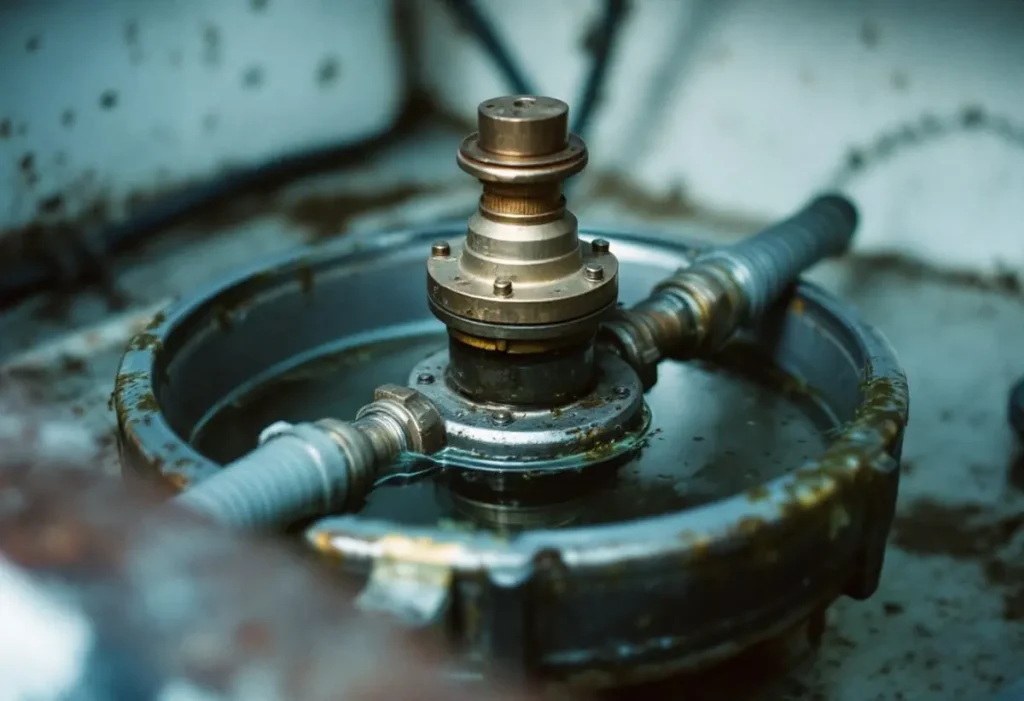
Dometic’s basic rule is 250 gallons per hour (4 gpm) per ton, where a ton is 12,000 BTU. Its own Table 2 lists less: 3 gal/min and a 1/2 in thru-hull for 12,000 BTU/h, 6 gal/min for 24,000 BTU/h. Follow your unit’s own table.
| Webasto FCF model | Minimum flow | Recommended flow | Suggested pump |
|---|---|---|---|
| FCF 5000 | 1.584 gal/min | 2.640 gal/min | Iwaki WB 350 |
| FCF 9000 | 2.904 gal/min | 3.960 gal/min | Iwaki WB 500 |
| FCF 12000 | 3.960 gal/min | 5.280 gal/min | Iwaki WB 1000 |
| FCF 16000 | 5.016 gal/min | 6.600 gal/min | Iwaki WB 1000 |
| FCF 24000 | 7.392 gal/min | 8.448 gal/min | Iwaki WB 2000 |
Webasto’s installation order:
- Fit a forward-facing speed scoop low and close to the keel.
- Add a bronze full-flow seacock, then a strainer below the pump; Webasto calls the strainer “mandatory.”
- Mount a centrifugal pump at least 1 ft (305 mm) below the waterline, since it is not self-priming.
- Run hose uphill to the condenser with no loops or high spots.
- Avoid elbows: each 90° elbow equals 2.5 ft of hose, and one on the pump outlet equals 20 ft.
- Bond every metal part touching seawater; skipping it voids Webasto’s warranty.
Does a marine air conditioner heat in cold water?
Yes, down to a floor that varies by maker. Webasto’s FCF and Dometic’s older Vector Compact manuals both say the unit will heat “in water temperatures as low as 40°F.” Mabru’s June 2026 manual is stricter: heat mode works “down to 50 degrees Fahrenheit,” and cooling to 95°F.
Below those floors, Webasto’s troubleshooting chart says to “shut down system to prevent damage to condenser.” Webasto notes seawater temperature “will directly affect” efficiency. Mabru’s owner check: the condenser should read no more than 15 degrees above inlet seawater.
How much power does a boat air conditioner draw?
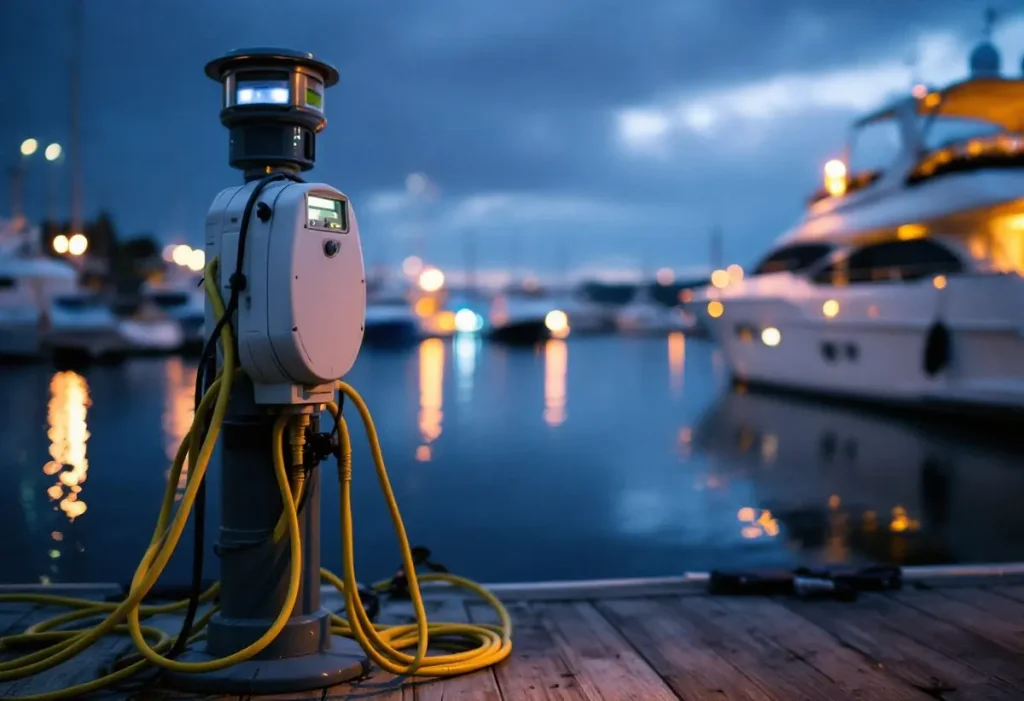
Running current is modest; starting current is the problem. Webasto’s 115 V table shows surges near four times running amps on its standard models.
| Webasto FCF, 115 V 60 Hz | Running current | Starting surge | Suggested breaker |
|---|---|---|---|
| 5,000 BTU | 5.8 A | 23.5 A | 15 A |
| 9,000 BTU | 8.3 A | 36.5 A | 15 A |
| 12,000 BTU | 11 A | 45 A | 20 A |
| 16,000 BTU | 12.4 A | 54.5 A | 25 A |
| 24,000 BTU (soft start) | 20.4 A | 39 A | 30 A |
At 115 V, the 16,000 model’s 12.4 A is about 1,430 watts (see our watts and amps guide), and its surge is 4.4 times that. The soft-start 24,000 model surges less than the 16,000.
Dometic’s breaker rule is to “multiply the running (heat) amps by 2.5,” adding pump amps first if the pump is wired to the unit. For generators, it warns of “the large starting inrush current” and recommends its SmartStart, a cousin of the compressor start kits used ashore.
On shore power, ABYC E-11.11.1 requires an ELCI “with or in addition to the main shore power disconnect circuit breaker(s),” which Blue Sea Systems says gives 30 mA protection for the whole AC system, though the standard applies only to new construction.
Which refrigerant do marine air conditioners use in 2026?
Both R-410A and newer A2L gases are sold. Webasto’s FCF line is charged with R-410A, while Dometic announced in January 2025 that its 2025 marine systems moved to R-454B, and to R-32 for “specific A/C applications.”
The federal text leaves boats in a gray zone. 40 CFR 84.54 bans GWP 700 or higher in “self-contained residential and light commercial air conditioning and heat pump products” made or imported from January 1, 2025, and the only marine refrigeration subsector it names is refrigerated transport. Dometic says “the EPA allows continued use of R-410A in marine applications”; we found no EPA text either way. See our R-410A rules explainer and our R-454B primer on A2L flammability.
Where can you install a marine air conditioner safely?
In the living space, never in the bilge or engine room. Dometic says never install the unit “where vapors from these areas could reach the unit,” and Mabru warns that condensate drains linked to engine rooms can carry carbon monoxide into cabins.
On gasoline boats, 33 CFR 183.410 requires electrical parts near fuel sources to be ignition protected unless isolated, for example by a sealed bulkhead or two feet of open space. Webasto rates condensate at about 1/2 gallon per hour in high humidity, routed downhill to a sealed sump, not the bilge, and not within 3 ft of engine or generator exhaust, much like a household condensate pump.
How we researched this
Researched October 31, 2026. After the ranking pages, we read Dometic’s guide (archived copy), the Webasto, Mabru and Dometic Vector Compact manuals, eCFR text of 40 CFR 84.54 and 33 CFR 183.410, and Blue Sea Systems’ quotation of ABYC E-11.11.1. Consulted 15 sources, cited 11. ABYC text is paywalled, so it is quoted via a maker. Excluded: installed prices (no federal series), retailer roundups, forums, and Reddit (electrical topic).
Frequently asked questions
How many BTU does my boat need?
Add up each cabin’s square feet and multiply by Dometic’s load factor: 60, 90 or 120 BTU/h per square foot for below, mid and above deck in temperate water, and 90, 120 or 150 in the tropics. A 56 sq ft stateroom plus a 90 sq ft salon needs 11,460 BTU/h.
Can a marine air conditioner run on batteries?
Some can. Mabru’s June 2026 manual rates its 12 V DC SC12DC at 5 hours on a 300 Ah lithium battery and 10 hours on 600 Ah, both including the 12 V pump. Mains-voltage models run from shore power, a generator or an inverter; a Webasto FCF 12000 draws 11 A at 115 V.
Why does my boat AC stop heating in winter?
Reverse-cycle units pull heat out of the seawater, so they lose output as the water cools. Webasto and Dometic manuals set the heating floor at 40°F seawater and Mabru at 50°F. Below 40°F, Webasto says to shut the system down to protect the condenser.
How big a generator does a boat air conditioner need?
Size it for the start, not the run. A Webasto FCF 16000 at 115 V runs at 12.4 A but surges to 54.5 A at start. Dometic says to take the spec sheets to your generator supplier and suggests a SmartStart to ease the inrush.
Do marine air conditioners still use R-410A?
Some do. Webasto’s FCF line uses R-410A, while Dometic moved its 2025 marine systems to R-454B, which it lists at a GWP of 466 versus 2088 for R-410A. 40 CFR 84.54 names no marine comfort cooling subsector, so confirm a new unit’s status with its maker.
Where should the condensate drain go?
Downhill to a sealed condensate or shower sump, not the bilge. Webasto rates condensate at about 1/2 gallon per hour in high humidity and says not to end the drain within 3 ft of any engine or generator exhaust outlet on board.
Sources
- Dometic. “Marine Air Conditioning: Guidelines for Selecting Air Conditioning for Your Boat” (archived copy). https://web.archive.org/web/20240520114955/https://www.dometic.com/globalassets/1-outdoor/out-category-pages/climate-%2Dcomfort/air-conditioners/dometic-marine-ac-guide-2023.pdf. Accessed October 2026.
- Webasto (Feel Cool Fast). “Marine Air Conditioner Installation and Operation Manual, FCF 5000 to 24000,” 4/2015. https://defender.com/assets/pdf/webasto/webastofcf_install_manual.pdf. Accessed October 2026.
- Mabru Power Systems. “Marine Self Contained Air Conditioning System Installation Manual,” June 2026. https://cdn.shopify.com/s/files/1/0260/9381/3863/files/MABRU_-_Installation_Manual_AC_DC_units.pdf. Accessed October 2026.
- Dometic. “Vector Compact Installation and Operation, L-2254,” revised 7-18-05. https://archive.org/download/manualsonline-id-f67f67c4-3746-4475-9b0c-6377687fef42/f67f67c4-3746-4475-9b0c-6377687fef42.pdf. Accessed October 2026.
- eCFR. “40 CFR 84.54, Restrictions on the use of hydrofluorocarbons.” https://www.ecfr.gov/current/title-40/chapter-I/subchapter-C/part-84/subpart-B/section-84.54. Accessed October 2026.
- eCFR. “33 CFR 183.410, Ignition protection.” https://www.ecfr.gov/current/title-33/chapter-I/subchapter-S/part-183/subpart-I/section-183.410. Accessed October 2026.
- Dometic. “G-Series Air Conditioning.” https://www.dometic.com/en/lp/marinelp-g-series-air-conditioning. Accessed October 2026.
- Dometic Group. “Dometic advances sustainability with new Marine AC refrigerant technology,” January 20, 2025. https://www.dometicgroup.com/en-us/press-media/news/global/dometic-advances-sustainability-with-new-marine-ac-refrigerant-technology. Accessed October 2026.
- Blue Sea Systems. “AC Ground Faults, the Boater and ABYC.” https://powerquality.blog/2023/05/03/ac-ground-faults-the-boater-and-abyc-understanding-equipment-leakage-circuit-interrupters-elcis-and-ground-fault-circuit-interrupters-gfcis-to-make-your-boat-safer/. Accessed October 2026.
- Marinaire. “Marine Air Conditioners” (sizing guidance). https://www.marinaire.com/category-s/30.htm. Accessed October 2026.
- Practical Sailor (Darrell Nicholson). “Keep Your Cool With A/C,” November 15, 2000. https://www.practical-sailor.com/marine-electronics/keep-your-cool-with-a-c/. Accessed October 2026.
Leave a Reply