Last reviewed: September 2026 · By the HVAC Brief Editorial Team · Our sourcing and editorial standards
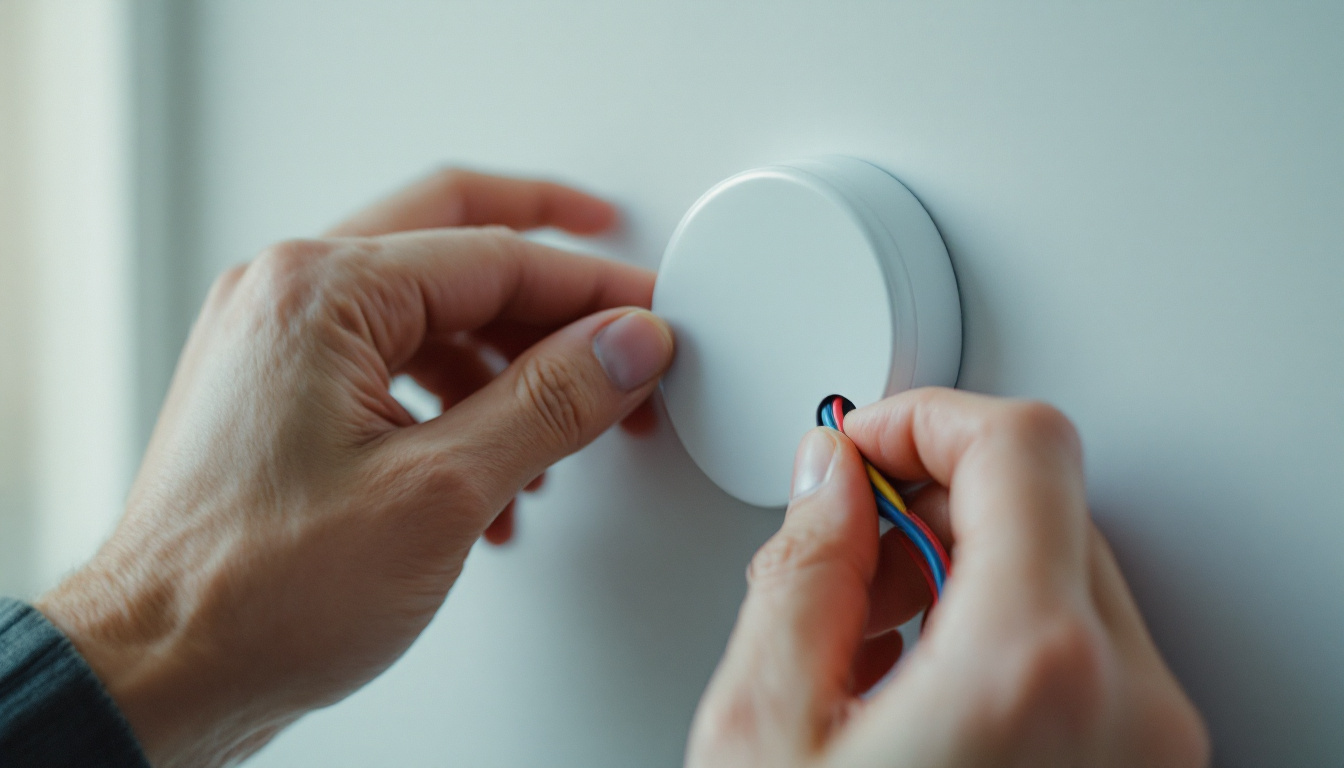
Most smart thermostats need a C wire, a common wire that supplies continuous power, and that is the single thing that decides whether the install takes twenty minutes or needs an electrician.
Adoption is still low. EIA’s residential survey counted 12.78 million US homes with a smart or internet-connected thermostat, against 52.59 million with a programmable one and 44.08 million with a non-programmable one.
The C wire question
A conventional thermostat is a switch: it closes a circuit to call for heat or cooling, and it needs no power of its own. A smart thermostat runs a screen and a radio continuously, so it needs a constant supply, which is what the C, or common, wire provides.
- Check what is behind the current thermostat. Turn the power off at the breaker, pull the thermostat off its plate, and photograph the wires and their terminal letters.
- Look for a wire on C. Sometimes an unused wire is tucked into the wall cavity, which is the easiest fix of all.
- If there is no C wire, the options are a power-extender kit supplied with many thermostats, running a new cable, or choosing a model designed to work without one.
- Note the system type. Heat pump wiring differs from a furnace and air conditioner, and dual fuel systems need a thermostat that can switch between them.
Compatibility, beyond the C wire
| System | Usually compatible | What to watch |
|---|---|---|
| Gas or oil furnace with central air | Yes | Needs a C wire or a power extender |
| Heat pump with auxiliary heat | Yes, with the right model | Must control reversing valve and auxiliary or emergency heat |
| Dual fuel, heat pump plus furnace | Only specific models | Needs a switchover setting, not a generic setup |
| Line voltage electric baseboard | No, in most cases | Requires a line voltage model, 120 or 240 volts |
| Millivolt or proprietary systems | Often not | Check manufacturer compatibility before buying |
ENERGY STAR’s own guidance is short and correct: “Make sure the smart thermostat you purchase is compatible with your heating and cooling system.” Our explainer on how thermostats work covers the control logic underneath.
A smart thermostat changes when the system runs, not how well it runs. It cannot make a single-stage furnace modulate, fix duct leakage, or compensate for an oversized system. On a heat pump, a badly configured one can run expensive auxiliary heat more than necessary; see heat pump faults and normal behaviour. Zoning, not scheduling, is what fixes uneven rooms: see zoning systems.
Does it save money?
ENERGY STAR states that “Smart thermostats that earn the ENERGY STAR label have been independently certified, based on actual field data, to deliver energy savings.” That certification is a real, evidence-based bar, and it is product-level rather than a promise about your house.
We publish no savings percentage, because the outcome depends on your schedule, your setpoints and your equipment. The mechanism is simple: savings come from the system running less, so a household that already sets back overnight has less to gain than one that never touches the dial. That is also why the 44.08 million homes on non-programmable thermostats have the most to gain.
Installing one safely
- Kill the power at the breaker, not just at the thermostat.
- Photograph the existing wiring before disconnecting anything, and label wires by terminal, not by colour, because colour conventions are not reliable.
- Do not let wires fall into the wall. Clip them or tape them to the wall while you work.
- Set the system type correctly during setup: conventional, heat pump, or dual fuel. This is the most common configuration error.
- Test both modes before you finish, and on a heat pump confirm auxiliary heat only comes on when it should.
Frequently asked questions
Do I need a C wire for a smart thermostat?
Most need continuous power, which the C or common wire supplies. If there is no C wire, options are a power-extender kit included with many models, running new cable, or buying a model designed to work without one. Check behind the existing thermostat first, because an unused wire is often tucked into the wall.
Will a smart thermostat work with my system?
Conventional furnace and central air systems are usually straightforward. Heat pumps need a model that controls the reversing valve and auxiliary heat, dual fuel systems need specific models, and line voltage electric baseboard needs a line voltage thermostat. ENERGY STAR advises confirming compatibility before you buy.
Do smart thermostats actually save energy?
ENERGY STAR certifies models based on actual field data showing energy savings. How much you save depends on your schedule and setpoints, since savings come from the system running less. Households that never set back their temperature have the most to gain.
How common are smart thermostats?
EIA’s residential survey counted 12.78 million US homes with a smart or internet-connected thermostat, 11.7% of the 109.45 million homes that have a thermostat at all. Programmable models were in 52.59 million homes.
Methodology and limitations
Household thermostat counts are EIA RECS 2020 table HC6.1. Certification statements are quoted from ENERGY STAR. Wiring guidance is general; the equipment manufacturer’s instructions govern.
- We publish no savings percentage, because results depend on household behaviour.
- RECS 2020 remains the current vintage for equipment data; the 2024 survey’s heating and cooling tables are due in spring 2027 See what the 2024 survey release covers.; smart thermostat adoption has likely risen since.
- Low voltage thermostat work is generally owner-accessible, but system wiring varies and errors can damage equipment.
Sources
- US Energy Information Administration, Residential Energy Consumption Survey 2020, table HC6.1.
- ENERGY STAR, Smart Thermostats.
The HVAC Brief is an independent trade publication. We do not sell equipment, take manufacturer advertising, or accept payment for placement in our research. Corrections welcome.
Leave a Reply