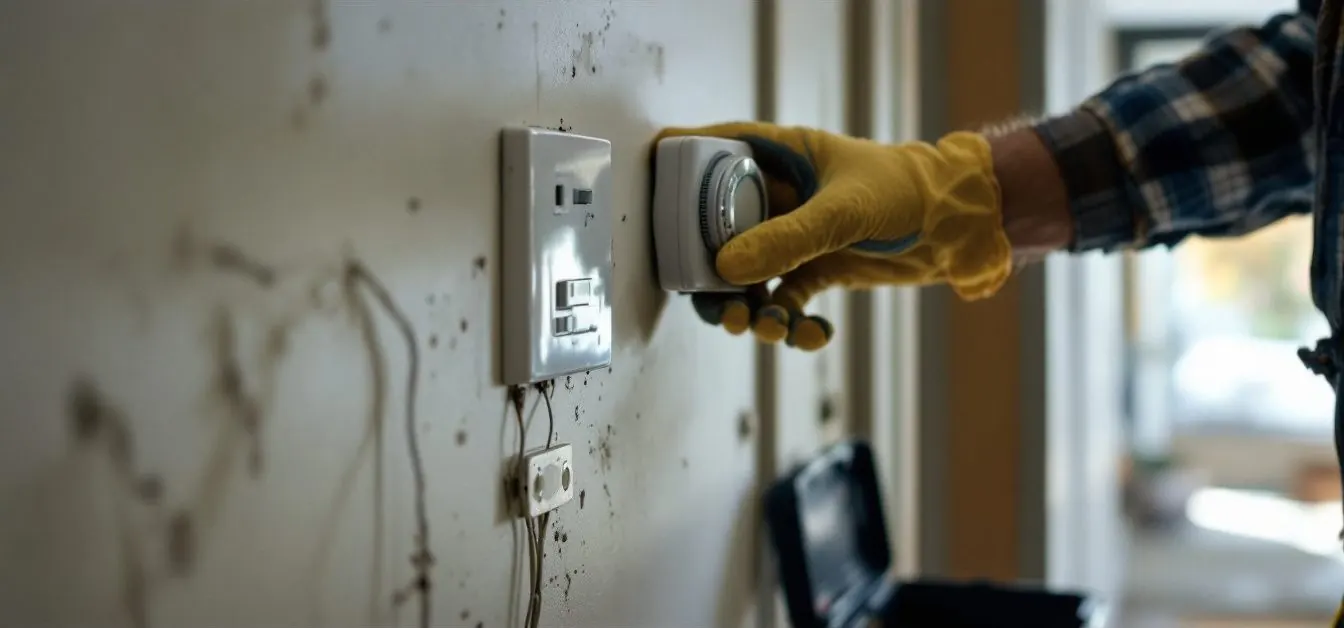
What is a mercury thermostat? A mercury thermostat is an older dial or lever wall thermostat that switches heating and cooling with sealed glass vials of mercury, more than 4 grams per unit. Every known maker has stopped selling them, and several states ban putting one in the trash.
Key Takeaways
- The average unit has 1.4 switches, each with at least 2.8 grams of mercury, per TRC data in the IMERC fact sheet.
- Thermostats sold in the US carried 29,253 pounds of mercury in 2001 and none in the 2016 report (IMERC, December 2018).
- Federal rules say household waste is not hazardous waste (40 CFR 261.4(b)(1)), so a homeowner’s trash ban comes from state law.
- TRC’s chart, revised October 14, 2026, marks 14 states with mandatory thermostat laws (TRC chart).
- California contractors who remove one must take it to an authorized collection location (HSC 25214.8.15).
- TRC lists over 3,400 collection locations in 47 states and charges contractors and homeowners no fee (TRC FAQ).
What is a mercury thermostat, and how does it work?
A mercury thermostat uses a bimetal coil that expands and contracts with room temperature and tilts a glass mercury switch, opening or closing the circuit that starts the furnace, heat pump or air conditioner, per the IMERC fact sheet from the states’ mercury clearinghouse.
Thermostat Recycling Corporation (TRC) figures there give 1.4 switches at a minimum of 2.8 grams each, so one thermostat holds more than 4 grams. For the control logic, see our explainer on how a wall thermostat calls for heat and cooling.
Sales collapsed within a decade: IMERC states recorded 29,253 pounds of mercury in thermostats sold in the US in 2001, 28,901 in 2004, 7,485 in 2007, 32 in 2010, 102 in 2013 and 0 in 2016. The big three makers reported a phase-out in October 2009; all eight reporting makers had depleted inventories as of January 2015.
How can you tell if a thermostat has mercury?
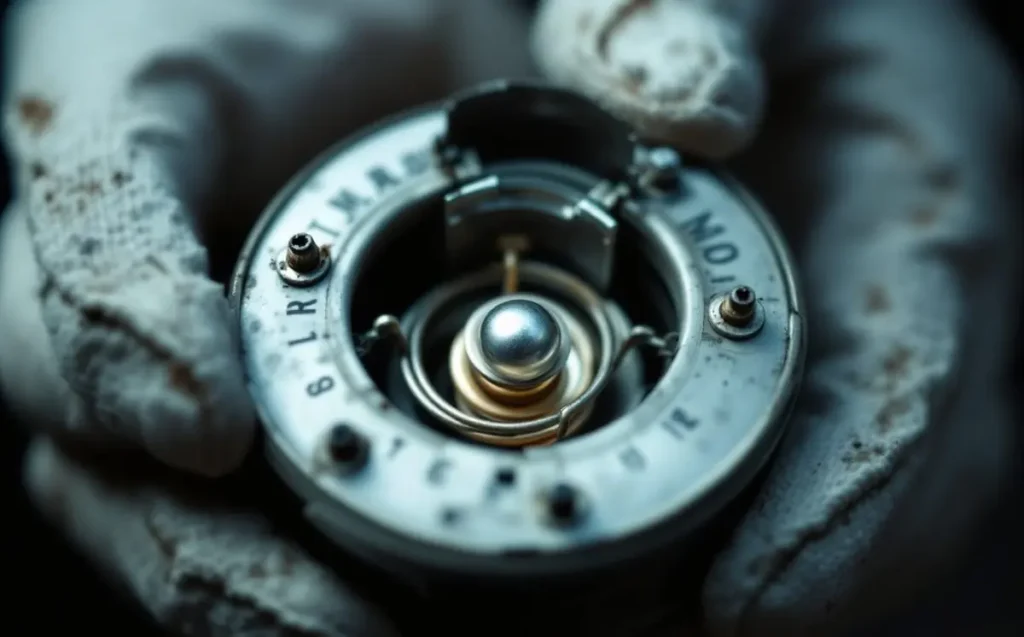
Look for a dial or lever, a building from before 2002 and a non-programmable unit, then check under the cover for a small glass ampule. Those are the clues on TRC’s homeowner page.
- Check for a dial or lever control and a pre-2002 building.
- Pull the cover off carefully and look for a small glass vial holding a silver liquid.
- Leave the vial attached. Maine DEP says in normal use the mercury “is entirely contained in a glass bulb.”
No vial usually means another type; Maine DEP lists electronic, snap-action, reed switch and vapor-filled diaphragm types. If a non-mercury dial unit acts up, our symptom-by-symptom thermostat troubleshooting still applies.
Is it illegal to throw away a mercury thermostat?
It depends on who and where you are. Federal rules exempt household waste, so a homeowner’s trash ban comes from state law; a business discarding one falls under federal universal waste rules.
The household exclusion sits in 40 CFR 261.4(b)(1); 40 CFR 273.8 makes universal waste rules optional for households. For businesses, 40 CFR 273.9 defines mercury-containing equipment as a device “including thermostats” that “contains elemental mercury integral to its function.”
TRC says seventeen states further regulate sale or disposal. IMERC names California, Illinois, Maine, Massachusetts, Minnesota, New Hampshire, New York, Rhode Island and Vermont as restricting or prohibiting household trash disposal.
Correction
TRC’s homeowner page says “the law requires” anyone replacing a mercury thermostat to dispose of it properly. For a homeowner, that duty comes from state law: the federal text exempts household waste. Recycle anyway; TRC drop-off is free.
Mercury thermostat laws by state: what the verified texts require
We verified seven state laws plus the federal rule from statute or agency text. Several carry sunset or repeal dates, so read the Status column.
| Jurisdiction | What the rule says | Citation | Status |
|---|---|---|---|
| Federal | Universal waste “mercury-containing equipment”; household waste excluded; small handlers hold it no longer than one year | 40 CFR 273.9, 261.4(b)(1), 273.15 | In force |
| California | In-state wholesalers must collect; a contractor who removes one must take it to an authorized location | Health and Safety Code 25214.8.14, 25214.8.15 | Obligations run until January 1, 2030 |
| Illinois | Sale ban from July 1, 2008; landfill ban and contractor recycling duty from July 1, 2011 | Mercury Thermostat Collection Act, per Illinois EPA | Illinois EPA says the program sunsets January 1, 2021 |
| Maine | No sale; makers fund collection with a $5 minimum incentive; wholesalers must be collection sites; trash disposal banned | 38 M.R.S. §1665-B; Maine DEP | In force |
| Minnesota | No sale, install or reinstall after August 1, 2007; makers pay to collect replaced mercury thermostats | Minn. Stat. 116.92, subd. 5 and 8d | In force |
| New York | Landfills and incinerators may not knowingly accept them; wholesalers collect since July 1, 2014 | ECL 27-2903, 27-2909 | Repealed January 1, 2027 |
| Pennsylvania | No sale, installation or disposal with mercury inside; contractors collect or give customers notice | Act 97 of 2008, Sections 4 to 6 | Effective Dec. 8, 2009, per PA DEP |
| Vermont | No knowing disposal in a landfill or combustor; contractors must deliver removed units for recycling; $5 minimum incentive | 10 V.S.A. §7107, §7116 | In force |
Note: Illinois EPA gives a January 1, 2021 sunset while TRC’s chart lists 1/1/23, and New York’s statute marks its landfill ban “Repealed January 1, 2027”.
TRC’s chart also lists CT, IA, MA, MT, NH, OR and RI (Iowa sunset 1/1/22, Montana 5/8/25); we could not open those statutes, so they are omitted. For this year’s federal equipment dates, see our 2026 HVAC rule calendar.
Where do you recycle a mercury thermostat?
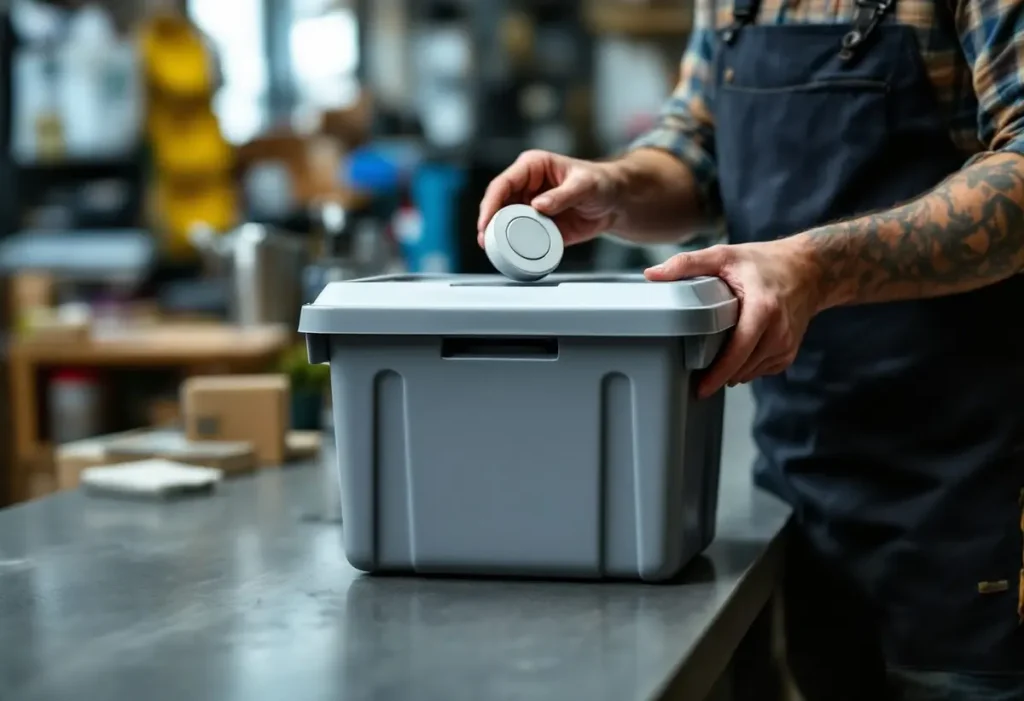
Take it, whole, to a TRC drop-off at an HVAC wholesaler, retailer or household hazardous waste site. TRC lists over 3,400 collection locations in 47 states and charges contractors and homeowners no fee.
Per the TRC FAQ, all HVAC wholesalers in CA, CT, IA, IL, ME, MT, NH, NY, PA, RI and VT must collect them at no cost; elsewhere participation is voluntary. Units must be whole and not leaking.
Cash helps: Maine DEP describes a $5.00 credit or check per thermostat, and Vermont law sets a $5.00 minimum. In 2017, Vermont collected 42 per 10,000 people and New York 4 per 10,000 (IMERC Table 3).
- Before removal, photograph and label the wires; our terminal-by-terminal wiring guide explains why wire color is not proof.
- Keep the old unit level and whole; do not pull the vial off the coil.
- Seal it in a plastic bag and take it to a TRC site or your household hazardous waste program.
- Mount the replacement using our thermostat placement rules from the manuals.
IMERC lists electromechanical and electronic programmable thermostats as non-mercury replacements. If you go digital, start with our smart thermostat compatibility checklist, then compare models in our Ecobee and Nest spec comparison.
A programmable unit pays off only with a schedule; see what DOE says a setback saves.
What do HVAC contractors have to do with a removed mercury thermostat?
Handle it as universal waste: keep it intact, put any leaking unit in a closed container, and ship it within one year. California and Vermont statutes also require the removing contractor to deliver it to a collection point.
40 CFR 273.13(c)(1) requires a closed container for leaking units, and 40 CFR 273.15(a) caps accumulation at one year. TRC matches: return the bin within one year, and never ship loose mercury, which “cannot be transported as universal waste.”
Illinois law carries penalties for contractors who skip recycling, per Illinois EPA; Pennsylvania contractors collect or give customers notice. Treat it with the same paperwork discipline as refrigerant recovery, and check your state board alongside our HVAC license requirements by state.
What should you do if a mercury thermostat breaks?
Clear people and pets out, open windows, and never vacuum, sweep or pour mercury down a drain, EPA says. Then ventilate for at least 24 hours after cleanup.
- Put on gloves and bag any glass in a zip locking bag.
- Push beads together with cardboard, then draw them up with an eyedropper.
- Lift tiny beads with shaving cream on a small brush or with duct tape.
- Bag and label everything as your local health or fire department directs.
EPA scopes these steps to spills no larger than a thermometer’s; with at least 2.8 grams per switch, ask your health department which guidance applies. EPA lists poison control at 1 (800) 222-1222 (EPA).
How many mercury thermostats are still being collected?
Fewer each year in most reporting states. In 2025 TRC collected 4,230 whole thermostats in Pennsylvania but 1,212 in New York, a 55% decrease from 2024, and TRC estimates US units should be out of service by the end of 2065.
| State | Whole thermostats, 2025 | Mercury collected, 2025 | Change vs 2024 |
|---|---|---|---|
| Pennsylvania | 4,230 | 38.5 lb | 4% increase |
| Minnesota | 3,188 | 23.8 lb | 22.2% decrease |
| Maine | 2,028 | 13.3 lb | 29% decrease |
| Connecticut | 1,265 | 10.0 lb | Not stated |
| New York | 1,212 | 10.3 lb | 55% decrease |
TRC collections peaked at 200,064 in 2010 and passed 2.7 million in total by 2020. With a 30 to 50 years life expectancy, pre-phase-out units are still coming off walls. Reports sit on TRC’s state reports page.
How we researched this
Research date: October 31, 2026. We attempted 35 sources and cite 22, grouped below: eCFR text read through the versioner API, seven state statutes or agency pages, the IMERC fact sheet and TRC documents.
Excluded: state laws we could not open, a $20 New York incentive from a 2025 bill rather than current law, unsourced competitor figures, and prices (no federal series). Reddit was skipped: mercury exposure is a safety topic.
Frequently asked questions
How much mercury is in a mercury thermostat?
More than 4 grams in a typical unit. TRC data cited in the 2018 IMERC fact sheet put the average at 1.4 switches per thermostat, each with a minimum of 2.8 grams of elemental mercury. Industrial multistage models can hold more.
Can I throw a mercury thermostat in the trash?
Not in states with disposal bans. Federal rules exempt household waste, but Maine DEP says trashing one is illegal there, Vermont bars knowing disposal in a landfill or combustor, and Pennsylvania bans disposal with the mercury inside. TRC drop-off is free everywhere.
Is a mercury thermostat dangerous to keep on the wall?
Not while the vial is intact. Maine DEP says the mercury is entirely contained in a glass bulb in normal use, and TRC says units are safe as long as the ampule remains intact. The risk is breakage: Maine DEP says trashed thermostats get burned or broken.
Do you get paid to recycle a mercury thermostat?
In some states. Maine DEP lists a $5.00 credit or check per thermostat, and Vermont law requires a $5.00 minimum incentive. New York’s statute lets the state require a five dollar incentive if collection goals are missed.
When did they stop making mercury thermostats?
General Electric, Honeywell and White-Rodgers reported phasing out manufacture and sale in October 2009, per IMERC. All eight makers that reported to IMERC had depleted their inventories as of January 2015, and the 2016 report shows 0 pounds sold.
What can replace a mercury thermostat?
IMERC lists electromechanical types (air-controlled, reed switch, vapor-filled diaphragm, snap-switch) and electronic programmable thermostats as suitable non-mercury replacements. Minnesota has banned reinstalling a mercury unit since August 1, 2007.
Sources
- NEWMOA. “IMERC Fact Sheet: Mercury Use in Thermostats” (December 2018). https://www.newmoa.org/wp-content/uploads/2023/01/thermostats_2018.pdf. Accessed October 2026.
- eCFR. “40 CFR 273.8, 273.9, 273.13 and 273.15.” https://www.ecfr.gov/current/title-40/chapter-I/subchapter-I/part-273. Accessed October 2026.
- eCFR. “40 CFR 261.4, Exclusions.” https://www.ecfr.gov/current/title-40/chapter-I/subchapter-I/part-261/subpart-A/section-261.4. Accessed October 2026.
- US EPA. “What to Do if a Mercury Thermometer Breaks.” https://www.epa.gov/mercury/what-do-if-mercury-thermometer-breaks. Accessed October 2026.
- Thermostat Recycling Corporation. “What is Mercury?”, “FAQs”, “Program History”, “Recycling By State” and “Safe Storage.” https://thermostat-recycle.org/program-info/faqs/. Accessed October 2026.
- Thermostat Recycling Corporation. “Mandatory State Legislation Chart” (revised 10/14/2026). https://thermostat-recycle.org/wp-content/uploads/2026/10/Mandatory-State-Legislation-Chart.pdf. Accessed October 2026.
- Thermostat Recycling Corporation. “2025 Annual Reports” (CT, ME, MN, NY, PA). https://thermostat-recycle.org/program-info/state-reports/. Accessed October 2026.
- Maine. “38 M.R.S. §1665-B” and Maine DEP “Mercury Thermostat Recycling.” https://legislature.maine.gov/statutes/38/title38sec1665-B.html. Accessed October 2026.
- Vermont. “10 V.S.A. §7107 and §7116.” https://legislature.vermont.gov/statutes/section/10/164/07116. Accessed October 2026.
- California. “Health and Safety Code 25214.8.14, 25214.8.15, 25214.8.19” (Public.Law copy). https://california.public.law/codes/ca_health_and_safety_code_section_25214.8.15. Accessed October 2026.
- New York. “ECL 27-2903 and 27-2909” (Public.Law copy). https://newyork.public.law/laws/n.y._environmental_conservation_law_section_27-2909. Accessed October 2026.
- Minnesota. “Minn. Stat. 116.92.” https://www.revisor.mn.gov/statutes/cite/116.92. Accessed October 2026.
- Pennsylvania. “Act 97 of 2008” and PA DEP “Mercury-Free Thermostat Act.” https://www.legis.state.pa.us/WU01/LI/LI/US/HTM/2008/0/0097..HTM. Accessed October 2026.
- Illinois EPA. “Thermostat Recycling.” https://epa.illinois.gov/topics/waste-management/materials-management/mercury/state-programs/thermostats.html. Accessed October 2026.
Leave a Reply