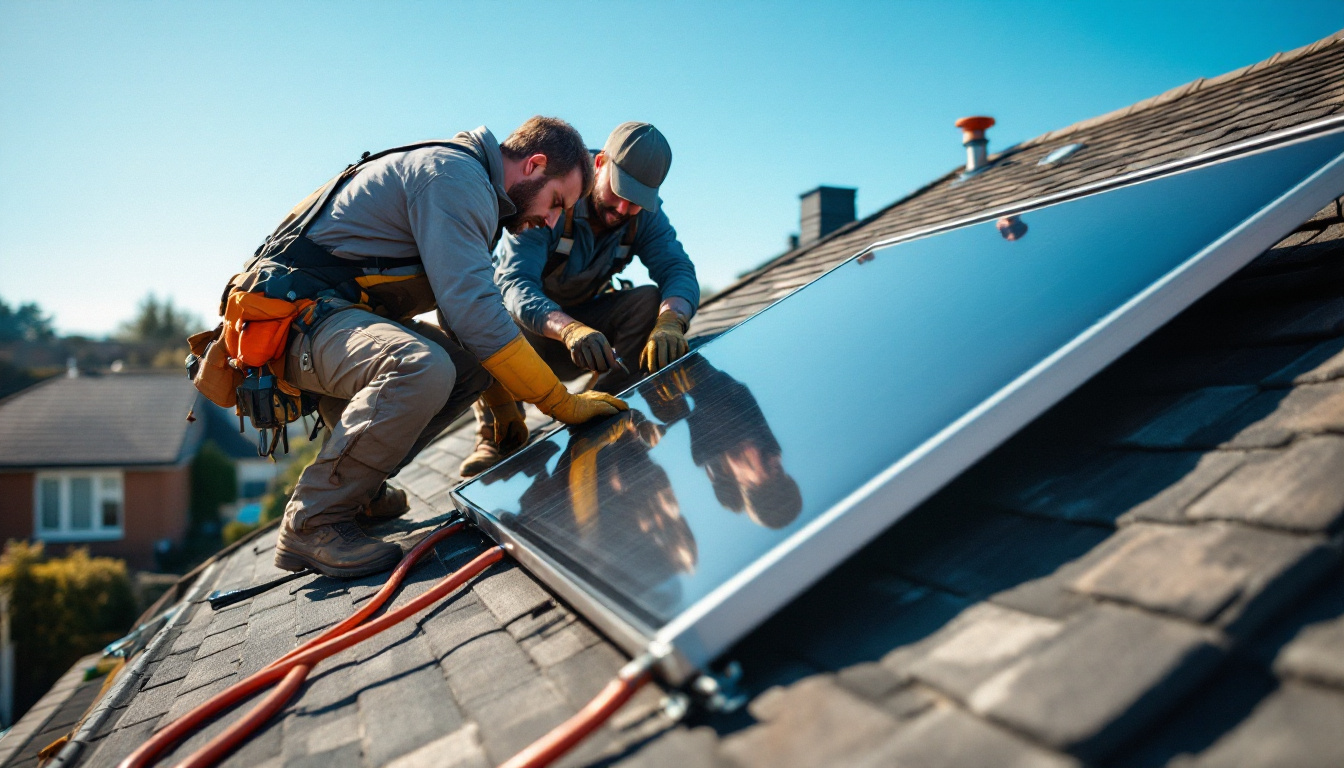
Does a solar water heater still make sense in 2026? A solar water heater still cuts water heating bills 50% to 80%, says DOE. The 30% federal credit does not: section 25D ends at expenditures made after December 31, 2025.
Key Takeaways
- Public Law 119-21, section 70506 rewrote section 25D: no credit “with respect to any expenditures made after December 31, 2025” (enrolled text, July 4, 2025).
- An expenditure counts as made when installation is finished, so a 2026 completion earns nothing (IRS FS-2025-05, August 21, 2025).
- Bills drop 50% to 80%; Solar Energy Factor runs 1.0 to 11, 2 or 3 typical (DOE Energy Saver, archived).
- ENERGY STAR’s floor is SUEF 3.00 with electric backup, 1.80 with gas (ENERGY STAR criteria).
- Pumped indirect systems suit freezing climates; batch collectors only mild-freeze ones (DOE Energy Saver, archived).
- Sizing: 20 square feet of collector for each of the first two people, plus 1.5 gallons of storage per square foot (DOE Energy Saver, archived).
What is a solar water heater, and what is in the package?
A solar water heater is a collector plus an insulated storage tank that preheats domestic hot water with sunlight, backed by a conventional heater for cloudy days. DOE splits the field two ways: active systems, with pumps and controls, and passive systems, without.
Active systems are direct or indirect: direct circulation pumps household water through the collectors, while indirect circulation pumps a non-freezing fluid through a heat exchanger that heats the potable water. The passive types are integral collector storage, or batch, and thermosyphon units that DOE says usually hold 40 gallons.
DOE says solar systems almost always require a backup, so the solar tank preheats water before the existing heater. That is why this slots into a plan to swap out an aging tank, and why a batch collector is sometimes packaged with an on demand heater.
| System family | Pump, and what handles freezing | DOE guidance on climate |
|---|---|---|
| Active direct circulation | Pumped potable water; nothing inherent | “Work well in climates where it rarely freezes” |
| Active indirect circulation | Non-freezing fluid, heat exchanger | “Popular in climates prone to freezing temperatures” |
| Integral collector storage (batch) | No pump; outdoor pipes exposed | “Installed only in mild-freeze climates” |
| Thermosyphon | No pump; rooftop tank | Majority hold 40 gallons |
Which solar water heater type survives a freezing climate?
The pumped indirect system. DOE calls indirect circulation popular in climates prone to freezing because the collector loop carries a non-freezing fluid instead of potable water. ENERGY STAR draws the line at 42 degrees F: if temperatures are likely to fall below that, choose a closed loop system with antifreeze.
DOE says batch units should be installed only in mild-freeze climates, because the outdoor pipes could freeze in severe cold. Freeze damage is a plumbing failure, and DOE says it is best to have a qualified solar thermal systems contractor do the install, so the usual questions you would ask before hiring any trade apply.
How do OG-300 and the Solar Energy Factor express annual performance?
OG-300 certifies a complete system, not a collector, against the ICC 901/SRCC 300 standard, and produces energy ratings customised for nearly 200 locations across North America. The Solar Energy Factor is what they turn on: energy delivered divided by the electrical or gas energy put in.
DOE puts the range at 1.0 to 11 and says systems rated 2 or 3 are the most common. The companion figure is solar fraction, the share of the load the sun covers: it runs 0 to 1.0, and DOE gives 0.5 to 0.75 as typical.
ICC-SRCC also publishes a Solar Uniform Energy Factor, SUEF, as an optional appendix to ICC 900/SRCC 300-2020, so a solar system can be compared with any other water heater on the Uniform Energy Factor scale used by federal water heater rules, under the DOE test method at 10 CFR Part 430, Subpart B, Appendix E.
How much collector and storage does a solar water heater need?
DOE frames the job as finding the collector area and storage volume that meet 90% to 100% of household hot water needs during the summer. The contractor rule of thumb is about 20 square feet of collector for each of the first two family members.
- Start with 20 square feet of collector for each of the first two people.
- Add 8 square feet per extra person in the US Sun Belt, 12 to 14 in the northern United States.
- Pick the tank by headcount: 50 to 60 gallons for one to three people, 80 gallons for three to four, larger for four to six.
- On an active system, allow roughly 1.5 gallons of storage per square foot of collector, or up to 2 gallons in very warm, sunny climates.
That storage ratio is what stops the system overheating when demand is low: a bigger collector forces a bigger tank, not the other way round, and cutting the load before buying capacity is the cheaper half.
DOE’s arithmetic runs on a federal test benchmark of 64.3 gallons a day, the average for a household of three.
Is the federal tax credit for solar water heating still available?
No. Section 25D carried qualified solar water heating property at 30%, but Public Law 119-21, section 70506, signed July 4, 2025, amends section 25D(h) by “striking ‘to property placed in service after December 31, 2034’ and inserting ‘with respect to any expenditures made after December 31, 2025′”.
The statute’s conditions still matter, because state and utility programs borrow them. Section 25D(d)(1) required that at least half of the energy used by the property be derived from the sun, and section 25D(b)(2) barred the credit unless the property was certified for performance by the non-profit Solar Rating Certification Corporation. That is why OG-300 mattered on a tax form.
Timing is the trap. Section 25D(e)(8)(A) treats an expenditure as made when the original installation is completed, and IRS fact sheet FS-2025-05, issued August 21, 2025, restates it: a contract paid in December 2025 with collectors going up in February 2026 produces nothing. The same law ended the 25C credit, which took the heat pump incentive off the table, and closed 25D on ground loop systems.
Correction: the 30% credit is gone, whatever the old pages say
Marketing still promises 30% on solar water heating through 2032 or 2034. That was the pre-2025 schedule in section 25D(g), and section 70506 deleted paragraphs (4) and (5) outright. Even the IRS Residential Clean Energy Credit page still carried legacy phase-out wording on September 18, 2026.
How does a solar water heater compare with a heat pump water heater?
Both cut water heating energy without burning fuel on site, but the heat pump water heater needs no roof, no glycol loop and no southern exposure. DOE says they can be two to three times more energy efficient than conventional electric resistance water heaters.
The siting constraints differ in kind. One is fixable indoors; the other is set by the building, and a north facing roof cannot be argued with.
| Attribute | Solar water heater | Heat pump water heater |
|---|---|---|
| Performance metric | Solar Energy Factor, solar fraction, SUEF | Uniform Energy Factor |
| ENERGY STAR floor | SUEF 3.00 electric backup, 1.80 gas | UEF 3.30 integrated, 2.20 split and 120V/15A |
| Site requirement | South facing roof, sun 10 AM to 4 PM | 40 to 90 degrees F space, 1,000 cubic feet of air |
| Federal credit, September 2026 | None; 25D ended after December 31, 2025 | None; 25C ended after December 31, 2025 |
For most retrofits the comparison is short. A heat pump unit that pulls heat from the surrounding air replaces the tank in a day with no roof work. A solar system adds a second tank, a roof penetration and a fluid loop.
Who should still install a solar water heater in 2026?
A narrow group: households with a genuinely south facing roof, strong year round sun, an expensive backup fuel, and a payback that never leaned on the credit. Everywhere else, the repeal moved a 30% discount onto the homeowner. The same collectors heat swimming pools, where unglazed panels and a summer only season change the arithmetic, covered in our guide to gas, heat pump and solar pool heaters.
Running cost is one line of DOE arithmetic: divide the benchmark daily load by the Solar Energy Factor, then multiply by 365 and by the fuel price. DOE’s own illustration, at SEF 1.1 and a stated $1.10 per therm, lands on $149.83 a year against $257.52 for a gas tank at UEF 0.64. Those are teaching numbers, so check what each fuel delivers per unit of heat and the rate in your state first.
Maintenance is light: DOE puts service on simple systems at every 3 to 5 years, and says systems with electrical components usually need a replacement part or two after 10 years.
The installed base was already small. EIA’s 2020 survey counted 59.33 million US homes on natural gas for the main water heater and 57.04 million on electricity, against 0.41 million on “some other fuel”, the bucket holding solar thermal. If the current tank prompted the search, diagnose first: the reason there is no hot water is often a failed element, and federal rule dates decide what is on the shelf.
How we researched this
Research date: September 18, 2026. Figures were read at source: Public Law 119-21 and section 25D at govinfo, IRS fact sheet FS-2025-05, four DOE Energy Saver pages, two ENERGY STAR pages, two ICC-SRCC pages and EIA RECS 2020 Table HC8.1.
Energy Saver pages return errors to automated requests, so the DOE pages were read from Internet Archive copies captured January 1, 2026, and labelled archived copy. The section 25D text is the 2024 United States Code edition, correct for subsections (b)(2), (d)(1) and (e)(8) but predating the termination amendment, which is quoted from the enrolled bill.
Excluded: installed cost figures, since no federal source publishes a price for residential solar water heating; and Reddit, where a site:reddit.com search returned no usable threads.
Frequently asked questions
Can you still get the 30% federal tax credit for a solar water heater?
No. Public Law 119-21, section 70506, amended section 25D so the credit does not apply to expenditures made after December 31, 2025. IRS fact sheet FS-2025-05 treats an expenditure as made when installation is completed.
What is the difference between active and passive solar water heating?
Active systems have circulating pumps and controls; passive systems do not. DOE says passive systems are typically less expensive and less efficient, but can be more reliable and may last longer.
Will a solar water heater work in a cold climate?
An indirect system will. DOE says pumped indirect circulation, which runs a non-freezing fluid through the collectors and a heat exchanger, is popular in climates prone to freezing. ENERGY STAR sets the antifreeze line at 42 degrees F.
What is a good Solar Energy Factor?
DOE puts the Solar Energy Factor range at 1.0 to 11 and says systems rated 2 or 3 are the most common. It is energy delivered divided by the electrical or gas energy put in.
What does OG-300 certification actually cover?
ICC-SRCC’s OG-300 certifies a complete system against the ICC 901/SRCC 300 standard, not a bare collector. It covers safety and durability and rates energy performance for nearly 200 North American locations.
Do you still need a conventional water heater as well?
Almost always. DOE says solar water heating systems almost always require a backup for cloudy days and times of increased demand, usually a conventional storage heater.
Sources
- U.S. Government Publishing Office. “H.R. 1, enrolled, section 70506 (Public Law 119-21).” https://www.govinfo.gov/content/pkg/BILLS-119hr1enr/html/BILLS-119hr1enr.htm. Accessed September 2026.
- U.S. Government Publishing Office. “26 U.S.C. 25D, 2024 Edition.” https://www.govinfo.gov/content/pkg/USCODE-2024-title26/html/USCODE-2024-title26-subtitleA-chap1-subchapA-partIV-subpartA-sec25D.htm. Accessed September 2026.
- Internal Revenue Service. “Fact Sheet FS-2025-05, August 21, 2025.” https://www.irs.gov/newsroom/faqs-for-modification-of-sections-25c-25d-25e-30c-30d-45l-45w-and-179d-under-public-law-119-21-139-stat-72-july-4-2025-commonly-known-as-the-one-big-beautiful-bill-obbb. Accessed September 2026.
- Internal Revenue Service. “Residential Clean Energy Credit.” https://www.irs.gov/credits-deductions/residential-clean-energy-credit. Accessed September 2026.
- DOE Energy Saver. “Solar Water Heaters” (archived copy, January 1, 2026). https://web.archive.org/web/20260101033954id_/https://www.energy.gov/energysaver/solar-water-heaters. Accessed September 2026.
- DOE Energy Saver. “Estimating the Cost and Energy Efficiency of a Solar Water Heater” (archived copy, January 1, 2026). https://web.archive.org/web/20260101014634id_/https://www.energy.gov/energysaver/estimating-cost-and-energy-efficiency-solar-water-heater. Accessed September 2026.
- DOE Energy Saver. “Sizing a New Water Heater” (archived copy, January 1, 2026). https://web.archive.org/web/20260101015556id_/https://www.energy.gov/energysaver/sizing-new-water-heater. Accessed September 2026.
- DOE Energy Saver. “Heat Pump Water Heaters” (archived copy, January 1, 2026). https://web.archive.org/web/20260101014727id_/https://www.energy.gov/energysaver/heat-pump-water-heaters. Accessed September 2026.
- EPA ENERGY STAR. “Water Heater Key Product Criteria.” https://www.energystar.gov/products/water_heaters/residential_water_heaters_key_product_criteria. Accessed September 2026.
- EPA ENERGY STAR. “Solar Water Heaters.” https://www.energystar.gov/products/solar_water_heaters. Accessed September 2026.
- ICC-SRCC. “OG-300 Certification Program.” https://solar-rating.org/programs/og-300-program/. Accessed September 2026.
- ICC-SRCC. “Solar Uniform Energy Factor.” https://solar-rating.org/standards-specs/suef/. Accessed September 2026.
- U.S. Energy Information Administration. “RECS 2020, Table HC8.1.” https://www.eia.gov/consumption/residential/data/2020/hc/pdf/HC%208.1.pdf. Accessed September 2026.
Leave a Reply