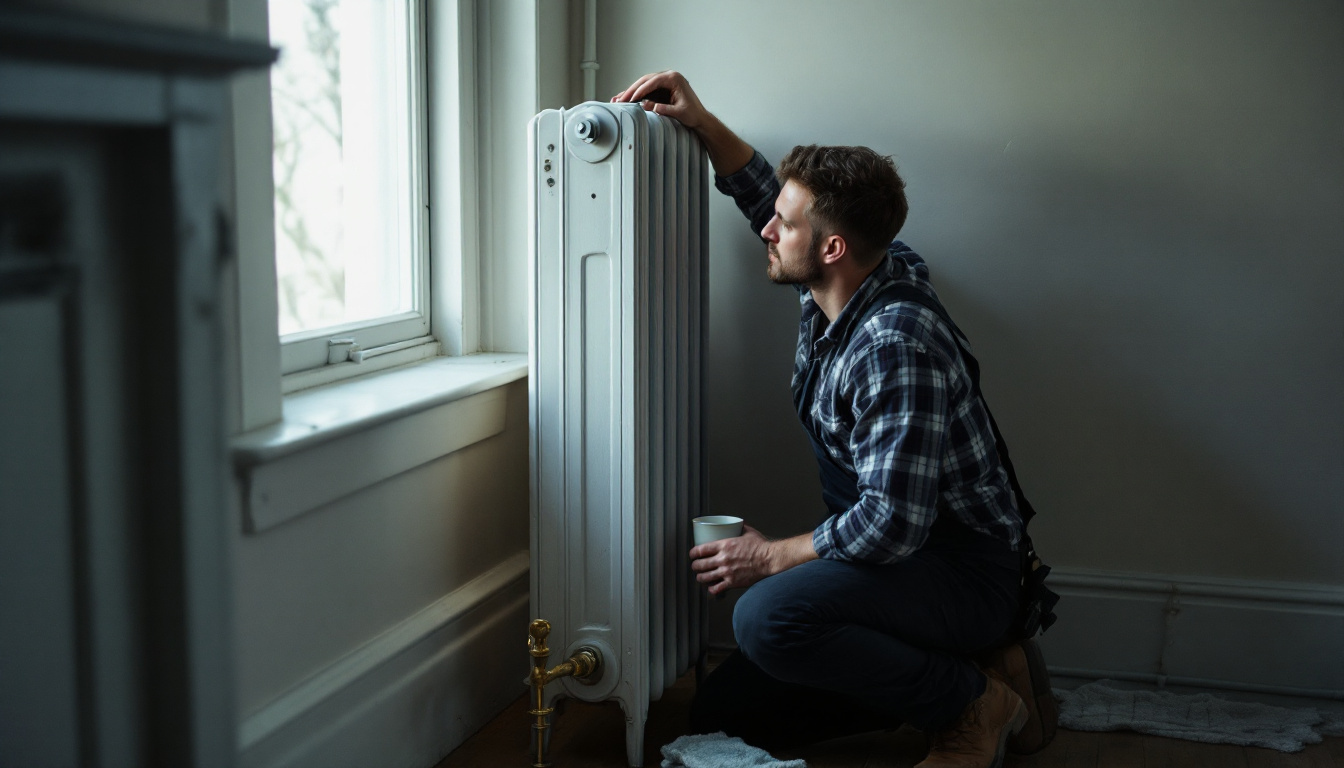
Why will my radiator not heat? Radiator heating repair splits on one question: steam or hot water. A hot water radiator cold at the top is trapped air and needs bleeding. A steam radiator that stays cold or bangs has a failed air vent or bad pitch, and must never be bled.
Key Takeaways
- 9.29 million US homes ran a steam or hot water system as main heating equipment in 2020, 7.5% of 123.53 million (EIA RECS 2020).
- DOE Energy Saver tells hot water owners to “bleed radiators at the start of each heating season,” and steam owners to check and replace clogged one-pipe air vents.
- A one pipe steam radiator has no bleed valve. Its air vent mounts low, “about a third of the way up from the bottom” (DOE Building America, describing one pipe practice in multifamily buildings).
- Banging is water where steam wants to travel: “Backpitched steam mains can create low spots where water collects.” Steam runs low, 2 to 5 psi above atmospheric in the building boiler example DOE describes.
- Set hot water radiator valves for an 18°F to 20°F drop, inlet to outlet. A far larger drop signals a block.
How do you tell a steam radiator from a hot water radiator?
Count the pipes and look for a bleed screw. A one pipe steam radiator has one large pipe entering low and a small air vent on the side. A hot water radiator has two pipes, or a square bleed valve at a top corner. Settle that first, because every step after it diverges.
Hot water, or hydronic, is the logic behind water loops buried in a floor slab. EIA reports both types as one category, worth knowing before you look for a count of what US homes run on.
| What you see | One pipe steam | Hot water (hydronic) |
|---|---|---|
| Pipes | One, entering low | Two, or a baseboard loop |
| Air device | Self-acting vent on the side | Bleed valve at a top corner |
| Owner bleeding | Never. No bleed valve exists | Yes, once each heating season |
| Boiler gauge | Steam, 2 to 5 psi | Water pressure, expansion tank |
Why does radiator heating repair start with air, not the boiler?
Because air is what blocks heat from arriving. In a hot water loop, trapped air gathers at the top of the radiator and keeps water off the upper fins. In a steam main, air must be pushed out before steam advances: “Air in the main and riser piping blocks the passage of steam and improper venting traps it in place.”
The far end of a building goes cold first, so owners overheat everything to satisfy one room, much as a thermostat in the wrong room does.
How do you bleed a hot water radiator that is cold at the top?
Cold at the top, warm at the bottom, is trapped air. DOE Energy Saver puts it on the hot water list: “Bleed radiators at the start of each heating season to remove unwanted air.”
- Run the heat 15 to 20 minutes, then mark every radiator cold at the top.
- Switch the boiler or circulator off and wait ten minutes for the water to settle.
- Hold a cloth and cup under the bleed valve, open it a quarter turn with a radiator key.
- Let it hiss until water flows steadily, then close it snug.
- Work outward from the boiler, then upward, and read the gauge afterwards. Below its cold fill pressure, the system will not reach the top floor.
A radiator needing this monthly is drawing air in somewhere, a job for the annual boiler visit.
Safety
Never bleed a steam radiator and never crack a steam valve to let air out. On hot water, the water behind the bleed valve is hot: the Consumer Product Safety Commission reports most adults suffer third-degree burns from two seconds of exposure to 150°F water, and burns at 140°F in six seconds.
What does radiator heating repair look like on a one pipe steam system?
On steam it is the air vent, the pitch or the valve position. Steam reaches the radiator only once the air ahead of it leaves through the vent, so a vent corroded shut leaves that radiator cold.
- Confirm the supply valve is fully open. It is not a throttle: half open leaves steam and condensate fighting through one opening.
- Listen at the vent during a call for heat. A good vent hisses, then goes silent when steam arrives. Silence from the start means it is clogged.
- Check pitch with a level. The radiator must slope back toward the supply valve so condensate drains out.
- Mount the replacement vent low, “usually about a third of the way up from the bottom.” Building America specifies slow radiator vents so the mains fill first.
Banging is the other steam complaint: water sitting where steam wants to travel. Building America: “Backpitched steam mains can create low spots where water collects. These often cause water hammer, especially at the start of a heating cycle.” A half open supply valve does the same locally, forcing steam and draining condensate through one narrowed opening. So does pressure. Building America notes a typical building steam boiler “may be set to operate at a range of 2-5 pounds per square inch (psi) above atmospheric pressure,” and recommends tuning for dry steam at no more than 2 psi.
What if the radiator is cold at the bottom instead of the top?
Cold at the bottom is not air, so bleeding does nothing. Flow is restricted low down: a valve shut or seized, or sludge settled in an old cast iron section.
The test is the temperature drop across the radiator. DOE Energy Saver says to set radiator valves for an 18°F to 20°F drop, inlet to outlet; a far larger drop means too little water is passing. Building America’s loop rule matches: “Ensure a minimum of a 20°F temperature differential between the supply and return temperatures under design conditions.” On steam, a cold bottom with a hot top means condensate cannot drain, which returns you to pitch.
Sludge is the quiet failure, and the remedy is a power flush or a magnetic filter. Checking the room against what a foot of electric baseboard puts out shows whether the emitter is undersized instead.
Do thermostatic radiator valves fix a room that never gets warm?
They fix the opposite problem. A thermostatic radiator valve caps how much heat a radiator gives up once the room is satisfied, so it stops overheating rather than curing a cold room. Building America: “A fluid-filled capsule inside the TRV operator expands as room temperature increases. As it expands it closes the valve, blocking entry of steam or hot water into the heat emitter.”
On two pipe steam the valve sits at the radiator inlet. On one pipe, TRVs “are installed at the vent side of the radiator, principally because of debris and condensate clogging issues at the inlet.” Solve underheating first. The guide cites DOE that overheating raises fuel use by as much as 3% per degree Fahrenheit above the set point, and found “as much as 15% heating fuel savings” from TRV retrofits, “but only if other measures are implemented in conjunction with TRVs.” For room-by-room control, how zoning divides a system compares better.
When is radiator heating repair actually a boiler repair?
If every radiator is cold, stop diagnosing radiators. One cold radiator among warm ones is a distribution fault; a whole cold system is a boiler, control, fuel or pressure fault.
On hot water, read the pressure gauge first: a system that has lost water through repeated bleeding or a failed expansion tank will not carry heat upstairs. On steam, a tripped low water cutoff stops the burner, which from the top floor looks like a dead boiler. Both are cheaper to catch during routine distribution-side service.
Some jobs are never homeowner work: the boiler pressure control, the relief valve, the low water cutoff and two pipe steam traps. The owner list is bleeding, keeping steam valves fully open, and reporting noises early. The rest belongs with whoever is specifying and commissioning the equipment.
EIA counted 23.54 million US homes on main heating equipment 20 or more years old in 2020, and Building America records a federal floor of 80% AFUE on small gas boilers since 1992. If a system fails twice in a season, the question shifts to what efficiency floors and venting rules require. DOE Energy Saver: “Steam boilers operate at a higher temperature than hot water boilers, and are inherently less efficient.” Read that against the cost of a million Btu by fuel.
How we researched this
Research date: September 2026. Cited: EIA RECS 2020 tables HC6.1 and HC6.6; four DOE Building America Solution Center guides (steam balancing, thermostatic radiator valves, gas-fired boilers, condensing boilers) for the mechanical guidance and the pressure and temperature figures; two DOE Energy Saver pages, both now 404 on energy.gov and read as archived copies; and CPSC publication 5098.
Excluded: contractor blogs, lead-generation repair sites and parts retailers, none of which supply a number here. No prices appear, because no federal series publishes repair pricing for radiator work. Reddit was not mined: this topic touches fuel-burning appliances and hot water, so it falls under our safety-topic exclusion. EIA reports steam and hot water as one category, so we publish no split between them.
Frequently asked questions
Can you bleed a steam radiator?
No. A one pipe steam radiator has no bleed valve; its air vent opens and shuts on its own. DOE Energy Saver’s steam instruction is to “check air vents on one-pipe systems and replace them if they are clogged or stuck open,” not to bleed anything.
Why is my radiator cold at the top but hot at the bottom?
On hot water that is trapped air, and opening the bleed valve at the top corner releases it. DOE Energy Saver lists bleeding radiators at the start of each heating season as routine maintenance. A radiator that traps air again within weeks is drawing it in somewhere.
Why does my steam radiator bang?
Water is sitting where steam wants to travel. Building America notes that “backpitched steam mains can create low spots where water collects” and that these “often cause water hammer.” In a radiator, the same fault is a slope running away from the supply valve.
How many US homes still have radiators?
EIA’s 2020 survey counted 9.29 million homes whose main heating equipment is a steam or hot water system, out of 123.53 million, roughly 7.5%. It does not separate steam from hot water, and 5.37 million of those homes sit in the very-cold and cold regions.
What pressure should a residential steam system run at?
Low. Building America observes that a typical building steam boiler “may be set to operate at a range of 2-5 pounds per square inch (psi) above atmospheric pressure,” and advises tuning it for dry steam at no more than 2 psi.
Is a cold radiator ever a boiler fault?
Yes, when every radiator is cold rather than one. A whole cold system points at the boiler, its controls, the fuel supply or system pressure. One cold radiator among warm ones points at that radiator’s vent, valve or pitch.
Sources
- U.S. Energy Information Administration. “RECS 2020 Table HC6.1, Space heating in U.S. homes, by housing unit type.” https://www.eia.gov/consumption/residential/data/2020/hc/pdf/HC%206.1.pdf. Accessed September 2026.
- U.S. Energy Information Administration. “RECS 2020 Table HC6.6, Space heating in U.S. homes, by climate region.” https://www.eia.gov/consumption/residential/data/2020/hc/pdf/HC%206.6.pdf. Accessed September 2026.
- DOE Building America Solution Center. “Steam System Balancing for Multifamily Existing Buildings.” https://basc.pnnl.gov/resource-guides/steam-system-balancing-multifamily-existing-buildings. Accessed September 2026.
- DOE Building America Solution Center. “Thermostatic Radiator Valves on Steam Heating Systems.” https://basc.pnnl.gov/resource-guides/thermostatic-radiator-valves-steam-heating-systems. Accessed September 2026.
- DOE Building America Solution Center. “Condensing Boilers.” https://basc.pnnl.gov/resource-guides/condensing-boilers. Accessed September 2026.
- DOE Building America Solution Center. “Gas-Fired Boilers.” https://basc.pnnl.gov/resource-guides/gas-fired-boilers. Accessed September 2026.
- U.S. Department of Energy, Energy Saver. “Heat Distribution Systems.” Archived copy; live page 404. https://web.archive.org/web/2025id_/https://www.energy.gov/energysaver/heat-distribution-systems. Accessed September 2026.
- U.S. Department of Energy, Energy Saver. “Furnaces and Boilers.” Archived copy; live page 404. https://web.archive.org/web/2025id_/https://www.energy.gov/energysaver/furnaces-and-boilers. Accessed September 2026.
- U.S. Consumer Product Safety Commission. “Avoiding Tap Water Scalds,” Publication 5098. https://www.cpsc.gov/s3fs-public/5098.pdf. Accessed September 2026.
Leave a Reply