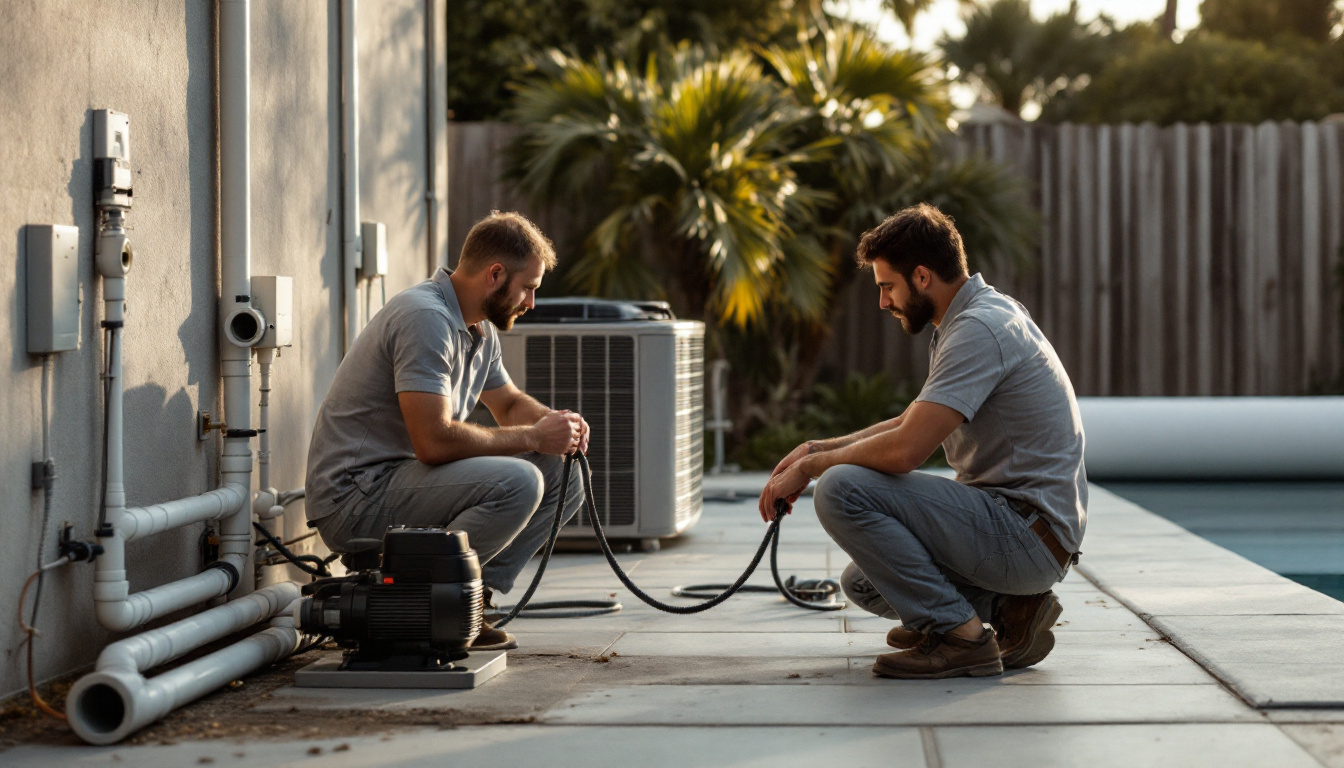
Which pool heater is best? A pool heater comes in three kinds: gas, heat pump and solar. Gas heats fastest in any weather, heat pumps cost far less to run above about 50°F, and solar has almost no fuel cost. A cover beats all three.
Key Takeaways
- Gas pool heaters must reach 82% thermal efficiency under 10 CFR 430.32(k).
- From May 30, 2028, gas and electric pool heaters must meet an integrated thermal efficiency (TEi) floor, per DOE’s May 2023 final rule.
- DOE puts heat pump pool heater COPs at 3.0 to 7.0, efficient above 45°F to 50°F air (archived copy).
- A pool cover can save 50% to 70% of heating costs, DOE says (archived copy).
- At the June 2026 U.S. residential electricity price of 18.34 cents per kWh (EIA), an uncovered Atlanta heat pump season runs about $2,131 by our arithmetic.
- The federal 25D credit ended for expenditures after December 31, 2025, under Public Law 119-21, and pool heating did not qualify.
How does each type of pool heater work?
Every pool heater sits in the filter loop, after the pump and filter. Gas burns natural gas or propane, a heat pump moves heat out of outdoor air, and solar collectors absorb sunlight.
DOE Energy Saver’s gas pool heater guidance (archived copy) says gas units “can maintain any desired temperature regardless of the weather or climate.” A heat pump pool heater runs the refrigerant cycle in our heat pump explainer, handing the heat to pool water at the condenser.
Solar systems divert filtered water through collectors when they are warmer than the pool. DOE says unglazed plastic collectors suit pools used only above freezing, while glazed collectors work in colder weather. A solar water heater for the house is a separate product.
| Pool heater type | Heat source | Efficiency measure | Weather limit (DOE) | Typical life (DOE) |
|---|---|---|---|---|
| Gas (natural gas or propane) | Burner and heat exchanger | Thermal efficiency: 82% floor; some models 89% to 95% | None; holds any set point | 5 or more years |
| Heat pump (electric) | Outdoor air via compressor | COP 3.0 to 7.0 (300% to 700%) | Efficient above 45°F to 50°F air | 10 or more years |
| Solar (unglazed or glazed) | Sunlight on collectors | Btu per square foot per day (SRCC OG400) | Needs sun and freeze protection | 10 to 20 years |
What does the federal pool heater standard require?
Today, 10 CFR 430.32(k)(1) requires gas-fired pool heaters made from April 16, 2013 until May 30, 2028 to reach 82% thermal efficiency. From May 30, 2028, paragraph (k)(2) sets an integrated thermal efficiency (TEi) floor for gas-fired and electric pool heaters.
The eCFR table sets the gas formula at 84 × (QIN + 491) ÷ (QIN + 2,536), where QIN is certified input in Btu/h. The electric formula is 600 × PE ÷ (PE + 1,619), where PE is active electrical power in Btu/h. DOE’s final rule at 88 FR 34624 adopted “new energy conservation standards for electric pool heaters,” so electric models face a federal floor for the first time.
By our arithmetic, a 400,000 Btu/h gas heater must reach about 83.6% TEi, and a heat pump drawing 5 kW (17,060 Btu/h) about 548%. Resistance heating cannot pass 100%, so on our reading only heat pumps clear the electric floor; DOE used resistance as the electric baseline. Both dates sit on our federal compliance calendar.
How big a pool heater do you need?
DOE sizes gas and heat pump pool heaters the same way: pool surface area × temperature rise × 12, giving output in Btu per hour.
- Pick the desired pool temperature.
- Subtract the average air temperature of the coldest swim month to get the rise.
- Measure the pool surface area in square feet.
- Multiply area × rise × 12.
The factor of 12 assumes a 1°F to 1.25°F rise per hour and 3.5 mph wind. A 1,000 square foot pool needing a 20°F rise calls for 240,000 Btu/h, by our arithmetic. DOE lists gas outputs of 75,000 to 450,000 Btu, while standard heat pump sizes top out at 125,000 Btu, one reason DOE advises a professional sizing analysis.
How much collector area does a solar pool heater need?
DOE’s rule of thumb (archived copy) is solar collector area equal to 50% to 100% of the pool’s surface area, more in cloudier places. Its Florida example: a 15 by 30 foot pool used year round needs 100%, or 450 square feet of collectors. Northern California owners typically size at 60% to 70%.
DOE says collectors can face up to 45° east or west of true south without a large loss, and a cover reduces the area needed. The Solar Rating and Certification Corporation rates pool collectors under its OG400 standard.
Why does a pool cover save more than any heater upgrade?
Because evaporation is the largest heat loss, and a cover stops it. DOE calls covering a pool “the single most effective means of reducing pool heating costs,” with savings of 50% to 70%. Each pound of 80°F water that evaporates takes 1,048 Btu out of the pool.
In DOE’s Atlanta example at 80°F, a cover cuts the gas bill from $3,063 to $578, about 81% by our arithmetic. The trade-off: DOE says an opaque cover can cut solar absorption by 20% to 40%.
Common myth
A better heater is not the first fix. Going from a 55% to a 95% gas heater saves $422 per $1,000 of heating cost in DOE’s table; a cover can save 50% to 70%.
What does a pool heater cost to run per season?
For DOE’s 1,000 square foot outdoor pool in Atlanta, held at 80°F from April through October, our repricing gives about $6,534 for gas and $2,131 for a heat pump uncovered, or $1,233 and $393 covered.
DOE’s gas table assumes an 80% efficient heater at $1.09 per therm; its heat pump table assumes COP 5.0 at $0.1301 per kWh. EIA puts the June 2026 U.S. residential electricity price at 18.34 cents per kWh and the June 2026 residential natural gas price at $24.09 per thousand cubic feet. At EIA’s 1,036 Btu per cubic foot, that is about $2.33 per therm.
| Pool heater type (Atlanta, 80°F) | DOE energy basis | Our arithmetic | Season cost at 2026 prices |
|---|---|---|---|
| Gas, uncovered | $3,063 at $1.09/therm | 2,810 therms × $2.33 | $6,534 |
| Gas, with cover | $578 at $1.09/therm | 530 therms × $2.33 | $1,233 |
| Heat pump, uncovered | $1,512 at $0.1301/kWh | 11,622 kWh × $0.1834 | $2,131 |
| Heat pump, with cover | $279 at $0.1301/kWh | 2,145 kWh × $0.1834 | $393 |
| Solar | No fuel; pump energy not modeled by DOE | None | $0 fuel |
June gas prices ran high: EIA’s January 2026 residential price was $13.96 per thousand cubic feet. Local prices vary; see our state electricity price table and the cost of heat by fuel comparison.
Why is pool heater installation a licensed job?
Because gas models need a gas line and venting, and heat pumps need an electrical connection outdoors near water. DOE’s 2023 rule “assumes that pool heater installations are performed by licensed professionals,” and DOE Energy Saver says to use a qualified professional, “especially the electric hookup.”
In the rule record, Rheem said installations must follow local codes or, absent them, the National Fuel Gas Code (NFPA 54) and National Electrical Code (NFPA 70). DOE noted that gas heaters near 84% efficiency can form condensate in the vent. Permit rules vary by jurisdiction.
- Gas: gas line or propane tank plus venting; check carbon monoxide detector placement in attached spaces.
- Heat pump: DOE counted extra electrical connection cost for new electric installs.
- Solar: DOE says some states require a plumber’s or solar contractor’s license.
Vet the installer with our contractor checklist.
Is there a federal tax credit for a solar pool heater?
No. Section 25D covered solar property “to heat water for use in a dwelling unit,” and 25D(e)(3) excludes costs allocable to “a swimming pool, hot tub, or any other energy storage medium” with another function.
The credit is also gone: section 70506 of Public Law 119-21 ends it “with respect to any expenditures made after December 31, 2025,” and the IRS credit page now says it is “not available for any property placed in service after December 31, 2025.” The same law ended the 25C credit, as we covered in our 25C expiration report.
For household hot water, see our guides to the heat pump water heater and the tankless water heater.
How we researched this
We consulted and cite 14 primary sources: eCFR 10 CFR 430.32 and 430.2, the 2023 DOE final rule, four DOE Energy Saver pool pages (archived copies; the live pages return errors), three EIA tables, Public Law 119-21, 26 U.S.C. 25D and two IRS pages. Research date: September 21, 2026.
Season costs are our arithmetic, not DOE estimates. We excluded installed prices (DOE’s solar range has no dollar year or sample basis), manufacturer claims and contractor blogs, and skipped Reddit because the topic involves gas and electrical safety.
Frequently asked questions
Is a heat pump or gas pool heater cheaper to run?
Usually a heat pump. In DOE’s Atlanta tables at 80°F, repriced by us to June 2026 EIA prices, an uncovered season costs about $2,131 with a heat pump and $6,534 with gas. Gas still wins for fast heat-up and occasional use.
Do heat pump pool heaters work in cold weather?
They lose efficiency as the air cools. DOE Energy Saver says heat pump pool heaters work efficiently while the outside temperature stays above the 45°F to 50°F range. Because most outdoor pools are used in warm and mild weather, DOE says this usually is not an issue.
What size pool heater do I need?
DOE’s formula is pool surface area in square feet, times the temperature rise, times 12, in Btu per hour. A 1,000 square foot pool needing a 20°F rise comes to 240,000 Btu/h. Wind, humidity and cool nights change the answer, so DOE advises professional sizing.
What is the new pool heater efficiency standard in 2028?
From May 30, 2028, 10 CFR 430.32(k)(2) sets an integrated thermal efficiency floor for gas and electric pool heaters. By our arithmetic, a 400,000 Btu/h gas model needs about 83.6%, and an electric model drawing 5 kW needs about 548%. Until then, gas models need 82% thermal efficiency.
How much does a pool cover save on heating?
DOE Energy Saver says savings of 50% to 70% are possible when the pool is covered while not in use. Covers work by stopping evaporation, the largest heat loss. DOE adds that they cut make-up water by 30% to 50% and chemical use by 35% to 60%.
Can I claim a tax credit for a solar pool heater?
No. Section 25D covered solar property to heat water for use in a dwelling unit and excluded costs allocable to a swimming pool or hot tub. Public Law 119-21 also ended the credit for any expenditures made after December 31, 2025.
Sources
- eCFR. “10 CFR 430.32.” https://www.ecfr.gov/current/title-10/chapter-II/subchapter-D/part-430/subpart-C/section-430.32 Accessed September 2026.
- eCFR. “10 CFR 430.2.” https://www.ecfr.gov/current/title-10/chapter-II/subchapter-D/part-430/subpart-A/section-430.2 Accessed September 2026.
- U.S. Department of Energy. “Consumer Pool Heaters final rule,” 88 FR 34624. https://www.federalregister.gov/documents/2023/05/30/2023-10849/energy-conservation-program-energy-conservation-standards-for-consumer-pool-heaters Accessed September 2026.
- DOE Energy Saver. “Heat Pump Swimming Pool Heaters” (archived copy). https://web.archive.org/web/20260101022502/https://www.energy.gov/energysaver/heat-pump-swimming-pool-heaters Accessed September 2026.
- DOE Energy Saver. “Gas Pool Heaters” (archived copy). https://web.archive.org/web/20250620235339/https://www.energy.gov/energysaver/gas-swimming-pool-heaters Accessed September 2026.
- DOE Energy Saver. “Solar Swimming Pool Heaters” (archived copy). https://web.archive.org/web/20260101014622/https://www.energy.gov/energysaver/solar-swimming-pool-heaters Accessed September 2026.
- DOE Energy Saver. “Swimming Pool Covers” (archived copy). https://web.archive.org/web/20260101014018/https://www.energy.gov/energysaver/swimming-pool-covers Accessed September 2026.
- U.S. Energy Information Administration. “Electric Power Monthly, Table 5.6.A.” https://www.eia.gov/electricity/monthly/epm_table_grapher.php?t=epmt_5_6_a Accessed September 2026.
- U.S. Energy Information Administration. “Natural Gas Prices.” https://www.eia.gov/dnav/ng/ng_pri_sum_dcu_nus_m.htm Accessed September 2026.
- U.S. Energy Information Administration. “Energy conversion calculators.” https://www.eia.gov/energyexplained/units-and-calculators/energy-conversion-calculators.php Accessed September 2026.
- U.S. Government Publishing Office. “H.R. 1, enrolled (Public Law 119-21).” https://www.govinfo.gov/content/pkg/BILLS-119hr1enr/html/BILLS-119hr1enr.htm Accessed September 2026.
- U.S. Government Publishing Office. “26 U.S.C. 25D.” https://www.govinfo.gov/content/pkg/USCODE-2024-title26/html/USCODE-2024-title26-subtitleA-chap1-subchapA-partIV-subpartA-sec25D.htm Accessed September 2026.
- Internal Revenue Service. “Instructions for Form 5695 (2025).” https://www.irs.gov/instructions/i5695 Accessed September 2026.
- Internal Revenue Service. “Residential Clean Energy Credit.” https://www.irs.gov/credits-deductions/residential-clean-energy-credit Accessed September 2026.
Leave a Reply