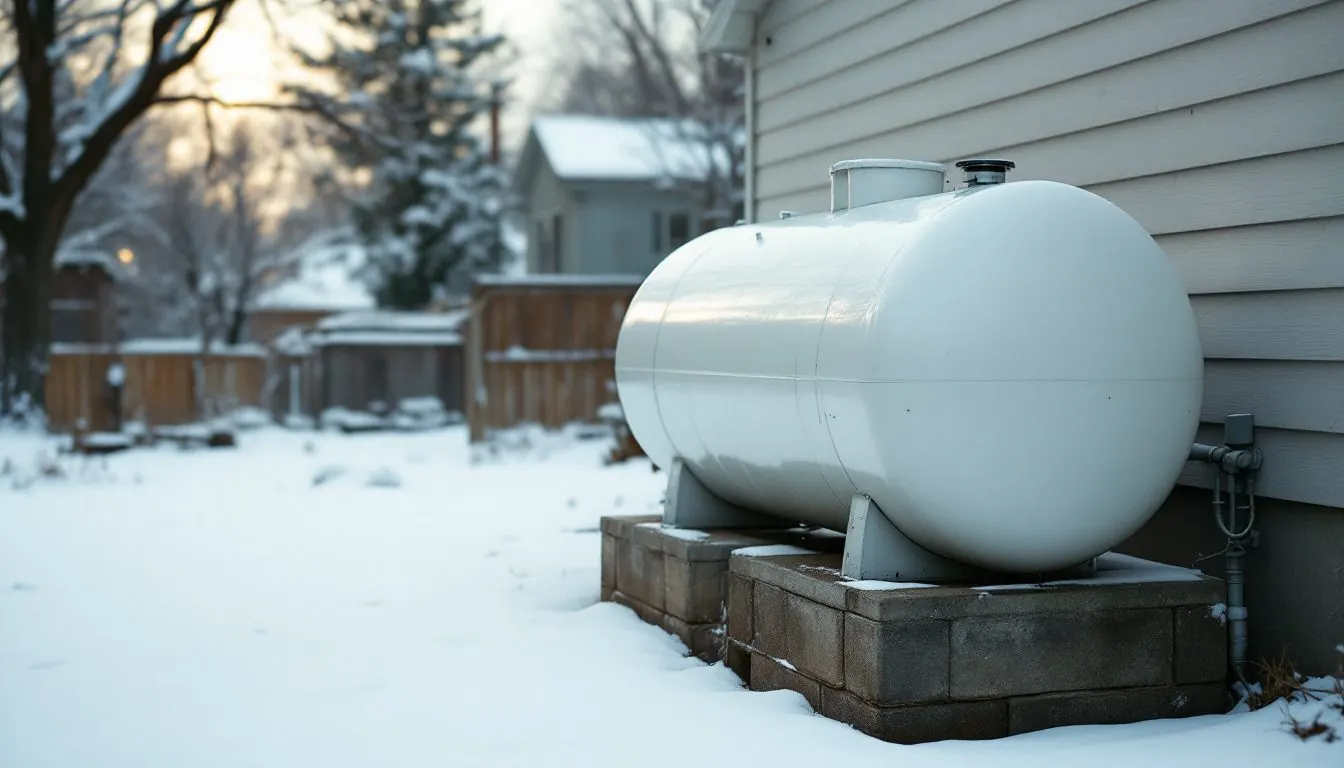
How long a 500 gallon propane tank lasts in January: about 104 days. A full tank holds about 400 gallons, and EIA’s January 2027 forecast for the average propane-heated US home is 3.86 gallons a day for heat, hot water and cooking. The gauge reaches the 30% reorder point after about 65 days.
Climate moves that number most: about 79 days in a Midwest January (156 gallons forecast) and 136 in the South. Over the whole winter the average US propane home burns 488 gallons, so one fill covers about 82% of it. Tank sizes, leases and delivery plans belong to our guide to propane heating systems.
How many days does a full 500 gallon propane tank last in each winter month?
Between 79 and 217 days per fill, depending on the month and the region. We divided 400 gallons by EIA’s forecast daily use for each month.
| Month | US average | Northeast | Midwest | South |
|---|---|---|---|---|
| November | 164 / 103 | 160 / 100 | 133 / 83 | 217 / 136 |
| December | 114 / 71 | 115 / 72 | 88 / 55 | 150 / 94 |
| January | 104 / 65 | 101 / 63 | 79 / 50 | 136 / 85 |
| February | 112 / 70 | 106 / 66 | 86 / 54 | 155 / 97 |
| March | 143 / 89 | 127 / 80 | 111 / 70 | 208 / 130 |
January burns 3.86 gallons a day for the US average, 3.95 in the Northeast, 5.05 in the Midwest and 2.94 in the South. EIA counts only homes heating mainly with propane, includes water heating and appliances, and models the gallons from its 2020 RECS survey corrected for degree days, so a drafty farmhouse runs faster than the table. EIA publishes no West propane figure.
Why does a full 500 gallon tank hold only 400 gallons, and when should you call for more?
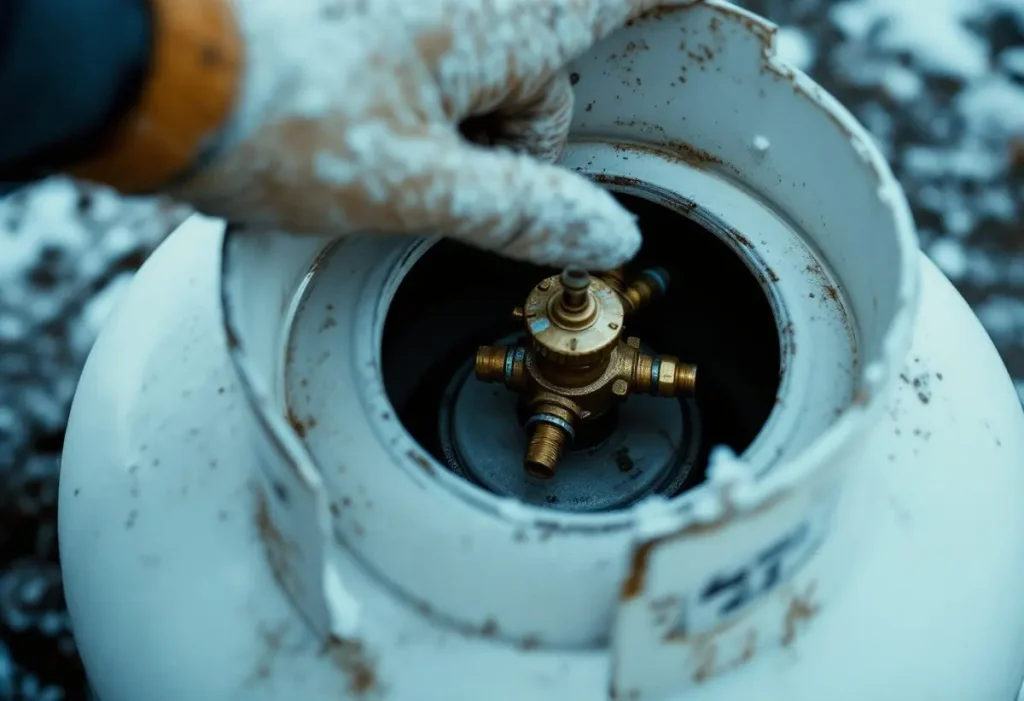
Because the dealer stops at 80% of the tank’s water capacity, and the gauge on the tank reads percent of that capacity, not gallons. The national retailer Ferrellgas tells customers “we’ll only fill your tank to 80 percent of its water capacity” and asks will-call customers to phone “when the gauge reads 30 percent.” North Carolina’s LP-gas regulator gives the reason: a “full” tank is about 80% liquid “so there is expansion space if the liquid warms.”
To turn the dial into gallons, multiply the reading by 500. A 30% reading means 150 gallons left; 20% means 100. On a 500 gallon tank, the 80% to 30% stretch is 250 gallons, which is the number that sets how often the truck comes.
The last 30% is 150 gallons: about 39 days at the US January average and about 30 days in a Midwest January, before any cold snap or delivery delay. Running dry costs more than gallons: the Propane Education & Research Council’s safety booklet says the retailer or a qualified professional should then “perform a leak check, restore gas service, and, if needed, light your pilot lights”, which is why a furnace often will not start after a propane refill until that visit happens.
How do you work out the days from your own furnace size?
Divide the furnace’s nameplate input by 91,452 Btu, EIA’s heat content for a gallon of propane, to get gallons per hour at full fire. Multiply by the hours the burner actually fires each day, add the non-heating load, and divide 400 by the total.
Days per fill = 400 ÷ (input Btu/h ÷ 91,452 × burner hours per day + 0.73)
The 0.73 gallons a day is EIA’s non-heating use for a US propane-heated home in January: 22.51 gallons in 31 days for water heating, cooking and drying.
| Furnace input | Gallons per burner hour | 4 h a day | 8 h a day | 12 h a day | 16 h a day |
|---|---|---|---|---|---|
| 60,000 Btu/h | 0.66 | 119 days | 67 days | 47 days | 36 days |
| 80,000 Btu/h | 0.87 | 95 days | 52 days | 36 days | 27 days |
| 100,000 Btu/h | 1.09 | 78 days | 42 days | 29 days | 22 days |
| 120,000 Btu/h | 1.31 | 67 days | 36 days | 24 days | 18 days |
Use burner hours, not blower hours. The rating plate figure is input, so AFUE does not change gallons per burner hour; a 96% furnace just needs fewer burner hours for the same day.
Most homes fire far less than dealer examples assume. EIA’s January figure leaves 3.13 gallons a day for heat in the average US propane home, which is about 3.6 burner hours on an 80,000 Btu/h furnace. An Arizona dealer’s example of 8 burner hours a day (about 40 days per tank) is more than twice EIA’s average burn. Our figures on how long a furnace should run per day give a better starting guess.
How fast does a cold snap empty a 500 gallon propane tank?
About two and a half times faster at a 5°F daily mean than at 45°F: roughly 50 days per fill against 126 for the average US propane home. Each degree the day’s mean sits below 65°F is one heating degree day.
From EIA’s season forecast we derived a K factor, degree days per heating gallon: 8.2 for the US average (3,104 degree days over 378 heating gallons), 9.08 in the Midwest and 10.85 in the Northeast. Daily use is degree days divided by K, plus the regional non-heating load.
| Daily mean outdoor temp | Degree days per day | US average: gal/day | US average: days | Midwest: days | Northeast: days |
|---|---|---|---|---|---|
| 45°F | 20 | 3.16 | 126 | 136 | 153 |
| 35°F | 30 | 4.38 | 91 | 99 | 113 |
| 25°F | 40 | 5.60 | 71 | 78 | 90 |
| 15°F | 50 | 6.82 | 59 | 64 | 74 |
| 5°F | 60 | 8.04 | 50 | 54 | 63 |
Your own K factor beats these: take the gallons between two deliveries, subtract 0.73 a day for hot water and cooking, and divide the heating degree days for those dates by what is left. Oil dealers use the same method, shown on our page about how much heating oil a house uses.
How long does a 500 gallon propane tank last for a Generac home generator?
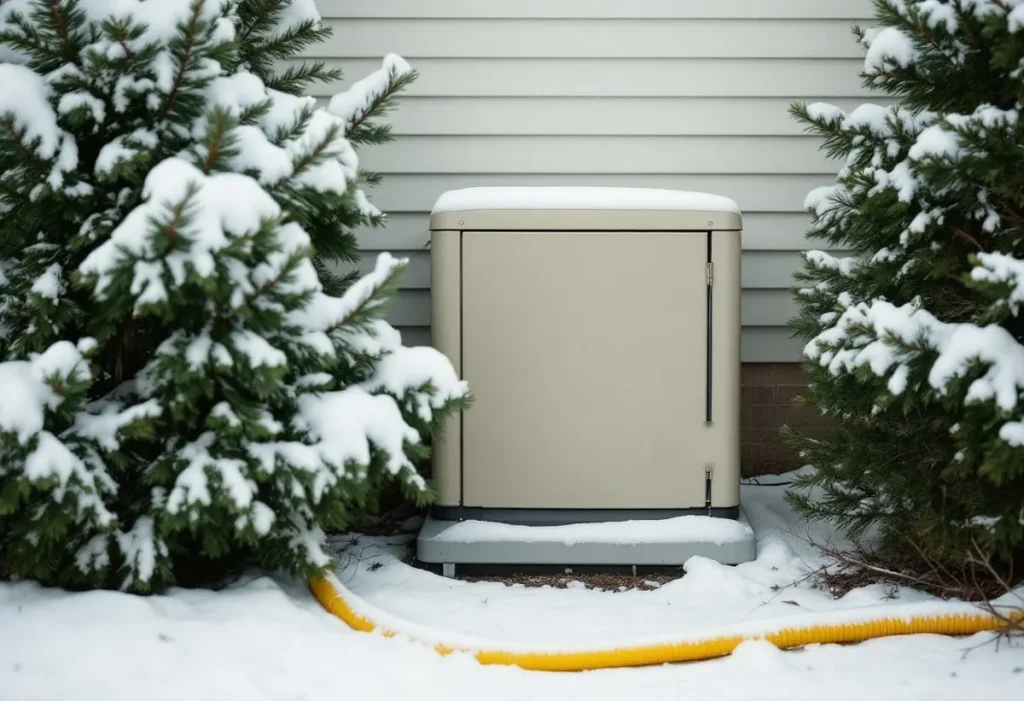
For a Generac 22kW (model 7042), about 158 hours at half load and 108 hours at full load on a 400 gallon fill, or 6.6 and 4.5 days of nonstop running. Generac’s product page lists LP consumption of 2.53 gallons per hour at 50% load and 3.71 at 100%.
The generator and furnace share the tank. In a January outage, 24 hours at half load (60.7 gallons) plus the 3.86 gallon US average is about 64.6 gallons a day: a full fill lasts about 6.2 days, a tank at the 30% mark about 2.3. For other generators, divide 400 by the spec sheet rate. Hookup steps are in our plan for keeping a house warm during a power outage.
How long does a 500 gallon tank last if propane only heats water and cooks?
About 551 days, roughly 18 months, on our estimate: 400 divided by EIA’s January non-heating rate of 0.73 gallons a day. Summer use may differ, and a pool heater or gas fireplace changes everything.
How far does a 500 gallon propane tank have to be from the house, above or below ground?
At least 10 feet, on a pad or buried, in North Carolina’s reading of NFPA 58. Its LP-gas regulator confirms that an ASME tank over 125 gallons water capacity must be 10 feet from a building or a property line “that can be built upon,” and that “all UG tanks of 2,000-gallon water capacity or smaller must be at least 10 feet from buildings and property lines that can be built on,” citing Table 6.4.1.1 of the LP-Gas Code.
States adopt different editions, so in many jurisdictions the local fire marshal or LP-gas inspector decides. North Carolina adds that 2011 rules require corrosion protection on underground tanks buried since. Burying the tank does not change how long the 400 gallons last.
Frequently asked questions
How long does a 500 gallon propane tank usually last?
For a home heating with propane, usually most of one winter. EIA forecasts 488 gallons from November 2026 through March 2027 for the average US propane-heated home, about 1.22 fills of a 500 gallon tank. Midwest homes need about 1.57 fills (629 gallons), while the average South home, at 361 gallons, gets through the winter on less than one fill.
How often do you need to refill a 500-gallon propane tank?
In January, about every 65 days for the average US propane-heated home if you call at 30% as Ferrellgas advises, since 250 gallons are used between an 80% fill and a 30% reading. A Midwest home burning EIA’s forecast 5.05 gallons a day reaches 30% in about 50 days; a South home takes about 85.
How much does a 500-gallon propane tank cost to fill?
About $1,032 for 400 gallons at EIA’s forecast 2026-27 winter average of $2.58 a gallon, before taxes, which EIA’s prices exclude. Regional forecasts give about $1,332 in the Northeast at $3.33, $842 in the Midwest at $2.11 and $1,291 in the South at $3.23. Delivery, minimum and after-hours fees vary by dealer.
How many years does a 500 gallon propane tank last?
None of the state and industry documents we read gives a 500 gallon ASME tank an expiration date; periodic requalification applies to DOT cylinders. North Carolina’s LP-gas regulator warns that corrosion can make a tank unsafe and that keeping the tank painted “is a significant way to extend the tank life.” A dealer inspection, not the calendar, decides retirement.
How we researched this
Research date: 24 November 2026. We computed days per fill, reorder intervals, K factors and base loads from the propane rows of EIA’s Winter Fuels Outlook tables WF01 and WF02 (November 2026 update), with EIA’s 91,452 Btu per gallon. Fill level and the 30% call point come from Ferrellgas and North Carolina’s Department of Agriculture, generator rates from Generac, run-out steps from PERC. We excluded unsourced dealer blog figures for appliance use and the “750 gallons” figure, which contradicts EIA’s table. Results are averages, not your house.
Sources
- U.S. Energy Information Administration. “Winter Fuels Outlook, Tables WF01 and WF02 (Short-Term Energy Outlook, November 2026).” https://www.eia.gov/outlooks/steo/report/perspectives/2026/10-winterfuels/wf01.xlsx. Accessed November 2026.
- U.S. Energy Information Administration. “British thermal units (Btu).” https://www.eia.gov/energyexplained/units-and-calculators/british-thermal-units.php. Accessed November 2026.
- Ferrellgas. “How to read my propane tank gauge.” https://www.ferrellgas.com/tank-talk/blog-articles/how-to-read-your-propane-tank-gauge/. Accessed November 2026.
- North Carolina Department of Agriculture and Consumer Services, Standards Division. “LP-Gas FAQ for Consumers.” https://www.ncagr.gov/divisions/standards/lp-gas/lp-gas-faq-and-interests-consumers/standards-lp-gas-faq-consumers. Accessed November 2026.
- North Carolina Department of Agriculture and Consumer Services, Standards Division. “Separation Distances for Underground Propane Tanks.” https://www.ncagr.gov/divisions/standards/standards-lp-gas/standards-lp-gas-interests-industry/lp-gas-code-interpretations/standards-underground-tanks-near-elevated-buildings. Accessed November 2026.
- Generac. “Standby Generator, 22kW, WiFi Enabled (7042).” https://www.generac.com/residential-products/standby-generators/gaseous/22kw-standby-generator-wifi-enabled-7042/. Accessed November 2026.
- Propane Education & Research Council. “Propane Safety Booklet (PRC-101063D).” https://cloudinary.propane.com/images/v1756137316/website-media/PRC-101063D-Propane-Safety-Booklet_digital-1_144644b80f7/PRC-101063D-Propane-Safety-Booklet_digital-1_144644b80f7.pdf. Accessed November 2026.
Leave a Reply