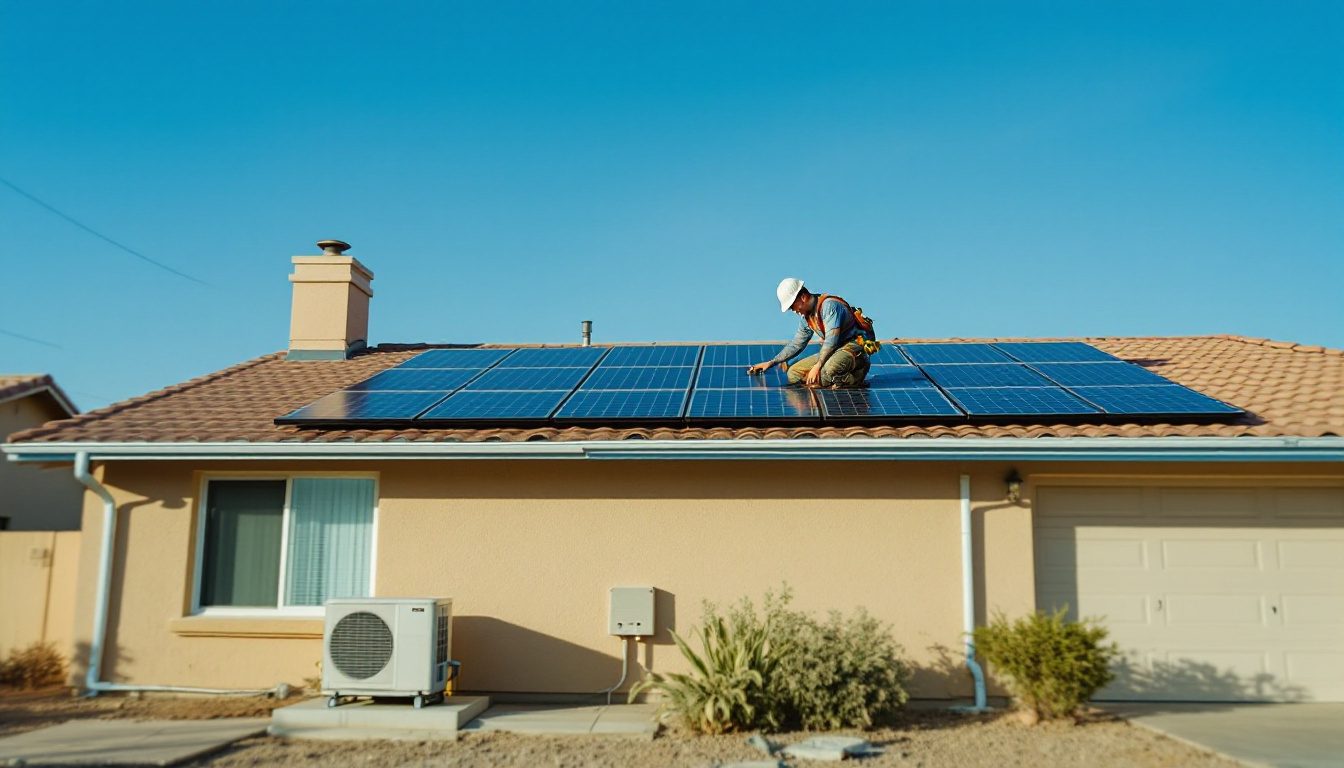
What is a solar air conditioner? A solar air conditioner is any cooling system powered by photovoltaic panels. In most homes that means ordinary central AC or a heat pump paired with rooftop solar; sometimes it is a hybrid mini split wired to its own panels. Offsetting a year of cooling takes about 1.1 to 3.2 kW of panels.
Key Takeaways
- Homes with air conditioning used 2,318 kWh for it in 2020, plus 457 kWh for the indoor fan, per EIA’s 2020 Residential Energy Consumption Survey.
- 1 kW of rooftop panels makes about 1,753 kWh a year in Phoenix and 1,301 kWh in Boston, per NREL’s PVWatts model.
- Offsetting a year of cooling takes about 2.9 kW (8 panels of 400 W) in Phoenix and 1.1 kW (3 panels) in Boston, in our worked example.
- The 30% federal solar credit ended for expenditures after December 31, 2025, under Public Law 119-21, section 70506.
- Summer demand peaks around 5:00 p.m. or 6:00 p.m., per EIA, as solar output fades.
- Utilities in 16 states use net billing or other compensation instead of net metering (DSIRE, May 2026).
What is a solar air conditioner?
A solar air conditioner is a normal air conditioner or heat pump that gets some or all of its electricity from solar panels. The compressor and coils are unchanged; what differs is where the power comes from and where unused solar output goes.
Three setups sell under the name: a grid-tied rooftop array feeding the house, a hybrid AC/DC ductless mini split wired to its own panels, and a fully off-grid system with batteries.
| Setup | How the AC gets power | After sunset | Unused solar | Best fit |
|---|---|---|---|---|
| Grid-tied rooftop PV plus standard AC or heat pump | Inverter feeds the home panel | Grid or home battery | Exported for utility credit | Most homes with central air |
| Hybrid AC/DC mini split (e.g. EG4 12K) | Panels wire to the outdoor unit; outlet fills the gap | Grid | Lost; no export path | One room, garage or shop |
| Off-grid PV, battery and AC | Battery bank and inverter | Battery only | Stored until full, then wasted | Sites with no utility |
Solar heat is a separate technology: see our solar water heater guide and passive solar heating.
How much electricity does air conditioning use in a year?
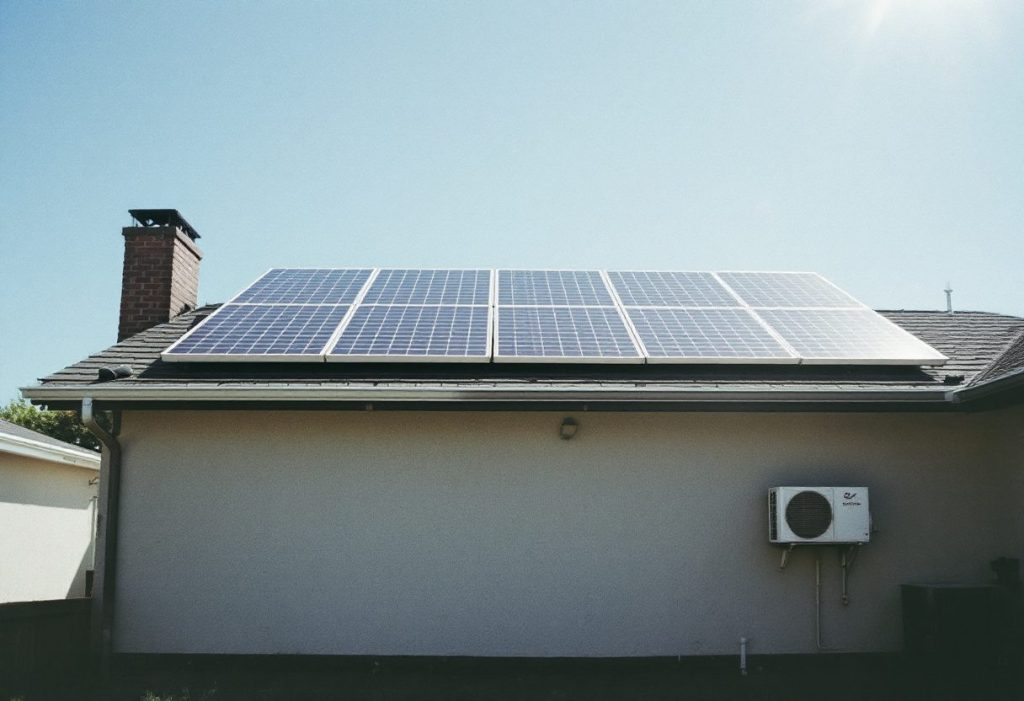
The average US household with air conditioning used 2,318 kWh for it in 2020, plus 457 kWh for the indoor air handler, about 2,775 kWh in all. That annual figure, not the unit’s wattage, is what the panels must match.
Climate drives the spread. Mountain South households averaged 4,276 kWh for AC plus 739 kWh for the fan, nearly four times New England’s figure, while the Marine climate region averaged 902 kWh.
Per the EIA table footnotes, the AC figure includes evaporative coolers and power from on-site solar. For dollars by state, see what air conditioning costs to run; for how hot summer ran, see the cooling degree day index.
How many solar panels does it take to run an air conditioner?
Divide your annual cooling kWh by what 1 kW of panels produces where you live. For the average AC household (2,775 kWh), that is about 1.6 kW with Phoenix sunshine and 2.1 kW with Boston’s, or 4 to 6 panels of 400 W. Treat it as a worked example, not a rule. For a Phoenix home:
- Cooling energy. Mountain South average: 4,276 plus 739 kWh, or 5,015 kWh a year.
- Solar yield. PVWatts: 1,753 kWh per kW a year (fixed roof mount, 20 degree tilt, south-facing, 14.08% losses).
- Array size. 5,015 divided by 1,753 is 2.86 kW.
- Panel count. At an assumed 400 W each, 7.2 panels, so 8.
| City | RECS group used | AC kWh | Cooling fan kWh | PV kWh per kW | Array | 400 W panels |
|---|---|---|---|---|---|---|
| Phoenix, AZ | Mountain South | 4,276 | 739 | 1,753 | 2.9 kW | 8 |
| Houston, TX | West South Central | 3,873 | 693 | 1,420 | 3.2 kW | 9 |
| Miami, FL | Hot-humid climate | 4,173 | 720 | 1,550 | 3.2 kW | 8 |
| Atlanta, GA | South Atlantic | 3,112 | 553 | 1,400 | 2.6 kW | 7 |
| Chicago, IL | East North Central | 1,425 | 281 | 1,307 | 1.3 kW | 4 |
| Denver, CO | Mountain North | 1,396 | 298 | 1,594 | 1.1 kW | 3 |
| Los Angeles, CA | Pacific | 1,514 | 297 | 1,676 | 1.1 kW | 3 |
| Boston, MA | New England | 1,136 | 288 | 1,301 | 1.1 kW | 3 |
Each row applies a regional average to one city (Miami uses the Hot-humid region), so a large or leaky house needs more. These are annual offsets that rely on the grid to bank surplus; running a unit off panels in real time depends on how many watts an air conditioner draws.
Can a solar air conditioner run at night?
A solar air conditioner runs at night only on grid power or a battery, because panels produce nothing after dark. The gap starts before sunset: EIA reports summer electricity use peaks around 5:00 p.m. or 6:00 p.m., when panel output is already falling.
There is a seasonal gap too. In Chicago, PVWatts puts a 1 kW array at 158 kWh in July and 57 kWh in December, while cooling falls in a few summer months, so an annual-offset array leans on the grid to bank surplus.
DOE defines net metering as compensating owners for solar power exported to the grid. DSIRE’s May 2026 map shows investor-owned utilities in 16 states using net billing or other compensation instead, and one state offering none. A battery shifts afternoon surplus into the evening, at added cost.
How is a hybrid DC solar mini split different from rooftop solar?
A hybrid DC solar mini split takes power from panels wired to its outdoor unit and tops up from an outlet; rooftop solar feeds the whole house and exports the rest. The hybrid is simpler for one room, but only rooftop solar can use or sell every kilowatt hour.
The EG4 12K spec sheet is typical: the maker lists rated PV wattage of 1,100 W, rated cooling power of 950 W, a SEER2 of 22.5 and a 115 VAC second input. Those are manufacturer figures, not independent tests.
With no grid-tie inverter, output the unit cannot use on a mild day is lost. Kits with pre-charged line sets invite owner installation; read what EPA allows in our guide to DIY mini split kits.
Is there still a tax credit for a solar powered air conditioner in 2026?
No. The federal residential clean energy credit (section 25D) does not apply to expenditures made after December 31, 2025, so panels or a battery installed in 2026 earn no federal credit. Public Law 119-21, section 70506, moved the end date from 2034.
Correction to older guides
Many solar AC pages still promise a 30% credit. The IRS page for the credit says it covered 30% of costs for solar panels and battery storage installed from 2022 through December 31, 2025. A 2025 deposit does not rescue a 2026 job: the IRS FAQ on the 2025 law treats the expenditure as made when the original installation is completed.
The heat pump and central air credit ended the same day; see what the expired 25C credit costs you. State and utility incentives vary, so check DSIRE and your utility.
Is solar air conditioning worth it?
Solar air conditioning pays best with a large cooling load, strong sun and fair export credit. At the 2025 US average residential price of 17.30 cents per kWh, the average household’s 2,775 kWh of cooling is worth about $480 a year; the Phoenix example’s 5,015 kWh, about $868.
The price is from EIA’s Electric Power Monthly; rerun it with your rate from our electricity prices by state table and weigh it against written quotes. No federal series tracks solar AC installed prices, so we print none.
Sealing and insulating first shrinks both the AC and the array, the logic behind insulating before you size equipment, and a higher-efficiency unit than the SEER2 minimum cuts the kWh the panels must cover.
- Estimate cooling kWh: summer bills minus a mild spring month.
- Run PVWatts for your roof to get kWh per kW.
- Divide the first by the second, then by panel wattage.
- Ask how your utility credits exports.
- Compare two or more written quotes in dollars per watt.
How we researched this
Researched October 8, 2026. Cooling electricity: EIA’s 2020 Residential Energy Consumption Survey, Table CE5.3a (revised March 2024), averages per household using each end use. Solar yield: NREL PVWatts v8 API, standard module, 14.08% losses, fixed south-facing roof array at 20 degrees; the API answered at developer.nlr.gov because developer.nrel.gov did not resolve. Tax law: the enrolled text of Public Law 119-21 and irs.gov. We consulted 17 sources and cite 10.
Excluded: vendor and lead-generation price ranges (no federal series exists), unsourced savings percentages, and LBNL’s Tracking the Sun, whose site refused our requests. EG4 figures are labeled as manufacturer claims. We did not use Reddit. Panel counts are a worked example, not a sizing rule.
Frequently asked questions
Can solar panels run a central air conditioner?
Yes. In the usual grid-tied setup the panels feed the house and the central AC draws power like any appliance. The average AC household’s 2,775 kWh of yearly cooling can be offset by about 1.6 to 2.1 kW of panels, depending on local sun, based on EIA and PVWatts data. The grid covers evenings.
Do I need batteries for a solar air conditioner?
Not for a grid-tied system, which uses the grid after sunset and exports midday surplus. A battery helps when export credit is low or you want cooling in outages; EIA reports summer demand peaks around 5:00 p.m. or 6:00 p.m., as panel output falls. Off-grid systems need one.
What happens to a solar air conditioner on a cloudy day?
It keeps cooling. A grid-tied system draws more from the utility, and a hybrid such as the EG4 12K tops up from its 115 VAC input, per the manufacturer. Clouds show up in yearly yield: PVWatts estimates 1,301 kWh per kW in Boston against 1,753 kWh in Phoenix.
Is there a 30% tax credit for a solar air conditioner in 2026?
No. The section 25D credit, which paid 30% for solar panels and battery storage, does not apply to expenditures made after December 31, 2025, under Public Law 119-21, section 70506. The IRS treats an expenditure as made when installation is completed, so a 2026 installation paid for in 2025 does not qualify.
Does solar air conditioning work in a cool, cloudy state?
Yes, with a smaller array because the cooling load is smaller. EIA’s East North Central average is 1,425 kWh for AC plus 281 kWh for the fan, and PVWatts puts 1 kW of panels in Chicago at 1,307 kWh a year: about 1.3 kW, or 4 panels of 400 W.
How much can solar air conditioning save per year?
It depends on cooling load and your rate. At EIA’s 2025 average residential price of 17.30 cents per kWh, the national average 2,775 kWh of cooling is worth about $480 a year. A Phoenix-area home using 5,015 kWh would offset about $868 at that price, before local rate differences.
Sources
- U.S. Energy Information Administration. “2020 RECS, Table CE5.3a: Detailed household site electricity end-use consumption, averages.” https://www.eia.gov/consumption/residential/data/2020/c&e/xls/ce5.3a.xlsx. Accessed October 2026.
- National Renewable Energy Laboratory. “PVWatts v8 API” (Phoenix query shown; same settings for all cities). https://developer.nlr.gov/api/pvwatts/v8.json?api_key=DEMO_KEY&system_capacity=1&module_type=0&losses=14.08&array_type=1&tilt=20&azimuth=180&lat=33.45&lon=-112.07. Accessed October 2026.
- U.S. Government Publishing Office. “H.R. 1, enrolled bill (Public Law 119-21), section 70506.” https://www.govinfo.gov/content/pkg/BILLS-119hr1enr/html/BILLS-119hr1enr.htm. Accessed October 2026.
- Internal Revenue Service. “Residential Clean Energy Credit.” https://www.irs.gov/credits-deductions/residential-clean-energy-credit. Accessed October 2026.
- Internal Revenue Service. “FAQs for modification of sections 25C, 25D and others under Public Law 119-21.” https://www.irs.gov/newsroom/faqs-for-modification-of-sections-25c-25d-25e-30c-30d-45l-45w-and-179d-under-public-law-119-21-139-stat-72-july-4-2025-commonly-known-as-the-one-big-beautiful-bill-obbb. Accessed October 2026.
- NC Clean Energy Technology Center, DSIRE. “Net Metering for Investor-Owned Utilities” (May 2026). https://ncsolarcen-prod.s3.amazonaws.com/wp-content/uploads/2026/05/DSIRE_Net_Metering_May2026.pdf. Accessed October 2026.
- U.S. Department of Energy, Solar Energy Technologies Office. “Homeowner’s Guide to Going Solar.” https://www.energy.gov/eere/solar/homeowners-guide-going-solar. Accessed October 2026.
- U.S. Energy Information Administration. “Electric Power Monthly, Table 5.3.” https://www.eia.gov/electricity/monthly/epm_table_grapher.php?t=epmt_5_03. Accessed October 2026.
- U.S. Energy Information Administration. “Hourly electricity consumption varies throughout the day and across seasons” (February 21, 2020). https://www.eia.gov/todayinenergy/detail.php?id=42915. Accessed October 2026.
- EG4 Electronics (manufacturer). “EG4 12K and 24K Hybrid Mini-Split AC/DC R32 spec sheet.” https://eg4electronics.com/wp-content/uploads/2025/10/EG4-12K-24K-Hybrid-Mini-Split-ACDC-R32-Spec-Sheet.pdf. Accessed October 2026.
Leave a Reply