
How to start an HVAC business? Get state licensed and EPA Section 608 certified, register and insure the company, finance the truck and tools, then price labor from federal wage data. The odds beat the folklore: 42.6% of construction businesses opened in 2015 were still operating ten years later.
Key Takeaways
- 59.4% of the 107,004 employer firms in plumbing, heating and air conditioning had fewer than five employees in 2022 (Census SUSB).
- Another 178,663 had no payroll at all in 2023, averaging about $78,000 in receipts (Census Nonemployer Statistics).
- 42.6% of construction establishments opened in the year to March 2015 survived ten years, against 34.7% for all private industry (BLS).
- 40 CFR 82.154 bars refrigerant sales unless the buyer is Section 608 certified or employs a certified technician (eCFR).
- The median HVAC mechanic earned $29.33 an hour in May 2025 (BLS OEWS); wages are 69.5% of construction compensation cost (BLS ECEC).
- SBA microloans reach $50,000, averaging about $13,000 (SBA).
How do you start an HVAC business, step by step?
Starting an HVAC business takes seven steps, in order, because each unlocks the next. You cannot legally buy refrigerant without Section 608 certification, and lenders and insurers usually want a license on file first.
- Qualify yourself: a state contractor license where required, plus federal Section 608 certification.
- Pick a lane: residential service, replacement, new construction or light commercial.
- Register the company with your state and get an Employer Identification Number.
- Insure it: general liability and commercial auto, then workers’ compensation once you hire.
- Finance the start with savings, a credit line or an SBA guaranteed loan.
- Price the work from federal wage and benefit data.
- Pull permits and win the first jobs.
If you are still on the trade route before step one, start with our guide to becoming an HVAC technician. For step seven, see when HVAC work needs a permit.
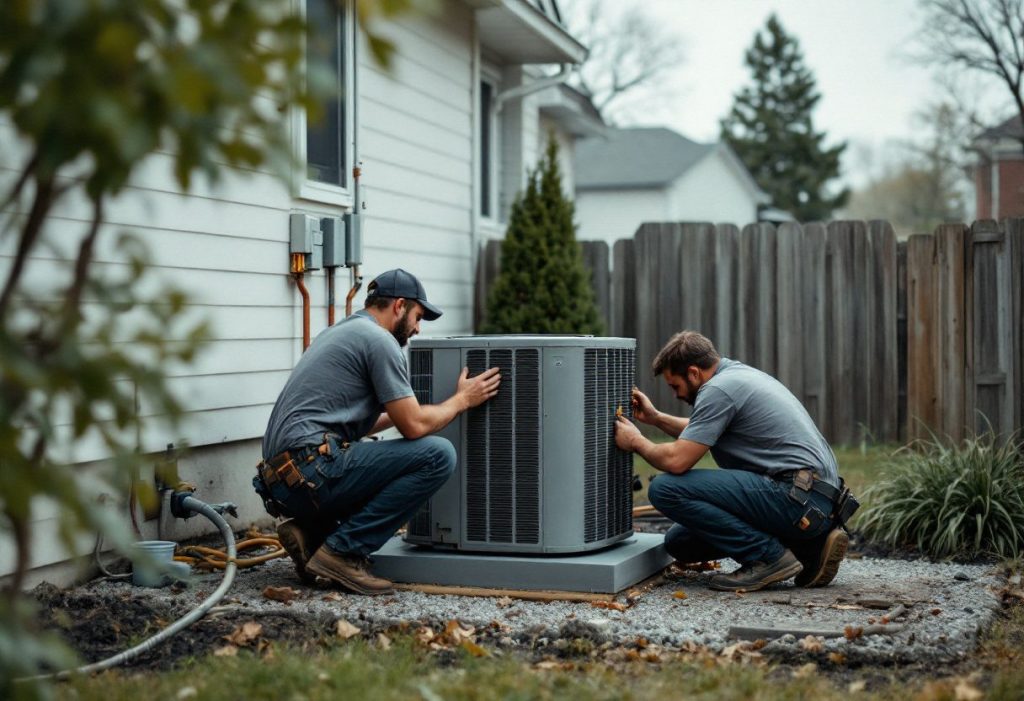
What does a new HVAC company actually look like?
A new HVAC company usually looks like one or two people. In 2022, 63,588 of the 107,004 employer firms in NAICS 238220 (companies, not locations, so fewer than the establishment count) had fewer than five employees, averaging 1.7 employees and about $386,000 in receipts, per Census Statistics of US Businesses.
That code covers plumbing too; no federal series separates HVAC. The total count and its growth are in our federal tally of HVAC businesses, so here we look only at size.
| Employees | Firms, 2022 | Share | Receipts per firm |
|---|---|---|---|
| Fewer than 5 | 63,588 | 59.4% | about $386,000 |
| 5 to 9 | 20,175 | 18.9% | about $1.35 million |
| 10 to 19 | 12,459 | 11.6% | about $2.96 million |
| 20 to 99 | 9,415 | 8.8% | about $9.89 million |
| 100 or more | 1,367 | 1.3% | about $91.1 million |
Source: Census SUSB 2022, NAICS 238220. Receipts per firm is our division of total receipts by firms in each class.
Below them sits a larger group with no payroll. Census Nonemployer Statistics counted 178,663 such businesses in 2023, 160,491 of them sole proprietorships, taking in $14.0 billion, about $78,000 each. That is where most owner operators start, and the first hire turns them into an employer firm. Our metro ranking of where HVAC work is concentrated shows which markets carry the most activity.
How many new HVAC businesses survive?
About four in ten construction startups are still operating ten years later. Of 49,837 construction establishments opened in the year to March 2015, 83.3% survived one year, 57.5% five and 42.6% ten, per BLS Business Employment Dynamics.
That beats the economy. All private industry managed 79.6%, 50.2% and 34.7% for the same cohort. The newest cohort agrees: 79.7% of construction establishments opened in the year to March 2024 lasted a year, against 77.9% overall.
Survivors grow, from 4.0 employees on average at opening to 8.9 by March 2025, which is why hiring and pricing matter more than the logo.
Correction to a common claim
Several startup guides say about 20% of small businesses close within two years and credit the SBA. The source is this BLS series, covering all industries, and it shows roughly 20% gone within the first year: 79.6% of the 2015 cohort survived year one and 69.1% year two. For construction, year two was 74.9%.
What licenses do you need to start an HVAC business?
You need two separate credentials to start an HVAC business: a contractor license set by your state or city, and federal EPA Section 608 certification. Holding one does not satisfy the other. Classes, exams and bonds differ by state; we compare them in our state by state HVAC license requirements.
The federal piece is uniform. Under 40 CFR 82.161, anyone expected to open a refrigerant circuit needs Type I (small appliances), Type II (medium, high and very high pressure), Type III (low pressure) or Universal certification. Apprentices are exempt only while closely supervised by a certified technician.
The rule that bites a new company is the sales restriction in 40 CFR 82.154: no refrigerant unless you are certified or employ a certified technician and show proof. Our explainer on which 608 type technicians need covers the exam choice.

How much does it cost to start an HVAC business?
No federal agency publishes what it costs to start an HVAC business, so any single startup figure online is a vendor or insurer estimate. The federal record gives cost categories and a few fixed prices, such as the Employer Identification Number, which the IRS says never carries a fee. We left out dollar figures nobody official publishes; three local quotes beat an unsourced average.
| Cost category | Official price | Why no national figure |
|---|---|---|
| Employer Identification Number | $0 | IRS charges no fee |
| State license, exam and bond | Set by each state | Varies by state and sometimes city |
| EPA Section 608 exam | Not set by EPA | Run by approved programs; 40 CFR 82.161 sets no price |
| Service van and upfit | None published | No federal series prices it |
| Tools and recovery machine | None published | Machines must meet 40 CFR 82.158; no price set |
| Insurance | Quoted by insurers | Priced on payroll, trade class, state and claims |
The SBA’s business insurance guide lists workers’ compensation, unemployment and disability insurance for any business with employees, and general liability as the core cover for injury and property damage claims. Workers’ compensation is run state by state. For stock, our HVAC equipment price index tracks the producer prices behind your cost on the box.
How do you finance a heating and air conditioning startup?
A heating and air conditioning startup can be funded from savings, a credit line or an SBA backed loan. The SBA sets the program rules; lenders make the credit decision. Match the program to the purchase.
| SBA program | Maximum | Who lends | Fits | Excludes |
|---|---|---|---|---|
| Microloan | $50,000 | Nonprofit intermediaries | Working capital, tools, equipment | Existing debt, real estate |
| 7(a) | $5 million | SBA 7(a) lenders | Working capital, equipment, buying a company | Few restrictions |
| 504 | $5.5 million | Certified Development Companies | Buildings, land, equipment with 10+ years of life | Working capital, inventory |
For a one-truck start, the SBA microloan fits best, repaid over up to seven years. The 7(a) program covers changes of ownership, the usual route for buying an existing shop. A shop that has lasted five years has cleared the steepest part of the survival curve, and its service agreements come with it; our guide to maintenance plans as contracts explains what those obligate.
How should a new HVAC company price its labor?
Price labor from the cost of a technician hour. The median HVAC mechanic earned $29.33 an hour in May 2025, or $61,010 a year, across 409,670 jobs, per BLS Occupational Employment and Wage Statistics, with $19.25 at the 10th percentile and $45.78 at the 90th.
In construction, wages were 69.5% of employer compensation cost in June 2026, per the BLS Employer Costs for Employee Compensation release. Legally required benefits (Social Security, Medicare, unemployment insurance and workers’ compensation) cost $4.42 an hour.
- Start with the wage: your local rate, or the $29.33 national median.
- Load it: divide by 69.5%, so $29.33 becomes about $42.20 an hour. This applies the construction ratio to one occupation.
- Divide by billable time from your dispatch records; no federal series measures it. As an illustration, at three billable hours in four, $42.20 becomes about $56.27.
- Add overhead and margin: truck, insurance, software, rent and your own pay.
Local rates differ widely, and our state wage rankings for technicians give the figure for your market. Trade pay has also outpaced the wider economy since 2019, as our analysis of federal contractor pay data shows, so revisit the rate every year.
How we researched this
Research date: October 8, 2026. The top three ranking guides are software vendor or small business content; none cites federal survival, firm size or wage data. We pulled the primary series: BLS Business Employment Dynamics (archived copy, data through March 2025), Census SUSB 2022 and Nonemployer Statistics 2023 for NAICS 238220, BLS OEWS May 2025, BLS ECEC June 2026, SBA and IRS pages, and eCFR text of 40 CFR 82.154 and 82.161.
We consulted 20 sources and cite 12. Excluded: every startup cost range, margin and market size figure in vendor, insurer and market research content, as none traces to a federal series. BLS publishes survival for construction, not the HVAC subsector. Reddit was not used.
Frequently asked questions
How much does it cost to start an HVAC business?
No federal source publishes an HVAC startup cost, so treat any single figure as an estimate. Official fixed prices are few: the IRS charges nothing for an EIN. States set license fees and bonds, and vans, tools and insurance must be quoted locally. Our HVAC tools list maps the core kit to the EPA and OSHA rules that require it. The SBA’s average microloan is about $13,000.
Is an HVAC business a good business to start?
On survival, construction beats the wider economy. BLS data shows 42.6% of construction establishments opened in the year to March 2015 were still operating ten years later, against 34.7% across all private industry. Survivors grew from 4.0 employees on average at opening to 8.9.
Can I start an HVAC business without a license?
Usually not legally, because states and many cities license HVAC contractors, so check your state rules first. Federally, 40 CFR 82.161 requires Section 608 certification for anyone opening a refrigerant circuit, and 40 CFR 82.154 bars refrigerant sales to buyers who are not certified and employ no certified technician.
How many HVAC businesses fail in the first year?
Between one in six and one in five construction startups close in their first year. BLS shows 83.3% of construction establishments opened in the year to March 2015 survived one year, and 79.7% of those opened in the year to March 2024 did. HVAC is not published separately.
Can I get an SBA loan to start an HVAC company?
Yes, if a lender approves you. SBA microloans reach $50,000 through nonprofit intermediaries and cannot pay existing debt or buy real estate. The 7(a) program reaches $5 million and covers working capital, equipment and buying an existing company. Lenders, not the SBA, make the credit decision.
What should I pay my first HVAC technician?
Start from the local market wage. The national median for HVAC mechanics and installers was $29.33 an hour in May 2025, with $19.25 at the 10th percentile and $45.78 at the 90th, per BLS. Benefits were 30.5% of construction compensation cost in June 2026.
Sources
- US Bureau of Labor Statistics. “Business Employment Dynamics, Table 7, Construction.” https://www.bls.gov/bdm/us_age_naics_23_table7.txt (archived copy, August 2026). Accessed October 2026.
- US Bureau of Labor Statistics. “Business Employment Dynamics, Table 7, Total Private.” https://www.bls.gov/bdm/us_age_naics_00_table7.txt (archived copy, August 2026). Accessed October 2026.
- US Census Bureau. “Statistics of US Businesses 2022.” https://www2.census.gov/programs-surveys/susb/tables/2022/. Accessed October 2026.
- US Census Bureau. “Nonemployer Statistics 2023.” https://www2.census.gov/programs-surveys/nonemployer-statistics/datasets/2023/historical-datasets/. Accessed October 2026.
- US Bureau of Labor Statistics. “OEWS May 2025, SOC 49-9021.” https://api.bls.gov/publicAPI/v1/timeseries/data/OEUN000000000000049902108. Accessed October 2026.
- US Bureau of Labor Statistics. “Employer Costs for Employee Compensation, June 2026.” https://www.bls.gov/news.release/ecec.t04.htm (archived copy). Accessed October 2026.
- US Small Business Administration. “Microloans.” https://www.sba.gov/funding-programs/loans/microloans. Accessed October 2026.
- US Small Business Administration. “7(a) loans.” https://www.sba.gov/funding-programs/loans/7a-loans. Accessed October 2026.
- US Small Business Administration. “504 loans.” https://www.sba.gov/funding-programs/loans/504-loans. Accessed October 2026.
- US Small Business Administration. “Get business insurance.” https://www.sba.gov/business-guide/launch-your-business/get-business-insurance. Accessed October 2026.
- Internal Revenue Service. “Get an employer identification number.” https://www.irs.gov/businesses/small-businesses-self-employed/get-an-employer-identification-number. Accessed October 2026.
- eCFR. “40 CFR 82.154, 82.158 and 82.161.” https://www.ecfr.gov/current/title-40/chapter-I/subchapter-C/part-82/subpart-F/section-82.161. Accessed October 2026.
Leave a Reply