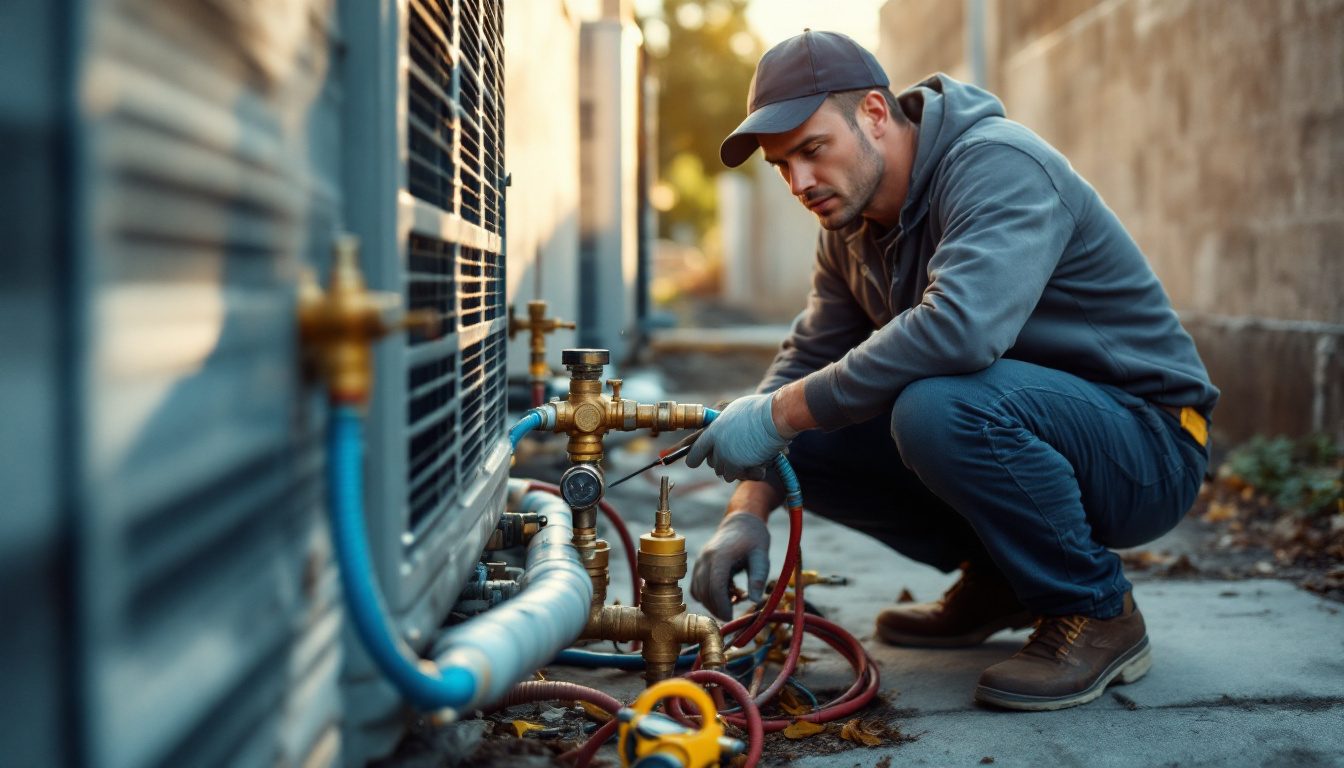
What are superheat and subcooling? Superheat and subcooling are temperature gaps from the refrigerant’s saturation point. Superheat is suction line temperature minus saturated suction temperature; subcooling is saturated condensing temperature minus liquid line temperature. Piston systems are charged by superheat, TXV systems by subcooling, always against the manufacturer’s target.
Key Takeaways
- R-410A saturates at 40°F at 118.8 psig and at 100°F at 318.6 psig, per the Arkema Forane PT chart built on NIST REFPROP data.
- The widely copied “70 psi equals 40°F” example is R-22 (68.6 psig at 40°F on the same Arkema chart), not R-410A.
- Goodman charges fixed orifice units “using the superheat method at the compressor suction line,” per its GPC15/GPH16 installation instructions.
- Rheem says liquid subcooling “must be used for final charge adjustment” on its R-410A condensing units (manual 92-21354-78-12).
- R-454B has a glide of about 2.3°F at evaporator pressure in Chemours’ REFPROP-based table: use dew point for superheat and bubble point for subcooling.
- A 30% undercharge cut efficiency 7% to 15% in NIST Technical Note 1848 lab tests (2014).
What are superheat and subcooling?
Superheat is how many degrees the suction vapor sits above its saturation (boiling) temperature at the measured pressure. Subcooling is how many degrees the liquid line sits below its saturation (condensing) temperature. Both need two readings: a gauge pressure converted to saturation temperature on a PT chart, and a pipe temperature from a clamp probe.
Goodman’s manual states superheat as “suction line temp minus sat. suction temp” and subcooling as saturated liquid temperature minus liquid line temperature. Superheat confirms the indoor coil has boiled off all the liquid before it reaches the compressor. Subcooling confirms the outdoor condenser has turned all the vapor back into liquid before the metering device.
- Superheat = suction line temperature minus saturated suction temperature (from suction pressure).
- Subcooling = saturated condensing temperature (from liquid line pressure) minus liquid line temperature.
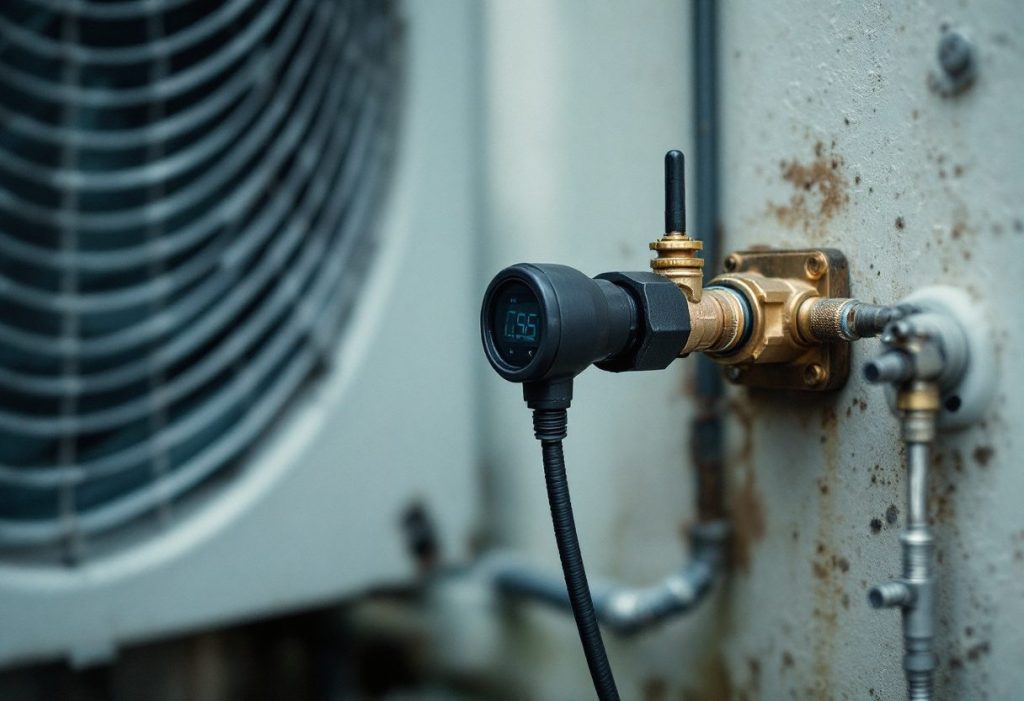
How do you calculate superheat? A worked R-410A example
On a fixed orifice (piston) system, you compare measured superheat with a target superheat read from the manufacturer’s chart for today’s indoor and outdoor conditions. Below, pressures come from the Arkema chart and the target from an archived Bryant charging sheet, written for an R-22 unit; use your own unit’s chart.
- Verify airflow first. Rheem requires 375 to 450 cfm per rated ton before any charge adjustment, the same logic behind the cfm per ton rule. Run the system at least 15 minutes.
- Measure outdoor dry bulb (85°F) and indoor wet bulb entering the coil (66°F). Bryant’s table gives a target superheat of 15°F at that intersection.
- Read suction pressure at the service valve: 118.8 psig, which is 40°F saturated on the R-410A column.
- Clamp a probe on the suction line at the same valve: 62°F.
- Superheat = 62°F minus 40°F = 22°F. That is 7°F above target, and Bryant’s instruction for a warmer than charted suction line is to add refrigerant, after a leak search.
Correction
Several top-ranking guides use “70 psi = 40°F” for R-410A. That is R-22: the Arkema chart puts R-22 at 68.6 psig at 40°F, while R-410A at 70.3 psig is only 15°F saturated. Using the R-22 figure on an R-410A system overstates the saturation temperature by 25°F and wrecks the superheat number.
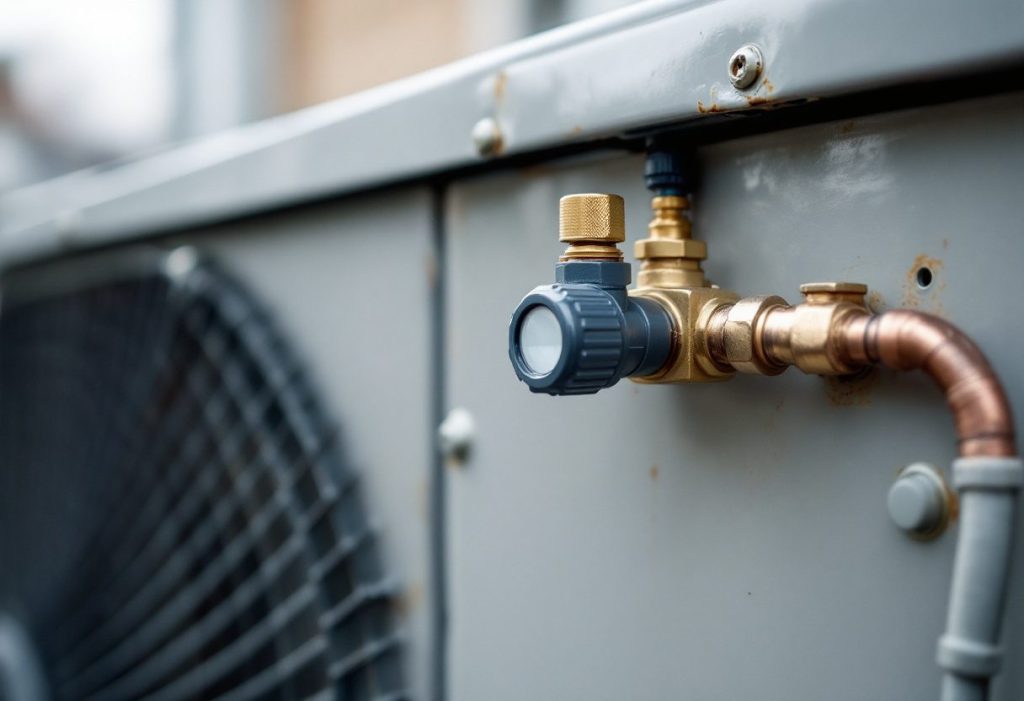
How do you calculate subcooling? A worked TXV example
On a TXV or electronic valve system, you charge to a fixed subcooling target set by the manufacturer, because the valve itself holds superheat. Rheem tells installers to check every system against the charging chart inside the access panel cover; Goodman’s GPH16 table lists 7°F design subcooling, ±2°F, at 95°F outdoor for the GPH1624H41.
- Weigh in the charge first. Rheem’s factory charge covers 15 feet of line set, plus 0.6 oz per extra foot of 3/8 inch liquid line, so a long refrigerant line set changes the starting point.
- Attach a clamp probe on the liquid line within 6 inches of the outdoor unit, as Rheem specifies.
- Read liquid line pressure at the service valve: 318.6 psig, which is 100°F saturated for R-410A.
- Read liquid line temperature: 90°F.
- Subcooling = 100°F minus 90°F = 10°F. Against a 10°F target, the charge is correct. A 95°F liquid line would mean 5°F subcooling and an undercharge.
Rheem calls weighing in “a starting point ONLY,” and the unit’s own chart beats any rule of thumb.
Which superheat and subcooling method fits which metering device?
Use superheat for fixed metering devices and subcooling for thermostatic or electronic valves. A TXV opens and closes to hold its own superheat, so superheat tells you little about charge on a TXV system, while subcooling tracks how much liquid is stacked in the condenser.
| Situation | Charge method | Where the target comes from | Source |
|---|---|---|---|
| Fixed orifice, piston | Superheat at suction line | Chart: outdoor dry bulb x indoor wet bulb | Goodman GPC15/GPH16; Bryant charging sheet |
| TXV system | Subcooling at liquid line | Charging chart in panel or manual table | Rheem 92-21354-78-12; Goodman GPH16 |
| TXV at light load (55°F to 60°F) | Subcooling only, no valve adjustment | Manual | Goodman GPC15/GPH16 |
| Outdoor below 55°F (cooling) | Weigh in, recheck later | Nameplate charge plus line set adder | Rheem 92-21354-78-12 |
How does R-454B glide change superheat and subcooling?
R-454B is a blend that boils across a small temperature range, called glide, so its PT chart has two columns. Use the dew point (vapor) column for superheat and the bubble point (liquid) column for subcooling, the rule laid out in an ACHR News glide primer (2019).
The gap is real. Arkema lists R-454B at 40°F as 112.0 psig on the liquid side and 107.0 psig on the vapor side; at 100°F the figures are 300.8 and 290.9 psig. Chemours’ table for R-454B, the A2L refrigerant with a GWP of 466, puts the bubble point about 2.3°F below the 40°F dew point at the same pressure.
- Superheat example: suction pressure 107.0 psig reads 40°F on the dew column. Read it on the bubble column instead and 107.0 psig falls between 101.5 psig (35°F) and 112.0 psig (40°F), so superheat comes out about 2°F too high.
- Subcooling example: liquid pressure 300.8 psig reads 100°F on the bubble column. With a 90°F liquid line, subcooling is 10°F. Reading the vapor column overstates it by about 2°F.
That 2019 primer quoted only 0.2°F of glide for Carrier’s R-454B. Chemours’ table shows more than ten times that near 40°F, nearly a quarter of a 10°F target.
What do high or low superheat and subcooling readings mean?
Read superheat and subcooling together: the pair points to the fault, while either number alone can mislead. High superheat with low subcooling means too little refrigerant; high superheat with high subcooling means refrigerant is stuck behind a restriction.
| Fault (Rheem table) | Suction pressure | Superheat | Subcooling |
|---|---|---|---|
| Undercharge | Low | High | Low |
| Overcharge | High | Low | High |
| Liquid restriction (drier) | Low | High | High |
| Low evaporator airflow | Low | Low | Low |
| Dirty condenser | High | Low | Low |
On a sealed system that once had the right charge, an undercharge means refrigerant escaped, so the fix starts with refrigerant leak detection, not a top-off.
Low superheat with low subcooling usually points at the air side, the pattern behind a coil that freezes up. A dirty condenser drives head pressure up and both readings down, so clean the coils before judging charge.
NIST flags one trap: non-condensable gas from a poor evacuation can look like an overcharge, and removing refrigerant then creates an undercharge.
Why does an accurate charge matter? What the lab data show
Charge errors cost capacity and efficiency, and they are common. On the 2.5-ton TXV heat pump in NIST Technical Note 1848, a 30% undercharge, “a fault level commonly observed during field surveys,” cut efficiency 7% to 15%, while a 30% overcharge cost about 4%. The US DOE’s 2018 literature review tells installers to set charge “using manufacturer recommended methods (i.e., sub-cooling or superheat).”
The same DOE review summarizes Purdue work (Kim and Braun, 2010): a field-typical 12% to 19% undercharge averaged a 12.87% capacity loss and a 7.6% efficiency loss. It also cites a 2001 New Jersey baseline study in which 68% of systems were charged wrong, 47% under and 21% over. Southern California Edison lab tests cited by NIST measured a 54% capacity loss at 27% undercharge on one unit.
Pistons are touchier. An ORNL survey of ASHRAE project 1173 found piston units degraded below 90% of factory charge, while TXV units held until about 80%.
Owners can check filters and coils, but gauges go on only in licensed hands. Under 40 CFR 82.161, anyone likely to open the refrigerant circuit of a residential system needs Type II or Universal EPA 608 certification. If a contractor proposes topping off without readings, read why a recharge signals a leak first.
How we researched this
Researched October 8, 2026. We consulted 16 sources and cite 10. Pressures come from the Arkema Forane PT chart (May 2025) and the Chemours Opteon XL41 property table, both generated from NIST REFPROP; the 2.3°F glide is our arithmetic from the Chemours table. Charging procedures come from named Goodman, Rheem and Bryant installation documents, Tier 2 sources but primary for their own equipment. Charge fault effects come from NIST, US DOE and ORNL reports.
Excluded: unsourced target ranges from content farms, Parker and Honeywell PT charts that blocked our tools, and Reddit (refrigerant handling topic). Worked example readings are illustrative; chart conversions are real.
Frequently asked questions
What should superheat and subcooling be on R-410A?
There is no single number. Rheem’s R-410A condensing unit manual lists normal ranges of 12° to 15° superheat and 9° to 12° subcooling, but a piston system’s target moves with indoor wet bulb and outdoor dry bulb, and a TXV system’s target is on the unit’s own charging chart. Use that number.
Do you charge by superheat or subcooling?
Superheat for fixed orifice (piston) systems, subcooling for TXV systems. Goodman charges fixed orifice units using the superheat method at the compressor suction line, and Rheem requires liquid subcooling for the final charge adjustment on its R-410A condensing units.
What does high superheat and low subcooling mean?
Usually too little refrigerant. Rheem’s troubleshooting table pairs high superheat, low subcooling and low suction pressure with an undercharge. On a system that was once charged correctly, that means a leak to find and repair before any refrigerant goes back in.
Is there a superheat and subcooling calculator?
Any calculator performs the same two subtractions after a PT lookup. Arkema’s chart, built on NIST REFPROP data, lists R-410A at 118.8 psig for 40°F. Accuracy depends on the right refrigerant column and calibrated probes.
Can you check charge when it is cold outside?
Not reliably in cooling mode. Rheem recommends cooling-mode charging only at 55°F outdoor dry bulb and above, and treats pressures outside its listed ranges as reference only. Below that, weigh in the nameplate charge plus the line set adder and verify on a warmer day.
Can a homeowner check superheat and subcooling?
Connecting gauges is technician work. Under 40 CFR 82.161, anyone who could reasonably be expected to violate the integrity of the refrigerant circuit must pass an EPA-approved certification exam, Type II for residential air conditioners. Owners can still check filters, coils and airflow.
Sources
- Arkema. “Forane Refrigerants Pressure Temperature Chart” (05-2025). https://forane.arkema.com/files/live/sites/shared_arkema/files/downloads/fluorochemicals/Forane%20Ref%20PT%20Regular%20Chart%20EN. Accessed October 2026.
- Chemours. “Thermodynamic Properties of Opteon XL41 (R-454B).” https://opteon.com/es/-/media/files/opteon/opteon-xl41-thermo-properties-eng-031522.pdf. Accessed October 2026.
- Goodman. “Installation Instructions GPC15/GPH16 Package Units With R-410A.” https://images.homedepot-static.com/catalog/pdfImages/f7/f740f193-dd36-483c-9007-d7e1ea7dbb0a.pdf. Accessed October 2026.
- Rheem. “Installation Instructions, 13 and 14.5 SEER Condensing Units, R-410A,” 92-21354-78-12. https://resource.gemaire.com/is/content/Watscocom/Gemaire/rheem_14ajm18a01_article_1374780286043_en_ii.pdf. Accessed October 2026.
- Bryant. “Split System AC Wiring and Superheat Charging Table” (R-22 unit, archived by InspectAPedia). https://inspectapedia.com/aircond/Bryant-split-system-ac-wiring.pdf. Accessed October 2026.
- ACHR News. Bryan Orr, “An Introduction to Glide at Static Pressure” (2019). https://achrnews.com/articles/141877-an-introduction-to-glide-at-static-pressure. Accessed October 2026.
- NIST. “Sensitivity Analysis of Installation Faults on Heat Pump Performance,” TN 1848 (2014). https://nvlpubs.nist.gov/nistpubs/TechnicalNotes/NIST.TN.1848.pdf. Accessed October 2026.
- US DOE. “Residential HVAC Installation Practices: A Review of Research Findings” (2018). https://www.energy.gov/sites/prod/files/2018/06/f53/bto-ResidentialHVACLitReview-06-2018.pdf. Accessed October 2026.
- Oak Ridge National Laboratory. ORNL/TM-2018/485 (2018). https://info.ornl.gov/sites/publications/Files/Pub108381.pdf. Accessed October 2026.
- eCFR. “40 CFR 82.161 Technician certification.” https://www.ecfr.gov/current/title-40/chapter-I/subchapter-C/part-82/subpart-F/section-82.161. Accessed October 2026.
Leave a Reply