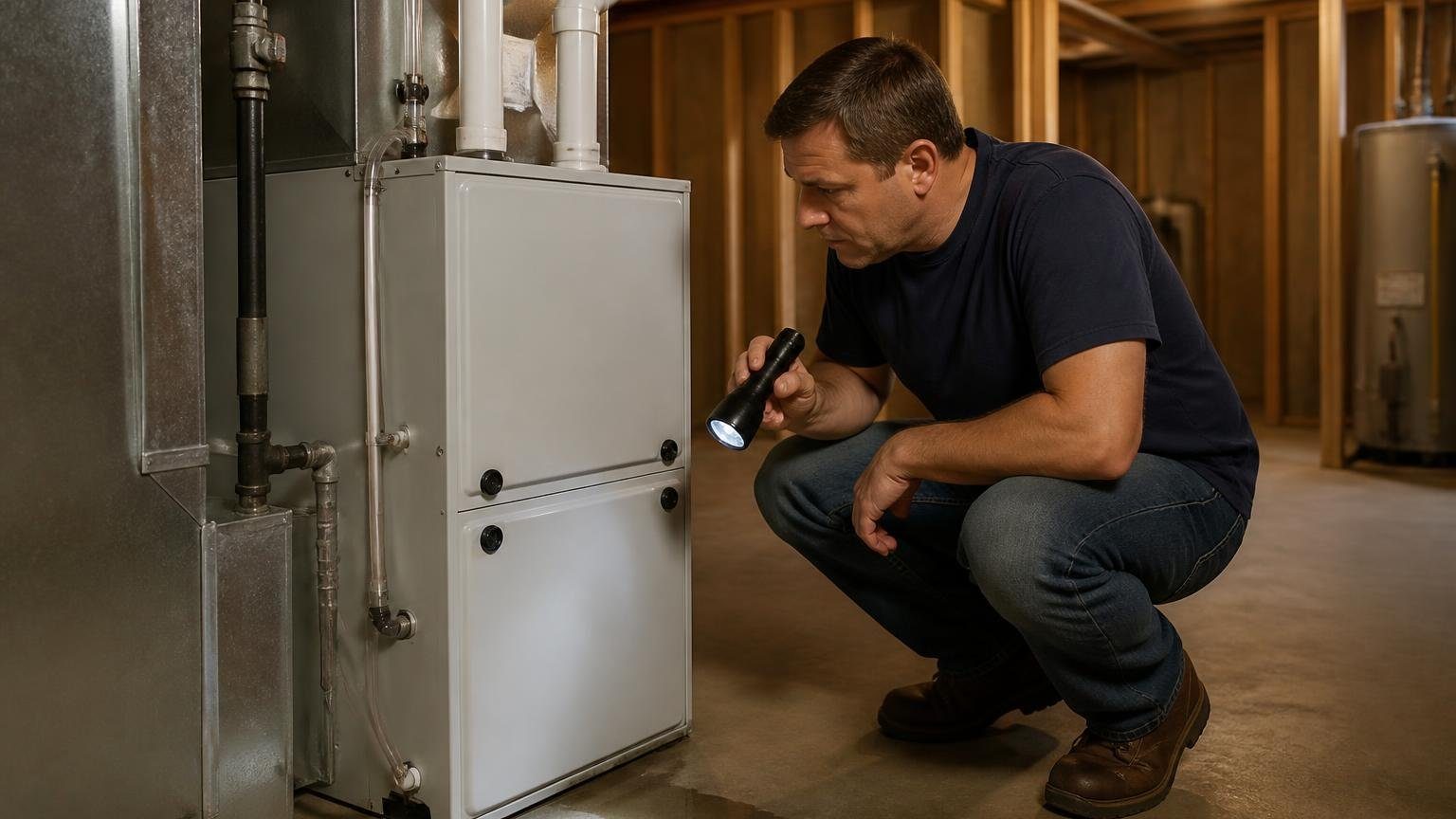
Furnace leaking water? It is almost always condensate. On a 90%+ high efficiency furnace, a clogged trap, drain line, pump or sagging vent pipe spills the water the furnace makes. With the AC on, the coil pan above the furnace is the usual source. Humidifier drains come third.
Key Takeaways
- Condensing furnaces (90% to 98.5% AFUE) make water by design; mid-efficiency models (80% to 83%) should stay dry, per DOE Energy Saver (archived copy).
- Carrier puts a 60,000 BTU/h furnace at roughly 0.7 gallons of water vapor per hour at full input.
- That condensate is pH 3 or below, so local code may require pretreatment, per DOE Building America.
- Goodman manual IOG-2015A requires a primed trap and a drain sloped 1/4 inch per foot.
- The IRC requires a secondary pan under an AC coil where an overflow would damage the building, per Building America.
- Technical Safety BC tied corroded secondary heat exchangers in 1989 to 2011 Carrier furnaces to carbon monoxide, not water.
Why is my furnace leaking water? The causes by season and furnace type
A furnace leaking water points to one of nine sources. Two questions narrow them: is the heat or AC running, and is the furnace condensing (90%+) or mid-efficiency (80%)? A condensing furnace has PVC vent pipes and a drain hose; an 80% model vents through metal pipe and has no drain.
| Cause | When | Furnace | How to confirm | Fix |
|---|---|---|---|---|
| Clogged trap or hose | Heat on | 90%+ | Water at the trap; inducer runs, burners never light | Technician |
| Dry or cracked trap | Heat on | 90%+ | Trap empty or split, water inside the cabinet | Technician |
| Frozen drain line | Cold snaps | 90%+ in unheated space | Ice in tubing that runs outdoors | Owner thaws; technician adds heat |
| Condensate pump failed | Either | Any with a pump | Reservoir full, pump silent | Owner tests; replace pump |
| PVC vent sag or joint leak | Heat on | 90%+ | Drips from vent joints | Technician |
| Flue gas condensing in vent or chimney | Heat on | 80% | Rust or drips at flue or chimney base | Technician |
| AC coil pan or drain clogged | AC on | Both | Water above the cabinet, float switch trip | Owner clears line |
| Frozen coil melting | AC on or just off | Both | Ice on coil, dirty filter | Owner changes filter; technician |
| Humidifier leak | Heat on | Both | Water below the humidifier | Owner fixes hose |
Is water from a high efficiency furnace normal?
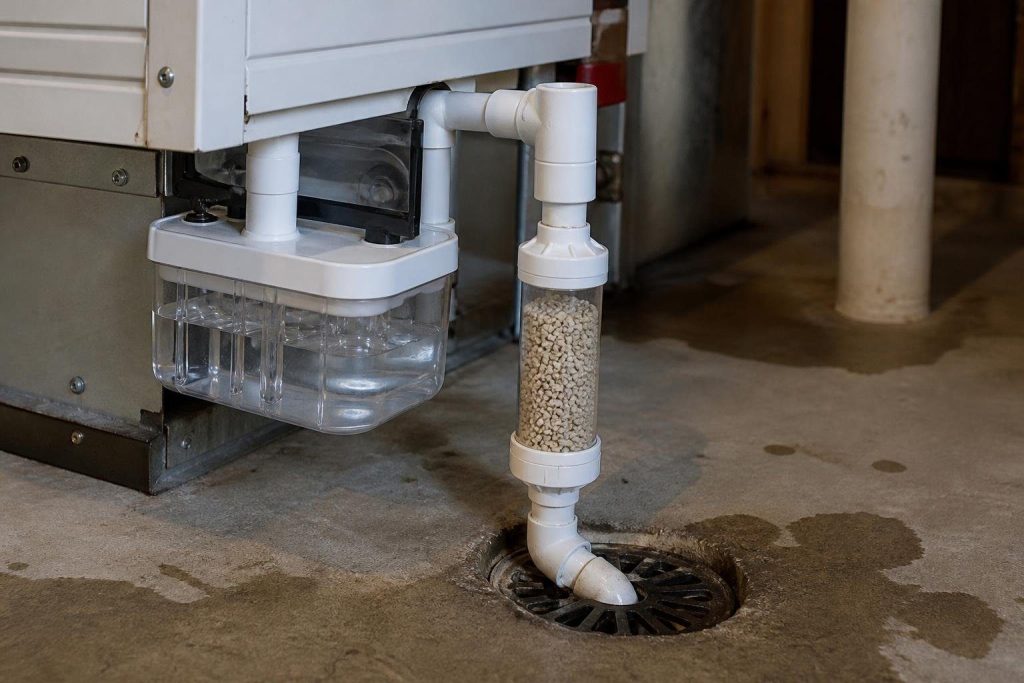
Yes, if it is a high efficiency furnace and the water goes down the drain. Its exhaust cools until the vapor condenses on the secondary heat exchanger and “releases extra heat,” per Building America. Water on the floor is never normal.
Carrier puts a 60,000 BTU/h furnace at roughly 0.7 gallons of water vapor per hour at full input. Eight burner hours on a cold day would be about 5.6 gallons (our arithmetic on Carrier’s figure), though only part of it condenses.
An 80% furnace is built to stay dry: its Category I vent runs at “a vent gas temperature that avoids excessive condensate production,” as the Watts venting FAQ puts it. DOE’s 95% AFUE floor from late 2028 will put more homes on condensing furnaces.
Why is the furnace leaking water when the heat is on?
With the heat on, a high efficiency furnace leaking water usually has a blocked or dry condensate path. On an 80% furnace, water points to the vent, where flue gas is condensing although it is designed not to.
On a 90%+ condensing furnace
Goodman’s IOG-2015A installation manual sets the rules most leaks break:
- Prime the trap by filling both sides with water, which “prohibits the possibility of flue gases escaping through the drain system.”
- Slope the drain line 1/4 inch per foot toward the drain, with no second trap.
- Slope horizontal vent pipe 1/4 inch per foot back toward the furnace, supported every three to five feet.
- Insulate vent pipe exposed below 35°F for extended periods.
- Where the space can freeze, protect the trap and line with trap heaters, heat tape or RV antifreeze.
Bosch’s BGH96 manual says the trap “can ONLY be primed by pouring water into the inducer drain side” and the drain must not run outside where it may freeze. Goodman’s troubleshooting chart lists a “blocked drain system” when the inducer runs with no furnace operation, which is why water and a pressure switch fault often arrive together.
On an 80% furnace
Trane’s A801X manual bars venting into a masonry chimney except as a chase. DOE Energy Saver warns that 80% appliances “have a greater risk of depositing acidic condensation in chimneys,” and that a chimney left oversized for a water heater “can lead to condensation and inadequate draft.”
The humidifier
The Aprilaire 600 instructions list a 3 gph water feed rate and a drain hose that needs constant downward slope with no kinks. See our whole house humidifier guide.
Why is the furnace leaking water when the AC is on?
Because the AC coil sits on top of the furnace. “Most furnace makers call for cooling coils to be placed downstream of the heat exchanger,” Building America notes, so in an upflow system the coil pan rides directly above the cabinet. When it overflows, the water runs down the furnace.
The usual culprits are a clogged AC drain line, a failed pump, or a coil that iced and is melting; rule out a dirty filter first when an AC is freezing up. Where AC and furnace share a drain, Goodman requires “an open tee” near the coil so coil pressure does not interfere with the furnace trap.
The IRC requires a secondary pan where an overflow would damage the building, at least 1½ inches deep under the IMC and IRC, per Building America, and a float switch shuts the system off before the pan spills. A rusted pan may mean coil replacement; other summer symptoms are in AC leaking water or blowing warm air. Aprilaire tells installers to set the humidifier damper to “SUMMER” for cooling.
Does a cracked heat exchanger make a furnace leak water?
Not the way many ranking pages suggest. An 80% furnace is built so its exhaust leaves without condensing, so a crack in its heat exchanger is a carbon monoxide question, not a water source.
Correction: the cracked heat exchanger myth
Carrier’s leak guide says pooling water “often indicates a blocked condensate drain line, a cracked heat exchanger, or a faulty humidifier,” yet frames the danger of a crack as combustion gases, “including carbon monoxide,” entering the airflow. The real overlap is the condensing furnace’s secondary heat exchanger, where condensate forms; Carrier’s FAQ lists “a corroded heat exchanger” among causes of water at the base. Even there the documented harm was gas. Technical Safety BC found corroded secondary heat exchangers in Carrier furnaces made between 1989 and 2011 let carbon monoxide into homes, and safety devices “did not reliably detect” it.
How do you find where the water under a furnace is coming from?
Power off first, then work top down: the highest wet spot is usually the source. Sealed panels and burners are a technician’s job.
- Turn the furnace off at the thermostat and service switch. If water reached the burners, gas valve or controls, leave it off.
- Dry the floor and watch for fresh water above the cabinet, at the side, along the vent or underneath.
- Look at the trap and hoses through the lower door for sludge, cracks or loose clamps. Goodman makes trap service a qualified servicer task.
- Follow the drain line for sags, kinks or an outdoor run that can freeze. If it ends in a pump, our condensate pump guide covers the float test.
- Check the vent pipe and humidifier for drips at joints and a kinked drain hose.
- In summer, check the filter and coil for ice.
- Restart and watch one cycle. If the inducer runs but the burners never light, call a technician; our guide on how to reset a furnace covers when a reset is appropriate.
Can a water leak damage the furnace control board?
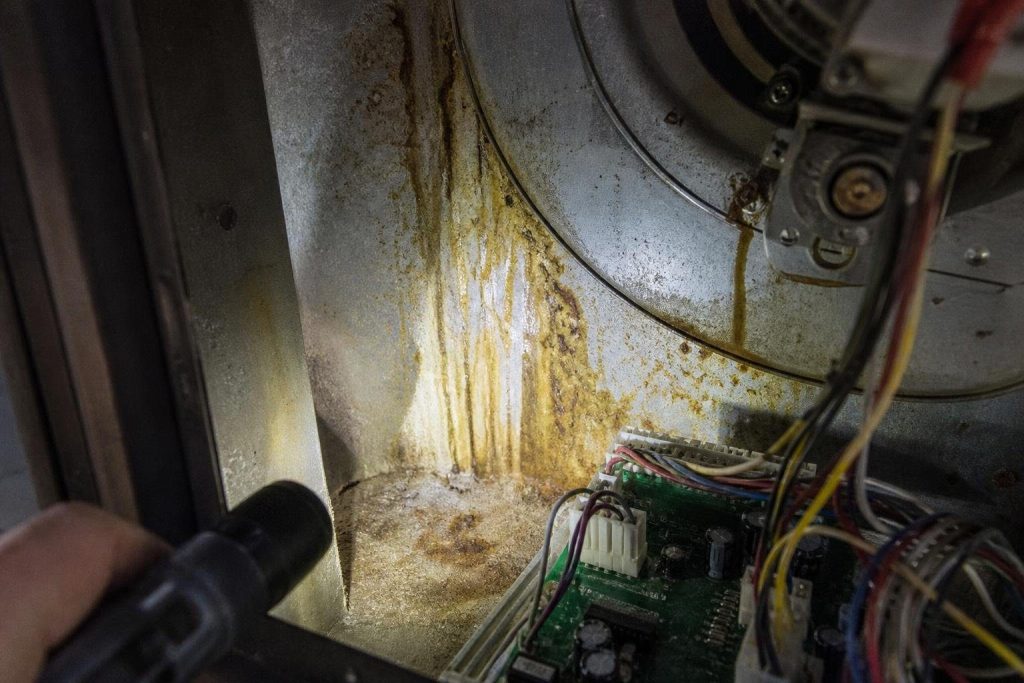
Yes, and makers treat it as a safety issue. Goodman says the furnace “must be located to protect the electrical components from water,” and Trane’s A801X manual says: “Do not use this furnace if any part has been under water.” Trane calls for a qualified agency to replace “all gas controls, control system parts, electrical parts that have been wet.” A drip above the furnace control board deserves a same-week repair.
How we researched this
Research date October 9, 2026. We read five maker documents (Goodman, Bosch, Trane, Aprilaire, Carrier), three DOE Building America guides, an archived DOE Energy Saver page, the DOE furnace standards announcement, a Watts venting FAQ and a Technical Safety BC notice. Building America restatements stand in for IRC and IMC text, which the code site blocks. Excluded: repair price ranges (no federal series), gallons per therm figures from forums and blogs, and Rheem and Lennox manuals we could not retrieve. Reddit was not mined because the topic involves gas combustion.
Frequently asked questions
Is it normal for a furnace to drain water?
Yes, for a condensing furnace rated 90% AFUE or higher, as long as the water leaves through the trap and drain line. Carrier estimates a 60,000 BTU/h furnace at full input makes roughly 0.7 gallons of water vapor per hour. An 80% furnace has no condensate drain, so water around one points elsewhere.
Is a furnace leaking water an emergency?
A slow drip from a drain fitting is not, but turn the furnace off if water has reached the burners, gas valve or control board. Trane’s manual says not to use a furnace if any part has been under water and to have wet gas controls and electrical parts replaced by a qualified agency.
Why is my high efficiency furnace leaking water in winter?
Ice. A drain line through a cold garage, attic or outdoors can freeze and back water into the cabinet. Goodman says that where the space can freeze, the trap and line must be protected with trap heaters, heat tape or RV antifreeze. Bosch says not to route the drain outside at all.
Why is water leaking from my furnace exhaust pipe?
On a condensing furnace, PVC vent pipe carries water that must run back to the furnace. Goodman requires horizontal runs to slope 1/4 inch per foot toward the furnace with support every three to five feet, so a sag pools water at joints. On an 80% furnace, drips at a metal flue mean exhaust is condensing where it should not.
Does furnace condensate need a neutralizer?
Sometimes. DOE Building America says condensing furnace condensate is pH 3 or below, so local code may require pretreatment before it reaches the sewer. A neutralizer, which Building America describes as calcium carbonate or a similar material, raises the pH. Local code decides whether you need one.
Why is my furnace leaking water when the AC is off?
If the heat is running on a 90%+ furnace, the water is its own condensate. If nothing is running, check the humidifier supply line, a condensate pump that stopped emptying, or an AC coil that froze and is melting. Aprilaire warns that a humidifier water line in a freezing space can crack and cause water damage.
Sources
- Goodman Manufacturing. “Installation Instructions, *CVC96*BA and *MVC96*BA Two-Stage Gas Furnace (IOG-2015A).” https://cdn.shopify.com/s/files/1/0748/4745/3475/files/GCVC96-Install_11e55e78-9b7a-49aa-bc24-d8f803e9a9af.pdf (retailer copy). Accessed October 2026.
- Bosch Home Comfort. “BGH96 Gas Furnace Installation, Operation and Maintenance Manual, RevC.” https://www.bosch-homecomfort.com/ca/media/country_pool/documents/installation-manuals/bgh96_furnace_revc_iom_09.2024.pdf. Accessed October 2026.
- Trane Technologies. “Installation Manual, A801X060AM3S (88-A801X004-1B-EN).” https://elibrary.tranetechnologies.com/public/residential-hvac/Literature/Installation/88-A801X004-1B-EN_11292024.pdf. Accessed October 2026.
- DOE Building America Solution Center. “Combustion Furnaces.” https://basc.pnnl.gov/resource-guides/combustion-furnaces. Accessed October 2026.
- DOE Building America Solution Center. “HVAC Has Corrosion-Resistant Condensate Drain Pan.” https://basc.pnnl.gov/resource-guides/hvac-has-corrosion-resistant-condensate-drain-pan. Accessed October 2026.
- DOE Energy Saver. “Furnaces and Boilers” (archived copy). https://web.archive.org/web/2025id_/https://www.energy.gov/energysaver/furnaces-and-boilers. Accessed October 2026.
- US Department of Energy. “DOE Finalizes Energy Efficiency Standards for Residential Furnaces.” https://www.energy.gov/articles/doe-finalizes-energy-efficiency-standards-residential-furnaces-save-americans-15-billion. Accessed October 2026.
- Carrier. “Furnace Leaking Water: Causes, Signs, and Solutions.” https://www.carrier.com/us/en/residential/hvac-resources/furnaces/furnace-leaking-water/. Accessed October 2026.
- Aprilaire. “Model 600 and 600M Humidifier Installation Instructions.” https://documents.alpinehomeair.com/product/Aprilaire%20600%20Series%20Installation%20Instructions%2001.08.pdf (retailer copy). Accessed October 2026.
- DOE Building America Solution Center. “Condensing Boilers.” https://basc.pnnl.gov/resource-guides/condensing-boilers. Accessed October 2026.
- Watts (PVI). “Venting FAQs.” https://dam.watts.com/AssetLink/53065.pdf. Accessed October 2026.
- Technical Safety BC. “Common gas furnaces pose risk to the public.” https://www.technicalsafetybc.ca/learn-about/technical-safety-bc/latest-news/common-gas-furnaces-pose-risk-to-the-public. Accessed October 2026.
Leave a Reply