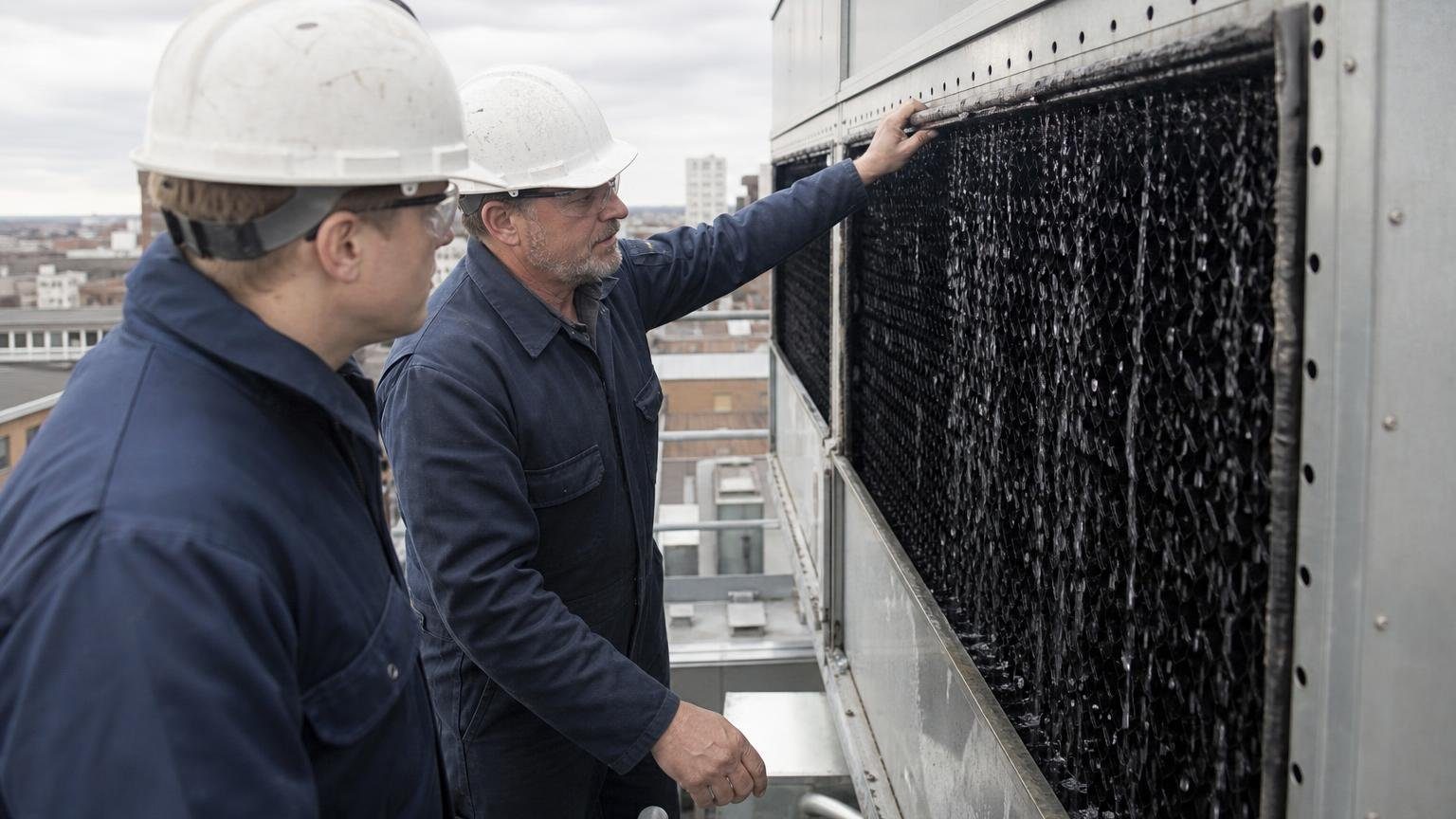
What is a cooling tower? It is a heat rejection device that cools water by evaporating a small part of it into moving air. On a commercial building it dumps the heat a water-cooled chiller removes, evaporating roughly 1 percent of its flow for every 10°F of cooling.
Key Takeaways
- Evaporation runs about 1 percent of flow per 10°F of cooling, per EPA WaterSense at Work.
- Energy codes rate open towers at 95°F in, 85°F out and 75°F wet bulb, per Washington Table C403.3.2(8).
- Towers often use 20 to 50 percent of a commercial facility’s water, per EPA.
- Going from three to six cycles of concentration cuts make-up water 20 percent, per DOE FEMP.
- CDC puts Legionella’s favorable growth range at 77 to 113°F.
- New York City has required monthly Legionella sampling since May 8, 2026, per NYC Health.
What is a cooling tower?
A cooling tower is the outdoor end of a water-cooled system. Warm water from a chiller condenser or a process is sprayed over fill, air is drawn through, and a small share evaporates and carries the heat away. The cooled water is pumped back for more.
The DOE Federal Energy Management Program (FEMP) cooling tower fact sheet lists airports, offices, hospitals and hotels as common comfort cooling users, usually paired with a water-cooled chiller. It also lists oil refining, steel mills and power plants, where process towers sit beside industrial ventilation systems.
New York City’s Local Law 77 of 2015 defines the term broadly: “a cooling tower, evaporative condenser or fluid cooler that is part of a recirculated water system.”
How does a cooling tower work? Range, approach and wet bulb
A cooling tower works by evaporation: water that evaporates into passing air takes heat with it, and the rest gets colder. Range is water in minus water out. Approach is water out minus the outdoor wet-bulb temperature, the floor no evaporative tower can cool below.
- A condenser water pump sends warm water to spray nozzles at the top.
- Water spreads over the fill, which SPX Cooling Technologies, maker of Marley towers, calls “one of the single most important components.”
- A fan moves outdoor air through the fill, and a small share of the water evaporates.
- Drift eliminators near the top catch droplets.
- Cooled water drops into the basin and returns to the condenser.
Dry air works better. FEMP compares Atlanta and Albuquerque: similar temperatures, but the drier desert air absorbs more water, so that tower runs cooler. A residential swamp cooler uses the same physics on room air.
Worked example at the code rating point
Washington’s energy code rates open towers at 95°F entering water, 85°F leaving and 75°F wet bulb: a 10°F range and a 10°F approach. A tower circulating 1,000 gpm at that range rejects 1,000 x 8.34 lb/gal x 60 min x 10°F, about 5.0 million Btu per hour.
At 12,000 Btu per hour per ton (FEMP’s definition, and the ton behind residential AC tonnage), that is about 417 tons, covering the building load plus the chiller compressor’s heat. Evaporation at 1 percent per 10°F is about 10 gpm. The pump moving 1,000 gpm is a far bigger cousin of a hydronic circulator pump.
What are the main cooling tower types?
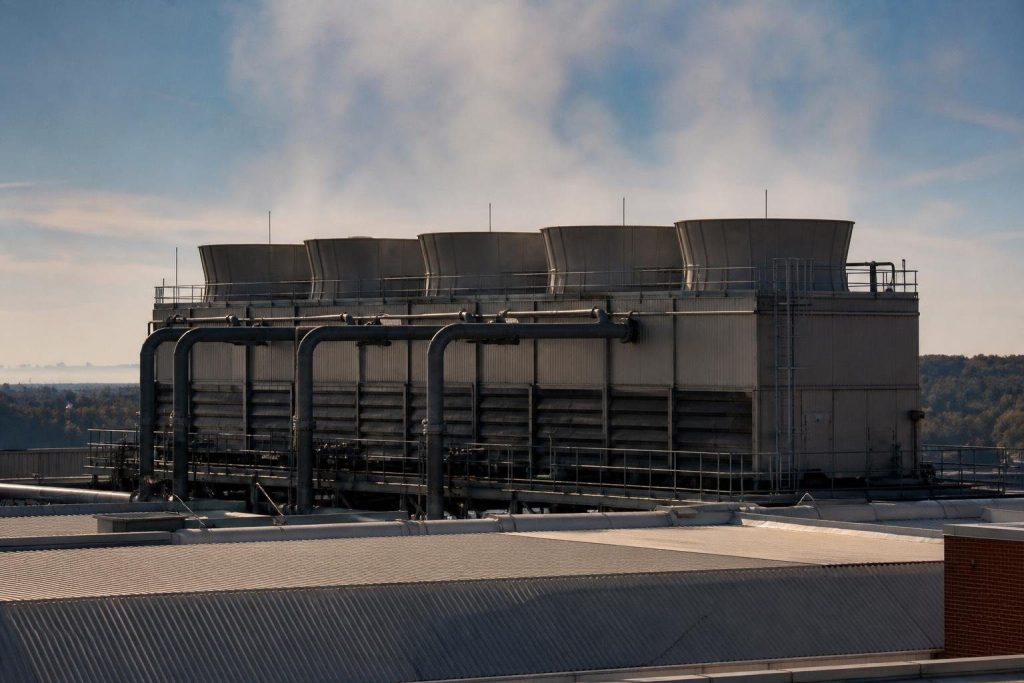
Cooling tower types sort three ways: open or closed circuit, crossflow or counterflow airflow, and fan or natural draft. A typical building tower is open-circuit with a fan.
| Type | How it works | What the source says |
|---|---|---|
| Open circuit | Condenser water falls through the fill | Code minimum 40.2 gpm/hp (axial fan) |
| Closed circuit (fluid cooler) | Loop fluid stays in a coil; spray water wets it | Minimum 16.1 gpm/hp (axial fan) at 102°F in, 90°F out |
| Crossflow | Air crosses falling water horizontally | Less air resistance, lower fan horsepower |
| Counterflow | Air rises against falling water | Coolest air meets coolest water |
| Induced draft | Fan on top to pull air through | Maker description (SPX) |
| Forced draft | Blowers at the base push air in | Maker description (SPX) |
| Natural draft (hyperbolic) | Tall shell, no fan | Very tall; power plant scale |
Sources: DOE FEMP fact sheet (2011); WAC 51-11C-403238; SPX Cooling Technologies (maker claims).
CDC notes that closed-circuit units can run in a “dry” mode in cool weather that uses no water.
Is a cooling tower considered HVAC?
Yes. A building cooling tower is HVAC equipment: the heat rejection half of a water-cooled air conditioning system, with its minimum efficiency set in the commercial mechanical section (C403) of the energy code.
Buildings use towers when loads justify a water-cooled chiller plant, and the work falls to commercial HVAC service crews. Smaller buildings often reject heat with air-cooled equipment or VRF systems instead.
The hyperbolic concrete towers in photos are natural draft towers, which FEMP describes as very tall structures that move air without fans. They are power plant equipment.
Homes do not have cooling towers. NYC’s health department says window air conditioners and systems that “do not recirculate water and release mist” are not cooling towers.
How much water does a cooling tower use, and how is it treated?
A cooling tower loses water to evaporation, blowdown, drift and leaks, and make-up water replaces all of it, per EPA. Evaporation dominates at about 1 percent of flow per 10°F of range. Drift runs 0.05 to 0.2 percent, and modern eliminators cut it below 0.005 percent.
Evaporation leaves minerals behind, so the tower bleeds off concentrated water as blowdown. The FEMP formula: blowdown equals evaporation divided by (cycles minus 1), and make-up equals blowdown plus evaporation.
Worked example: what cycles of concentration save
Our tower evaporates about 10 gpm. At 3 cycles, blowdown is 10 / 2 = 5 gpm and make-up is 15 gpm. At 6 cycles, blowdown is 10 / 5 = 2 gpm and make-up is 12 gpm: the 20 percent saving FEMP cites. FEMP also says blowdown falls 50 percent; the formula gives 60.
Cooling tower water treatment sets the ceiling on cycles, because higher mineral levels raise scaling and corrosion risk. A conductivity controller triggers blowdown at a set point, and FEMP recommends automated chemical feed above 100 tons. Load peaks in hot summers, as our cooling degree day index shows.
How does Legionella get into cooling towers?
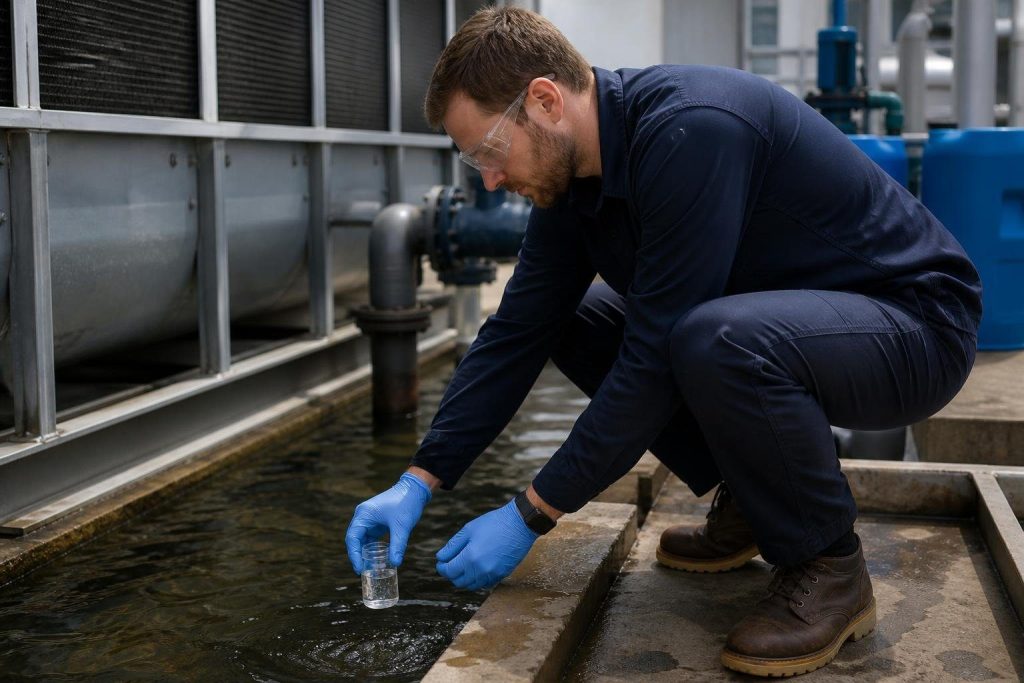
Legionella enters with ordinary water and multiplies when it is warm, stagnant or poorly disinfected; CDC names sediment and biofilm, temperature, water age and disinfectant residual as the key factors. Tower mist carries the bacteria out, and people breathe it in.
The CDC cooling tower module puts Legionella’s favorable growth range at 77 to 113°F, and our rating example returns 85°F water. CDC warns that aerosolized tower water “can spread the bacteria over miles.”
A 2017 Emerging Infectious Diseases study counted 6 New York City community outbreaks since 2006: 213 cases and 18 deaths. The 2015 outbreak, the largest on record, had 138 cases, and the largest outbreaks were caused by cooling towers.
Correction: closed-circuit is not Legionella-proof
A sealed process loop suggests no risk. CDC says both open- and closed-circuit cooling towers “release aerosolized water to the atmosphere,” because the spray water over the coil still recirculates in open air.
CDC design advice: high-efficiency drift eliminators, the lowest possible water temperature, and at least 25 feet between towers and building air intakes, so drift stays out of the ventilation system and rooftop make-up air units.
What do ASHRAE 188 and NYC’s cooling tower law require?
ASHRAE Standard 188 sets minimum legionellosis risk management requirements for building water systems and binds only where a code or regulator adopts it. New York City adds a dedicated law on registration, inspection, testing and certification. Elsewhere, rules depend on state and local code.
The Standard 188-2021 fact sheet says it is “written with enforceable language” for code adoption, and it excludes single-family homes.
| Rule | Covers | Key cooling tower requirement |
|---|---|---|
| ASHRAE Standard 188-2021 | Commercial, institutional, multifamily, industrial | Legionellosis risk management once adopted |
| New York State (per ASHRAE) | Buildings with towers | Maintenance plan per Standard 188-2015 |
| NYC Local Law 77 of 2015 | Towers, evaporative condensers, fluid coolers | Register before operation; certify by November 1 each year |
| NYC Admin Code 17-194.1 (2015 text) | Towers in use | Inspect and test at least every three months |
| NYC Health, 24 RCNY Chapter 8 | Registered systems | Monthly Legionella sampling from May 8, 2026; hyperhalogenation between July 1 and August 31 |
Sources: ASHRAE; Local Law 77 of 2015; NYC Health, accessed October 2026.
The 2015 law set civil penalties of up to $2,000 for a first violation and $5,000 after that, and the city tightened the rules again in 2025 after a Central Harlem cluster.
How we researched this
Research date: October 11, 2026. We read the top three Google results (SPX Cooling Technologies, Wikipedia, Delta Cooling) then primary sources: EPA, DOE FEMP, CDC, the text of NYC Local Law 77, NYC Health rules and a state energy code table. Ten sources are cited. Manufacturer statements are labeled as maker claims, and the worked examples are our own arithmetic on those sources.
Excluded: vendor lifespan, energy savings and price figures, because no federal series backs them, and Reddit, because Legionella is a health topic.
Frequently asked questions
What is the purpose of a cooling tower?
A cooling tower’s purpose is to reject heat to the outdoors. It cools condenser water from a chiller or process by evaporating a small part of it, about 1 percent of recirculating flow for every 10°F of cooling according to EPA. The cooled water then returns to pick up more heat.
Why do some buildings have cooling towers?
Large buildings with water-cooled chiller plants use towers to dump the heat those chillers remove. DOE FEMP lists airports, office buildings, conference centers, hospitals and hotels as common comfort cooling users. Smaller buildings typically use air-cooled equipment, which needs no tower.
How does Legionella get into cooling towers?
Legionella arrives with the make-up water and grows when tower water is warm, stagnant or poorly disinfected. CDC puts its favorable growth range at 77 to 113°F. Mist and drift from the tower carry the bacteria out, and people get Legionnaires’ disease by breathing in contaminated droplets.
What are cooling tower range and approach?
Range is entering water temperature minus leaving water temperature. Approach is leaving water temperature minus the outdoor wet-bulb temperature, which no evaporative tower can beat. At the energy code rating point of 95°F in, 85°F out and 75°F wet bulb, both the range and the approach are 10°F.
How often must cooling tower water be tested for Legionella?
It depends on local law. New York City has required monthly Legionella sampling since May 8, 2026, with no more than 31 days between samples, while its original 2015 law required inspection and testing at least every three months. Elsewhere, check state and local code; ASHRAE 188 applies only where adopted.
Can a house have a cooling tower?
Not in practice. NYC’s health department says window air conditioners and other systems that do not recirculate water and release mist are not cooling towers, and ASHRAE 188 excludes single-family homes. A home that wants evaporative cooling uses a swamp cooler, which cools room air directly instead of water.
Sources
- US Environmental Protection Agency. “WaterSense at Work, Section 6.3: Cooling Towers.” https://www.epa.gov/system/files/documents/2023-05/ws-commercial-watersense-at-work_Section_6.3_Cooling_Towers.pdf. Accessed October 2026.
- US Department of Energy, FEMP. “Best Management Practice #10: Cooling Tower Management.” https://www.energy.gov/cmei/femp/best-management-practice-10-cooling-tower-management. Accessed October 2026.
- US Department of Energy, FEMP and PNNL. “Cooling Towers: Understanding Key Components of Cooling Towers and How to Improve Water Efficiency (DOE/PNNL-SA-75820, 2011).” https://www1.eere.energy.gov/femp/pdfs/waterfs_coolingtowers.pdf. Accessed October 2026.
- Washington State Legislature. “WAC 51-11C-403238, Table C403.3.2(8): Minimum Efficiency Requirements, Heat Rejection Equipment (2020 archive).” https://lawfilesext.leg.wa.gov/Law/WACArchive/2020/htm/WAC%20%2051%20%20TITLE/WAC%20%2051%20-%2011C%20CHAPTER/WAC%20%2051%20-%2011C-403238.htm. Accessed October 2026.
- Centers for Disease Control and Prevention. “Controlling Legionella in Cooling Towers (updated January 3, 2025).” https://www.cdc.gov/control-legionella/php/toolkit/cooling-towers-module.html. Accessed October 2026.
- Fitzhenry R, et al., Emerging Infectious Diseases 23(11). “Legionnaires’ Disease Outbreaks and Cooling Towers, New York City, New York, USA (2017).” https://wwwnc.cdc.gov/eid/article/23/11/16-1584_article. Accessed October 2026.
- New York City Council. “Local Law 77 of 2015.” https://www.nyc.gov/assets/buildings/local_laws/ll77of2015.pdf. Accessed October 2026.
- NYC Department of Health and Mental Hygiene. “Cooling Tower Registration and Maintenance.” https://www.nyc.gov/site/doh/business/permits-and-licenses/cooling-towers.page. Accessed October 2026.
- ASHRAE. “Standard 188-2021, Legionellosis: Risk Management for Building Water Systems (fact sheet).” https://www.ashrae.org/file%20library/about/government%20affairs/advocacy%20toolkit/virtual%20packet/standard-188_2021-fact-sheet.pdf. Accessed October 2026.
- SPX Cooling Technologies (manufacturer). “What Is A Cooling Tower?.” https://spxcooling.com/coolingtowers/. Accessed October 2026.
Leave a Reply