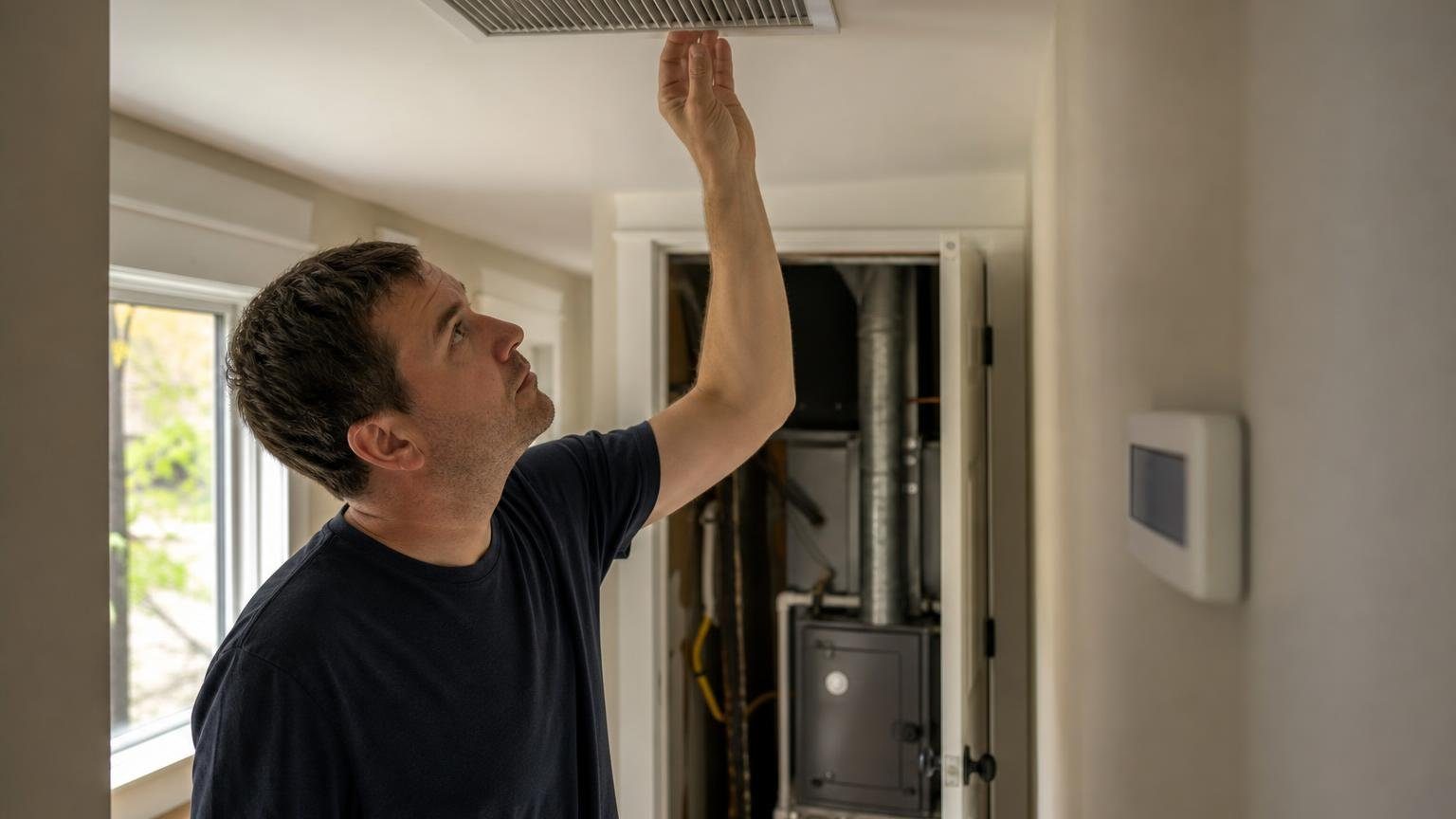
Fan on vs auto: which thermostat setting should you use? AUTO, for most homes. ON runs the blower nonstop, which costs about $67 a month with an older PSC motor at July 2026 US power prices and puts coil moisture back into the air in summer. ON pays off mainly with an efficient ECM blower and a filtration need.
Key Takeaways
- Fan-only mode: PSC blowers drew a median 500 watts, ECM blowers 100 watts (31-furnace study, Pigg and Talerico, ACEEE 2004).
- At 18.31 cents per kWh, the July 2026 US average (EIA), that is about 9 cents versus 2 cents an hour.
- Fan ON blew 19% of condensed coil water back into the room in a Florida Solar Energy Center test (FSEC).
- Furnace fans built since July 3, 2019 face a federal watts per 1,000 cfm limit (10 CFR 430.32(y)).
- EPA notes a central system filters air only when the fan is running (EPA, archived copy).
- Honeywell says Circ runs the fan about 35% of the time (Honeywell Home).
What is the difference between fan ON and AUTO?
AUTO runs the blower only while the furnace, air conditioner or heat pump is answering a call; ON runs it all day whether or not anything is heating or cooling. The fan switch is a separate circuit on the thermostat, which our guide to how a thermostat talks to the equipment explains.
The switch changes blower electricity, moisture removal and filter hours. Many thermostats add a third choice, Circ. If the furnace is blowing room temperature air between cycles, the setting is the first thing to check, as our cold air troubleshooting sequence shows.
How much does fan ON vs AUTO cost on your electric bill?
Fan ON costs about $7 to $135 a month, depending mostly on the blower motor: in fan-only mode, older permanent split capacitor (PSC) blowers drew a median 500 watts and electronically commutated (ECM) blowers a median 100 watts in a Wisconsin field study of 31 new furnaces.
The DOE Building America Solution Center gives similar figures: PSC motors “typically consume between 500 and 550 watts,” while ECM fans use “about 80 in continuous fan mode.” We multiplied each by 730 hours, one month of nonstop running, at EIA’s July 2026 residential prices.
| Blower (source) | Watts | kWh per 730 hours | Louisiana, 12.72¢ | US average, 18.31¢ | California, 33.61¢ |
|---|---|---|---|---|---|
| PSC, high end (DOE BASC) | 550 | 401.5 | $51.07 | $73.51 | $134.94 |
| PSC, field median (Pigg 2004) | 500 | 365 | $46.43 | $66.83 | $122.68 |
| ECM, field median (Pigg 2004) | 100 | 73 | $9.29 | $13.37 | $24.54 |
| ECM, continuous mode (DOE BASC) | 80 | 58.4 | $7.43 | $10.69 | $19.63 |
These are ceilings. ON only adds the hours the blower would otherwise sit idle, and residential system fans generally run less than 25% of the hours in a year, so switching to ON adds roughly three quarters of the figures above. Over 7,400 hours of year-round fan-only running, the Wisconsin study put the motor gap at “nearly 3,000 kWh.” Check your own rate against our state electricity price table.
Does fan ON vs AUTO change indoor humidity?
Yes. In cooling season, fan ON raises indoor humidity, because the blower dries the wet coil back into the house after the compressor stops. A 1987 Florida Solar Energy Center test found that in a 20-minute cycle with 10 minutes of compressor run time, 19% of the condensed moisture was re-evaporated into the room.
Shorter cycles were worse. With 5 minutes of compressor time in a 10-minute cycle, the same FSEC study measured moisture removal 44% lower in fan ON mode than in AUTO. FSEC’s later part-load report, FSEC-CR-1537-05, explains why: “moisture that condenses on the coil surfaces during the cooling cycle evaporates back into air stream when the coil is off.”
Myth check
Several page-one articles claim fan ON gives “better dehumidification.” The measured evidence points the other way in cooling mode. Keep AUTO during humid months, and aim for the targets in our ideal indoor humidity guide.
The penalty is largest in humid climates and with oversized systems that short-cycle. If the house already feels cool but damp, read our explainer on why a house gets cold but clammy before you change the fan; a whole-house or portable dehumidifier fixes moisture more directly than airflow does.
Why does the blower motor type change the answer?
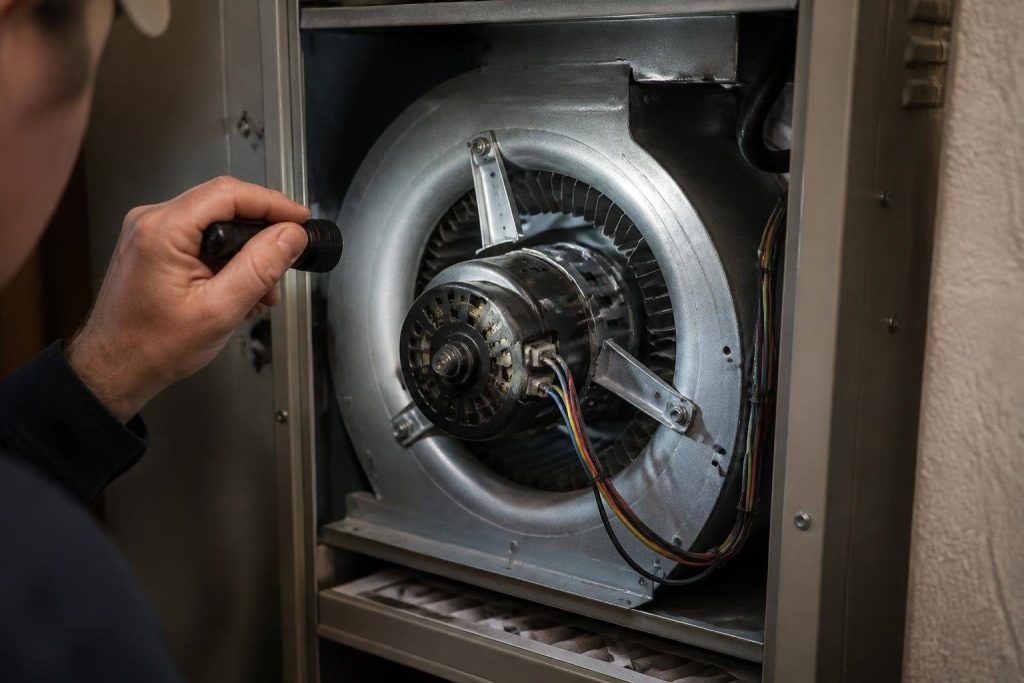
Because a PSC motor loses efficiency at low speed and an ECM does not. Lawrence Berkeley National Laboratory reports that PSC motors run above 70% efficient at high speed but “may drop down into the 20% range” at low speed, while brushless permanent magnet (ECM) motors stay above 80% across a wide speed range (LBNL-59866).
Federal law now pushes furnaces toward efficient blowers. Under 10 CFR 430.32(y), residential furnace fans made on and after July 3, 2019 must meet a fan energy rating (FER) in watts per 1,000 cfm. For a condensing gas furnace the limit is 0.044 x Qmax + 195, so a fan with 1,200 cfm maximum airflow is capped at 247.8 watts per 1,000 cfm.
The table excludes fans in “CAC/HP indoor units,” so heat pump and AC air handlers are not covered. And because an ECM adds less waste heat, a furnace running one continuously burns slightly more gas (Gusdorf et al. 2003, cited by Pigg), which the electricity savings “almost certainly more than offset.” Our blower motor guide shows how to tell which motor you have.
Does running the fan on improve filtration and comfort?
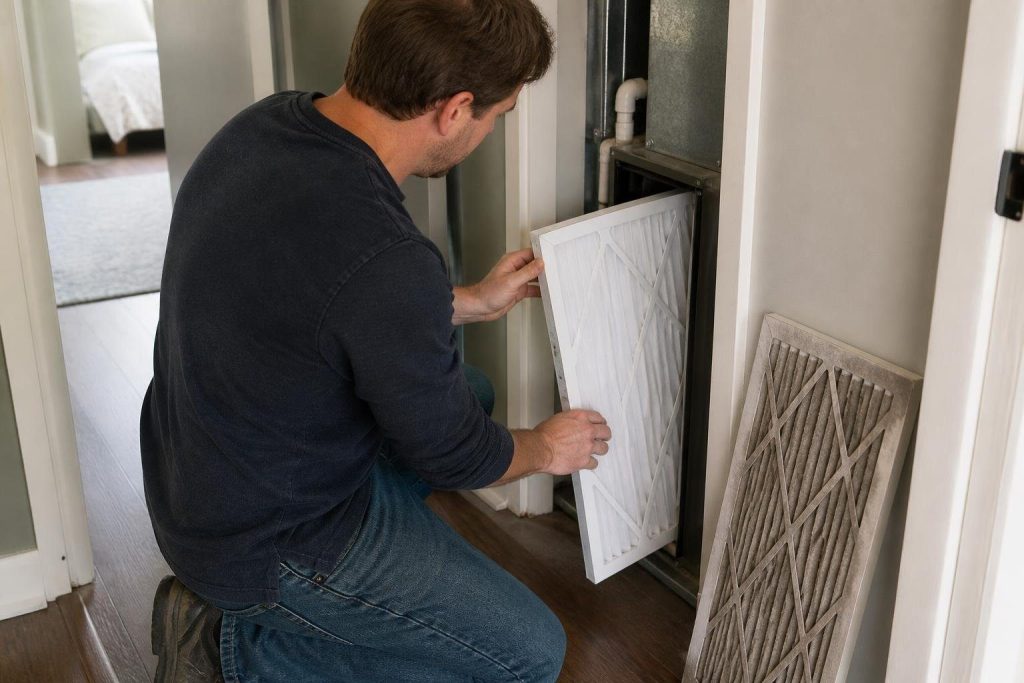
Yes, filtration improves with more fan hours, which is the strongest case for ON. EPA’s guidance says to “run the system fan for longer times, or continuously, as HVAC systems filter the air only when the fan is running” (EPA, archived copy).
Run time is the bottleneck. In a 2019 ASHRAE Journal article hosted by EPA, Harriman, Stephens and Brennan note that residential fans run less than 25% of the year, which is why EPA’s updated guidance recommends a MERV 13 filter or higher in central systems. A denser filter also adds resistance, so confirm your blower can handle it with our MERV and airflow explainer.
The same authors note that ductless systems often run their fans continuously at variable speed “to provide air mixing.” A central ECM blower can do this at low speed; a PSC blower does it at full speed and full price.
Fan on vs auto in winter and with heat pumps
In winter, fan on vs auto is mostly about comfort. Between burner cycles, ON pushes room temperature air through the registers, which feels like a draft. A PSC blower’s waste heat stays in the house, so the winter penalty is smaller; the gas take-back finding above shows that motor heat offsets burner time.
Heat pumps behave the same way between cycles, and in heating mode they also pause for frost removal; our defrost cycle explainer covers what the indoor unit does then. Note that heat pump air handlers sit outside the furnace fan rule, so ask the installer which blower motor yours uses. Set your temperatures first using our winter and summer thermostat settings, then decide on the fan.
Which fan setting should you use?
Use AUTO by default, Circ for extra filtration at lower cost, and ON for short stretches or with an ECM blower in a dry season. Honeywell says its Circ position runs the fan “approximately 35% of the time, roughly 20 minutes each hour, minus any time the fan is already running” with heating or cooling (Honeywell Home; a maker statement, other brands differ).
| Situation | Setting | Why |
|---|---|---|
| Humid summer, any system | AUTO | FSEC measured up to 44% less moisture removal with fan ON |
| Allergy or smoke days, ECM blower | ON or Circ | EPA: filtering needs the fan running; ECM draws 80 to 100 W |
| Allergy or smoke days, PSC blower | Circ, or ON for those days only | About 9 cents an hour at 500 W |
| Winter, gas furnace | AUTO | ON blows room temperature air between burner cycles |
| Winter, heat pump | AUTO | Same draft effect; air handler not covered by the FER rule |
To decide, work through it in order:
- Identify the blower motor (PSC or ECM) from the furnace or air handler label.
- If it is cooling season and indoor humidity runs above your target, stay on AUTO.
- If you need more filtration, fit the best filter your blower handles, then try Circ before ON.
How we researched this
Researched October 11, 2026. None of the top three ranking articles cited a number. We consulted 11 primary or maker sources and cited 10 (LBNL-417E was read but not needed): FSEC, LBNL, ACEEE, DOE Building America, 10 CFR 430.32(y) via the eCFR API, EIA, EPA and Honeywell (a maker claim).
Monthly costs are our arithmetic: watts x 730 hours x EIA’s July 2026 price. We found no fan ON vs AUTO recommendation from DOE Energy Saver or ENERGY STAR, so we quote none. Contractor blogs were excluded. A Reddit thread informed only the questions.
Frequently asked questions
Should I leave my AC fan on or auto?
Auto, in most homes. With the fan on between cooling cycles, the blower re-evaporates water from the coil. A Florida Solar Energy Center test found 19% of the condensed moisture went back into the room in a 20-minute cycle, so fan ON raises summer humidity.
Does running the fan on cost more?
Yes. A PSC blower drawing 500 watts costs about $66.83 for a 730-hour month at the July 2026 US average of 18.31 cents per kWh, from EIA. An ECM blower at 100 watts costs about $13.37. Your real extra cost is lower, since the fan already runs during heating and cooling.
Should the fan be on or auto in winter?
Auto, because ON blows room temperature air between burner cycles. In a Wisconsin survey, 3% of households without a new furnace in the past year ran the fan continuously in heating season, versus 33% of ECM furnace program participants.
Does fan ON help with humidity?
Not in cooling season. FSEC measured moisture removal 44% lower with the fan on when the compressor ran 5 minutes in a 10-minute cycle. For a damp house, keep AUTO and treat the moisture directly with a properly sized dehumidifier.
What does the Circulate or Circ fan setting do?
It runs the fan part of each hour without a heating or cooling call. Honeywell says its Circ position runs the fan about 35% of the time, roughly 20 minutes each hour. It is a middle option for filtration without paying for ON around the clock.
Does leaving the fan on clean the air better?
It can. EPA notes HVAC systems filter the air only when the fan is running, and its updated guidance recommends a MERV 13 filter or higher in central systems. Make sure the blower can handle the added filter resistance before upgrading.
Sources
- Florida Solar Energy Center. “Another Aspect of Duty Cycling: Effects on Indoor Humidity” (FSEC-PF-118-87). https://stars.library.ucf.edu/fsec/1006. Accessed October 2026.
- Florida Solar Energy Center. “Understanding the Dehumidification Performance of Air-Conditioning Equipment at Part-Load Conditions” (FSEC-CR-1537-05). https://stars.library.ucf.edu/fsec/513. Accessed October 2026.
- Pigg, S. and Talerico, T. “Electricity Savings from Variable-Speed Furnaces in Cold Climates.” ACEEE Summer Study 2004. https://www.aceee.org/files/proceedings/2004/data/papers/SS04_Panel1_Paper23.pdf. Accessed October 2026.
- Lawrence Berkeley National Laboratory. “BPM Motors in Residential Gas Furnaces: What are the Savings?” (LBNL-59866). https://www.osti.gov/biblio/889624. Accessed October 2026.
- DOE Building America Solution Center. “ECM Air Handler Fans.” https://basc.pnnl.gov/resource-guides/ecm-air-handler-fans. Accessed October 2026.
- eCFR. “10 CFR 430.32(y), Residential furnace fans.” https://www.ecfr.gov/current/title-10/chapter-II/subchapter-D/part-430/subpart-C/section-430.32. Accessed October 2026.
- US Energy Information Administration. “Electric Power Monthly, Table 5.6.A.” https://www.eia.gov/electricity/monthly/epm_table_grapher.php?t=epmt_5_6_a. Accessed October 2026.
- US EPA. “Can running the HVAC system in my home help protect me from COVID-19?” Archived copy. https://19january2025snapshot.epa.gov/indoor-air-quality-iaq/can-running-hvac-system-my-home-help-protect-me-covid-19. Accessed October 2026.
- Harriman, L., Stephens, B. and Brennan, T. “New Guidance for Residential Air Cleaners.” ASHRAE Journal, September 2019, hosted by EPA. epa.gov PDF. Accessed October 2026.
- Honeywell Home. “How does the FAN Auto/On switch or key work?” https://honeywellhome.com/us/en/support/7-day-programmable-thermostats-3. Accessed October 2026.
Leave a Reply