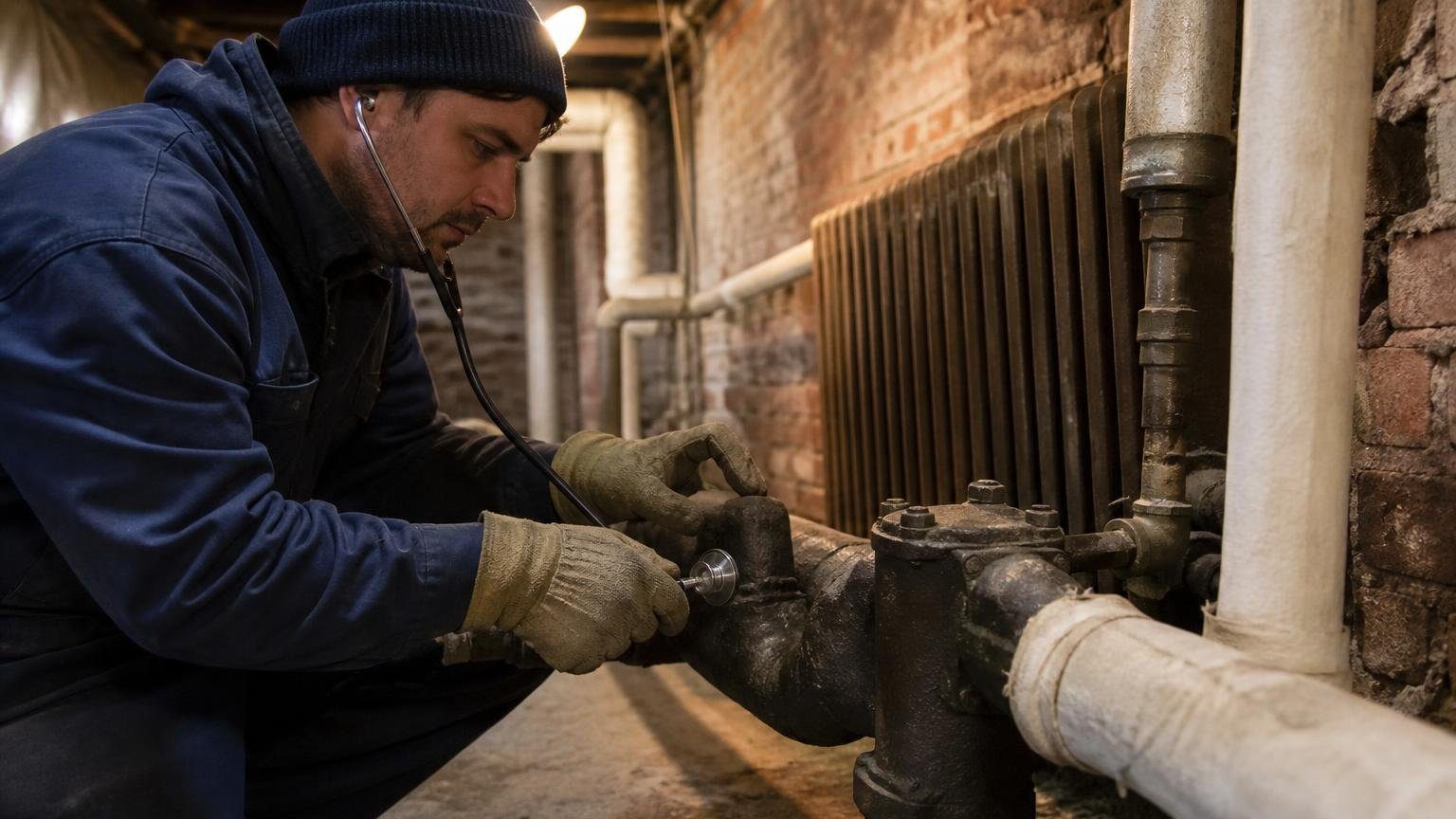
What is a steam trap? A steam trap is an automatic valve that drains condensate and air from steam equipment while holding back live steam. DOE says 15% to 30% of traps may have failed in systems left unmaintained for 3 to 5 years, and one stuck open on a 150 psig line can waste $6,640 a year.
Key Takeaways
- Unmaintained for 3 to 5 years, a steam system may have 15% to 30% of its traps failed; a scheduled program keeps leakers under 5% (DOE Steam Tip Sheet #1).
- A 1/8 inch trap stuck open at 150 psig loses 75.8 lb of steam an hour: $6,640 a year at $10.00 per 1,000 lb (DOE example).
- Traps come in three families: thermostatic, mechanical and thermodynamic (DOE Steam Sourcebook).
- Inverted bucket and disc traps usually fail open; float and thermostatic traps usually fail closed (FEMP O&M Guide).
- FEMP rates temperature the least reliable test and says to use at least two of sight, sound and temperature (FEMP 9.3.6).
- Two pipe home radiators use thermostatic traps that usually fail open, starving other rooms (Gifford, via Building America).
What does a steam trap do?
A steam trap lets condensate, air and other gases out of a steam space and keeps live steam in. Steam heats by condensing, so the water it leaves behind must drain. The ANSI/FCI 69-1 definition, quoted by maker TLV, calls it a “self contained valve which automatically drains the condensate from a steam containing enclosure while remaining tight to live steam.”
When a trap misbehaves, DOE says “excess steam will flow through the end-use device or the condensate will back up into it,” and backup “may lead to water hammer.” New to steam? Start with how a steam heating system moves heat, or our boiler versus furnace comparison.
What are the main types of steam traps?
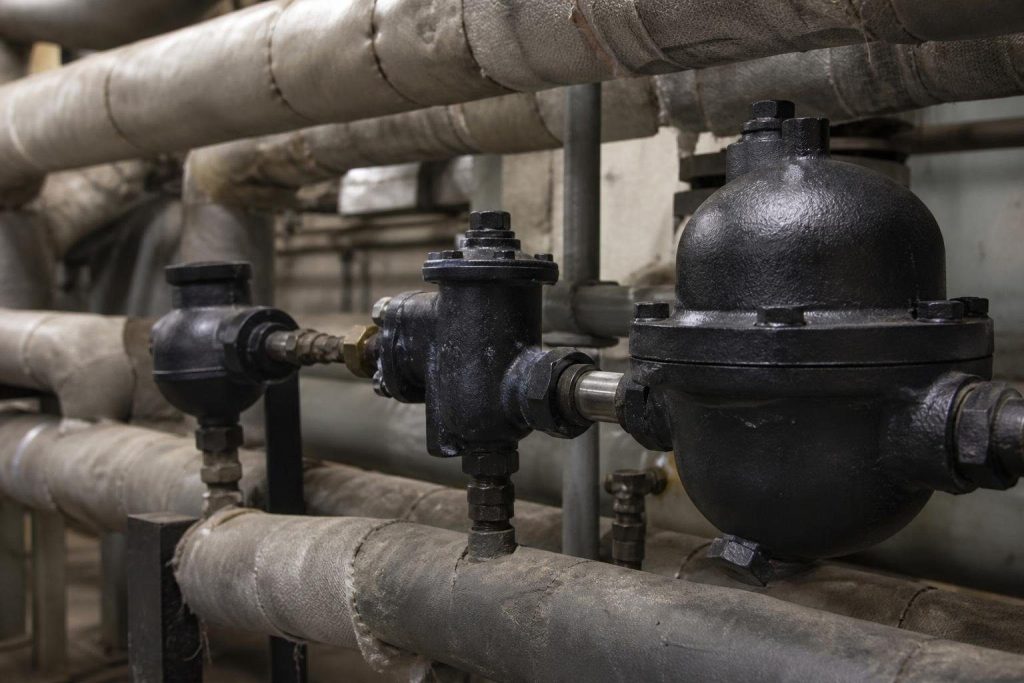
The main types of steam traps are thermostatic, mechanical and thermodynamic, named for what they sense: temperature, density or steam velocity. DOE’s steam sourcebook describes each; FEMP adds where each fits and how it usually fails.
| Trap type | What it senses | Where it fits | Usual failure |
|---|---|---|---|
| Thermostatic radiator trap (balanced pressure) | Temperature: a liquid filled capsule or bellows expands in steam | Outlet of each radiator on two pipe steam | Usually open |
| Bimetallic thermostatic | Temperature: a two metal strip bends as it heats | Holds condensate back until it cools below steam temperature | Open or closed |
| Float and thermostatic (F&T) | Density: a float rises on condensate; a thermostatic vent passes air | Heavy and light loads, high and low pressure; not where water hammer is likely | Usually closed |
| Inverted bucket | Density: trapped steam lifts the bucket and shuts the valve | Lines prone to water hammer; insulate where it can freeze | Usually open |
| Thermodynamic disc | Velocity: fast steam under the disc snaps it shut | Steady pressure service; handles superheat; poor air venting | Usually open |
Sources: DOE Steam Sourcebook pp. 11 to 13; FEMP O&M Guide 9.3.5.1; radiator row from Gifford (Building America).
An F&T trap is a float trap plus an air vent, because a plain float trap “cannot vent air on start-up,” DOE notes.
Which steam trap goes on a home radiator?
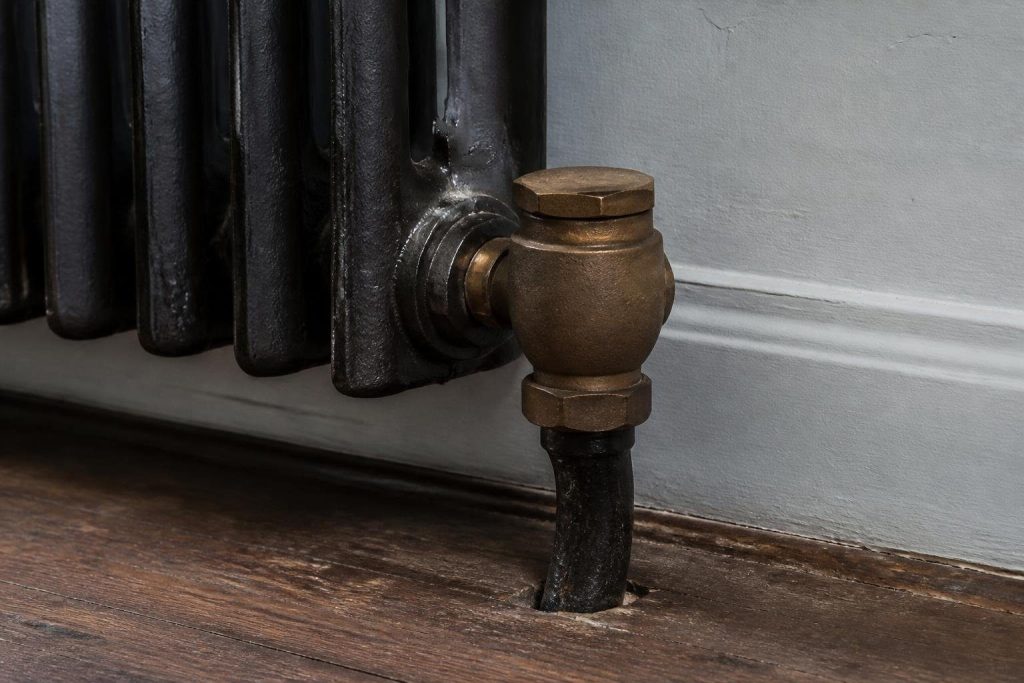
Two pipe steam puts a thermostatic trap at each radiator outlet; one pipe radiators use an air vent instead. In an article hosted by DOE’s Building America Solution Center, Henry Gifford describes “a thin-walled copper or stainless steel capsule” holding an alcohol and water mix that boils in steam and pushes a pin shut.
These traps usually fail open. Steam pressurizes the return, other radiators lose the pressure difference that pushes air out, and they air bind. The radiator with the broken trap gets hot while complaints come from rooms whose traps may be fine. That pattern is why fixing a cold radiator on steam differs from bleeding a hot water one.
The common workaround, raising the boiler to 6 or 7 psig, overheats some rooms and underheats others, Gifford says. Compare the normal steam boiler pressure setting. Maker Hoffman says a trap’s rating must equal or exceed system pressure (manual HS-229H).
How does a steam trap fail?
A steam trap fails open, blowing live steam into the return, or closed, holding condensate in the equipment. FEMP says closed traps “do not result in energy or water losses” but cut heating capacity and raise water hammer risk.
FEMP names oversizing and dirt as two of the most common causes. An oversized inverted bucket can lose its prime on a sudden pressure change and sink, forcing the valve open. FEMP’s symptom checklist includes:
- An abnormally warm boiler room, or steam in condensate returns.
- Water hammer, or rooms overheating and underheating at once.
- Inlet and outlet lines at the trap nearly the same temperature.
Boiler pressure that is hard to hold is on the list too, so a boiler that seems to be failing may have a trap problem.
Safety: never work on a live trap
On October 10, 1986, a condensate induced water hammer at a government research facility injured four steamfitters, two fatally, FEMP records. A crew had swapped a trap without shutting off steam, then drained the flooded line through a gate valve. Investigators blamed “a lack of procedures and training.”
How much steam does a failed steam trap waste?
A failed open steam trap wastes steam in proportion to orifice size and line pressure. DOE’s Steam Tip Sheet #1 publishes these Boiler Efficiency Institute rates for steam discharging to atmosphere.
| Orifice diameter | 15 psig | 100 psig | 150 psig | 300 psig |
|---|---|---|---|---|
| 1/32 inch | 0.85 | 3.3 | 4.8 | n/a |
| 1/16 inch | 3.4 | 13.2 | 18.9 | 36.2 |
| 1/8 inch | 13.7 | 52.8 | 75.8 | 145 |
| 3/16 inch | 30.7 | 119 | 170 | 326 |
| 1/4 inch | 54.7 | 211 | 303 | 579 |
| 3/8 inch | 123 | 475 | 682 | 1,303 |
Steam loss, lb/hr. Source: U.S. DOE Steam Tip Sheet #1 (2012).
DOE’s worked example: a 1/8 inch trap stuck open at 150 psig, steam valued at $10.00 per 1,000 lb. 75.8 lb/hr times 8,760 hours times $10.00 per 1,000 lb equals $6,640 a year.
On a 15 psig building line the same orifice loses 13.7 lb/hr. FEMP’s example assumes a system energized 4,380 hours a year. Our calculation: 13.7 times 4,380 is 60,006 lb, about $600 a year at DOE’s price, or about $300 if you halve the loss for a partly blocked trap as FEMP’s example does. $10.00 is DOE’s illustration, not a current US price.
How do you test a steam trap?
You test a steam trap by sight, sound or temperature, and FEMP says to use at least two, because each alone misleads. DOE adds a fourth route, electronic monitoring.
- Look. At a test valve, flash steam from a good trap is “a relatively lazy, billowy plume”; live steam from a failed open trap is “a much sharper, higher velocity plume,” per FEMP.
- Listen. A stethoscope or ultrasonic detector separates normal cycling from a steady blow. Maker Armstrong warns that on a manifold “a good trap can telegraph a bad trap’s signal” (testing guide 310E-EN).
- Take temperatures. A trap far below steam temperature is flooded: failed closed or a plugged strainer. A downstream pipe that stays hot suggests steam is passing.
The temp gun is where DIY advice goes wrong. FEMP calls temperature “the least reliable” method, because saturated steam and condensate share one temperature. A hot trap proves nothing.
Wireless trap sensors can feed alarms into a building automation system. FEMP cautions that a compromised sensor can give “a false sense of security.”
How often should steam traps be checked?
Steam traps should be checked at least once a year, more often as pressure rises. DOE sets annual checks for systems below 30 psig, the range most building heating steam runs in. Federal and maker schedules differ; use the stricter one.
| Source | High pressure | Medium pressure | Low pressure |
|---|---|---|---|
| DOE AMO Steam Tip Sheet #1 | 150 psig and above: weekly to monthly | 30 to 150 psig: monthly to quarterly | Below 30 psig: annually |
| FEMP O&M Guide, Release 3.0 | Every 6 months | Every 6 months | Every 6 months; process traps every 3 months; all at least yearly |
| Hoffman HS-229H (maker, radiator traps) | n/a | n/a | Every 2 to 3 days after start-up until clean, then every 6 months |
FEMP wants every trap numbered and mapped. At home, fold a trap check into the annual boiler service visit and write it into any maintenance plan contract.
Larger buildings can write trap surveys into a commercial service agreement. Owners weighing whether to keep steam at all can compare a hot water loop, which needs no steam traps.
How we researched this
In October 2026 we read and cite seven documents: two DOE Advanced Manufacturing Office publications, the FEMP O&M Best Practices Guide, a Building America hosted article on two pipe steam, and three maker documents (Armstrong, Hoffman, TLV), labelled as maker claims. The $600 and $300 figures are our arithmetic on DOE and FEMP inputs.
Excluded: installed trap prices (no federal series), a 25 psig radiator trap rating seen only on retail listings, and untraceable trade video claims. Steam is a burn and water hammer hazard, so we used no Reddit or forum material.
Frequently asked questions
What does a steam trap do?
A steam trap drains condensate, air and other gases from steam pipes and equipment while holding back live steam. FEMP calls traps “automatic valves that release condensed steam (condensate) from a steam space while preventing the loss of live steam.” Without one, steam blows into the return or water floods the radiator.
How do you tell if you have a bad steam trap?
FEMP’s failure checklist includes steam in the condensate return, water hammer, a hot boiler room, and rooms that overheat while others stay cold. Inlet and outlet pipes at nearly the same temperature also point to a trap passing steam. Confirm with two test methods before replacing it.
How much does a steam trap cost?
No federal source publishes installed steam trap prices, so we do not quote one. DOE does publish the cost of leaving one broken: a 1/8 inch trap stuck open at 150 psig wastes about $6,640 a year at $10.00 per 1,000 lb of steam. Get written quotes.
What is the difference between a steam trap and a condensate trap?
In steam work they usually mean the same device, because a steam trap’s job is draining condensate, as the ANSI/FCI 69-1 definition quoted by TLV states. The phrase is also used loosely for other drain fittings, so check which device a quote names.
Can a failed steam trap cause water hammer?
Yes. Condensate backed into a steam main can be picked up at up to 120 feet per second, about 82 mph, FEMP says. The damage comes from velocity, not pressure, so it “can be as damaging in low-pressure systems as it can in high.”
Can I replace a radiator steam trap myself?
Hoffman’s manual says all work must be done by qualified personnel trained on steam systems, with the trap at 0 psi before servicing, and supply valves opened slowly to prevent water hammer. FEMP’s 1986 case shows the stakes: two steamfitters died after trap work done without proper procedures.
Sources
- U.S. Department of Energy, Advanced Manufacturing Office. “Inspect and Repair Steam Traps, Steam Tip Sheet #1.” https://www.energy.gov/sites/prod/files/2014/05/f16/steam1_traps.pdf. Accessed October 2026.
- U.S. Department of Energy, Advanced Manufacturing Office. “Improving Steam System Performance: A Sourcebook for Industry, Second Edition.” https://www.energy.gov/sites/prod/files/2014/05/f15/steamsourcebook.pdf. Accessed October 2026.
- U.S. Department of Energy, Federal Energy Management Program (PNNL). “Operations and Maintenance Best Practices: A Guide to Achieving Operational Efficiency, Release 3.0.” https://www.energy.gov/sites/prod/files/2020/04/f74/omguide_complete_w-eo-disclaimer.pdf. Accessed October 2026.
- Gifford, Henry. “How to Make a Two-Pipe Steam Heating System Really Work.” BSE, June 2003, hosted by DOE Building America Solution Center. https://basc.pnnl.gov/sites/default/files/resource/e5f3f69e9ad7c32fa467f99b473202.pdf. Accessed October 2026.
- Armstrong International (maker). “Steam Trap Testing Guide for Energy Conservation, 310E-EN.” https://shop.affiliatedsteam.com/customer/docs/skudocs/armstrong-steam-trap-testing-guide-for-energy-conservation.pdf. Accessed October 2026.
- Xylem Bell & Gossett, Hoffman Specialty (maker). “Balanced Pressure Thermostatic Steam Traps, Instruction Manual HS-229H.” https://prod.xylem.com/siteassets/brand/bell-amp-gossett/resources/manual/510977_HS-229H.pdf. Accessed October 2026.
- TLV (maker). “What is a Steam Trap?” https://www.tlv.com/en-us/steam-info/steam-theory/steamtrap-basics/what-is-a-steam-trap. Accessed October 2026.
Leave a Reply