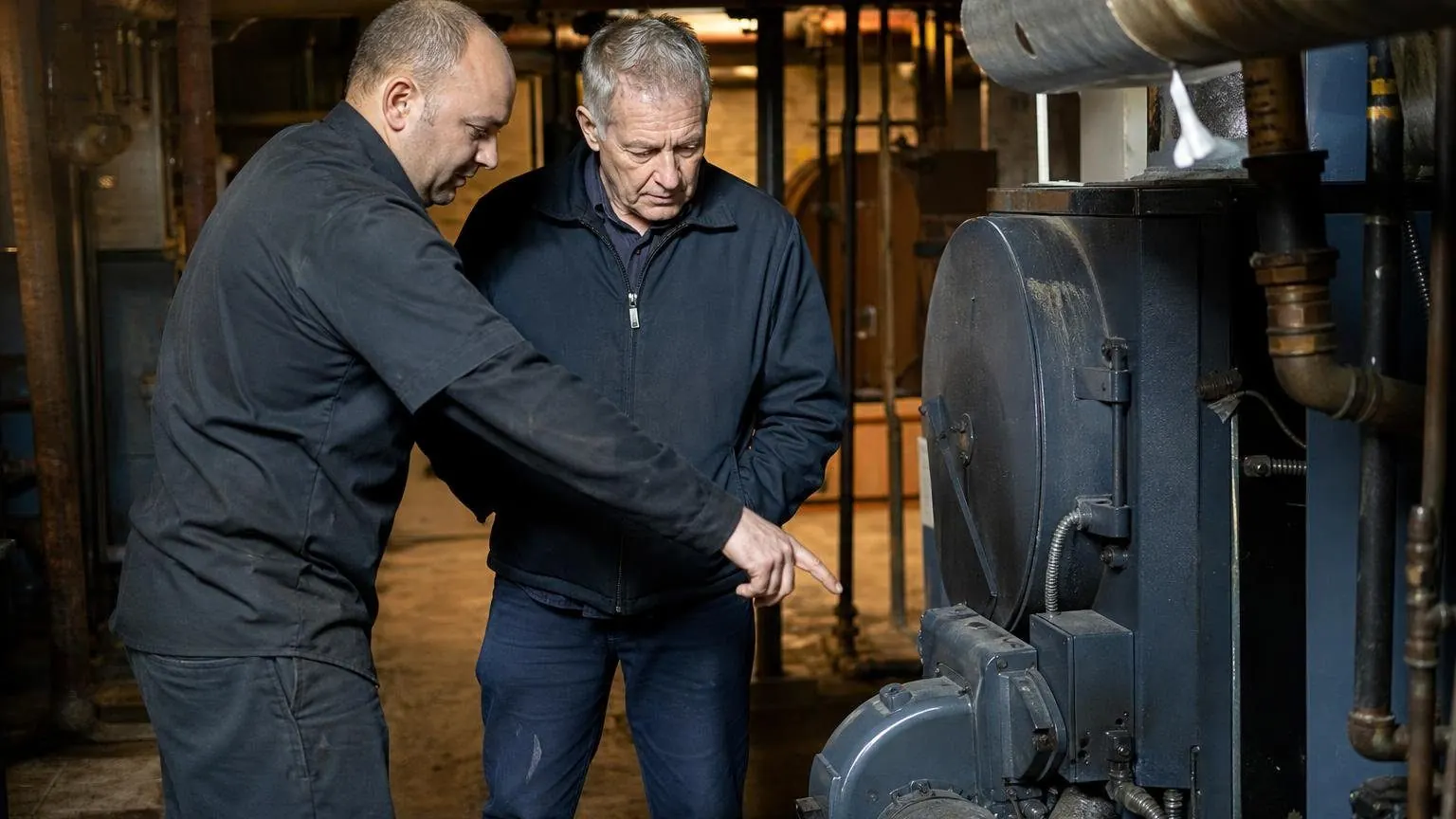
What is Local Law 97? Local Law 97 is New York City’s building emissions law: most buildings over 25,000 gross square feet must report yearly carbon emissions and stay under a limit, or pay $268 for each metric ton over it, with much tighter limits from 2030.
Key Takeaways
- It covers buildings over 25,000 gross sq ft, or two or more on one tax lot totaling over 50,000 sq ft, per the NYC Department of Buildings.
- The yearly penalty is excess tons of CO2e times $268; not filing costs $0.50 per sq ft per month under 1 RCNY §103-14.
- The multifamily limit is 0.00675 tCO2e per sq ft through 2029 and 0.003346640 for 2030 to 2034, per the same rule.
- In year one, 95% of 19,963 required properties filed and 9,951 Article 320 filers met their limit, per DOB’s year-one report.
- In the city’s 2024 benchmarking data, 4.4% of 2,050 gas-heated mid-size apartment properties exceed the 2024 limit; 56% would exceed the 2030 limit (our analysis).
- The Court of Appeals ruled on May 22, 2025 that state climate law does not preempt Local Law 97, per the Sabin Center database.
What is Local Law 97?
Local Law 97 of 2019 caps the annual greenhouse gas emissions of New York City’s largest buildings. DOB says buildings produce over two thirds of city emissions, and the law aims to cut emissions from the largest buildings 40 percent by 2030 and to net zero by 2050.
Article 320 of the Administrative Code sets yearly limits for most private buildings, with DOB rule 1 RCNY §103-14. Article 321 sets a one-time requirement for certain affordable housing and houses of worship. It is a performance standard, not an equipment ban, unlike the rules in our state gas ban tracker.
Which buildings does Local Law 97 cover?
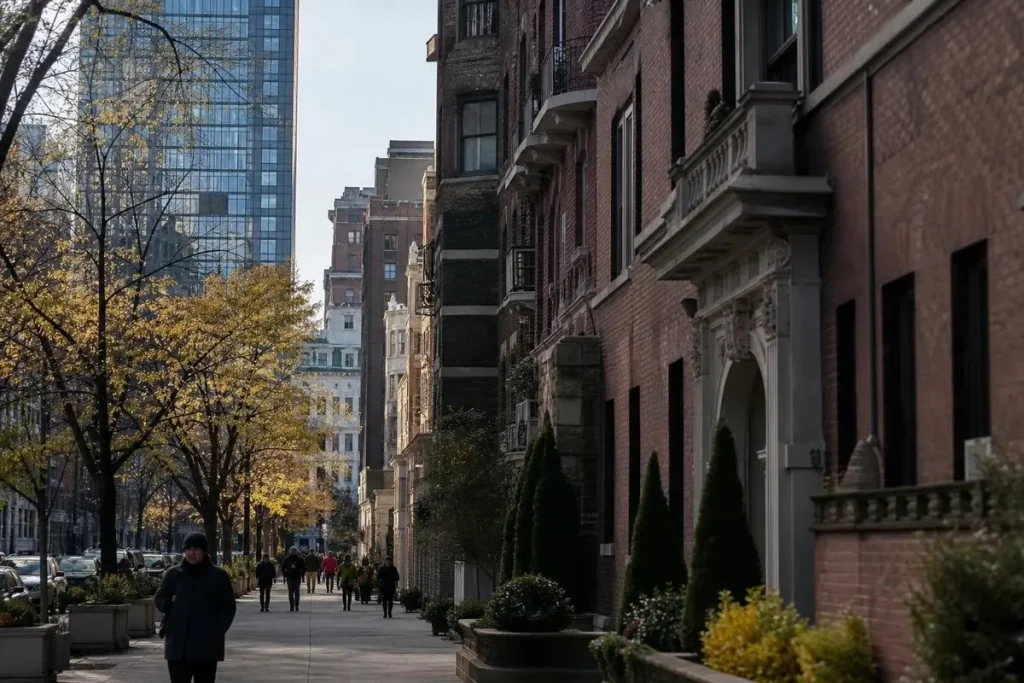
Local Law 97 covers a building over 25,000 gross square feet, two or more buildings on one tax lot that together exceed 50,000 square feet, and two or more condominium buildings under one board that together exceed 50,000 square feet.
| DOB pathway | Who it applies to | Requirement |
|---|---|---|
| Article 320 from 2024 | Most market-rate covered buildings | Annual report and limit from 2024 |
| Article 320 from 2026 | 1 to under 35% rent-regulated units | Annual limits; first report due 2027 |
| Article 320 from 2035 | Mitchell-Lama and income-restricted housing | Annual limits; first report due 2036 |
| Article 321 | Over 35% rent regulated, project-based federal housing, HDFC co-ops, houses of worship | One time: meet the 2030 limit or install prescriptive measures |
The Article 321 prescriptive list in the enacted law reads like a steam-plant tune-up: radiator temperature controls, boiler controls with indoor and outdoor sensors, repaired steam traps and master venting. The same work helps owners meet the minimum heat rules for landlords without overheating.
What are the Local Law 97 emissions limits?
Local Law 97 limits are metric tons of CO2e per square foot, by use; a building’s limit is each space’s area times its factor. 1 RCNY §103-14 allows the older occupancy-group limits only for 2024 and 2025; after that, its Energy Star Portfolio Manager (ESPM) property-type factors apply.
| ESPM property type | 2024 to 2029 (tCO2e/sf) | 2030 to 2034 (tCO2e/sf) |
|---|---|---|
| Multifamily Housing | 0.00675 | 0.003346640 |
| Office | 0.00758 | 0.002690852 |
| Hotel | 0.00987 | 0.003850668 |
| K-12 School | 0.00675 | 0.002230588 |
| Non-Refrigerated Warehouse | 0.00426 | 0.000883187 |
| Hospital (General Medical and Surgical) | 0.02381 | 0.007335204 |
The statute’s original 2030 figure for apartments (occupancy group R-2) was 0.00407. The rule’s Multifamily Housing factor is lower, so summaries quoting the statute understate how tight 2030 is.
How is a Local Law 97 penalty calculated?
A Local Law 97 penalty equals reported emissions minus the limit, in metric tons, times $268, for each calendar year. Emissions are each energy source’s annual use times its greenhouse gas coefficient.
- Limit: floor area of each ESPM type times its factor.
- Emissions: each energy source times its coefficient, summed, less allowed deductions.
- Penalty: any excess times $268.
| Energy source | 2024 to 2029 | 2030 to 2034 |
|---|---|---|
| Grid electricity (tCO2e per kWh) | 0.000288962 | 0.000145 |
| Natural gas (tCO2e per kBtu) | 0.00005311 | 0.00005311 |
| No. 2 fuel oil (tCO2e per kBtu) | 0.00007421 | 0.00007421 |
| District steam (tCO2e per kBtu) | 0.00004493 | 0.0000432 |
The 2024 to 2029 values are in section 28-320.3.1.1 of the enacted law; the 2030 values are in 1 RCNY §103-14. Electricity’s coefficient roughly halves in 2030 while gas stays flat.
Correction to a common example
A widely shared engineering example reuses the 2024 electricity coefficient for 2030. At 7,500,000 kWh a year, that overstates 2030 emissions by about 1,080 metric tons.
Worked example: what would a 100,000 sq ft gas-heated apartment building owe?
A typical 100,000 sq ft gas-heated apartment building passes the 2024 limit easily and lands just over the 2030 limit, owing about $3,206 a year. Heat pumps put it well under both limits. These are our calculations under stated assumptions, not a compliance determination.
- 100,000 sq ft, all ESPM Multifamily Housing, Article 320.
- Energy use at the median of 2,050 gas-heated, single-use multifamily properties of 75,000 to 125,000 sq ft in the city’s 2024 benchmarking file: 54.4 kBtu of gas and 3.98 kWh of grid electricity per sq ft.
- All gas feeds the boiler for heat and hot water at an assumed 80% seasonal efficiency.
- Heat pumps deliver the same heat at an assumed seasonal COP of 2.5, or 1.5 (the rule’s electrification floor at 5°F) as a stress case. No offsets or credits.
| Metric tons CO2e | 2024 to 2029 | 2030 to 2034 |
|---|---|---|
| Limit: 100,000 sq ft times factor | 675.0 | 334.7 |
| Gas: 5,440,000 kBtu | 288.9 | 288.9 |
| Electricity: 398,000 kWh | 115.0 | 57.7 |
| Total, gas boiler | 403.9 | 346.6 |
| Penalty, gas boiler | $0 | $3,206 (12.0 t over) |
| Heat pumps, COP 2.5 (908,199 kWh) | 262.4 | 131.7 |
| Heat pumps, COP 1.5 (1,248,332 kWh) | 360.7 | 181.0 |
A building at the 75th percentile for both gas (66.1 kBtu per sq ft) and electricity (5.58 kWh per sq ft) would emit 432.0 t in 2030, 97.3 t over, for a $26,077 yearly penalty. With the median building’s electricity, gas above about 52.1 kBtu per sq ft breaks the 2030 limit. Energy bills shift too, as our heat pump vs gas running cost comparison shows.
The order of work usually follows the math: tighten controls with a building automation system, then address the boiler. A like-for-like swap, covered in our boiler replacement guide, still carries the 0.00005311 gas coefficient into 2030.
Electrified routes include VRF systems and central air to water heat pumps feeding existing hydronic loops.
Under 1 RCNY §103-14, cold climate heat pumps above COP 1.5 at 5°F and heat pump water heaters can count as beneficial electrification. Equipment installed and operating before January 1, 2027 earns a coefficient of -0.0013 tCO2e per kWh, which our example leaves out.
Can offsets, RECs or good faith efforts reduce the bill?
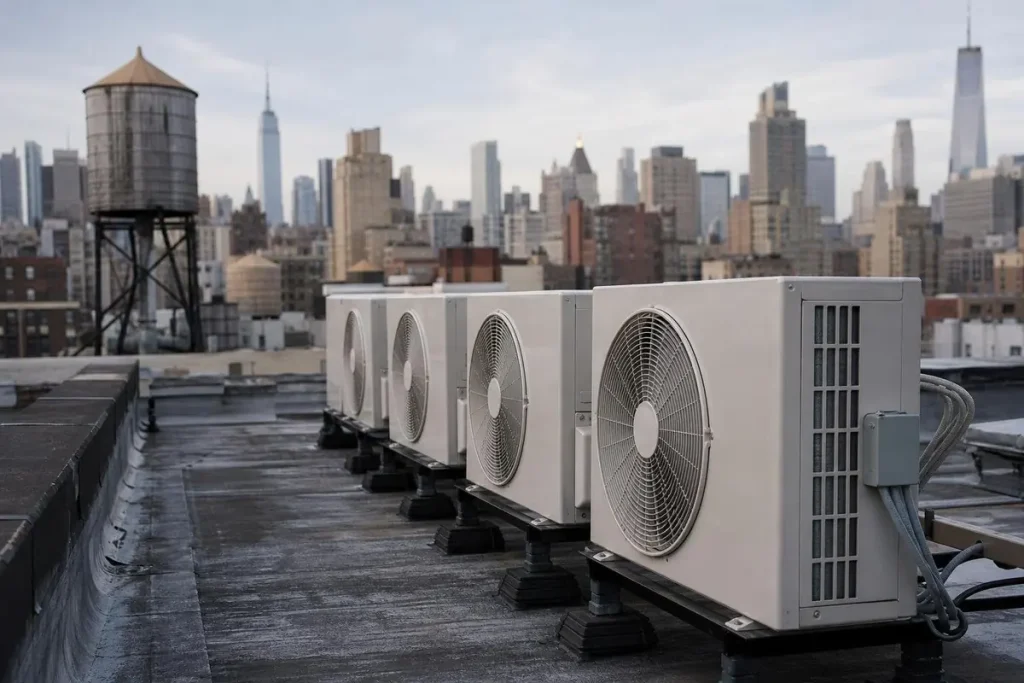
Yes, within limits. Offsets from the city’s Affordable Housing Reinvestment Fund can cover at most 10% of a building’s emissions limit. Renewable energy credits can offset only electricity emissions, and good faith efforts can mitigate a 2024 to 2029 penalty.
DOB’s REC FAQ says Tier 4 RECs, from projects delivering power into New York City, qualify and no others currently do, and that RECs cannot deduct on-site fossil fuel emissions. NYSERDA’s Tier 4 page (archived copy) set the first Tier 4 Summer Sale for August 2026, with power imported over the Champlain Hudson Power Express line.
Good faith requires filing, benchmarking, lighting and sub-meter attestations, plus a showing such as a decarbonization plan filed by May 1, 2025. Plan filers cannot claim RECs for 2024 to 2029 and need an approved application for their 2030 work by May 1, 2028. Of 10,437 Article 320 filers, 470 were over the 2024 limit and 149 of those requested this mitigation.
Is Local Law 97 being enforced in 2026?
Yes. Local Law 97 is in force: DOB issues Notices of Deficiency and pursues penalties at the Office of Administrative Trials and Hearings against Article 320 owners who do not cure. We found no enacted change to the $268 penalty or the limits as of October 2026.
For filing year 2026, DOB’s deadline notice set reports due May 1 and no later than June 30, with extensions to August 29, 2026. On May 22, 2025 the Court of Appeals reversed the Appellate Division, holding that the Climate Leadership and Community Protection Act does not preempt the law.
The open fight is over RECs. Int 0159-2026 would cap REC use at 10% of a building’s electricity emissions in excess of its limit; it sat in the Committee on Housing and Buildings when we checked. Confirm any compliance decision with a registered design professional and DOB; this is general information, not legal advice.
How we researched this
Research date: October 30, 2026. We consulted 25 documents and cite 10, led by the enacted law, 1 RCNY §103-14 and DOB reports. The Administrative Code site and nycourts.gov blocked automated reads, so section numbers come from the enacted law and DOB.
Our benchmarking cut used NYC Open Data’s LL84 file for calendar year 2024 (39,090 rows): Multifamily Housing as the only use, 75,000 to 125,000 sq ft, gas and grid electricity only. Data are self-reported and unaudited. Conversions use EIA’s 3,412 Btu per kWh. Vendor calculators and consultant blogs were excluded as sources for numbers; no Reddit material was used on this legal topic.
Frequently asked questions
Does Local Law 97 apply to co-ops and condos?
Yes, if the building passes the size test of 25,000 gross square feet, or 50,000 square feet for two or more condominium buildings under one board. HDFC co-ops meeting Article 321 thresholds follow the one-time Article 321 path. Garden-style properties where each owner runs their own heat can qualify for an exception.
What is the penalty for not filing a Local Law 97 report?
Under 1 RCNY §103-14, a late owner owes gross floor area times $0.50 for each month the report is missing, within the 12 months after May 1. For a 100,000 sq ft building that is $50,000 a month, on top of any penalty for exceeding the limit.
When are Local Law 97 reports due?
Reports are due May 1 for the prior calendar year, certified by a registered design professional. For 2026, DOB allowed filing through June 30, with extensions to August 29 if requested by June 30. The first-year deadline was extended to December 31, 2025, per DOB’s year-one report.
Do I have to install heat pumps to comply with Local Law 97?
No. The law limits emissions, not equipment. In our worked example, a median gas-heated 100,000 sq ft apartment building emits 403.9 t against a 675.0 t limit through 2029. Heat pumps are one route to 2030, alongside controls, efficiency work, limited offsets and qualifying RECs.
Was Local Law 97 struck down in court?
No. In Glen Oaks Village Owners v. City of New York, the Court of Appeals on May 22, 2025 reversed the Appellate Division and held that the state’s Climate Leadership and Community Protection Act does not preempt Local Law 97, as summarized in the Sabin Center’s litigation database.
How much does the electricity coefficient change in 2030?
It falls from 0.000288962 to 0.000145 tCO2e per kWh, about half, while natural gas stays at 0.00005311 per kBtu. In our worked example, that change alone cuts electricity emissions from 115.0 t to 57.7 t.
Sources
- NYC Department of Buildings. “LL97 Greenhouse Gas Emissions Reduction.” https://www.nyc.gov/site/buildings/codes/ll97-greenhouse-gas-emissions-reductions.page. Accessed October 2026.
- NYC Department of Buildings. “1 RCNY §103-14.” https://www.nyc.gov/assets/buildings/rules/1_RCNY_103-14.pdf. Accessed October 2026.
- New York City Council. “Local Law 97 of 2019.” https://www.nyc.gov/assets/buildings/local_laws/ll97of2019.pdf. Accessed October 2026.
- NYC Department of Buildings. “Local Law 97: 2024 Compliance and Reporting Rates.” https://www.nyc.gov/assets/buildings/pdf/ll97yr1.pdf. Accessed October 2026.
- NYC Department of Buildings. “Deadlines for Sustainability Laws in 2026.” https://www.nyc.gov/assets/buildings/pdf/sustain_dead-sn.pdf. Accessed October 2026.
- NYC Department of Buildings. “REC Policy for Local Law 97: FAQ.” https://www.nyc.gov/assets/buildings/pdf/recs_faqs.pdf. Accessed October 2026.
- NYC Open Data. “Building Energy and Water Data Disclosure for Local Law 84.” https://data.cityofnewyork.us/Environment/NYC-Building-Energy-and-Water-Data-Disclosure-for-/5zyy-y8am. Accessed October 2026.
- New York City Council. “Int 0159-2026.” https://intro.nyc/0159-2026. Accessed October 2026.
- Sabin Center for Climate Change Law. “Glen Oaks Village Owners Inc. v. City of New York.” https://www.climatecasechart.com/case/glen-oaks-village-owners-inc-v-city-of-new-york/. Accessed October 2026.
- NYSERDA. “Tier 4 REC Voluntary Sales” (archived July 13, 2026). https://web.archive.org/web/20260713210858/https://www.nyserda.ny.gov/All-Programs/Clean-Energy-Standard/Voluntary-REC-Sales/Tier-4-REC-Voluntary-Sales. Accessed October 2026.
Leave a Reply