How long does it take AC to cool a house? For a furnished 2,000 sq ft house with a healthy 3-ton unit, we calculate about 2.5 to 3.5 hours from 80°F to 72°F on an 85°F evening and 5 to 7 hours on a 95°F afternoon. Walls and furniture set that time, not the air.
How long does it take to cool a house from 80°F to 72°F, and from other starting points?
From 80°F to 72°F, plan on 2.5 to 10 hours. Each cell gives two answers: 25,000 Btu/h reaching the rooms (tight or indoor ducts), then 20,000 Btu/h (attic ducts).
| Start to target | 85°F day, AC on at 6 p.m. | 95°F day, AC on at 3 p.m. | 105°F day, AC on at 3 p.m. |
|---|---|---|---|
| 78°F to 72°F | 1.5 / 2.5 h | 4 / 6.5 h | 6.5 / 9 h |
| 80°F to 72°F | 2.5 / 3.5 h | 5 / 7 h | 7 / 10 h |
| 85°F to 75°F | 3 / 4 h | 5.5 / 7.5 h | 7.5 / 10 h |
| 85°F to 72°F | 4 / 5.5 h | 7 / 9.5 h | 9 / 12.5 h |
| 90°F to 75°F | 4.5 / 6 h | 7.5 / 9.5 h | 9.5 / 12.5 h |
The long cells finish only because the sun goes down: a 7 hour pull-down started at 3 p.m. ends near 10 p.m. A house idle only 2 or 3 hours has cooler walls and beats these times. Ranking pages quote 18 minutes per degree or one degree per hour with no measured house behind either; this one unit spans 1.5 to 12.5 hours.
Why does 8°F take hours when the air alone needs under 6 minutes?
Because the air is about 3% of what has to cool. Drywall and contents hold about 33 times the heat of the air.
| What cools | Basis | Btu per °F | Btu for 8°F | Minutes at 25,000 Btu/h, no heat gain |
|---|---|---|---|---|
| Air | 16,000 ft³ × 0.075 lb/ft³ × 0.24 Btu/lb·°F | 288 | 2,304 | 5.5 |
| Drywall | 6,000 ft² of 1/2 in board × 0.54 Btu/ft²·°F | 3,250 | 26,000 | 62 |
| Furniture and contents | 2,000 ft² × 8 lb/ft² × 0.39 Btu/lb·°F | 6,230 | 49,800 | 120 |
| Total | 4.9 Btu/°F per sq ft of floor | 9,768 | 78,100 | 187 |
Air values are from AHRI 210/240, the 8 lb/ft² from the Building America House Simulation Protocols, and gypsum (800 kg/m³, 1,090 J/kg·K) and wood (1,630 J/kg·K) from DOE’s EnergyPlus material dataset. Drywall at three times floor area is our assumption; contents are the least certain line, since no field test we found measured a furnished house.
The thermostat reads air, which drops 1 to 4°F below the walls in the first half hour; then both fall together. LBNL Site 5 shows the shape: 83.1°F at 5 minutes, 77.7°F at 30, 76.3°F at 60.
How much of a 3-ton AC is left to pull the house down on a 95°F afternoon?
About 7,100 Btu/h with tight ducts and 2,100 with attic ducts. Rheem Form A11-337 rates the RA14AZ36, a nominal 3-ton outdoor unit, at 34,200 Btu/h: 25,000 sensible and 9,200 latent. Only sensible output lowers temperature.
Goodman GSXN403610 expanded data shows what moves that. At 80°F return, 67°F wet bulb and 1,150 cfm, printed values work out to 25,800 Btu/h sensible at 85°F outside and 24,500 at 105°F, so outdoor heat mostly raises the load. Humidity matters more: at 95°F outside, dropping to 63°F wet bulb lifts 25,300 to 28,900 Btu/h.
Rooms get less. LBNL-43724 measured 1.8 tons at the registers of a 3-ton Texas house and simulated 1.66 to 1.68 tons for its better 3-ton systems, about 20,000 Btu/h. Our 17,900 Btu/h gain is 400 Btu/h per °F indoor to outdoor (assumed), 7,850 of sun and attic heat (assumed) and 2,150 internal, the 630 W Title 24 figure in another LBNL model. LBNL’s Manual J sensible loads for two 1,500 sq ft Sacramento houses scale to 16,300 to 23,200 Btu/h at 2,000 sq ft, which brackets it.
By hand: hours = 4.9 × sq ft × (degrees to drop minus net ÷ (2 × sq ft)) ÷ net. Net is delivered Btu/h minus average heat gain; the subtracted term is the air-to-wall gap, from an assumed 0.5 Btu/h·ft²·°F surface film.
| Step | 85°F evening | 95°F afternoon |
|---|---|---|
| Average heat gain during the pull-down | 8,500 Btu/h | 15,000 Btu/h |
| Net cooling | 16,500 Btu/h | 10,000 Btu/h |
| Air runs ahead of walls by (net ÷ 4,000) | 4.1°F | 2.5°F |
| Walls and contents must fall | 3.9°F | 5.5°F |
| Hours (9,768 × fall ÷ net) | 2.3 | 5.4 |
| Hour-by-hour model result | 2.3 | 5.2 |
What did instrumented houses actually measure?
Thermostat pull-downs to 75.2°F (24°C) took 8 to 257 minutes across all test configurations in the six new, nearly all unoccupied houses of LBNL-43724. These are the “as found” runs, by outdoor temperature.
| Site, as found | Nameplate / delivered tons | Outdoor at 60 min | Thermostat at 5 min, 60 min | Minutes to 75.2°F |
|---|---|---|---|---|
| 1, Palm Springs CA | 5 / 3.6 | 80.1°F | 79.0°F, 71.8°F | 11 |
| 2, Palm Springs CA | 5 / 2.7 | 81.5°F | 78.4°F, 72.5°F | 26 |
| 5, Sacramento CA | 2.5 / 1.7 | 88.3°F | 83.1°F, 76.3°F | 87 |
| 3, Mountain View CA | 3.5 / 2.5 | 91.2°F | 77.5°F, 75.0°F | 29 |
| 6, Cedar Park TX | 3 / 1.8 | 93.7°F | 79.9°F, 81.1°F | 257 |
| 4, Sacramento CA | 2 / 1.5 | 96.4°F | 86.0°F, 81.7°F | 239 |
Outdoor temperature sorts these better than tonnage: the two runs above 93°F took about 4 hours, the 5-ton runs near 80°F under half an hour. LBNL says many comparisons rest on a single test and “should be interpreted with some caution.” Our model gave 82 and 309 minutes for Sites 5 and 4 against 87 and 239 measured, so treat our figures as good to 30% at best.
The thermostat is not the whole house: when Site 5’s read 75.0°F, its kitchen read 81.9°F. The CMHC highlight on the Canadian twin research houses in Ottawa (2,400 sq ft, unfurnished) reports recovery from a 77°F daytime set forward to 71.6°F of “up to seven hours on the hottest days”, with outdoor air peaking at 86.36°F.
How fast should the temperature fall between hour 1 and hour 2?
About 1.6 to 2°F per hour on an 85°F evening and 0.5 to 0.9°F per hour on a 95°F afternoon in our furnished model; empty LBNL Sites 4 and 5 ran 2.2 to 3.2°F per hour. On an 85°F evening, about 1°F or less in that hour means roughly 15,000 Btu/h or less is reaching the rooms, 40% short of a healthy 3-ton system. On a 95°F afternoon the same reading proves little; a house that stalls for days belongs on our house won’t cool below 75 page.
If the evening test fails, measure the temperature split: Goodman prints 22°F at 80°F return, 67°F wet bulb and 1,150 cfm with 95°F outside. Then work through AC running but not cooling. A technician should measure airflow against 400 cfm per ton, charge against the maker’s chart, and duct leakage; leave refrigerant and capacitors to them. LBNL Site 2 was found at 70% of required charge.
Would a bigger AC or better ducts shorten the pull-down more?
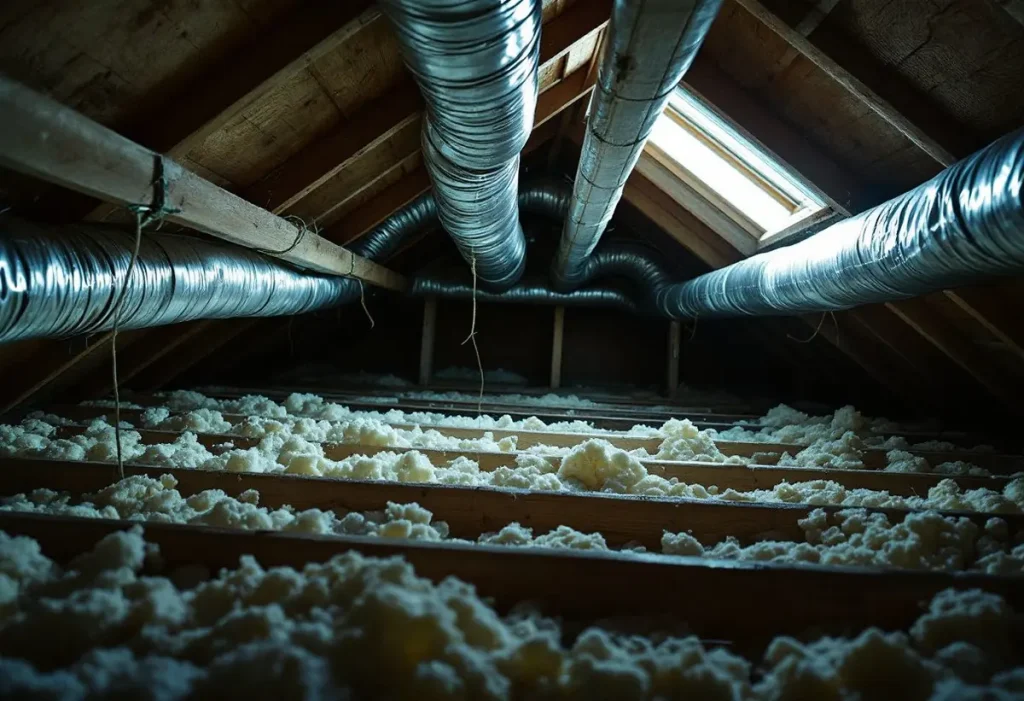
Better ducts beat one extra ton in LBNL’s Sacramento design-day simulations. To reach 75.2°F by 5 p.m., a 4-ton system with typical attic ducts had to start at 10:30 a.m. (6.5 hours), a 3-ton with the best attic ducts at 11:45 a.m. (5.25 hours), and a 3-ton with ideal indoor ducts at 12:30 p.m. (4.5 hours).
On those same best ducts a 4-ton needed only 2.5 hours, and our model agrees (5.2 down to 2.8 hours at 33,000 Btu/h), but mild days then bring short cycling, so sizing belongs to a load calculation. Duct location and sealing help every hour of the year.
Will setting the thermostat to 60°F cool the house faster?
No. DOE Energy Saver (archived copy) says a colder setting “will not cool your home any faster and could result in excessive cooling and unnecessary expense.” On a single-stage unit the setpoint only decides when the compressor stops: Goodman’s table has columns for return air and outdoor temperature, none for setpoint. Leaving the blower on is a separate fan on vs auto question.
Is it cheaper to turn the AC off or raise it while you are out?
Raising it saves energy. DOE says “Keep your house warmer than normal when you are away”, and its thermostat page (archived copy) caps the claim at “as much as 10% a year” for 7° to 10°F held 8 hours. The Ottawa houses predicted 13% seasonal electrical savings on sunny days and 2.9% on cloudy days from that 77°F set forward, against 23.3% from holding 75.2°F all day, all from a 71.6°F benchmark.
On a 95°F day, a house soaked at 85°F needs 5.5 to 7.5 hours to read 75°F, so schedule the start. Setback depth is on our thermostat settings page; dollars are under what air conditioning costs to run.
Frequently asked questions
How long does it take AC to cool a house 1 degree?
The first degrees take minutes. After the first half hour, one degree took about 20 to 30 minutes in the empty LBNL Site 4 and Site 5 houses, measured at 2.2 to 3.2°F per hour. Our furnished model gives 30 to 40 minutes on an 85°F evening and 1 to 2 hours on a 95°F afternoon.
Why does the house still feel warm when the thermostat reaches the setpoint?
The thermostat reads air, and walls and contents lag. In our model they sit near 75°F to 76°F when the air hits 72°F. Rooms lag too: LBNL Site 3 reached its thermostat target in under half an hour, yet upstairs took another hour and a half and read 6°F hotter at that moment.
How long does it take to cool a 1,500 sq ft house?
LBNL measured two empty 1,500 sq ft Sacramento houses reaching 75.2°F in 87 minutes with a 2.5-ton unit from 83.1°F at about 88°F outside, and 239 minutes with a 2-ton unit from 86.0°F at about 97°F outside. Add time for furniture: our model nearly doubles a pull-down for 8 lb/ft² of contents.
How we researched this
We read the documents listed below in full or at the cited tables. We built a two-node heat balance (air plus lumped drywall and contents), compared it with two empty LBNL houses, and ran a 20°F daily outdoor swing peaking at 4 p.m. Envelope, solar and surface-film values are stated assumptions. Ranking blogs were excluded as number sources because none cited a measured house. We did not read the ASHRAE Handbook. Research date: November 2026.
Sources
- LBNL. “Distribution Effectiveness and Impacts on Equipment Sizing for Residential Thermal Distribution Systems,” LBNL-43724, 1999. https://escholarship.org/uc/item/94c2064w. Accessed November 2026.
- Canada Mortgage and Housing Corporation. “Effects of Thermostat Setting on Energy Consumption,” 2005. https://assets.cmhc-schl.gc.ca/sf/project/archive/publications/rhse-penrse/63816.pdf. Accessed November 2026.
- NREL. “Building America House Simulation Protocols,” 2010. https://www.osti.gov/servlets/purl/1218850. Accessed November 2026.
- LBNL. “Reducing Residential Peak Electricity Demand with Mechanical Pre-Cooling of Building Thermal Mass.” https://escholarship.org/uc/item/4x28r51q. Accessed November 2026.
- Rheem. “RA14AZ technical specifications,” Form A11-337, distributor copy. https://www.budgetheating.com/content/files/downloadables/ra14az%20technical%20specifications.pdf. Accessed November 2026.
- Goodman. “SS-GSXN4 specification sheet,” retailer copy. https://cdn.shopify.com/s/files/1/0766/1171/5363/files/GSXN402410.pdf. Accessed November 2026.
- AHRI. “Standard 210/240,” incorporated-by-reference copy. https://law.resource.org/pub/us/cfr/ibr/inc/ansi/ahri.0210-0240.2020.2023.pdf. Accessed November 2026.
- U.S. DOE and NREL. “EnergyPlus ASHRAE_2005_HOF_Materials dataset,” G01a and G05. https://raw.githubusercontent.com/NREL/EnergyPlus/develop/datasets/ASHRAE_2005_HOF_Materials.idf. Accessed November 2026.
- U.S. DOE Energy Saver. “Spring and Summer Energy-Saving Tips,” archived copy. https://web.archive.org/web/2025id_/https://www.energy.gov/energysaver/spring-and-summer-energy-saving-tips. Accessed November 2026.
- U.S. DOE Energy Saver. “Programmable Thermostats,” archived copy. https://web.archive.org/web/2025id_/https://www.energy.gov/energysaver/programmable-thermostats. Accessed November 2026.
Leave a Reply