
What happens if return duct is too small: the blower starves, return static pressure climbs and airflow can fall below the 350 CFM per ton floor in Daikin’s manual and California code. The grille whistles, the AC coil can freeze and a furnace can trip its high limit. A manometer reading behind the filter confirms it.
Which symptom do you have, and which number proves the return is the cause?
Each symptom has one reading that separates a starved return from a dirty filter or failed part. Get that reading before anyone quotes ductwork. A return can also be starved from the room side, and covering a return vent with a couch or rug cuts airflow the same way.
| Symptom | Reading to get | The line that matters |
|---|---|---|
| Return grille whistles or roars | Blower CFM divided by grille core area, in ft/min | Nailor 67FB45: NC 20 at 400 ft/min on a 22 x 22; NC 43 at 1,000 ft/min on a 16 x 12 |
| Weak air at every register | Manometer between filter and blower, then total external static | The maximum on the rating plate; 0.5 in. w.c. on Daikin’s AMST air handler |
| Ice on the coil or suction line | Total static checked against the maker’s fan table, giving CFM per ton | Below 350 CFM per ton (Daikin AMST range 350 to 450; Title 24 minimum 350) |
| Furnace shuts off, blower keeps running | Supply air minus return air temperature | Rise above the plate range; Goodman *R9T960303AN goes 30 to 37 degrees F on one tap from 0.10 to 0.50 in. w.c. |
Compiled by The HVAC Brief from the Nailor, Daikin, Goodman and California Energy Commission documents linked below. NC is a noise rating, not a whistle measure. Ice is the least specific clue, because low refrigerant also causes it; our page on the two causes of a frozen coil separates them. None of the manuals we read names an airflow at which a coil freezes.
How much airflow does a too-small return cost on real fan tables?
About 9 to 14 percent between 0.5 and 0.8 in. w.c. on the tapped blowers below. LBNL-58742 measured about 30 percent less airflow at 0.8 in. water on PSC furnaces. High static alone is not a verdict, because the tap’s starting point decides the result.
| Maker table and tap | CFM at 0.5 | CFM at 0.8 | Loss | CFM per ton at 0.8 |
|---|---|---|---|---|
| Rheem 801T70317, Med. Hi | 1,209 | 1,100 | 9% | 367 (3 tons) |
| Rheem 801T70317, Med. (factory heating tap) | 981 | 844 | 14% | 281 (3 tons) |
| Goodman *R9T960303AN, F05 | 930 | 825 | 11% | Tonnage not stated |
HVAC Brief calculation from the Rheem 801T manual (Table 11, “3 ton/70K”) and Goodman IOG-2038E. At 0.8 in. w.c., one Rheem tap stays above 350 CFM per ton and the other falls to 281. Our CFM per ton explainer traces those targets.
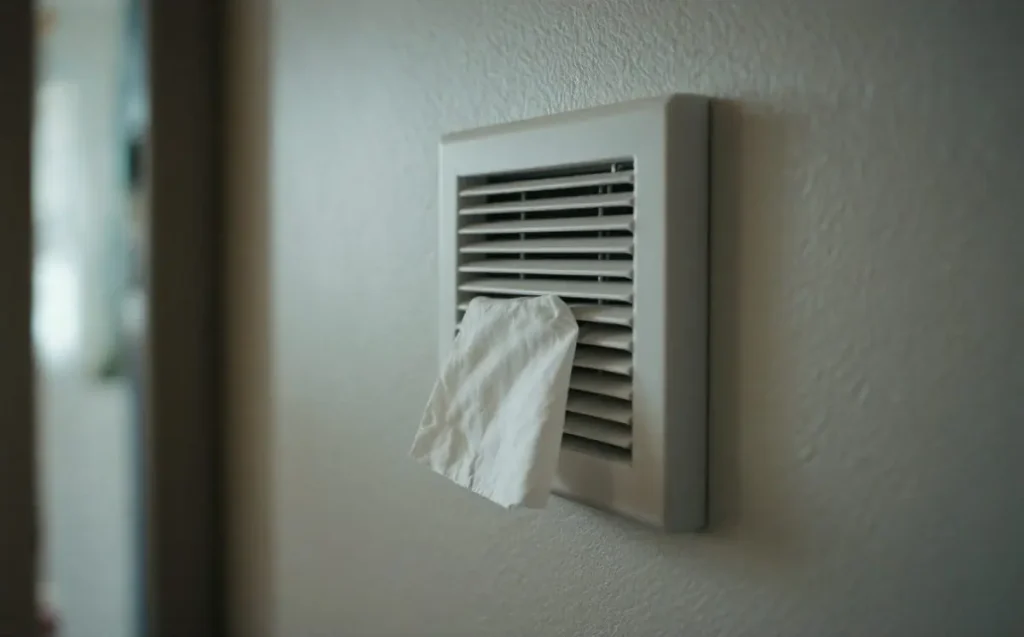
Is the restriction in the duct, the grille or the filter?
Two readings answer it, one on each side of the filter. John Proctor’s ASHRAE Journal field data shows why: across 34 split systems in two-year-old California homes, mean filter drop was 0.282 in. w.c., mean return static 0.417 and mean total 0.887.
If that return figure includes the filter, as a reading behind it would, the filter alone is about 68 percent of it (0.282 divided by 0.417; our arithmetic and reading of his table). Proctor found no system at or below 0.50 and calls the return “the dominant cause of high statics in these homes,” so the filter is the first suspect inside it.
- Run the highest airflow mode with a clean filter and all registers open.
- Read A and B, then subtract. With the filter in the grille there is no port A: read B with the filter in, then out.
- Have the technician add port C and find airflow on the fan table.
No manual we read publishes a return-only limit, only the total on the plate. Our working test, not a published rule: on a 0.5 in. w.c. plate, a port A reading above about 0.25 means grille and duct alone spend half the budget. Leave port C to a technician, since coil tubing sits close behind that sheet metal; our static pressure guide covers the full test.
What size return duct does a 2, 3, 4 or 5 ton system need?
California’s Title 24 Tables 150.0-B and 150.0-C are the only published table we found in inches: 18 in. for one duct at 2 tons, then two ducts from 16 and 14 in. at 3 tons to two 20s at 5 tons. One-duct rows stop at 2.5 tons (20 in.).
| Tons | CFM at 400 per ton | One duct, min. | Two ducts, min. | Duct velocity, ft/min | Title 24 filter grille, sq in | Filter area at 300 ft/min, sq in |
|---|---|---|---|---|---|---|
| 2.0 | 800 | 18 in. | 14 + 12 in. | 453 one; 431 two | 600 | 384 |
| 3.0 | 1,200 | No row | 16 + 14 in. | 487 | 900 | 576 |
| 4.0 | 1,600 | No row | 18 + 18 in. | 453 | 1,200 | 768 |
| 5.0 | 2,000 | No row | 20 + 20 in. | 458 | 1,500 | 960 |
HVAC Brief calculation: sizes from the 2022 tables; velocity is CFM over round duct area; the last column is CFM divided by 300, times 144, the disposable basis in Goodman’s GMVM service manual. Title 24 requires each duct to be 30 feet or shorter with no more than 180 degrees of bend, no zoning dampers and a clean filter drop of 0.1 in. w.c. or less. The 2025 compliance form cites the same two tables.
Outside California this is a benchmark, and the local inspector decides; Goodman sends duct design to ACCA Manual D, which we did not read. Nailor’s 67FB45 data puts 1,200 CFM through a 22 x 22 (3.17 sq ft core) under 400 ft/min, about .055 negative static, and through a 16 x 12 (1.24 sq ft) at about 968 ft/min, close to .344 at 1,000 ft/min, damper included.
Straight stretched duct costs little above 14 in.; the real warning is compression. LBNL’s flex duct tests found moderate compression could raise pressure drop by a factor of four on 6, 8 and 10 in. ducts. Rigid metal does not compress; no document we read gave a metal roughness, so the chart has no metal bar. Our page on flex sag and compression shows how it happens.
Why does a 1 inch filter make an undersized return worse?
Its small face speeds the air: one 16 x 25 is 400 sq in, so 1,200 CFM crosses it at 432 ft/min, against the 300 ft/min disposable basis in Goodman’s GMVM tables and about 192 ft/min at Title 24’s 900 sq in.
Goodman warns: “Avoid using highly restrictive 1″ filters which produce static pressure loss greater than .25″ W.C.” Proctor’s field mean of 0.282 sits over that line, and he estimates a 10.8 percent sensible EER gain from cutting it to 0.1. The same manual says a deep-pleated MERV 8 filter “often has lower static pressure loss than a 1″ filter.” Our page on MERV and airflow covers the rating side.
Does a too-small return burn out the blower motor?
No study we read shows that, and the two motor types react in opposite ways. LBNL-58742 found power showing “a gradual increase with pressure” for its BPM prototype “but a reduction with increasing pressure for the PSC.” A choked PSC motor can draw less power while moving less air, so a low power reading does not clear the return.
Variable speed motors held almost constant flow up to about 1.2 in. water, falling from about 7 CFM per watt near 0.2 in. water to about 3 at 0.8, which hides the symptom. We found no primary figure for years of blower life lost, so we give none. The documented damage path is thermal: Goodman names “limit switch tripping and heat exchanger failure.” Never jumper a limit; our limit switch page separates high limit trips from rollout trips, which are a technician call.
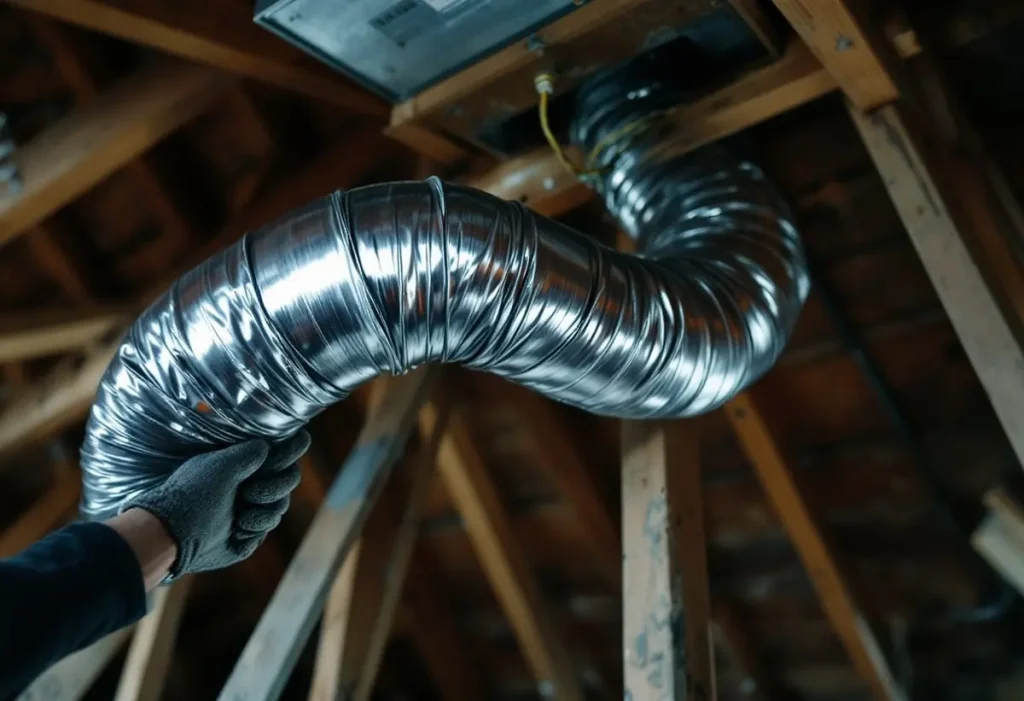
Which fix comes first: filter, grille, second return or bigger duct?
Re-measure after each step. With B minus A above .25 in. w.c., change the filter or move to a deep media cabinet. With 800 ft/min or more at the grille, our flag rather than a published limit, enlarge it. At the furnace, Goodman says an “undersized opening will cause reduced airflow,” flanges left folded cut bottom return area about 18 percent, and upflow installs at 1,600 CFM or more need two side returns or a bottom return.
Only then add a second return or re-run the duct from the Title 24 sizes. A faster blower tap is not a return fix: Rheem’s Med. to Med. Hi step adds 228 CFM at 0.5 in. w.c., but real system pressure climbs as airflow rises. Single-room problems belong with air balancing or the transfer paths under supply and return vents.
Frequently asked questions
Can a too small return duct make a furnace overheat?
Yes. Goodman’s *R9T96 manual warns that excess static “can cause excessive temperature rise” and “limit switch tripping and heat exchanger failure.” On its *R9T960303AN table, one tap’s high-fire rise climbs from 30 to 37 degrees F as static goes from 0.10 to 0.50 in. w.c.
Is one return enough for a whole house?
Sometimes, on smaller systems. California’s Title 24 Table 150.0-B offers a single return duct path only from 1.5 to 2.5 tons, with two ducts through 5 tons in Table 150.0-C. That is a state compliance option, not national code, and it assumes runs of 30 feet or less.
Does a whistling return grille always mean the duct is too small?
No, the grille itself may be the restriction. Nailor rates its 67FB45 in the 16 x 12 size at NC 21 at 500 ft/min but NC 43 at 1,000 ft/min. Divide blower CFM by grille core area first. If that velocity is low, check for a loose frame or duct gaps.
How we researched this
In November 2026 we read the documents listed below plus California’s 2025 CF3R-MCH-28-H form; the GMVM page came through a text extract of a hosted copy. We excluded contractor blogs and calculator sites, whose return velocity limits carry no source.
Sources
- California Energy Commission. “2022 Building Energy Efficiency Standards, Section 150.0(m), Tables 150.0-B and 150.0-C.” https://www.energy.ca.gov/sites/default/files/2022-12/CEC-400-2022-010_CMF.pdf. Accessed November 2026.
- John Proctor, ASHRAE Journal. “Residential AC Filters, October 2012.” https://mail.proctoreng.com/dnld/ASHRAE2012.pdf. Accessed November 2026.
- Goodman. “*R9T96 Installation Instructions, IOG-2038E.” https://mobile.goodmanmfg.com/mobileapp/stellent/pdf/infoPdf/Lit/IOG-2038E.pdf. Accessed November 2026.
- Goodman. “GMVM Service Instructions, page 46.” https://www.manualslib.com/manual/1188865/Goodman-Gmvm.html?page=46. Accessed November 2026.
- Daikin Comfort. “AMST Installation Manual, IO-4011B.” https://daikincomfort.com/docs/default-source/amst/im-io-4011b.pdf. Accessed November 2026.
- Rheem. “801T Series Installation Instructions.” https://resource.gemaire.com/is/content/Watscocom/Gemaire/rheem_r801t_en_ii.pdf. Accessed November 2026.
- Nailor Industries. “Model 67FB45 Performance Data.” https://nailor.com/sites/default/files/documents/PDHC67FB45.pdf. Accessed November 2026.
- Abushakra, Walker and Sherman, LBNL. “Compression Effects on Pressure Loss in Flexible HVAC Ducts, 2002.” https://escholarship.org/uc/item/0d76400v. Accessed November 2026.
- Walker and Lutz, LBNL. “Laboratory Evaluation of Residential Furnace Blower Performance, LBNL-58742, 2005.” https://www.aivc.org/sites/default/files/lbnl-58742.pdf. Accessed November 2026.
Leave a Reply