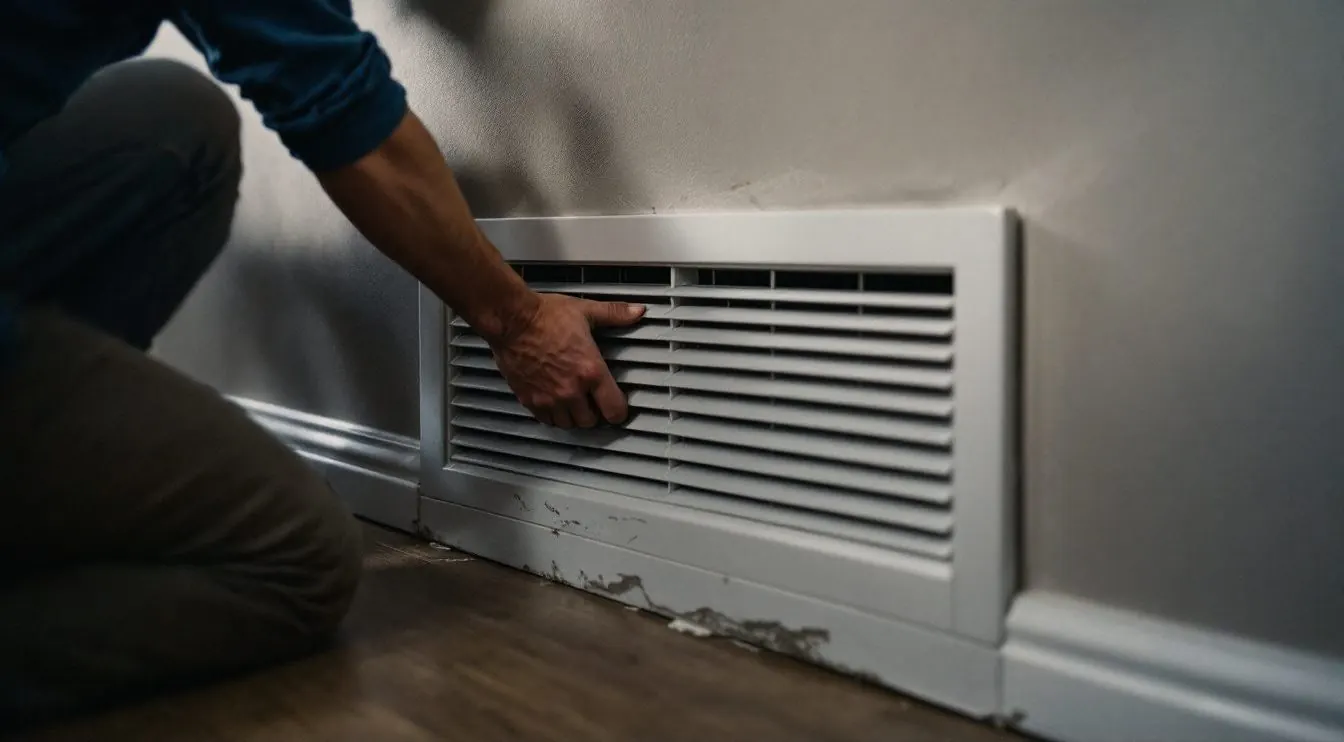
What happens if you cover a return vent: the blower loses air and the house falls out of pressure balance. On a Goodman 80,000 Btu furnace, covering 56% of a single 20 x 20 return pushes the heat rise past its 65°F plate limit, and closed rooms without a working return averaged +9.1 Pa versus the hall in Florida field tests.
How much airflow is lost when a couch or rug covers part of a return grille?
Little until about half the grille is hidden, then the system runs off the maker’s table. We solved a real fan table against a real grille table: one central 20 x 20 return on a Goodman GM9S80 0803B* furnace, at the 0.5 in. w.c. rating point when clear.
| Share of grille face covered | Open core, sq in | Grille loss in cooling, in. w.c. | Cooling airflow (3 tons) | Heating airflow | Heat rise, plate 35 to 65°F |
|---|---|---|---|---|---|
| 0% (clear) | 376 | 0.08 | 1,241 CFM, 414 per ton | 959 CFM | 61.8°F |
| 25% | 282 | 0.13 | 1,226 CFM, 409 per ton | 949 CFM | 62.4°F |
| 50% | 188 | 0.28 | 1,185 CFM, 395 per ton | 923 CFM | 64.2°F |
| 60% | 150 | 0.42 | 1,148 CFM, 383 per ton | 897 CFM | 66.1°F, over limit |
| 67% | 124 | 0.60 | Past 0.80 in. w.c.: no maker data | 867 CFM | 68.3°F, over limit |
| 75% or more | 94 or less | 1.05 or more | No maker data | No maker data | No maker data |
HVAC Brief calculation: fan curves from the Goodman GM9S80 spec sheet (cooling tap F05, heating tap F04, 0.1 to 0.8 in. w.c.); grille loss from the Nailor 67FB45 table for a 20 x 20 (2.61 sq ft core), which follows velocity squared; rise = output ÷ (1.08 × CFM) with Goodman’s 64,000 Btu/h output.
Nailor puts this grille at .086 in. w.c. at 500 ft/min and .344 at 1,000 ft/min: four times the loss at twice the speed, so the second half of a cover costs far more than the first. Goodman’s tables stop at 0.80 in. w.c., so past two thirds covered we print no number. A fully covered single return leaves only duct leaks to feed the blower, which only a manometer can size up; our static pressure guide covers that test.
With two similar returns, hiding one is roughly the 50% row, an approximation since the ducts behind them rarely match.
At what point does a covered return overheat a furnace?
On this furnace, at about 56% covered. Goodman lists a 35 to 65°F rise range for the GM9S80 0803B*, and its formula (output ÷ 1.08 × CFM) means 64,000 Btu/h needs at least 912 CFM. Tap F04 delivers 959 CFM at 0.5 in. w.c. and 832 at 0.8: a margin of about 47 CFM.
Goodman’s installation manual IOG-2038E names the damage path: too much static “will result in insufficient air that can cause excessive temperature rise. This can cause limit switch tripping and heat exchanger failure.” Our limit switch page explains that cycle; never jumper the switch. No source we read says how many trips it takes to crack a heat exchanger.
Will a covered return freeze the AC coil in summer?
Partly covering it rarely will with a blower like this one; covering most of it, or any cover on an older PSC blower, can. FSEC’s Parker study gives targets of 350 to 450 CFM per ton and warns that “Very low air flow may lead to evaporator coil icing, refrigerant flood back and eventual compressor failure.”
The Goodman motor in our table still held 383 CFM per ton at 60% covered. Permanent split capacitor (PSC) blowers sag faster: Walker and Lutz at LBNL measured a 30% airflow reduction at 0.8 in. w.c., against almost constant flow to about 1.2 in. w.c. for the BPM motors tested. A system at 400 CFM per ton that loses 30% lands near 280. FSEC logged one 4 ton system at 130 CFM per ton with “small returns, iced over coil”. If ice is already showing, our page on why an AC freezes up separates airflow from a low charge.
Why does a half-covered return grille start whistling?
Because the same air has to squeeze through half the opening at twice the speed. On Nailor’s 20 x 20 rows, the 1,241 CFM cooling flow crosses the clear grille at about 475 ft/min, interpolated to about NC 23; half covered it runs about 908 ft/min, close to NC 43, and the table tops out at NC 46 at 1,000 ft/min. A half-covered grille is only one source, and a furnace whistling noise also traces to a loaded filter, closed registers or a leaky cabinet seam.
NC is a lab room noise rating, not whistle pitch, but a 20 point jump is audible. If the noise stays after the couch moves, suspect an undersized return duct instead.
What happens to a bedroom when its return is covered and the door is shut?
The room pressurizes, its supply drops and the rest of the house goes negative. A covered return and shut door leave only the door gap, the setup FSEC measured in 70 central Florida homes (Cummings and Withers, ASHRAE Transactions 2006): closed rooms averaged +9.1 Pa against the hallway and the central zone fell to an average of 2.9 Pa below outdoors.
The spread is wide. In FSEC’s house #36, two closed rooms with 209 and 245 CFM of supply reached +32.2 and +37.3 Pa against outdoors, while rooms with 47 and 59 CFM stayed under +3.5 Pa. The more air a room’s supply delivers, the more a covered return hurts it. FSEC lists more leakage out of the room, less supply into it and more supply duct leakage: one mechanism behind one room hotter than the others.
The Florida code FSEC cites caps the difference across closed doors at 2.5 Pa; ENERGY STAR’s Rater checklist (Rev. 14, item 6.2) wants bedrooms within minus 3 to plus 3 Pa, or 5 Pa for rooms with 150 CFM or more. IRC M1602.2 adds: “The amount of return air taken from any room or space shall be not greater than the flow rate of supply air delivered to such room or space.”
Can a covered return make a gas water heater or furnace backdraft?
It can add to the negative pressure behind it where an atmospheric (draft hood) appliance shares the house air. FSEC reports most such appliances spill at about 5 to 10 Pa of depressurization, cites a CMHC limit of 3 to 5 Pa, and found 5 of its 70 homes past 5 Pa with doors closed.
Goodman’s IOG-2038E says “to prevent the blower from interfering with combustion air or draft when a central return is used, a connecting duct must be installed between the unit and the utility room wall,” and its venting check tests “for spillage from draft hood appliances at the draft hood relief opening after 5 minutes of main burner operation.” IRC M1602.2 bans returns within 10 feet of a draft hood in the same space and in furnace rooms.
Stop line: if a covered return sits near the furnace or water heater, uncover it and have a technician run a worst case depressurization and spillage test with a manometer and CO analyzer. Soot at a draft hood or a CO alarm means shut the appliance off and call. Our CO detector placement page covers where alarms belong.
How far should furniture sit from a return vent, and do decorative covers work?
Far enough that the gap around the furniture is at least as open as the grille. No maker manual we read gives a furniture distance. FSEC’s transfer tests give a usable yardstick: a bare wall hole needed 54 square inches per 100 CFM to hold the loss to 2.5 Pa.
Applied to a sofa gap (our extension of a wall-hole test): the 1,241 CFM return above needs about 670 square inches. An 84 inch sofa with both 30 inch ends open gives 144 inches of open edge, so about 4.7 inches from the wall; with the ends boxed in, about 8.0 inches. A 150 CFM bedroom return needs about 1 inch. Rugs and magnetic covers leave no gap: bottom row of the table.
Decorative covers work when their open area matches the grille’s: FSEC’s requirement rose to 103 square inches per 100 CFM with grilles on both sides and fell to 79 with oversized grilles. PNNL’s Building America Solution Center uses at least 1 square inch of grille free area per CFM as a rule of thumb for transfer grilles, and says a door undercut usually has to be 1.5 inches or more. Our supply and return vents explainer covers which grille is which; closing supply registers is a different problem, handled in what happens when you close an air vent.
Frequently asked questions
Can I remove a return vent grille?
Removing the grille cuts the loss: in FSEC’s tests a bare hole needed 54 square inches per 100 CFM, against 103 with grilles on both sides. But the grille keeps objects out of the duct and often holds the filter. Sealing the return duct is a design change that IRC M1602.2 sends to Manual D.
Are return air vents necessary?
Yes for a ducted furnace or air handler. Goodman’s IOG-2038E says “A closed return duct system must be used, with the return duct connected to the furnace.” One central return plus transfer grilles can replace a return in every room if closed rooms stay within about 3 Pa of the hall.
Why is my AC return vent not pulling air?
A tissue that will not stick to the grille points to a clogged filter, a stopped blower or a disconnected return duct pulling from the attic or crawl space. Goodman has technicians read negative pressure “between the filter and the furnace blower”: near zero suggests a duct break, strongly negative the filter.
Should air return vents stay open in winter?
Yes. On the furnace we modelled, heating is where a covered return bites first: the 64,000 Btu/h GM9S80 0803B* passes its 65°F rise limit at about 56% covered, while in cooling the same blower held 383 CFM per ton at 60%. Holiday furniture and winter rugs are the usual cause.
Can I add a return vent to existing ductwork?
Usually, as a new branch off the return trunk or a transfer grille into a common area. IRC M1602.2 requires return and transfer openings sized to the maker’s instructions or Manual D, and PNNL’s rule of thumb for a transfer grille is at least 1 square inch of free area per CFM of room supply.
How we researched this
Researched 9 November 2026 from the documents listed below: two Goodman manuals, the Nailor grille table, two FSEC papers, an LBNL blower report, IRC Chapter 16, ENERGY STAR’s Rater checklist and PNNL guidance. The coverage table is our calculation assuming one central return at 0.5 in. w.c. when clear and a solid cover. We excluded the ranking contractor and lifestyle pages: none cites a document, and their furniture distance has no source we could find.
Sources
- Goodman Manufacturing. “GM9S80/GC9S80 Product Specifications, SS-GM9S80/GC9S80.” https://cdn.shopify.com/s/files/1/0794/3104/1346/files/GM9S80_GC9S80_Spec_Sheet.pdf. Accessed November 2026.
- Goodman Manufacturing. “Installation Instructions IOG-2038E.” https://mobile.goodmanmfg.com/mobileapp/stellent/pdf/infoPdf/Lit/IOG-2038E.pdf. Accessed November 2026.
- Nailor Industries. “Model 67FB45 Fixed Blade Return Grilles and Registers, Performance Data.” https://nailor.com/sites/default/files/documents/PDHC67FB45.pdf. Accessed November 2026.
- Cummings, J.B. and Withers, C.R., Florida Solar Energy Center. “Unbalanced Return Air in Residences: Causes, Consequences, and Solutions.” FSEC-RR-140-06. https://publications.energyresearch.ucf.edu/wp-content/uploads/2018/06/FSEC-RR-140-06.pdf. Accessed November 2026.
- Parker, D. et al., Florida Solar Energy Center. “Impact of Evaporator Coil Air Flow in Residential Air Conditioning Systems.” FSEC-PF-321-97. https://publications.energyresearch.ucf.edu/wp-content/uploads/2018/06/FSEC-PF-321-97.pdf. Accessed November 2026.
- Walker, I.S. and Lutz, J.D., Lawrence Berkeley National Laboratory. “Laboratory Evaluation of Residential Furnace Blower Performance.” 2005. https://www.aivc.org/sites/default/files/lbnl-58742.pdf. Accessed November 2026.
- City of Seattle. “2021 Seattle Residential Code, Chapter 16 Duct Systems (IRC M1602.2).” https://www.seattle.gov/documents/Departments/SDCI/Codes/SeattleResidentialCode/2021SRCChapter16.pdf. Accessed November 2026.
- U.S. EPA ENERGY STAR. “National Rater Field Checklist, Rev. 14.” https://www.energystar.gov/sites/default/files/2025-04/National%20Rater%20Field%20Checklist_Rev%2014.pdf. Accessed November 2026.
- PNNL Building America Solution Center. “Undercut Doors.” https://basc.pnnl.gov/resource-guides/undercut-doors. Accessed November 2026.
- PNNL Building America Solution Center. “Transfer Grilles.” https://basc.pnnl.gov/resource-guides/transfer-grilles. Accessed November 2026.
Leave a Reply