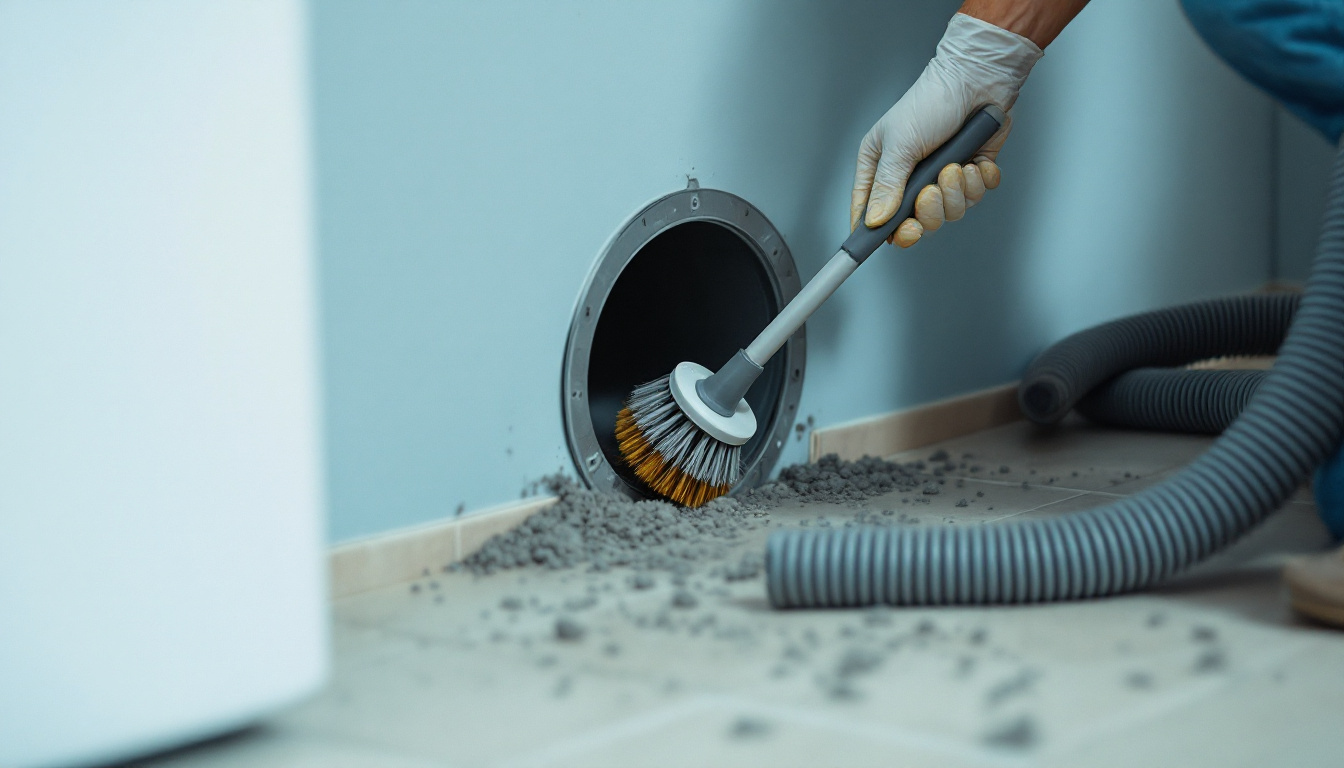
Dryer vent cleaning: how often, and what does it involve? Have the exhaust duct brushed end to end once a year, and clean the lint screen every load. Failure to clean is the leading factor contributing to ignition in US clothes dryer fires.
Key Takeaways
- Failure to clean led the contributing factors in 31% of home clothes dryer fires, 2018 to 2020 (USFA, NFIRS).
- USFA counted 2,900 residential dryer fires a year: 5 deaths, 100 injuries, $35 million in property loss (Topical Fire Report, 2012).
- CPSC staff put dryer structure fires at 6,900 in 2017 and 4,900 in 2014 (staff evaluation, May 2021).
- IRC Section M1502 sets 4 inches nominal smooth metal duct, 35 feet of developed length less 5 feet per mitered 90 degree elbow, an 8 feet UL 2158A transition duct, and a backdraft damper and no screen (DOE Building America).
- 102.32 million US homes had a clothes dryer in 2020; 20.11 million burned gas or propane (EIA RECS 2020, HC3.1).
What does dryer vent cleaning actually involve?
A real dryer vent cleaning pulls the appliance out, brushes and vacuums the whole run from both ends, then confirms air is escaping at the exterior hood with the dryer running. Emptying the lint screen is not the job; the wall duct is.
- Cut power, and close the gas valve if the dryer burns fuel.
- Pull the dryer forward and release the clamp on the transition duct.
- Vacuum the transition duct, the lint trap housing and the floor behind the dryer, where CPSC warns lint gathers.
- Feed a rotary brush on a flexible rod through the wall duct.
- Pull the exterior hood and clean the damper blades.
- Reconnect with a clamp, restore power and gas, and check discharge outside.
CPSC’s alert ends by telling readers to reconnect the ducting before using the dryer again, which says something about how often that gets skipped. It is a separate job from cleaning a forced-air system.
How often does a dryer vent need cleaning?
Once a year for the duct, every load for the lint screen. The DOE Building America Solution Center gives builders one line for homeowners: “At least once a year, have a professional technician clean the dryer exhaust duct.” USFA adds a nylon brush on the screen every six months.
Frequency tracks use, not the calendar. RECS 2020 counted 32.92 million US households running five or more loads a week. Long or bent runs fill faster, for the same reason restricted ductwork starves an air handler: every fitting adds resistance, and resistance is where lint settles.
What do the federal fire numbers actually show?
Three national estimates exist and they disagree, because they count different things. USFA’s NFIRS report put residential dryer fires near 2,900 a year. CPSC staff estimates ran 4,900 to 7,900 across 2012 to 2017. The National Fire Protection Association, a trade association, estimated 14,630.
| Estimate | What it counts | Period | Fires a year | Deaths | Injuries |
|---|---|---|---|---|---|
| USFA, NFIRS 5.0 | Residential buildings | 2008 to 2010 | 2,900 | 5 | 100 |
| CPSC staff | Structure fires, all fuels | 2017 | 6,900 | Under 10 | 180 |
| CPSC staff | Same series, low year | 2014 | 4,900 | Under 10 | 160 |
| NFPA (trade body) | Home fires, dryers only | 2010 to 2014 | 14,630 | 9 | 420 |
The spread is scope and method, not contradiction, the problem behind unreliable national repair cost figures. All three agree on the cause. USFA found dust, fiber and lint first ignited in 28% of residential dryer fires, and clothing in another 27%.
What are the symptoms of a blocked dryer vent?
Longer drying times come first. CPSC says clothing still damp at the end of a typical cycle, or drying that takes longer than normal, may mean the lint screen or the exhaust duct is blocked. DOE’s retrofit guidance adds clothes that come out too hot and a burning smell.
That smell is not the same signal as a burning smell from a furnace. In a dryer it means lint is touching something hot. Stop the machine until the duct is clean.
Safety point
Do not fit a screen or pest cage over the exterior dryer hood. IRC Section M1502.3 states that screens shall not be installed at the duct termination, and the DOE job aid repeats it as “termination fitting DOES NOT include grille/cage/screen.” A screen builds a lint plug where you never see it.
What does the residential code require of a dryer exhaust duct?
IRC Section M1502 sets the specification and the DOE Building America Solution Center restates it: rigid or semi-rigid metal, smooth interior, 4 inches nominal, supported at intervals not over 12 feet, run short and straight and sloped slightly down so condensate drains.
Three rules matter most. Joints are clamped or foil taped, never screwed, because fasteners that protrude into the duct catch lint. The duct terminates outdoors, at least 3 feet from any building opening and 10 feet from a condenser, with a backdraft damper and no screen.
Outdoors means outdoors. A duct ending in an attic, crawl space or soffit is a violation and a moisture problem at once, because a typical load vents about a gallon of water. The same rule governs where a bathroom fan may discharge, and a dryer duct above the insulation defeats the attic’s own venting.
How is the 35 foot maximum length measured?
Developed length, not tape measure length. IRC Section M1502.4.6.1 allows 35 feet from the transition duct connection to the outlet terminal, then deducts every fitting. Building America restates the two common deductions: 2.5 feet per 45 degree bend, 5 feet per 90.
| Fitting | Equivalent length deducted |
|---|---|
| 4 inch radius mitered 45 degree elbow | 2 feet 6 inches |
| 4 inch radius mitered 90 degree elbow | 5 feet |
| 6 inch radius smooth 45 degree elbow | 1 foot |
| 6 inch radius smooth 90 degree elbow | 1 foot 9 inches |
| 10 inch radius smooth 90 degree elbow | 1 foot 6 inches |
A 22 foot straight run with three mitered 90 degree elbows carries 15 feet of equivalent length, so 37 feet developed, which fails. Swap those turns for 6 inch radius smooth elbows and the deduction drops to 5.25 feet, so 27.25 feet, which passes. Above 35 feet the code requires a permanent label.
Which transition duct is allowed, and which is not?
The flexible piece between appliance and wall must be a single length listed and labeled to UL 2158A, no longer than 8 feet, and cannot be concealed in construction. That is IRC Section M1502.4.3. Semi-rigid metal is preferred.
Unlisted white vinyl and thin plastic accordion duct is the failure mode. CPSC tells consumers to replace plastic or foil accordion-type material with rigid or corrugated semi-rigid metal, which traps less lint and resists crushing. Building America adds that vinyl, nylon and foil ducts void the warranty of most dryers. A UL 2158A listed foil duct is legal; unlisted vinyl is not.
Does a gas dryer change the dryer vent cleaning job?
Yes, twice over. A fuel burning dryer sends products of combustion out the same duct as the moisture and lint, so a blocked run puts them in the laundry room. Every dryer also pulls air out of the house, depressurizing the room it sits in.
Building America spells out the second hazard: where a dryer shares a room with an atmospherically drafted water heater and makeup air is short, exhaust byproducts can be pulled back into the room rather than exiting up the flue, and burner flame can roll out. That is the arithmetic behind makeup air on large kitchen hoods, and why exhaust is half of what ventilation means.
USFA tells owners to have gas dryers inspected by a professional annually. Building America goes further: put a carbon monoxide alarm in the laundry area. CPSC’s latest estimate put heating systems behind 76 non-fire carbon monoxide deaths in 2022, 28% of the consumer product total. Fit it before the season’s other combustion checks.
What goes wrong after a dryer vent cleaning?
Most of the damage from a bad cleaning happens during reassembly.
- Screws at the joints. The code allows no fastener protruding more than one eighth of an inch into the duct.
- A screen or cage back on the termination, which IRC M1502.3 prohibits.
- A domestic booster fan, which IRC M1502.4.5 prohibits. For long runs the code recognises a power ventilator conforming to UL 705.
- Transition duct crushed by a dryer shoved back against the wall.
If a contractor wants to replace the run rather than clean it, ask in writing which M1502 rule it fails. Same proof standard as sealing versus replacing ductwork, and settle it before picking who does the work.
How we researched this
Research date: September 2026. Every figure was read at the publishing agency’s own page or PDF: two USFA sources, three CPSC, two DOE and EIA RECS 2020 Table HC3.1, listed below.
Code text: codes.iccsafe.org returns a 403 to automated requests, so IRC Section M1502 is cited through the DOE restatements, which name the section. The fitting table and booster fan rule were read in a published mirror of the 2021 IRC text and labelled as such.
Excluded: Reddit and every other user forum, skipped in full because this is a fire and combustion safety topic where anonymous anecdote cannot be verified. Also excluded: vendor price surveys, because no federal series publishes a price for this service, so the article gives no cost figure. NFPA appears once, named as a trade association, to show the spread.
Frequently asked questions
How often should a dryer vent be cleaned?
At least once a year by a professional, the instruction the DOE Building America Solution Center tells builders to give homeowners. Clean the lint screen before or after each load, and brush the screen with a nylon brush at least every six months, per USFA.
What are the signs of a clogged dryer vent?
CPSC names the main one: clothing still damp at the end of a typical cycle, or drying that takes longer than normal, may mean the lint screen or the exhaust duct is blocked. The test is to confirm exhaust air is escaping at the hood.
How long can a dryer vent be?
IRC Section M1502.4.6.1 allows 35 feet of exhaust duct from the transition duct connection to the outlet terminal, reduced by the equivalent length of every fitting. The DOE restatement gives 2.5 feet per 45 degree bend and 5 feet per 90 degree bend.
Is flexible foil dryer duct against code?
Not automatically. IRC Section M1502.4.3 permits a transition duct that is a single length listed and labeled to UL 2158A and no longer than 8 feet, and listed foil products exist. Unlisted vinyl or plastic accordion duct is not permitted.
Can a gas dryer cause carbon monoxide problems?
A fuel burning dryer sends products of combustion out the same exhaust duct, so a blocked run puts them indoors. Any dryer can also depressurize a room and backdraft a water heater in it. CPSC estimated 76 non-fire carbon monoxide deaths from heating systems in 2022.
How much does dryer vent cleaning cost?
No federal agency or national laboratory publishes a price series for dryer vent cleaning, so The HVAC Brief gives no national figure. Compare scope on a quote: whether the duct is brushed end to end, and whether airflow is verified at the hood.
Sources
- U.S. Fire Administration. “Clothes Dryer Fires in Residential Buildings.” https://www.usfa.fema.gov/downloads/pdf/statistics/v13i7.pdf. Accessed September 2026.
- U.S. Fire Administration. “Appliance and Electrical Fire Safety.” https://www.usfa.fema.gov/prevention/home-fires/prevent-fires/appliance-and-electrical/. Accessed September 2026.
- U.S. Consumer Product Safety Commission. “Overheated Clothes Dryers Can Cause Fires.” https://www.cpsc.gov/s3fs-public/5022.pdf. Accessed September 2026.
- U.S. Consumer Product Safety Commission. “Electric Clothes Dryer Fire Containment Requirements.” https://www.cpsc.gov/s3fs-public/ClothesDryerReportMay2021.pdf. Accessed September 2026.
- U.S. Consumer Product Safety Commission. “Non-Fire Carbon Monoxide Deaths, 2022 Annual Estimates.” https://www.cpsc.gov/content/Non-Fire-Carbon-Monoxide-Deaths-Associated-with-the-Use-of-Consumer-Products-2022-Annual-Estimates. Accessed September 2026.
- U.S. Department of Energy, Building America Solution Center. “Proper Clothes Dryer Venting.” https://basc.pnnl.gov/resource-guides/proper-clothes-dryer-venting. Accessed September 2026.
- U.S. Department of Energy. “Vent a Clothes Dryer, Job Aid 17-1.” https://www.energy.gov/sites/default/files/2024-07/17-1_vent-clothes-dryer.pdf. Accessed September 2026.
- U.S. Energy Information Administration. “RECS 2020, Table HC3.1.” https://www.eia.gov/consumption/residential/data/2020/hc/pdf/HC%203.1.pdf. Accessed September 2026.
- International Residential Code 2021, Section M1502 (code text mirror). https://up.codes/s/clothes-dryer-exhaust. Accessed September 2026.
- National Fire Protection Association. “Home Fires Involving Clothes Dryers.” https://content.nfpa.org/-/media/Project/Storefront/Catalog/Files/Research/NFPA-Research/US-Fire-Problem/Fire-causes/oswashersdryers.pdf. Accessed September 2026.
Leave a Reply