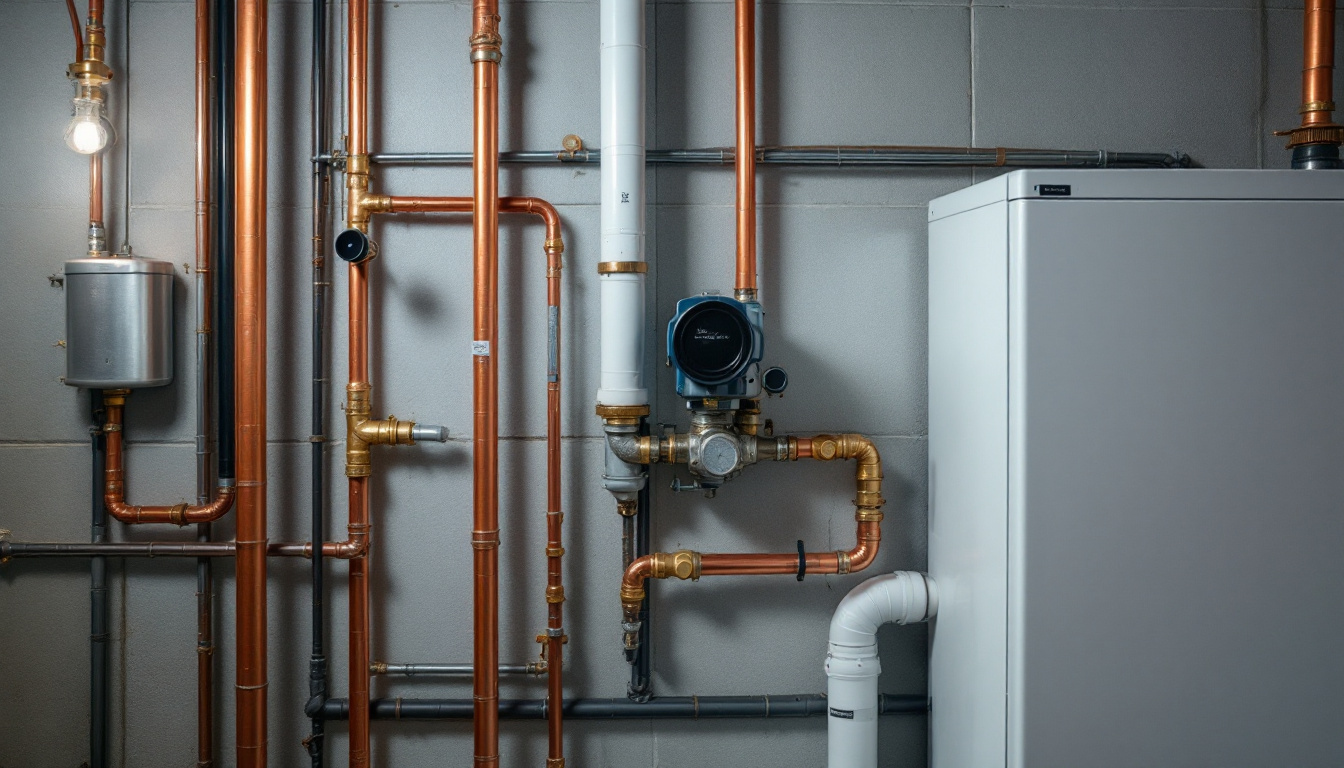
What does a boiler installation actually involve? A boiler installation is five linked jobs: a load calculation, a venting path, a combustion air supply, near-boiler piping with controls, and a commissioning test. Federal law sets the efficiency floor; local code sets the rest.
Key Takeaways
- Gas-fired hot water boilers built on or after January 15, 2021 must hit 84% AFUE under 10 CFR 430.32(e)(2)(iii)(A); oil-fired hot water is 86%.
- The same paragraph bans a constant-burning pilot and requires automatic water temperature adjustment.
- DOE says to set the reset curve so return water stays below 130°F, or the boiler stops condensing.
- Category I vents a chimney at negative pressure; Category IV vents plastic pipe through a sidewall.
- Indoor combustion air is 50 cubic feet per 1,000 Btu/h under IRC Section G2407.5.1.
- Heating appliances were tied to an estimated 76 non-fire carbon monoxide deaths in 2022, per CPSC estimates.
What does a boiler installation actually involve?
A boiler installation starts with arithmetic, not equipment. DOE’s Building America Solution Center checklist for an oil or gas boiler replacement puts sizing first: equipment “shall be selected and sized in accordance with the Air-Conditioning Contractors of America (ACCA) manuals J and S.”
Order matters because each step constrains the next. A condensing model chosen before the vent route is surveyed can leave no legal place to terminate the pipe. Capacity and fuel are settled in our replacement boiler guide; distribution in how baseboard loops carry heat.
The Energy Information Administration counted 9.29 million of 123.53 million occupied US homes on a steam or hot water system in 2020, a split mapped in how American homes are heated.
What efficiency must a new boiler installation meet?
Federal minimums live in 10 CFR 430.32(e)(2). For residential boilers manufactured on and after January 15, 2021, the rule sets 84% AFUE for gas-fired hot water, 82% for gas-fired steam, 86% for oil-fired hot water and 85% for oil-fired steam. Electric hot water and electric steam boilers carry no AFUE number. A combi boiler is tested under the same boiler rules even though it also heats tap water.
Those are the amended standards DOE adopted in a final rule published January 15, 2016. Boilers built between September 1, 2012 and that compliance date sat two points lower on each gas class. The trigger is manufacture date, not install date.
The paragraph also carries design requirements. A constant-burning pilot is not permitted on gas-fired boilers, and automatic water temperature adjustment is required on hot water boilers unless they carry a tankless domestic coil. Furnaces run a steeper track, as our report on the 95% AFUE furnace standard sets out.
Why does a condensing boiler need cold return water?
A condensing boiler earns its rating by pulling latent heat from the flue gas, which happens only when returning water is cold enough to drop the exhaust below its dew point. DOE describes a secondary heat exchanger that takes “residual heat in the combustion gases” into the cool return water, and sets the target below 130°F.
Getting there usually means supply temperature below the factory setting. Emitter sizing is the hidden variable: DOE notes baseboards and radiators must be sized on average loop temperature, since undersized emitters send water back too hot. Low-temperature hydronic floor loops make condensing easy; cast iron needs the curve pushed down.
Which venting category does the boiler installation fall under?
Venting category decides the material and the route. DOE’s gas-fired boilers guide defines Category I as a flue “at negative pressure with respect to the combustion appliance zone” above 140°F, Category III as positive pressure and non-condensing, and Category IV as a “vent pipe under positive pressure and flue gases under 140°F.”
| Category | Vent pressure | Flue gas | Typical vent and route |
|---|---|---|---|
| Category I (atmospheric or induced draft) | Negative | Above 140°F | Lined chimney or B vent, vertical |
| Category III | Positive | Above 140°F | Listed stainless gas vent, often sidewall |
| Category IV (condensing) | Positive | Under 140°F | PVC, CPVC or polypropylene, wall or roof |
| Direct vent (sealed combustion) | Varies | Varies | Two pipes: outdoor air in, flue out |
Because condensing flue gases are cooler, DOE says they “can be vented through the wall or roof by means of a PVC pipe rather than a chimney.” DOE’s gas-fired boilers code compliance brief sends installers to IRC Section G2427.8, Venting System Termination Location, which sets minimum distances from forced air inlets, windows, doors and gravity inlets by equipment size.
Condensate is the other side of the trade. DOE warns it “is highly acidic (pH less than or equal to 3) so local code may require that it be pretreated before disposing to the sewer.”
How much combustion air does the boiler room need?
If the boiler is not sealed combustion, the room supplies the air. DOE’s brief on rooms containing fuel-burning appliances restates IRC Section G2407.5.1: “The minimum required volume shall be 50 cubic feet per 1000 Btu/h of the appliance input rating.” A 100,000 Btu/h boiler needs 5,000 cubic feet of indoor volume.
Where the room is too small, outdoor openings take over: 1 square inch of free area per 4,000 Btu/h through vertical ducts, 1 per 2,000 Btu/h horizontal, or 1 per 3,000 Btu/h with a single opening. Direct vent equipment skips the calculation, and DOE says “the risk of backdrafting is eliminated.”
The orphaned flue problem
When a condensing boiler leaves a shared masonry chimney and vents out a sidewall, a water heater left behind can be stranded in an oversized, cold flue that no longer drafts. DOE’s checklist calls for sealing vacated chimney entry points and resolving orphaned water heater venting. Heating appliances were tied to an estimated 76 non-fire carbon monoxide deaths in 2022.
Why does an oversized boiler installation short cycle?
An oversized boiler satisfies the thermostat faster than it settles into steady combustion, so it stops and restarts. DOE puts it plainly: “When equipment is oversized, it can short cycle or turn on and off repeatedly before the demand is met, which can have negative impacts on energy use, comfort, and equipment durability.”
Sizing discipline is a code item. DOE cites IECC Section R403.7: equipment “shall be sized in accordance with ACCA Manual S based on building loads calculated in accordance with ACCA Manual J.” Where the smallest boiler still exceeds the load, DOE suggests oversizing the emitters to lengthen the burn.
An automatic post-purge control “keeps the system pump on for several minutes after the boiler stops firing to disperse the heat still residing in the mass of the boiler.” What that is worth depends on fuel prices, tracked in what heat costs by fuel.
Which controls does a boiler installation need?
Two layers apply. Federal law requires automatic water temperature adjustment, and specifies that with no inferred heat load the control “shall limit the temperature of the water in the boiler to not more than 140 degrees Fahrenheit.”
Energy code adds outdoor reset. DOE cites IECC Section R403.2: hot water boilers on one-pipe or two-pipe systems “should have an outdoor reset control that lowers the boiler water temperature based on the outdoor temperature.” Section R403.1 calls for a programmable thermostat, a device whose limits we cover in how thermostats actually work.
Sensor placement is part of the install. DOE puts the outdoor reset sensor “away from any exhaust vents including kitchen, bath, dryer, and mechanical system vents” and out of direct sunlight. It also cautions against pairing reset with deep nighttime setback, since a right-sized condensing system may lack the capacity to recover.
Can the same boiler heat the domestic hot water?
Yes. DOE describes boilers that “provide heat for a potable hot water tank in addition to providing hot water to room heaters,” which it calls indirect water heating. The tank, not the boiler, meets the draw.
The alternative is a tankless domestic coil inside the boiler, with a regulatory tell: 10 CFR 430.32 exempts boilers carrying those coils from the automatic water temperature requirement, because the boiler stays hot year round. For a separate appliance, see our water heater replacement guide.
Pipe an indirect tank as its own zone off the near-boiler manifold, with priority over space heating. That piping still has to hold the design spread: DOE requires “a minimum of a 20°F temperature differential” between supply and return under design conditions.
What should the commissioning paperwork show?
A boiler installation is finished when the documents exist, not when the burner lights. DOE’s checklist requires that “where present, the gas line shall be tested for leaks and a combustion safety test shall be performed after installation is complete.” Ask for these in writing:
- Model, fuel, input rating and AFUE, matched to its 10 CFR 430.32 class.
- The ACCA Manual J load calculation and the Manual S selection behind it.
- Venting category, vent material and termination against IRC Section G2427.8.
- Combustion air method: sealed, indoor volume, or outdoor openings.
- Gas leak test and combustion safety test results.
- Reset curve settings, below the boiler’s high limit.
- Supply and return temperatures showing the 20°F spread.
- Permit number and inspection sign-off, where required.
Keep that file. It is the baseline every later visit measures against, the point of our annual boiler service checklist, and the sharpest filter when vetting an HVAC contractor.
How we researched this
Research date: September 2026. Efficiency floors and design requirements were read directly from 10 CFR 430.32 on eCFR. Code sections are cited through DOE Building America Solution Center briefs, because codes.iccsafe.org blocks automated access. Installed prices are excluded: no federal or national-lab source publishes a residential boiler price series, and vendor surveys are not data. Reddit was skipped entirely, because this is a combustion and carbon monoxide topic where anonymous anecdotes are not evidence.
Frequently asked questions
Does a boiler installation need a permit?
In many jurisdictions, yes. Fuel-fired appliance replacement, gas piping and venting are normally permitted work. DOE’s checklist treats code compliance as part of the job, so ask for the permit number before final payment.
Can a condensing boiler use the existing chimney?
Usually not. DOE says condensing flue gases vent “through the wall or roof by means of a PVC pipe rather than a chimney.” A masonry flue left serving only a water heater has to be re-evaluated for that smaller load.
What is the minimum AFUE for an oil-fired boiler?
Under 10 CFR 430.32(e)(2)(iii)(A), an oil-fired hot water boiler manufactured on or after January 15, 2021 must reach 86% AFUE, and an oil-fired steam boiler 85%. Oil steam boilers carry no automatic water temperature design requirement.
Do steam boilers follow the same rules?
Partly. Gas-fired steam boilers must hit 82% AFUE and may not use a constant-burning pilot. Steam systems do not run cool return water, so the condensing logic above does not apply to them.
Does a new boiler require a carbon monoxide alarm?
DOE recommends an alarm in any home with combustion appliances, “in a central location, in the immediate vicinity of each separate sleeping area,” certified to CSA 6.19 or UL 2034 and hard-wired with battery back-up.
Why does a new boiler cycle on and off so often?
Usually oversizing. DOE warns that oversized equipment “can short cycle or turn on and off repeatedly before the demand is met.” A modulating burner, a lower reset curve or larger emitters all lengthen the burn.
Sources
- eCFR. “10 CFR 430.32.” https://www.ecfr.gov/current/title-10/section-430.32. Accessed September 2026.
- Federal Register. “Residential Boilers Final Rule, January 15, 2016.” https://www.federalregister.gov/documents/2016/01/15/2016-00025/energy-conservation-program-energy-conservation-standards-for-residential-boilers. Accessed September 2026.
- DOE Building America. “Condensing Boilers.” https://basc.pnnl.gov/resource-guides/condensing-boilers. Accessed September 2026.
- DOE Building America. “Gas-Fired Boilers.” https://basc.pnnl.gov/resource-guides/gas-fired-boilers. Accessed September 2026.
- DOE Building America. “Gas-Fired Boilers Code Compliance Brief.” https://basc.pnnl.gov/code-compliance/gas-fired-boilers-code-compliance-brief. Accessed September 2026.
- DOE Building America. “Rooms Containing Fuel-Burning Appliances.” https://basc.pnnl.gov/code-compliance/rooms-containing-fuel-burning-appliances-code-compliance-brief. Accessed September 2026.
- DOE Building America. “Oil or Gas Boiler Replacement.” https://basc.pnnl.gov/home-improvement-expert/checklists/oil-or-gas-boiler-replacement. Accessed September 2026.
- DOE Building America. “Combustion Safety: CO Alarms Installed.” https://basc.pnnl.gov/resource-guides/combustion-safety-co-alarms-installed. Accessed September 2026.
- ENERGY STAR. “Boilers.” https://www.energystar.gov/products/boilers. Accessed September 2026.
- CPSC. “Non-Fire Carbon Monoxide Deaths, 2022 Annual Estimates.” https://www.cpsc.gov/s3fs-public/Non-Fire-Carbon-Monoxide-Deaths-Associated-with-the-Use-of-Consumer-Products-2022-Annual-Estimates.pdf. Accessed September 2026.
- EIA. “2020 RECS Table HC6.1.” https://www.eia.gov/consumption/residential/data/2020/hc/pdf/HC%206.1.pdf. Accessed September 2026.
Leave a Reply