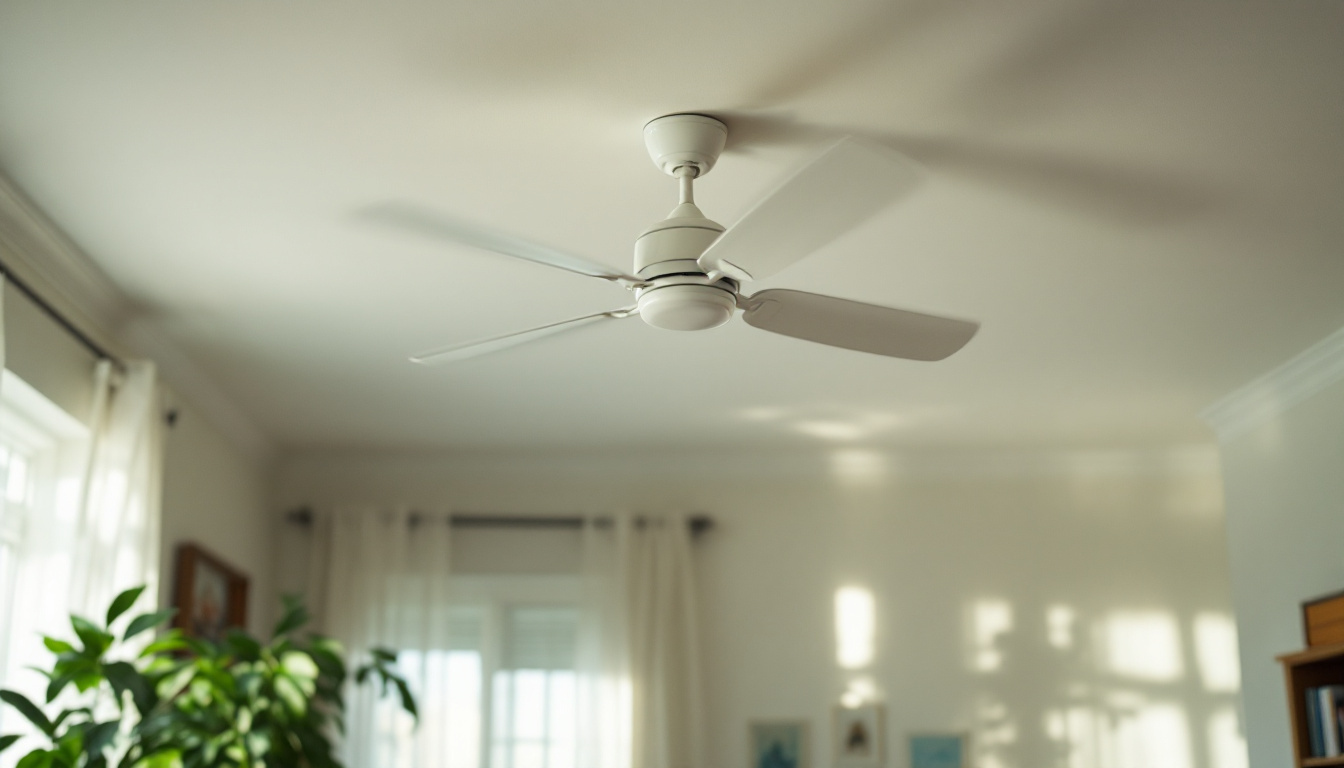
Which ceiling fan direction is right for summer and winter? Counterclockwise at higher speed in summer, viewed from below, for a cooling breeze. Clockwise on low in winter to push warm ceiling air down. DOE says a fan lets you raise the thermostat about 4°F, but only if you actually raise it.
Key Takeaways
- DOE: a running ceiling fan lets you raise the thermostat “by about 4°F without reducing comfort” (archived copy).
- Florida Solar Energy Center: fans plus a 2°F higher set point saved about 14% of cooling energy; with no set point change, use may rise 15%.
- Every ceiling fan made since January 1, 2007 must be reversible under 10 CFR 430.32(s), with narrow exceptions.
- Our calculation: a median 52-inch standard ENERGY STAR fan (29.0 W on high) costs about $1.28 a month at 8 hours a day and 18.34 cents per kWh.
- EIA’s 2020 RECS: 89.45 million of 123.53 million US homes use ceiling fans.
- Ceiling fans “cool people, not rooms,” says ENERGY STAR, so an empty room’s fan should be off.
Which ceiling fan direction is right in summer and in winter?
Counterclockwise in summer and clockwise in winter, looking up at the fan. DOE’s Fans for Cooling page (archived copy) says to “Run ceiling fans counterclockwise to create a cooling breeze” and in winter to “Reverse the direction to clockwise and set to low speed to circulate warm air from the ceiling down to living spaces.”
Speed matters too. Summer comfort comes from air moving across skin. In winter, ENERGY STAR describes a “gentle updraft” on low that “forces warm air near the ceiling down into the occupied space.”
| Situation | Direction (from below) | Speed | What the airflow does |
|---|---|---|---|
| Summer, room occupied | Counterclockwise | Medium to high | Downdraft onto people; wind chill effect (DOE, ENERGY STAR) |
| Winter, room occupied | Clockwise | Low | Updraft moves warm ceiling air down the walls (DOE, ENERGY STAR) |
| Any season, room empty | Not applicable | Off | No benefit; fans “cool people, not rooms” (ENERGY STAR) |
Why does the direction rule come down to blade pitch?
Because the blades are tilted. The Building America Solution Center (BASC), a DOE resource, defines blade pitch as “the angle of the fan’s blades, and it is measured in degrees.” Spin a tilted blade one way and it pushes air down; reverse it and the same tilt lifts air toward the ceiling.
So the counterclockwise rule describes how residential fans are built, not physics. ENERGY STAR’s check works on any fan: in summer, “standing directly under the ceiling fan you should feel a cool breeze.”
Federal rules at 10 CFR 430.32(s)(1) require “the capability of reversible fan action” on ceiling fans made since January 1, 2007, except industrial and outdoor fans or where safety standards forbid it. BASC says the control “is usually found on the fan’s switch housing, just below the blades.”
What is the right ceiling fan direction actually worth in energy?
Only what you take back at the thermostat. DOE says: “Using a ceiling fan allows you to raise the thermostat setting by about 4°F without reducing comfort.” The saving appears only when the set point moves; see our guide to summer and winter thermostat settings.
A 1996 Florida Solar Energy Center (FSEC) paper simulated Florida homes: fans plus a 2°F higher set point gave “about a 14% net savings in annual cooling energy use,” and 1°F gave 2.6%. With no change, “cooling energy use may increase by 15%.”
Metered results from over 400 Florida homes showed “no cooling energy savings due to ceiling fans”: owners with fans kept the same thermostat settings as owners without.
Fans cool people, not rooms
A ceiling fan does not lower air temperature. DOE’s summer tips page (archived copy): “Turn off ceiling fans when you leave the room. Remember that fans cool people, not rooms, by creating a wind chill effect.”
A ceiling fan only stirs the room it hangs in. A whole house fan and attic fans do different jobs, and BASC notes ceiling fans “cannot heat, cool, filter or dehumidify” air.
So a fan can make a muggy room feel cooler while the moisture stays, the problem behind a house that feels cold but damp. DOE adds: “In moderate climates, ceiling fans can sometimes replace air conditioning altogether.”
How much does a ceiling fan cost to run?
About half a cent an hour on high, by our calculation. No federal agency publishes a running cost, so we combined the ENERGY STAR certified ceiling fan list with EIA’s Electric Power Monthly Table 5.6.A.
- Wattage: 504 certified 52-inch standard models (huggers excluded), pulled September 2026; median 29.0 W on high, 3.5 W on low.
- Energy: DOE’s formula (watts × hours ÷ 1,000) gives 29.0 W × 8 hours = 0.232 kWh a day, 6.96 kWh over 30 days.
- Price: EIA puts the June 2026 US residential average at 18.34 cents per kWh.
- Cost: 6.96 kWh × $0.1834 = about $1.28 a month on high, about $0.15 on low.
At Hawaii’s June 2026 average of 52.72 cents the same month costs about $3.67; at Louisiana’s 13.49 cents, about $0.94 (see our state electricity price table). The bigger lever is the thermostat step, as our look at what air conditioning costs to run shows.
How efficient must a ceiling fan be under federal rules and ENERGY STAR?
Efficiency is airflow per watt (CFM/W), and the floor rises with blade span. Since January 21, 2020, 10 CFR 430.32(s)(2) requires standard ceiling fans to reach 0.65 D + 38.03 CFM/W, with D the blade span in inches; huggers need 0.29 D + 34.46.
ENERGY STAR’s key product criteria require 2.63 D minus 26.83 for standard fans from 36 to 78 inches, a “weighted efficiency metric based on the ceiling fan performance at multiple speeds and in stand-by mode.”
| Benchmark for a 52-inch standard fan | Minimum or median CFM/W | Basis |
|---|---|---|
| Federal standard, 10 CFR 430.32(s) | 71.83 | Our calculation from the formula |
| ENERGY STAR minimum | 109.93 | Our calculation from the formula |
| ENERGY STAR certified 52-inch models, median | 188.0 | Our calculation, 504 listed models |
Claims of the gap differ: ENERGY STAR says certified fans are “up to 44% more efficient than conventional fans,” while DOE’s Energy Saver page says “up to 60%.” The median counts models, not sales.
What size ceiling fan does a room need, and how high should it hang?
DOE says a 36 or 44 inch fan for rooms up to 225 square feet, 52 inches or more for larger rooms, and multiple fans in rooms longer than 18 feet. BASC prints a finer chart from the American Lighting Association (ALA), a trade group.
| Room area | Suggested fan size | Source |
|---|---|---|
| Up to 75 sq ft | 29 to 36 inches | ALA via BASC |
| 76 to 144 sq ft | 36 to 42 inches | ALA via BASC |
| 144 to 225 sq ft | 44 inches | ALA via BASC |
| 225 to 400 sq ft | 50 to 54 inches | ALA via BASC |
BASC says fans need ceilings “at least eight feet high” and “work best when the blades are 7 to 9 feet above the floor and 8 to 10 inches below the ceiling,” with at least 6 inches to the ceiling and 18 inches to walls. It cites FSEC tests showing “ceiling hugger” fans deliver “40% less air flow than standard ceiling fans.”
A ceiling fan is not a bathroom exhaust fan, and moving air out of a house is ventilation, a separate job.
How many US homes use ceiling fans, and when?
Most. EIA’s 2020 RECS counts 89.45 million of 123.53 million US homes using ceiling fans, about 72% by our division, and 34.07 million using four or more.
EIA found 28.92 million homes run their most used fan “all or almost all of the year,” against 22.13 million in summer only. For damp rooms in any season, a dehumidifier, not a fan, removes moisture.
How we researched this
Researched September 21, 2026. We opened 15 sources and cite 12: DOE Energy Saver (archived copies, as the live pages are unreliable), the DOE Building America Solution Center, ENERGY STAR criteria and its certified model dataset, 10 CFR 430.32 on eCFR, EIA’s 2020 RECS and Electric Power Monthly, and a 1996 FSEC paper. Wattage medians and every dollar figure are our calculations. Manufacturer claims, contractor blogs and Reddit were excluded, as was any percentage saving for the 4°F raise, which DOE does not publish.
Frequently asked questions
Which way should a ceiling fan spin in summer?
Counterclockwise when viewed from below, at medium to high speed. DOE Energy Saver says to “Run ceiling fans counterclockwise to create a cooling breeze.” Stand under the fan: if you feel a breeze on high, the direction is right. Higher speed does the cooling work.
Which way should a ceiling fan spin in winter?
Clockwise, on low speed. ENERGY STAR says this “produces a gentle updraft, which forces warm air near the ceiling down into the occupied space.” High speed in winter defeats the purpose by blowing air on people. DOE Energy Saver gives the same clockwise, low speed instruction.
Does ceiling fan direction really save energy?
Only if you change the thermostat. DOE says a fan lets you raise the setting “by about 4°F without reducing comfort.” A 1996 FSEC simulation found a 2°F raise saved about 14% of cooling energy, while no change could raise use by 15%.
Should I leave a ceiling fan on when nobody is home?
No. ENERGY STAR says ceiling fans “cool people, not rooms” and advises turning the fan off when a room is unoccupied. By our calculation, a 29.0 W fan left on high around the clock costs about $3.83 a month at 18.34 cents per kWh.
How do I change the direction on my ceiling fan?
Use the reversing switch. BASC says it “is usually found on the fan’s switch housing, just below the blades.” Federal rules require reversible action on ceiling fans made since January 1, 2007, except industrial fans, outdoor fans and cases where reversing would violate safety standards.
What size ceiling fan do I need for my room?
DOE suggests a 36 or 44 inch fan for rooms up to 225 square feet and 52 inches or more above that. BASC recommends blades 7 to 9 feet above the floor and 8 to 10 inches below a ceiling at least eight feet high.
Sources
- U.S. Department of Energy, Energy Saver. “Fans for Cooling.” Archived copy. https://web.archive.org/web/2025id_/https://www.energy.gov/energysaver/fans-cooling. Accessed September 2026.
- U.S. Department of Energy, Energy Saver. “Spring and Summer Energy-Saving Tips.” Archived copy. https://web.archive.org/web/2025id_/https://www.energy.gov/energysaver/spring-and-summer-energy-saving-tips. Accessed September 2026.
- U.S. Department of Energy, Energy Saver. “Estimating Appliance and Home Electronic Energy Use.” Archived copy. https://web.archive.org/web/2025id_/https://www.energy.gov/energysaver/estimating-appliance-and-home-electronic-energy-use. Accessed September 2026.
- DOE Building America Solution Center. “Ceiling Fans, ENERGY STAR.” https://basc.pnnl.gov/resource-guides/ceiling-fans-energy-star. Accessed September 2026.
- ENERGY STAR. “Ceiling Fans.” https://www.energystar.gov/products/ceiling_fans. Accessed September 2026.
- ENERGY STAR. “Ceiling Fans Key Product Criteria.” https://www.energystar.gov/products/lighting_fans/ceiling_fans/ceiling_fans_key_product_criteria. Accessed September 2026.
- ENERGY STAR. “Ceiling Fan Installation and Usage Tips.” https://www.energystar.gov/products/lighting_fans/ceiling_fans/installation_usage_tips. Accessed September 2026.
- ENERGY STAR. “ENERGY STAR Certified Ceiling Fans” dataset. https://data.energystar.gov/Active-Specifications/ENERGY-STAR-Certified-Ceiling-Fans/2te3-nmxp. Accessed September 2026.
- eCFR. “10 CFR 430.32 Energy and water conservation standards and their compliance dates,” paragraph (s). https://www.ecfr.gov/current/title-10/chapter-II/subchapter-D/part-430/subpart-C/section-430.32. Accessed September 2026.
- U.S. Energy Information Administration. “2020 RECS Table HC7.1: Air conditioning in U.S. homes.” https://www.eia.gov/consumption/residential/data/2020/hc/xls/HC%207.1.xlsx. Accessed September 2026.
- U.S. Energy Information Administration. “Electric Power Monthly Table 5.6.A,” June 2026 data. https://www.eia.gov/electricity/monthly/epm_table_grapher.php?t=epmt_5_6_a. Accessed September 2026.
- James, P., et al., Florida Solar Energy Center. “Are Energy Savings Due to Ceiling Fans Just Hot Air?” FSEC-PF-306-96, 1996. https://www.fsec.ucf.edu/en/publications/html/FSEC-PF-306-96/index.htm. Accessed September 2026.
Leave a Reply