
Steam radiator hissing is normal during warm-up: the air vent pushes air out ahead of the steam and should go quiet once steam reaches it, after roughly 1 to 20 minutes depending on the vent. Hissing after the radiator is hot, visible steam, or a spitting vent means a stuck vent, high pressure or trapped water.
Is the steam radiator hissing air (normal) or hissing steam (a fault)?
Air leaving a cold radiator is a dry, invisible hiss early in the cycle; steam leaving a hot one shows as a wisp and wets the vent. Hoffman Specialty draws the line on its Model 1A instruction sheet: “Vapor or slight moisture from the vent is normal. Steam continuously passing through the vent indicates a malfunction.”
| What you hear or see | When | Most likely cause | What to do |
|---|---|---|---|
| Soft, steady hiss from the radiator vent | Warm-up, until the radiator is hot to the vent end | Normal: air pushed out ahead of the steam | Nothing |
| Loud whistle while the radiator fills | During fill | Orifice too small, debris, or pressure higher than needed (DOE) | Check pressure first, then fit a faster or clean vent |
| Hiss with a visible plume after the radiator is hot | Every cycle, after steam arrives | Vent element failed or stuck open | Replace the vent; Hoffman says “as needed or every 10 years” |
| Several vents hiss steam at once | Late in long cycles | Boiler cut-out above the vents’ drop-away pressure (Hoffman 1A: 1½ psig) | Read the pressuretrol and gauge |
| Vent spits or dribbles water | Start of cycle or mid-cycle | Radiator tilted away from its valve, valve half closed, wet steam, or vent too fast (Peerless) | Open the valve fully, level the radiator toward the valve |
| Hiss at the stem under the valve handle | While the radiator is hot | Valve stem packing, not the vent | Snug the packing nut with the boiler off and cool |
Compiled by The HVAC Brief from Hoffman HS-100(C) and vents sheet, DOE Building America (2013) and Peerless One-Pipe Steam Systems (2010).
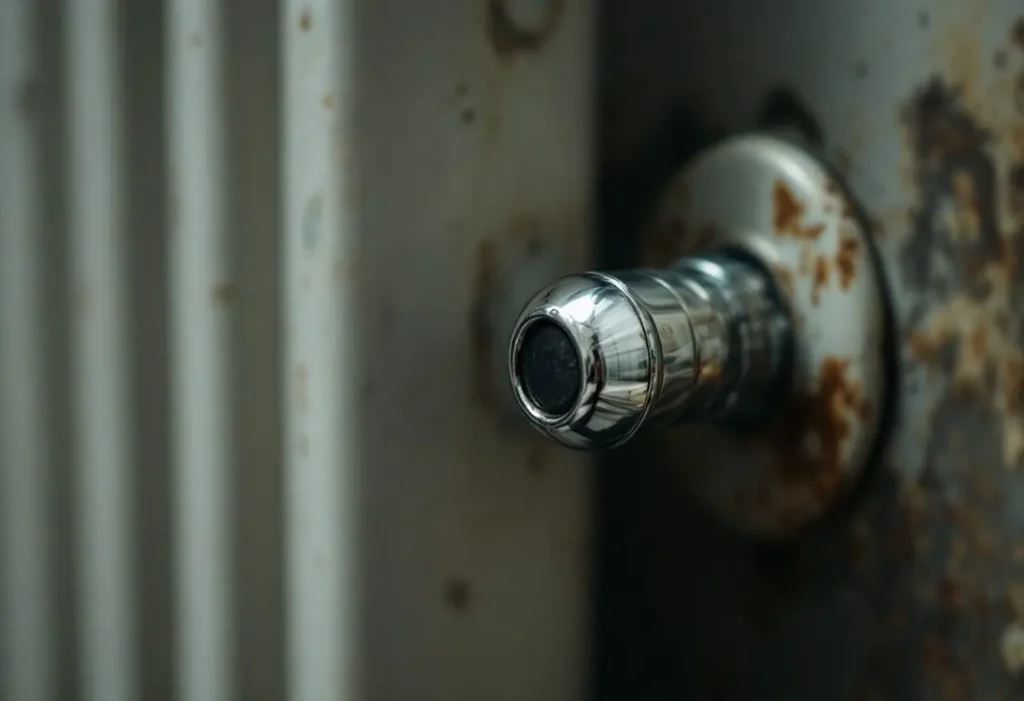
How many minutes should a radiator air vent hiss before it shuts?
Anywhere from about 1 to 20 minutes on the same radiator, depending on the vent. Gerry Gill and Steve Pajek bench-tested vent flow and published a venting capacity chart whose worked example uses 0.013 cubic feet of air per square foot of EDR (equivalent direct radiation), credited to Dan Holohan’s workbook. A 40 square foot EDR radiator therefore holds 0.52 cubic feet of air when cold.
| Vent on a 40 sq ft EDR radiator | Rated flow at 1 oz (cfm) | Minutes of hiss at 1 oz | Rated flow at 2 oz (cfm) | Minutes of hiss at 2 oz |
|---|---|---|---|---|
| Gorton No. 4 (slowest Gorton) | 0.025 | 20.8 | 0.040 | 13.0 |
| Gorton No. 5 | 0.080 | 6.5 | 0.130 | 4.0 |
| Gorton No. 6 | 0.150 | 3.5 | 0.235 | 2.2 |
| Gorton C | 0.270 | 1.9 | 0.450 | 1.2 |
| Gorton D (fastest Gorton) | 0.330 | 1.6 | 0.540 | 1.0 |
| Hoffman 40 (fixed port) | 0.042 | 12.4 | 0.067 | 7.8 |
| Hoffman 1A, port 1 | 0.020 | 26.0 | 0.026 | 20.0 |
| Hoffman 1A, port 6 | 0.145 | 3.6 | 0.225 | 2.3 |
HVAC Brief calculation: 0.52 cu ft of air divided by each vent’s measured flow in the Gill and Pajek chart (2005). 1 oz is 1/16 psi, so 2 oz is 0.125 psi. Runout air and condensing steam, ignored here, lengthen the hiss.
A slow vent near the thermostat can hiss for 13 minutes and still be healthy. Gorton’s own chart rates its No. 6 at 8 ordinary air valves and its D at 27, and tells owners to put small sizes near the boiler and large ones in the coldest rooms. The fault test is not the length of the hiss but whether it stops once the radiator is hot across to the vent.
Why does the steam radiator air valve keep hissing after the radiator is hot?
Because the part that closes it has failed. Peerless describes the vent as a float that keeps water in and a thermal element that “expands when heated to close off the vent”; when that element is fouled or tired, steam keeps passing, and Hoffman calls continuous steam a malfunction.
Confirm the radiator is hot up to the vent end; if not, the vent is still passing air. Look for paint over the port, a common failure in DOE’s Building America guide, and make sure the vent stands upright so its float can seat. On an adjustable 1A, Hoffman ships the cap on port 6, the fastest of six settings, so a new vent may hiss harder than the old one did. Mask the vent before any repainting, and painting a steam radiator covers which paints are rated for steam temperatures and why the work is done with the radiator cold.
Is boiler pressure making every steam radiator vent hiss?
Often, yes, when the hissing shows up on several radiators at once. Hoffman rates the Model 1A’s maximum operating pressure at 1½ psig, defined as its drop-away pressure, “maximum pressure against which the vent can open,” and Peerless warns that the boiler cut-out must sit below the vents’ drop-out pressure or they “cannot function after the initial cycle.”
DOE’s Building America guide says one-pipe systems should typically operate at ½ to 1½ psig and that wrong pressuretrol settings cause short cycles and distribution problems. The control matters: Resideo’s PA404A product data lists a subtractive model adjustable from 3.0 to 15 psi, so it can never cut out below 3 psi, double the 1A’s rating. The additive PA404A starts at 0.5 psi and breaks at set point plus differential, so a 0.5 setting with a 1 psi differential cuts out at 1.5 psi.
Hoffman’s fixed-port Model 40 is rated to 6 psig, so in a house with mixed vents the problem may show on only some radiators. Maker settings for the dial and differential are on our steam boiler pressure page.
Why is the steam radiator vent spitting water instead of just hissing?
Water is reaching the vent, and on 1-pipe steam it can only leave through the supply valve. Peerless states the condensate “must flow back through the same valve where the steam is entering,” so anything that holds water in the radiator floods the vent.
Check, in order: a supply valve left half open, which Peerless says will “restrict condensate flow and cause hammer in the radiator”; a radiator sloping down toward the vent end; and a vent too fast for its radiator, which Peerless says makes condensate pool. A level on top shows the slope; shim the vent end until it falls slightly toward the valve. If every radiator spits, suspect wet steam: the Building America steam balancing page warns that wet steam lets water leak from master vents. Cold rooms from the same faults are covered in our radiator heating repair guide.
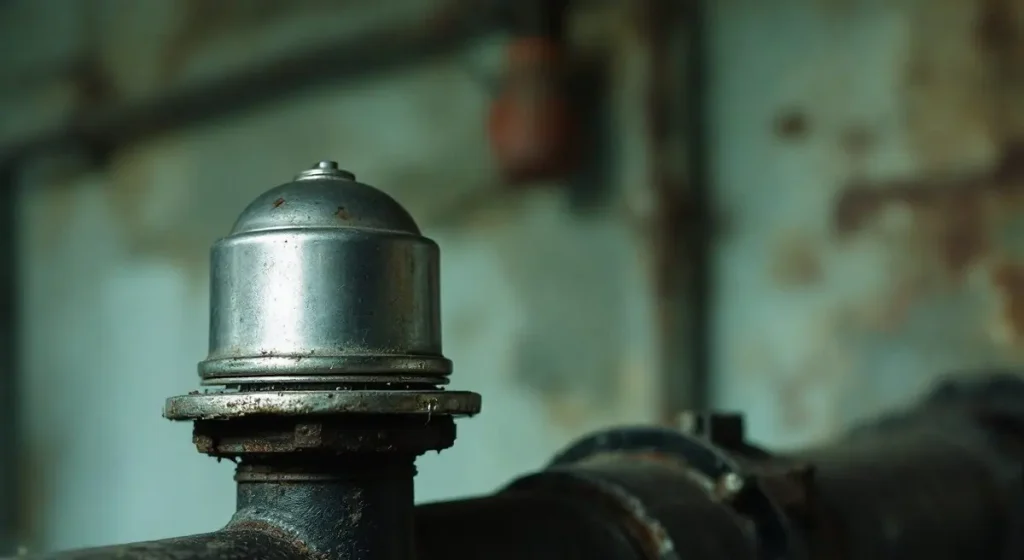
What does a hissing main vent in the basement mean?
A loud hiss at the end of a steam main in the first minutes of a cycle is the main vent working. DOE’s guide says main vents exist “to rapidly vent the large amount of air in the steam lines,” and Peerless calls them “the heart of a one-pipe system.”
The fault to worry about is a main vent that has gone silent. Peerless shows water hammer can collapse its float so it fails closed; the radiator vents then push out all the pipe air, hiss longer, and the nearest rooms heat first. Gill and Pajek measured the No. 2 at 2.200 cfm at 3 oz against 0.300 for a Gorton No. 6 radiator vent. DOE’s 2013 guide wants main vents at least 15 in. from the last elbow on a 6 to 10 in. nipple; the newer Building America resource page says 18 inches.
Steam radiator valve hissing: is it the vent or the valve stem?
A hiss from the small fitting on the side is the vent; a hiss or drip under the handle of the big supply valve is the stem packing. On 2-pipe steam there is no vent, and the hiss comes from a radiator steam trap passing steam. A drip rather than a hiss at that valve is a packing leak, and a radiator valve leaking water covers snugging the packing nut a fraction of a turn and repacking with graphite string when the nut runs out of thread.
Snug or repack it with the boiler off and the radiator cool, and never quiet a hiss by closing the supply valve partway: DOE’s guide says these valves “should always be completely open or completely closed.” Hot water radiators and baseboard have their own causes, covered in hot water baseboard noise.
When is a hissing steam radiator a stop-and-call problem?
Stop when the gauge glass on the boiler shows no water, when the pressure gauge sits well above the roughly 2 psig Peerless gives as a one-pipe operating point, or when water hammer shakes pipes. Peerless names wet steam and hammer as causes of “component damage,” and a low-water fault is the job of the low water cutoff.
A steam technician should read the actual cut-out on a low-range gauge against the vents’ ratings, clear the siphon loop (pigtail) Resideo requires under the control, and confirm each main vent opens cold and closes hot. Never unscrew a vent while the boiler is firing. Add vent checks to the annual boiler service visit; the system’s logic is in our steam heating system explainer.
Frequently asked questions
Is a steam radiator constantly hissing dangerous?
It is a fault more than a hazard. Hoffman’s Model 1A sheet says “Steam continuously passing through the vent indicates a malfunction” and calls for replacing the vent as needed or every 10 years. Several vents hissing at once points to pressure above the 1A’s 1½ psig drop-away rating.
What is the quickest steam radiator hissing fix?
With the boiler off, unscrew the vent and fit a new one, upright on its threads. If the new vent also hisses steam, the cause is pressure or water. DOE Building America says one-pipe systems should typically run at ½ to 1½ psig.
Can a hissing steam radiator vent be cleaned instead of replaced?
Sometimes. DOE’s 2013 Building America guide says radiator vents should be removed and tested, and a vent not passing air “should be cleaned or replaced.” A vent that passes steam when hot has a failed closing element, which cleaning does not repair.
Should a cast iron radiator hiss after the heat shuts off?
A short draw of air back in is normal. DOE’s Building America guide says that as radiators cool, “the air vents open and allow air to re-enter the system,” and Peerless explains that vents act as vacuum breakers when steam condenses.
How we researched this
In November 2026 we read the eight documents listed below: two Hoffman vent sheets, Gorton’s chart (distributor copy), the Peerless one-pipe guide, Resideo’s PA404A data, two DOE Building America steam documents and the Gill and Pajek venting chart. The minutes table is our arithmetic on Gill and Pajek’s bench rates, an estimate rather than a test. Forum posts and retailer listings were excluded; no repair prices appear because no federal source publishes them.
Sources
- Hoffman Specialty (ITT). “Model 1A and 1B Steam Vents, HS-100(C).” https://www.industrialstores.com/media/industrialstores/product/attachments/1571772410IM_1A-B.pdf. Accessed November 2026.
- Hoffman Specialty. “Radiator Steam Vents” (InspectAPedia copy). https://inspectapedia.com/heat/Hoffman_Steam_Vents_1A.pdf. Accessed November 2026.
- Gorton Heating Corporation. “Gorton Air Valve Chart” (distributor copy). https://www.nyrpcorp.com/content/Images/uploaded/Gorton%20Air%20Valves/Gorton%20Air%20Valve%20Chart.pdf. Accessed November 2026.
- Peerless Boilers. “One-Pipe Steam Systems” (2010). https://www.peerlessboilers.com/wp-content/uploads/2018/01/OnePipeSteam.pdf. Accessed November 2026.
- Resideo. “PA404A,B Pressuretrol, 60-2341.” https://res.cloudinary.com/dzhpkjoqj/Resideo/60-2341.pdf. Accessed November 2026.
- U.S. DOE Building America. “Measure Guideline: Steam System Balancing and Tuning” (2013). https://www1.eere.energy.gov/buildings/publications/pdfs/building_america/measure_guide_steam_system_balancing.pdf. Accessed November 2026.
- U.S. DOE Building America Solution Center. “Steam System Balancing in Multifamily Existing Buildings.” https://basc.pnnl.gov/resource-guides/steam-system-balancing-multifamily-existing-buildings. Accessed November 2026.
- Gill, Gerry, and Steve Pajek. “Venting Capacity Chart” (2005). https://www.heatinghelp.com/assets/documents/Balancing-Steam-Systems-Using-a-Vent-Capacity-Chart-1.pdf. Accessed November 2026.
Leave a Reply