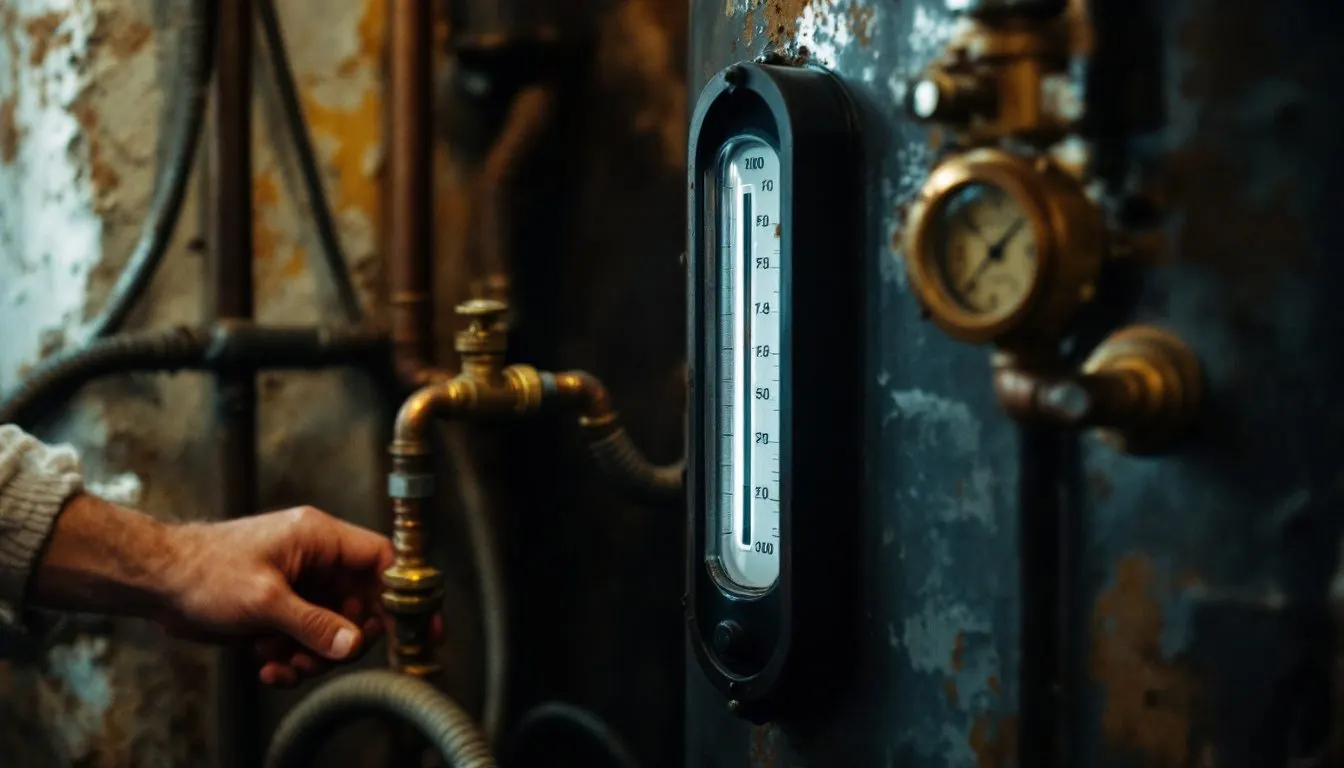
How to add water to a steam boiler: with the burner off and the boiler cool, read the gauge glass, then open the manual fill valve (or the feeder’s bypass or FEED button) slowly and close it when the water sits about halfway up the glass. If the glass shows no water while hot, shut the boiler off first.
How do you add water to a steam boiler, step by step?
Fill a cooled boiler slowly by hand and stop at the normal waterline. The order follows the Weil-McLain EG/PEG user manual 550-142-301 and the Burnham Independence manual 103538-08.
- Turn the thermostat down and wait. Right after shutdown the level reads low while condensate is still in the pipes; Hydrolevel builds a 2-minute factory delay into its VXT feeder for that reason.
- Read the gauge glass. Weil-McLain: “Normal waterline on a steam boiler is halfway up gauge glass.” A marked line on your boiler, or Burnham’s “Lowest Permissible Water Level” plate, wins over the halfway rule.
- If no water shows at all, stop and read the hot-boiler section below.
- Find the fill valve. Burnham pipes it to a return tapping. With an automatic feeder, use its FEED button (Hydrolevel VXT, McDonnell & Miller WFE) or the bypass valve piped around it.
- Open it a little and watch the glass. Burnham’s instruction after draining is to “Fill boiler slowly to normal waterline.” Feeders pass 1 gpm (VXT) to 2 gpm (WFE), so the level can rise fast.
- Close the valve fully at the normal line. If you overshoot, drain back to the line from the boiler drain once the water is cool; Hydrolevel warns that an overfilled system can let “water to escape radiators into the living space.”
- Log the date and amount. That log reveals a leak later.

Where should the water sit in the gauge glass, and what does each reading mean?
About halfway up is normal, per Weil-McLain; every other reading points to a specific fix.
| What the glass shows | What it usually means | What to do |
|---|---|---|
| Steady, about half full | Normal waterline (Weil-McLain) | Nothing; do not top up “to be safe” |
| Low, right after the burner stops | Steam bubbles collapsed, condensate still in the pipes (Peerless) | Wait for returns; recheck before filling |
| Near the bottom, burner off, water still visible | Low water cutoff has stopped the burner (Burnham) | Fill slowly to the normal line, then look for the loss |
| No water visible | Possible dry fire | Shut the boiler off; let it cool before any water goes in (Minnesota DLI, Weil-McLain, Burnham) |
| Bouncing or unsteady while firing | Oil and sediment from piping work (Burnham) | Skimming by a technician, not more water |
| Full to the top | Overfilled by hand, or a feeder valve that will not close (Hydrolevel) | Drain to the line when cool; have the feeder checked |
Compiled by The HVAC Brief from Weil-McLain 550-142-301, Burnham 103538-08, Peerless CHOS396, Hydrolevel VXT-24 and the Minnesota DLI boiler safety guide. A bouncing waterline also shows up as spitting vents, covered in why steam radiators hiss and spit.
Can you add water to a hot steam boiler with an empty gauge glass?
No. Minnesota’s Department of Labor and Industry tells operators: “If water is not visible in the water glass, shut the boiler off immediately until a safe water-level has been determined.” Weil-McLain’s warning is blunter: “Do not add cold water to a hot boiler. Thermal shock can cause the heat exchanger to crack.”
Burnham’s cool-down test: “Allow boiler to cool until crown sheet is no longer too hot to touch,” then “Fill boiler slowly to normal waterline.” No maker document we read gives minutes. Minnesota’s reason: if a low-water condition develops, “it could very well result in an overheating and explosion of your boiler.” An empty glass with the burner still firing means the low water cutoff failed too.
Owners may refill a cool boiler that shows water in the glass. A hot, dry boiler or a burner running at low water belongs to the technician, who checks the cutoff, the pressure control and gauge, and the sections for cracks before restart.
What does the automatic water feeder do, and when do you still fill by hand?
A feeder adds water when the low water cutoff calls, after a delay, usually only enough to restart the burner. In its factory LWCO setting, the Hydrolevel VXT-24 feeds “only until the low water cut-off re-energizes the burner circuit (or a maximum of 5 gallons),” and Hydrolevel says that “may only be enough water to satisfy the minimum requirements.” A boiler with a feeder can still sit low in the glass all winter.
The McDonnell & Miller WFE Uni-Match: its dwell and feed cycles “allow condensate to return to boiler before feeding,” and the feeder stops when the cutoff is satisfied or the cycle time runs out. The VXT shows LOC after “two consecutive feed cycles” fail to restore the cutoff (a leak, shut valve or clogged strainer). Its counter flashes after it rolls past 999 gallons, which Hydrolevel calls “an excessive feed amount for most applications.”
Do you blow down the low water cutoff when you add water?
Only a float type, and on its own schedule. Burnham’s Independence manual says to open the blow-off valve on a McDonnell & Miller 67 float cutoff “Weekly (or more frequently if necessary)”, following the blow-down card on the jacket. Probe cutoffs such as the McDonnell & Miller PSE-802 and Hydrolevel CycleGard CG400 get annual probe cleaning instead.
The DOE Building America steam guideline asks for restraint: when testing the cutoff, drain “only until the safety engages and the boiler shuts off,” because fresh oxygenated water corrodes the boiler. Test steps are in our low water cutoff guide; the yearly list is in what a boiler service should cover.
How much make-up water means the steam boiler has a leak?
Far less than most owners expect. Burnham’s limits for the Independence run between 0.1 and 0.4 gallons a month, and tells owners to keep leakage “to less than 2 percent of the total water volume each month.” Above that, its instruction is to have a qualified technician check the system for leaks.
| Burnham model | Water at normal line (gal) | Normal line to cutoff (gal) | Burnham max per month (gal) | Burnham max per year (gal) | One drop to cutoff equals |
|---|---|---|---|---|---|
| IN3I | 5.1 | 3.9 | 0.1 | 1 | 39 months of the cap |
| IN4I | 6.5 | 5.0 | 0.1 | 1 | 50 months |
| IN5I | 7.9 | 6.1 | 0.2 | 2 | 30 months |
| IN6I | 9.3 | 7.2 | 0.2 | 2 | 36 months |
| IN7I | 10.7 | 8.3 | 0.2 | 3 | 42 months |
| IN8I | 12.1 | 9.4 | 0.2 | 3 | 47 months |
| IN9I | 13.5 | 10.5 | 0.3 | 3 | 35 months |
| IN10 | 14.9 | 11.6 | 0.3 | 4 | 39 months |
| IN11 | 16.3 | 12.7 | 0.3 | 4 | 42 months |
| IN12 | 17.7 | 13.8 | 0.4 | 4 | 34 months |
HVAC Brief calculation: volumes from Table 1 and limits from Section X.M of the Burnham Independence manual 103538-08 (3/18); last column is the steamable volume divided by the monthly limit (script and output kept with this article). Read it this way: if an IN5I falls from the normal line to the cutoff in one month, it lost about 6.1 gallons, roughly 30 times what Burnham allows. Use your own manual’s figures for other boilers.
Hydrolevel’s VXT instructions give looser annual guidelines, 18 gallons a year up to 90,000 Btu/h net IBR and 35 above 185,000, but say the boiler maker’s limits “supercede Hydrolevel recommendations.” For how often a tight system should need a top-up at all, see how steam heating systems work.
Peerless says a boiler that “used a lot of make-up water” may have a leaking wet return; Weil-McLain lists “Leaks in boiler or piping” and rules out petroleum-based stop-leak compounds. Above the floor, vents that pass steam and a failed steam trap also cost water. Burnham explains the stakes: make-up water brings sediment and oxygen that “can corrode the cast iron through from the inside,” and its warranty excludes both failures.
What happens if a steam boiler runs out of water?
The low water cutoff should stop the burner first; if it fails, the boiler dry fires. McDonnell & Miller’s catalog MM-825 puts it plainly: “Should the internal water level drop too low, the boiler can burn out.” Peerless adds that even a sloped waterline from bad near-boiler piping “can actually result in dry firing some sections.” Margins are small: Peerless says new, smaller-content boilers “can usually only steam for about 15 minutes before they drop to the low water point.” If the heat is off and you suspect the cause, start with our no-heat boiler checks.
Frequently asked questions
How often should you have to add water to a steam boiler?
Rarely. Burnham’s Independence manual says that if you must add water more than once a month during normal operation, a qualified technician should check the system for leaks. Its monthly limits run from 0.1 to 0.4 gallons depending on boiler size, which is 1.6 to 6.4 cups by our conversion. Filling every week is a leak to find, not a routine.
How to add water to a boiler that heats with hot water, not steam?
A hot water boiler has no gauge glass; it is filled by pressure. The fill line runs through a boiler feed valve, and Taco’s instruction sheet 102-006 says its feed valve is factory set to deliver water at 12 psi. You top it up by watching the pressure gauge, not a water level, and the steam procedure on this page does not apply.
How long should a steam boiler cool before adding water?
No maker document we read sets a time in minutes. Burnham’s Independence manual uses a touch test: let the boiler cool “until crown sheet is no longer too hot to touch,” then fill slowly to the normal waterline. Weil-McLain’s user manual adds that cold water in a hot boiler can crack the heat exchanger through thermal shock.
Why does the water level drop when the steam boiler shuts off?
Peerless explains that when the burner stops, steam bubbles in the boiler water collapse, so the surface level drops, while condensate is still out in the piping. In some systems the level can briefly go out of the gauge glass. Wait for the returns before adding water, or the boiler will flood when the condensate arrives.
How we researched this
On 19 November 2026 we read the Burnham Independence manual (103538-08), the Weil-McLain user manual 550-142-301, Peerless CHOS396, Hydrolevel VXT-24 and McDonnell & Miller WFE feeder manuals, the MM-825 catalog, Taco sheet 102-006, DOE’s Building America steam guideline and Minnesota DLI’s boiler safety guide. The make-up table is our arithmetic on Burnham’s figures. The three ranking articles (reservoir tanks, commercial feed pumps, UK sealed systems) and forum, video and social posts were excluded as sources.
Sources
- U.S. Boiler Company (Burnham). “Independence Installation, Operating and Service Instructions, 103538-08 (3/18).” https://res.cloudinary.com/dzhpkjoqj/TradeService/BURNHMINST00031.pdf. Accessed November 2026.
- Weil-McLain. “User’s Manual CGa/CGi/EG/PEG/LGB, 550-142-301/0224.” https://www.weil-mclain.com/wp-content/uploads/Users-Manual-CGa-S3-CGi-S4-EG-PEG-S6-LGB-S2-S3-0224.pdf. Accessed November 2026.
- Peerless Boilers. “One-Pipe Steam Systems, CHOS396.” https://www.peerlessboilers.com/wp-content/uploads/2018/01/OnePipeSteam.pdf. Accessed November 2026.
- Hydrolevel. “Model VXT-24 Water Feeder Instructions” (PEX Universe copy). https://pexuniverse.com/uploads/literature/hl-vxt-24-ins.pdf. Accessed November 2026.
- McDonnell & Miller (Xylem). “Series WFE Uni-Match Electric Water Feeder IOM, MM-211163 rev 10.” https://www.xylem.com/siteassets/brand/mcdonnell-amp-miller/resources/manual/series-wfe-uni-match-electric-water-feeder-iom-en-fr-es-mm-211163-rev-10.pdf. Accessed November 2026.
- McDonnell & Miller (Xylem). “General Catalog MM-825” (Consolidated Supply copy). https://res.cloudinary.com/consolidated-supply/resource/raw/xylem_126400_catalog.pdf. Accessed November 2026.
- Taco, Inc. “Boiler Feed Valves and Dual Controls, Instruction Sheet 102-006” (SupplyHouse copy). https://s3.amazonaws.com/s3.supplyhouse.com/manuals/1319637262560/67032_PROD_FILE.pdf. Accessed November 2026.
- U.S. Department of Energy, Building America (Choi, Ludwig, Brand). “Measure Guideline: Steam System Balancing and Tuning for Multifamily Residential Buildings” (April 2013). https://www1.eere.energy.gov/buildings/publications/pdfs/building_america/measure_guide_steam_system_balancing.pdf. Accessed November 2026.
- Minnesota Department of Labor and Industry. “Boiler safety: Your guide to safer boiler operation.” https://www.dli.mn.gov/sites/default/files/pdf/boiler-safety.pdf. Accessed November 2026.
Leave a Reply