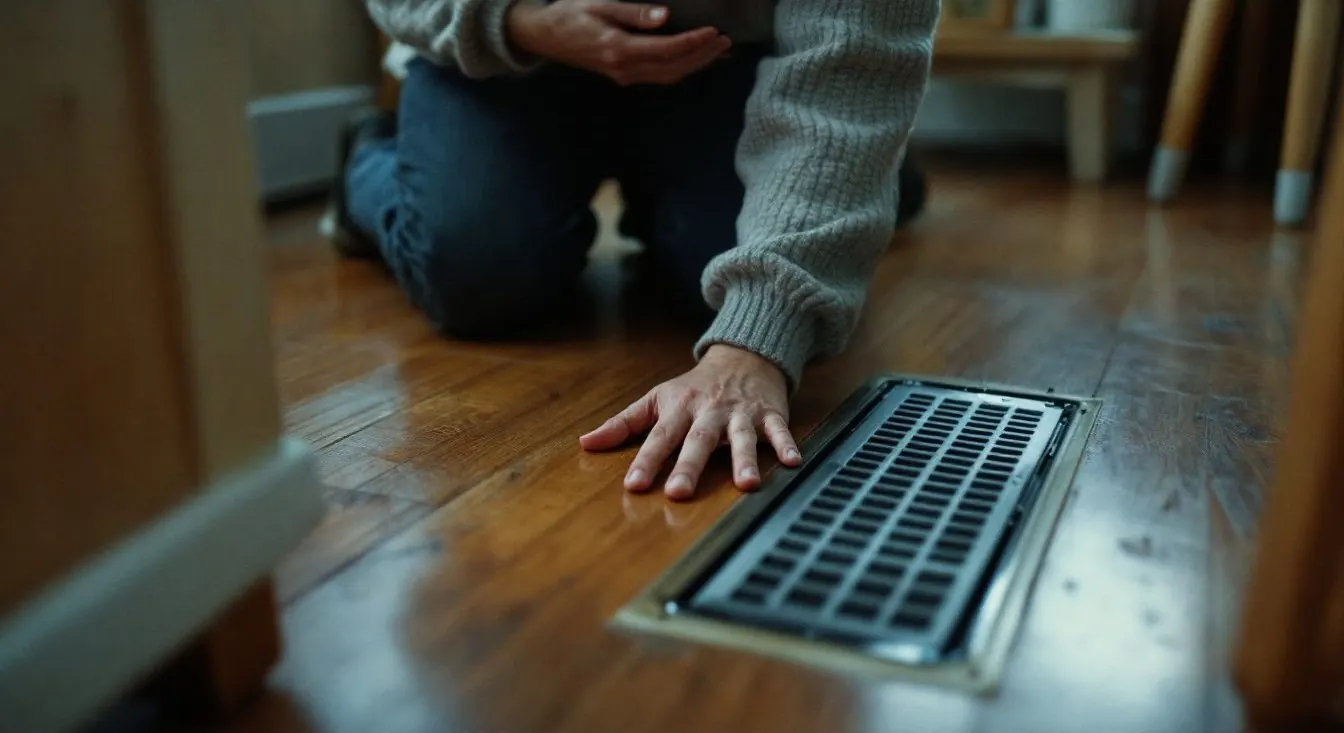
If the furnace is running but the house is not warming up, measure the temperature rise: supply air minus return air after 5 minutes of burner run. Below the rating plate range, the furnace is making too little heat. Above it, airflow is choked. Inside it, the heat is leaking from the ducts or the cold has outrun the furnace.
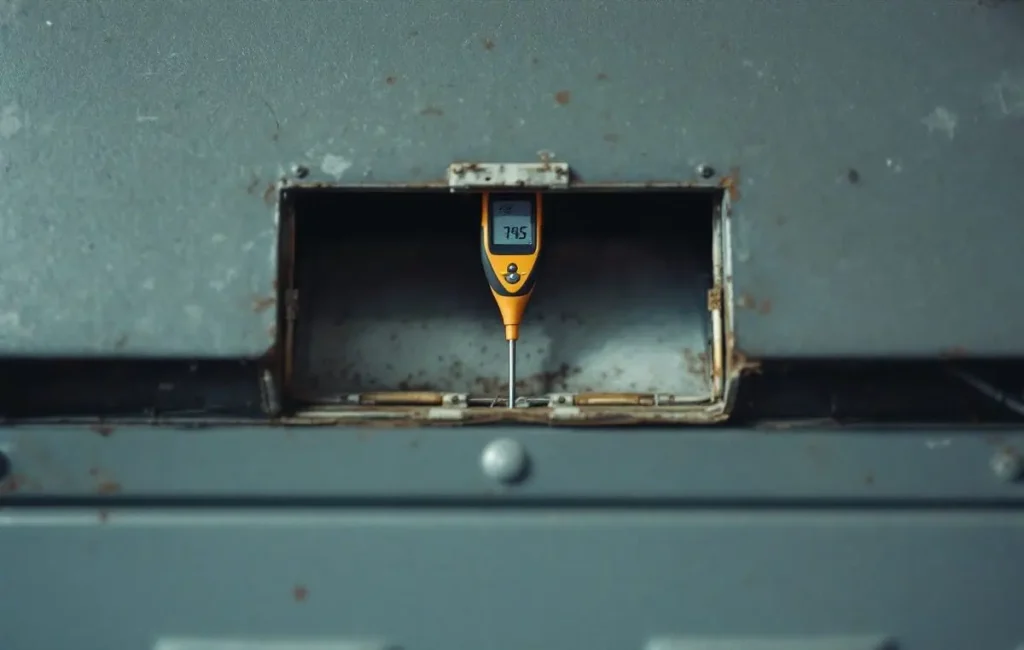
What does the temperature rise tell you when the furnace runs but the house stays cold?
Rheem’s 801T manual puts one thermometer in the supply duct, out of line of sight of the heat exchanger, and one in the return, then subtracts once the supply reading stops climbing (“approximately five minutes”) and compares the difference with the name plate (Rheem 801T installation manual).
The range is printed on the furnace name plate and varies by model. Rheem’s sample plate reads 25 to 55°F; Goodman’s spec sheet lists 30 to 60°F for the GMVC80803B*C and 15 to 45°F for the GMVC80603B*C (Goodman SS-FGMVC8). There is no single normal number; read your own plate.
| Rise you measure | What the maker says | What you feel | Next step |
|---|---|---|---|
| Near zero, blower on | Burners not lit; blower moves room air | Cool air | Fan setting, then ignition sequence |
| Below the plate range | Rheem: “the air flow is too much or the manifold pressure needs to be adjusted” | Lukewarm air, long runs | Technician checks gas pressure, staging, blower tap |
| Middle of the range | Rheem: the rise “should be in the middle of the range” | Hot at the furnace, rooms still cool | Compare registers with supply; check ducts and outdoor temperature |
| Above the range, or burners drop out with blower on | Rheem: “the air flow is too low”; Goodman: excess static pressure causes “limit switch tripping” | Hot bursts, then cool air | Clean filter, then a static pressure test |
Goodman prints the conversion that turns the rise into heat: Btu/h output = CFM × 1.08 × rise. For the GMVC80803B*C, rated at 64,000 Btu/h output, a 45°F rise in the middle of its range means about 1,317 CFM. If that same airflow shows only a 20°F rise, the furnace is delivering about 28,444 Btu/h, under half its rating.
Without test ports, a probe thermometer at the register nearest the furnace and at the main return grille gives a rough Rheem style reading; register air has crossed ductwork, so it understates the rise.
Is the house losing heat faster than the furnace can make it below the design temperature?
On the coldest nights, yes. A furnace is sized for the 99% heating design temperature of its location, and ENERGY STAR’s National HVAC Design Report allows a heating-only furnace of 100 to 140% of the calculated heat loss at that temperature (ENERGY STAR National HVAC Design Report).
| County | Heating design limit |
|---|---|
| Cass County, ND (Fargo) | minus 15°F |
| Hennepin County, MN (Minneapolis) | minus 11°F |
| Cook County, IL (Chicago) | minus 3°F |
| Franklin County, OH (Columbus) | 5°F |
| Fulton County, GA (Atlanta) | 20°F |
A furnace sized at exactly 100% of the loss runs nonstop at these temperatures. The guide notes that EPA recommends the Manual J 99% heating value for the closest weather station (ENERGY STAR Design Temperature Limit Reference Guide).
Worked example: a Minneapolis house losing 50,000 Btu/h at minus 11°F with 70°F inside (ENERGY STAR’s indoor design value), heated by the 64,000 Btu/h Goodman above, 128% of the loss.
| Furnace condition | Heat reaching the rooms | House holds 70°F down to | Burner run share at 0°F |
|---|---|---|---|
| High fire, ducts inside the house and tight | 64,000 Btu/h | minus 34°F | 68% |
| High fire, a quarter lost in attic ducts | 48,000 Btu/h | minus 8°F | 90% |
| Two-stage stuck on low fire (70%), tight ducts | 44,800 Btu/h | minus 3°F | 96% |
| Low fire and a quarter lost in ducts | 33,600 Btu/h | 16°F | Nonstop below 16°F |
Goodman states the GMVC8 “Low-fire rate is 70% of high-fire rate.” Tight ducts, and the furnace wins; leaky attic ducts, and it loses before the night reaches design. Our run time worked example shows the minute by minute cycling up to that point, and the load calculation explainer covers how the 50,000 figure is produced for a real house.
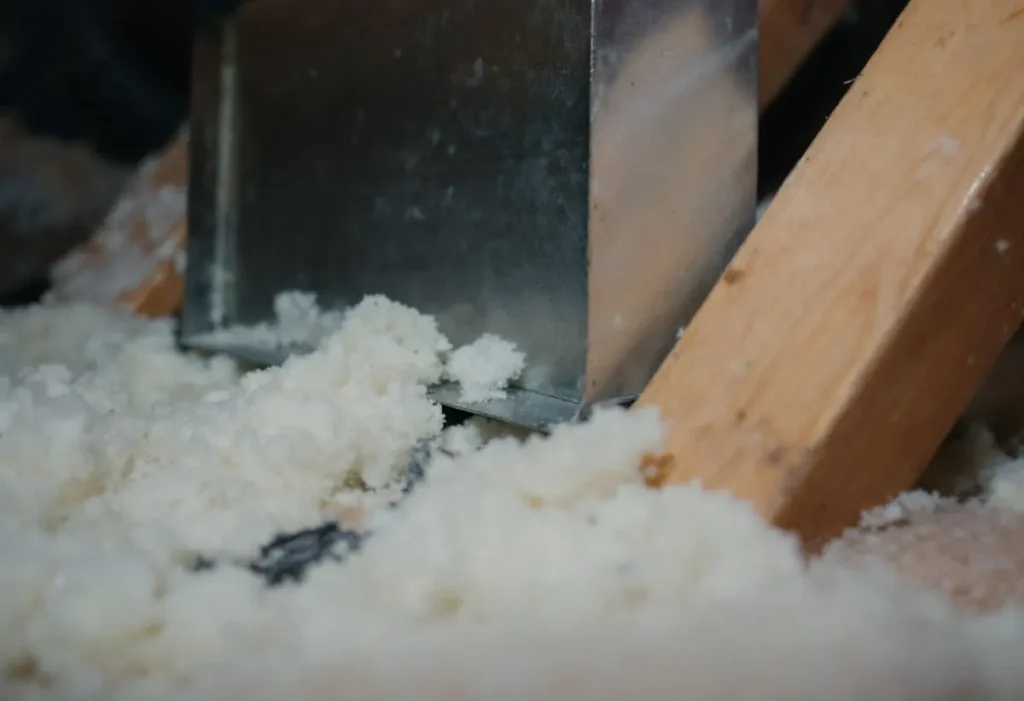
How much heat do leaky or attic ducts lose before it reaches the rooms?
Enough to make a healthy furnace look undersized. ENERGY STAR says that in a typical house “about 20 to 30 percent of the air that moves through the duct system is lost due to leaks, holes, and poorly connected ducts,” with “difficulty keeping the house comfortable, no matter how the thermostat is set” (ENERGY STAR, Duct Sealing).
DOE adds that leaking returns in an attic or vented crawl space draw unconditioned air into the furnace, and calls sealing “even more important” there (DOE, Minimizing Energy Losses in Ducts, archived copy). The tell: a normal rise at the furnace but cool registers, worst at the end of long attic runs. Our page on duct insulation R-values covers the code minimums for those runs.
Why does a dirty filter make the furnace run but blow only warm air?
Because the furnace protects itself by cutting the burners. Goodman’s IOG-2030A manual says too much external static pressure gives insufficient air “that can cause excessive temperature rise. This can cause limit switch tripping and heat exchanger failure” (Goodman IOG-2030A). Each trip shuts the gas while the blower runs on, so hot bursts alternate with room temperature air.
Rheem warns that “some high-efficiency filters have a greater than normal resistance to airflow” and tells installers to check airflow with any filter other than the factory one. ENERGY STAR’s checklist says to inspect, clean or change the filter once a month (ENERGY STAR maintenance checklist), more often than the quarterly change some contractor pages suggest. Our filter guide covers MERV ratings; if a clean filter does not stop the cycling, the limit switch page explains the reset rules and why a rollout trip is a stop line.
Furnace running but no flame, or not blowing hot air: is it a fault rather than the cold?
Yes. A rise near zero means no heat is being made, whatever the weather. Three versions have their own pages: a blower moving cool air with the thermostat fan on ON or a safety switch open is covered in furnace blowing cold air; an inducer that runs with no burner flame is traced step by step in thermostat says heat on but no heat; and burners lighting with a silent blower is in furnace blower not turning on.
Heat pumps run cooler supply air by design, so this rise test does not fit them; the page on a heat pump blowing cold air in heat mode covers defrost and auxiliary heat. Leave the house if you smell gas or a carbon monoxide alarm sounds; for a tripped burner compartment over temperature (rollout) switch, Rheem’s manual reads “DO NOT jumper or reset this switch” and calls for a qualified installer or service agency.
Why does the house take hours to warm back up after a setback on a cold night?
Because only the heat beyond the house’s current loss goes into raising the temperature, and that surplus shrinks as it gets colder. In our example house recovering from 62°F, the 64,000 Btu/h furnace has 44,247 Btu/h to spare at 30°F outside but only 18,938 Btu/h at minus 11°F. With a quarter lost in attic ducts, the spare heat at minus 11°F falls to 2,938 Btu/h, and the thermostat may never reach setpoint that night.
DOE says turning the thermostat back 7° to 10°F for 8 hours a day can save “as much as 10% a year,” and calls the idea that the furnace works harder to recover “a common misconception,” because a cooler house loses heat more slowly (DOE, Programmable Thermostats, archived copy). Below your county’s design temperature, though, a steady setpoint avoids a morning when the house never catches up.
Frequently asked questions
Why is my furnace running but not blowing air?
If the burners light but the blower stays off, heat builds until the limit switch shuts the burners down. Rheem’s 801T manual names overheating due to low air flow as one of the most common causes of heat exchanger failure, so switch it off and have the blower motor, capacitor and fan relay checked.
How do you heat a house when the furnace goes out?
Close off unused rooms and use listed electric space heaters on their own outlets. Ready.gov says to never heat your home with a gas stovetop or oven, and to run generators outdoors at least 20 feet from windows, doors and attached garages.
Is it normal for a furnace to run nonstop when it is very cold?
Yes, near the design temperature. ENERGY STAR allows a heating-only furnace of 100 to 140% of the design heat loss, so a furnace at the low end runs continuously on the design day. In our example the 128% furnace runs 78% of the time at minus 11°F. Nonstop running at 30°F or warmer points to a fault or duct loss.
Why is my HVAC running but not cooling the house?
That is the summer version; the matching test is the temperature split across the indoor coil. ENERGY STAR’s 20 to 30 percent duct air loss applies in cooling season too, and our AC temperature split guide gives the readings that point to low airflow or low refrigerant.
How we researched this
Research done 19 November 2026. We read the Rheem 801T and Goodman IOG-2030A installation manuals, Goodman’s SS-FGMVC8 specifications, two ENERGY STAR design documents, ENERGY STAR and DOE consumer pages (DOE in archived copies) and Ready.gov. Example house figures are our arithmetic, shown in the tables. Contractor blogs and forums were excluded as sources for numbers. We did not read ACCA Manual J itself; design temperatures are EPA’s restatement of ASHRAE and Manual J data.
Sources
- Rheem Manufacturing. “Installation Instructions, Upflow/Horizontal Gas Furnaces (R801T).” https://resource.gemaire.com/is/content/Watscocom/Gemaire/rheem_r801t_en_ii.pdf. Accessed November 2026.
- Goodman Manufacturing. “SS-FGMVC8 Specifications, GMVC8/GCVC8 Gas Furnaces.” https://apps.goodmanmfg.com/brochures/files/6039101d08220SS-FGMVC8.pdf. Accessed November 2026.
- Goodman Manufacturing. “IOG-2030A Installation and Operating Instructions, GM9S8/GC9S8.” https://documents.alpinehomeair.com/product/goodmangm9s8gc9s8installationmanual.pdf. Accessed November 2026.
- U.S. EPA ENERGY STAR. “National HVAC Design Report, Rev. 13.” https://www.energystar.gov/sites/default/files/asset/document/National%20HVAC%20Design%20Report_Rev%2013.pdf. Accessed November 2026.
- U.S. EPA ENERGY STAR. “Design Temperature Limit Reference Guide (2019 Edition).” https://www.energystar.gov/sites/default/files/asset/document/Design%20Temperature%20Limit%20Reference%20Guide%20%282019%20Ed%29%20%2D%20ENERGY%20STAR%20SFNH%20Rev11_MFNC%20Rev02.pdf. Accessed November 2026.
- U.S. EPA ENERGY STAR. “Duct Sealing.” https://www.energystar.gov/saveathome/heating-cooling/duct-sealing. Accessed November 2026.
- U.S. Department of Energy. “Minimizing Energy Losses in Ducts” (archived copy). https://web.archive.org/web/2025id_/https://www.energy.gov/energysaver/minimizing-energy-losses-ducts. Accessed November 2026.
- U.S. EPA ENERGY STAR. “Maintenance Checklist.” https://www.energystar.gov/saveathome/heating-cooling/maintenance-checklist. Accessed November 2026.
- U.S. Department of Energy. “Programmable Thermostats” (archived copy). https://web.archive.org/web/2025id_/https://www.energy.gov/energysaver/programmable-thermostats. Accessed November 2026.
- Ready.gov. “Winter Weather.” https://www.ready.gov/winter-weather. Accessed November 2026.
Leave a Reply