
Decode hot water radiator knocking by when it happens. Ticks during warm-up or cool-down are copper or steel pipes growing and shrinking against floor holes and joists. One bang as the heat shuts off is a zone valve or pump surge. A gurgling knock while it runs is trapped air. A rumble at the boiler is kettling.
When does your hot water radiator knock? Match the moment to the cause
Sit by the noisiest radiator through one full cycle, from the thermostat call to 30 minutes after it is satisfied, and note the moment of the knock. Five moments cover nearly every case.
| When you hear it | Sound | Where it starts | Cause the documents name | Test before you fix |
|---|---|---|---|---|
| First 30 seconds of a call | One thud or clunk in the basement | Check valve or flow check next to the circulator | Caleffi idronics 16: check valve under 12 diameters from the pump rattles | Measure the straight pipe between pump and valve |
| Warm-up and cool-down | Ticks, knocks, creaks that travel | Risers through floors, joist notches, pipe straps, radiator feet | Copper Development Association: copper grows 0.0000094 inch per inch per °F | Lay a hand on the pipe at the floor while it knocks |
| Steady, while the pump runs | Gurgle, trickle, a knock with a slosh | Top of the radiator, high runs of pipe | Taco TD11: noise from “water cascading in piping containing air” | Is the radiator cold at the top? Read the boiler gauge |
| While the burner fires | Rumble, popping, percolating | The boiler itself | Weil-McLain: mineral deposits, incorrect pH or insufficient water flow | Does it stop when the burner stops? |
| The moment a zone is satisfied | One sharp bang | Zone valve, or the pipes near it | Caleffi: a bypass valve that eliminates “water hammer noise” as zone valves close | Check the flow arrow on the valve body |
Compiled by The HVAC Brief from the Copper Development Association, Caleffi, Taco, Weil-McLain and Resideo documents listed under Sources. Baseboard systems share some causes but different parts; the hot water baseboard noise decoder covers fin tube cradles and brackets.
Is it really a hot water radiator, or a steam radiator that bangs?
Check first; the two knock for different reasons. A hot water radiator is full of water, has a supply and a return connection, and a small square or slotted bleeder near the top; Weil-McLain’s user manual says the gauge on a water boiler should not exceed 24 psig and on a steam boiler 15 psig. A one pipe steam radiator has a single pipe and an air vent on its side, and its banging comes from condensate trapped in pitched pipes, covered in our steam heating system guide.
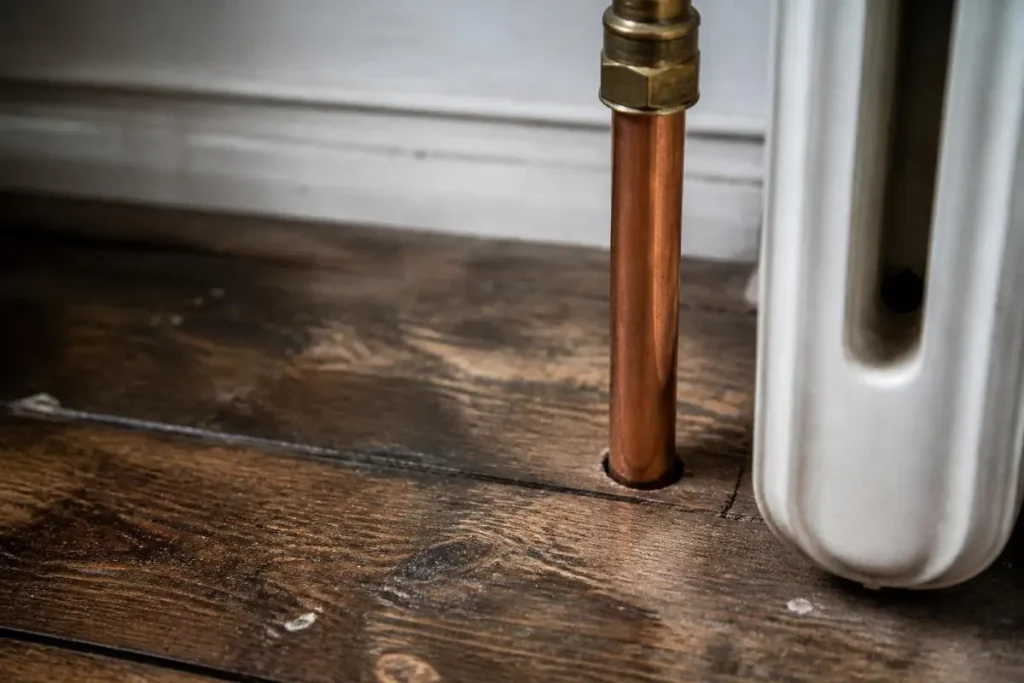
Why do radiator pipes knock while the system heats up and cools down?
Every pipe feeding the radiator grows as hot water arrives and shrinks as it cools, and where it is pinned it jumps instead of sliding. The Copper Development Association’s Copper Tube Handbook puts copper’s average coefficient at 0.0000094 inch per inch per °F and states the field rule that a copper stack moves “about 0.001 inch per degree F per 10-foot floor,” slightly more than iron and steel pipe. Most older radiator systems are black steel, so the figures below are an upper bound for them.
| Run feeding the radiator | Water at 140°F | Water at 160°F | Water at 180°F | Static head at the top |
|---|---|---|---|---|
| One floor riser, 9 ft | 0.076 in. | 0.096 in. | 0.117 in. | 3.9 psi |
| Two floor riser, 18 ft | 0.152 in. | 0.193 in. | 0.233 in. | 7.8 psi |
| Three floor riser, 27 ft | 0.228 in. | 0.289 in. | 0.35 in. | 11.7 psi |
| Basement main, 40 ft | 0.338 in. | 0.429 in. | 0.519 in. | n/a |
HVAC Brief calculation: length (ft) × 12 × 0.0000094 × (water temperature minus a 65°F room), CDA coefficient; static head = height ÷ 2.3 ft per psi, the CDA handbook’s conversion. Script hrk-calc.py is kept with our working files.
A quarter inch of travel drags a riser across a tight floor hole or joist notch, and each release is a knock the pipe carries to the radiator. The runout to the radiator also pushes the radiator itself: a heavy cast iron unit on a wood floor can stick and then slip on its feet. The CDA handbook calls for sleeves at intermediate floors so pipes move freely. The fixes: open the floor hole so the riser clears on all sides, sleeve joist notches, loosen straps that clamp instead of cradle, and set glides under the radiator feet. Running cooler water shrinks the travel by a third, from 0.233 in. to 0.152 in. on a two floor riser, which is one reason outdoor reset on the boiler aquastat quiets old houses.
Is a single bang when the heat shuts off water hammer from the zone valve?
Usually, yes: one sharp bang at the moment a zone is satisfied is moving water being stopped, and the valve that stops it is the place to look. Resideo’s V8043 zone valve takes 15 seconds to open and 4 to 5 seconds to close, and is built to close “against the flow of water to assure quiet operation,” which only works if the arrow on the body matches the flow. Taco’s Zone Sentry brochure lists a ball rotation of about 5 seconds, so neither should slam when installed right.
The other source is the pump. With one fixed speed circulator feeding several zones, each closing valve forces the same pump output through fewer radiators. Caleffi’s idronics 16 describes its 519 differential pressure bypass valve as built for exactly that case, bypassing the pressure “as the zone valves close, thus eliminating water hammer noise.” A technician checks the flow arrow, then for a bypass or variable speed circulator, then the pipe ahead of any check valve: idronics 16 calls for at least 12 diameters between a circulator outlet and a downstream check valve to stop the flapper rattling. Powerheads and end switches are in the zone valve explainer.
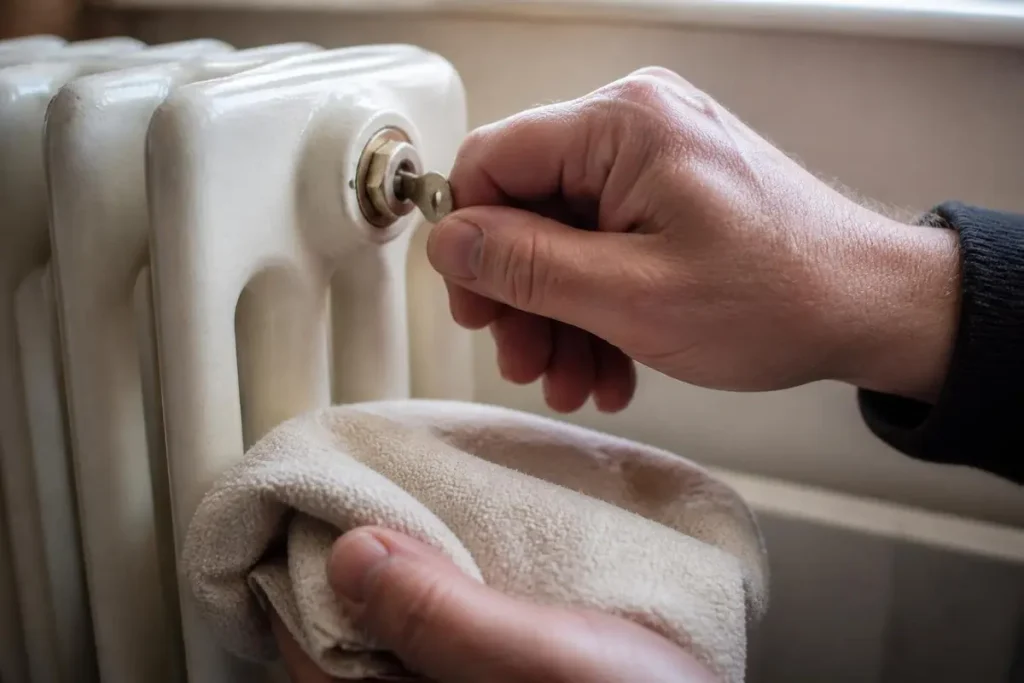
Why does a radiator gurgle, knock and stay cold at the top?
Air. Taco’s air elimination guide TD11 lists “noise in the system due to water cascading in piping containing air” among the faults air causes, and notes that cold water at 50ºF and 50 psi “can be up to 10 percent dissolved gas,” released as bubbles when it is heated. Weil-McLain’s user manual puts air first for radiators that “do not heat or are noisy” and says to “bleed air from system through air vents in radiators,” then lists low system pressure.
Old radiator piping is slow, which is why the air stays. Taco says flow of at least 2 feet per second, 3.2 gpm in 3/4 in. copper, is needed to carry bubbles to the boiler’s separator, and the oversized mains of a converted gravity system move water far slower than small tube at the same gpm. By the table above, a third floor radiator 27 ft over the gauge needs 11.7 psi just to stay full, so a cold reading near that leaves the top radiator near zero and sucking in air at its vent. Bleed top floor radiators last, then compare the gauge with the fill setting in our boiler pressure guide. The radiator heating repair guide walks through bleeding a radiator that is cold at the top.
Is the knocking coming from the boiler instead of the radiators?
If it rumbles or pops only while the burner fires, it is the boiler. Weil-McLain’s troubleshooting table names three causes for “popping or percolating noise heard in boiler”: mineral deposits from constant makeup water, incorrect pH (it wants 7.0 to 8.5), and insufficient water flow through the boiler. That is boiler kettling, and bleeding radiators will not touch it; a technician checks flow through the boiler, then water chemistry, then descales or flushes.
Why do water pipes knock when the hot water tap is turned on or off?
That is the plumbing, not the heating. The CDA handbook defines water hammer as the “pounding noises and vibrations” that develop “when the flowing liquid is stopped abruptly by a closing valve,” usually an appliance solenoid or a lever faucet snapped shut. It recommends a manufactured arrester “immediately upstream from the fixture valve” on a single fixture branch. Indiana’s amended residential code text for IRC P2903.5 requires that flow velocity “be controlled to reduce the possibility of water hammer” and that arresters conform to ASSE 1010; whether one is required at a given valve is up to the local inspector.
Ticking a few minutes after a hot tap opens is the hot line growing. The CDA handbook caps hot water velocity at 5 feet per second up to about 140°F and 2 to 3 feet per second above that. Popping from the tank itself is sediment, covered in water heater popping noise.
When should you shut the boiler off instead of chasing the knock?
Turn the boiler off at its service switch and call the same day if the relief valve is discharging water, if the gauge on a water boiler reads above the 24 psig Weil-McLain sets as its ceiling, or if banging comes with steam at the bleeder or the relief valve pipe. Weil-McLain ties frequent relief valve discharge to an undersized or flooded expansion tank or an inoperative limit control; the technician will check the expansion tank precharge against the cold fill pressure and the high limit before anything else.
Frequently asked questions
How do you use a hot water radiator bleeder valve?
With the circulator off and the radiator warm, hold a rag under the bleeder, open it a quarter turn with a radiator key or screwdriver, and close it when water, not air, comes out. Weil-McLain’s user manual tells owners to bleed air through the vents in radiators, then fill to correct pressure, so check the boiler gauge after bleeding the whole house and add water if it dropped.
Can a water hammer go away on its own?
Each bang dies out on its own: the CDA Copper Tube Handbook says the shock wave reverberates in the piping “until the energy has been spent in frictional losses.” The cause does not go away, so it repeats every time the same valve closes. On heating pipes the fix is usually a correctly oriented zone valve or a differential pressure bypass; on plumbing, an ASSE 1010 arrester at the fixture.
Why is my hot water system making a knocking sound only in one radiator?
A single noisy radiator usually has a local cause: a riser binding in its floor hole, a radiator foot sticking on the floor, or air trapped at that radiator because it is the highest point. Taco’s TD11 guide notes air bubbles need flow of at least 2 feet per second to be carried away, so slow branches keep their air. Bleed that radiator first, then check the floor hole.
How we researched this
Researched November 26, 2026. We read the CDA Copper Tube Handbook, Caleffi idronics 16, Taco TD11 (mirror copy), the Weil-McLain CGa, CGi, EG, PEG and LGB user manual, Resideo V8043 and Taco Zone Sentry literature, and Indiana’s P2903.5 text. Growth and head figures are our arithmetic from CDA numbers. Forum threads and contractor blogs were excluded from every figure; one top ranked thread gives steam advice to a hot water question. We did not read ASSE 1010 itself.
Sources
- Copper Development Association. “The Copper Tube Handbook.” https://copper.org/wp-content/uploads/2026/04/copper_tube_handbook_print_press.pdf. Accessed November 2026.
- Caleffi. “idronics 16: Hydronic Pipe and Circulator Sizing.” https://www.caleffi.com/sites/default/files/media/file/idronics_16_na.pdf. Accessed November 2026.
- Taco. “Air Elimination from Hydronic Heating Systems, TD11” (mirror copy). https://inspectapedia.com/heat/Air-Elimination-Guide-TACO.pdf. Accessed November 2026.
- Weil-McLain. “CGa, CGi, EG, PEG and LGB User Manual.” https://www.weil-mclain.com/wp-content/uploads/Users-Manual-CGa-S3-CGi-S4-EG-PEG-S6-LGB-S2-S3-0224.pdf. Accessed November 2026.
- Resideo. “V8043C, D, F and G Motorized Zone Valves.” https://res.cloudinary.com/dzhpkjoqj/Resideo/95C-10002EF.pdf. Accessed November 2026.
- Taco. “Zone Sentry Zone Valves.” https://4665334.app.netsuite.com/c.4665334/site/images/Technical%20Data%20Sheets/01066551_Taco-Z050C2-1-Brochure.pdf. Accessed November 2026.
- Indiana Department of Homeland Security. “P2903.5 Water hammer” code proposal. https://www.in.gov/dhs/files/53.27-09_Wagner_2903.5.pdf. Accessed November 2026.
Leave a Reply