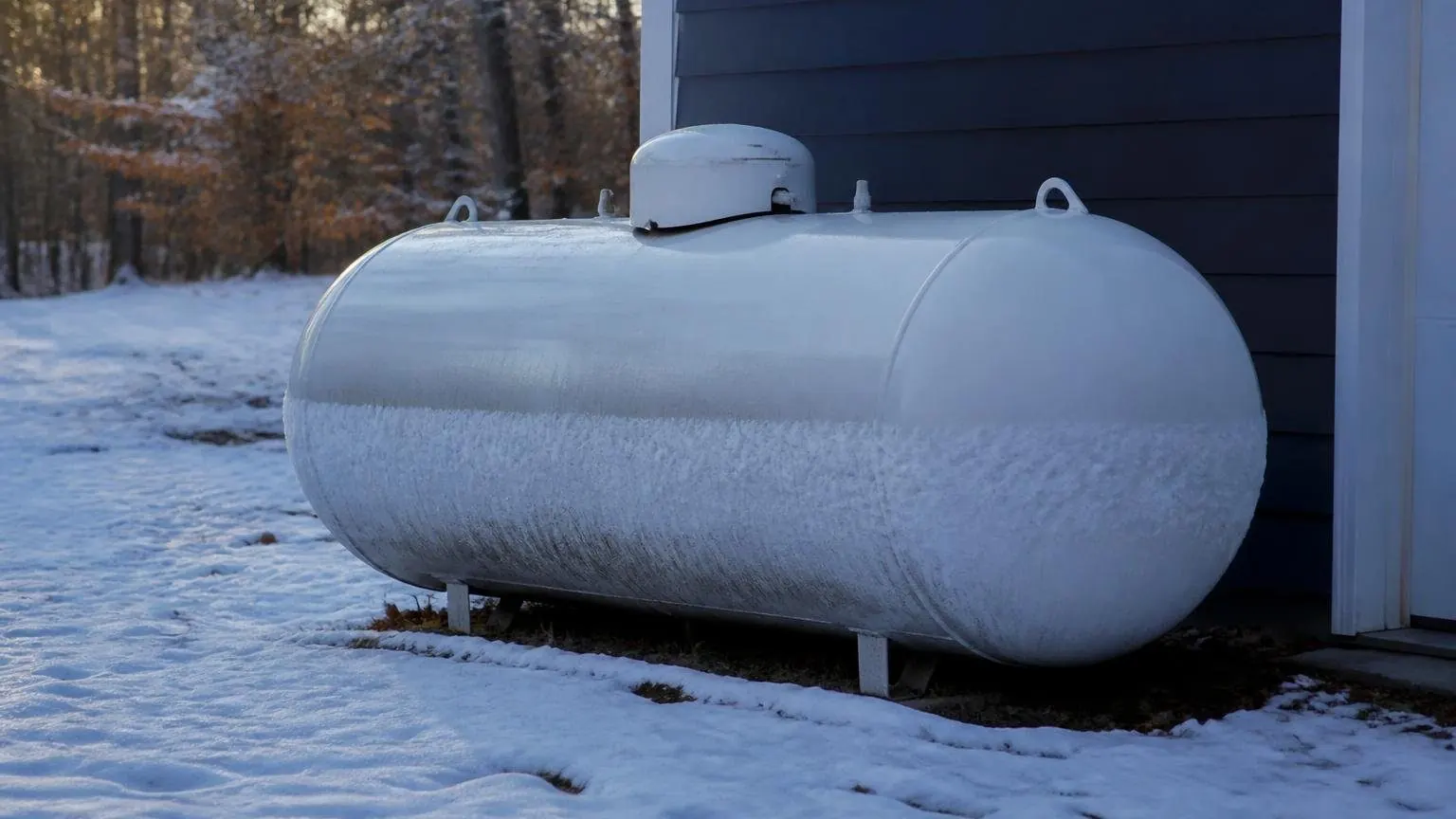
A propane tank freezing up is not frozen propane. Liquid propane boils at −44°F and pulls heat out of the steel as it turns to vapor, so moist air frosts the tank up to the liquid line. Frost is normal under heavy draw; a weak flame means the tank cannot vaporize enough. Never heat the tank.
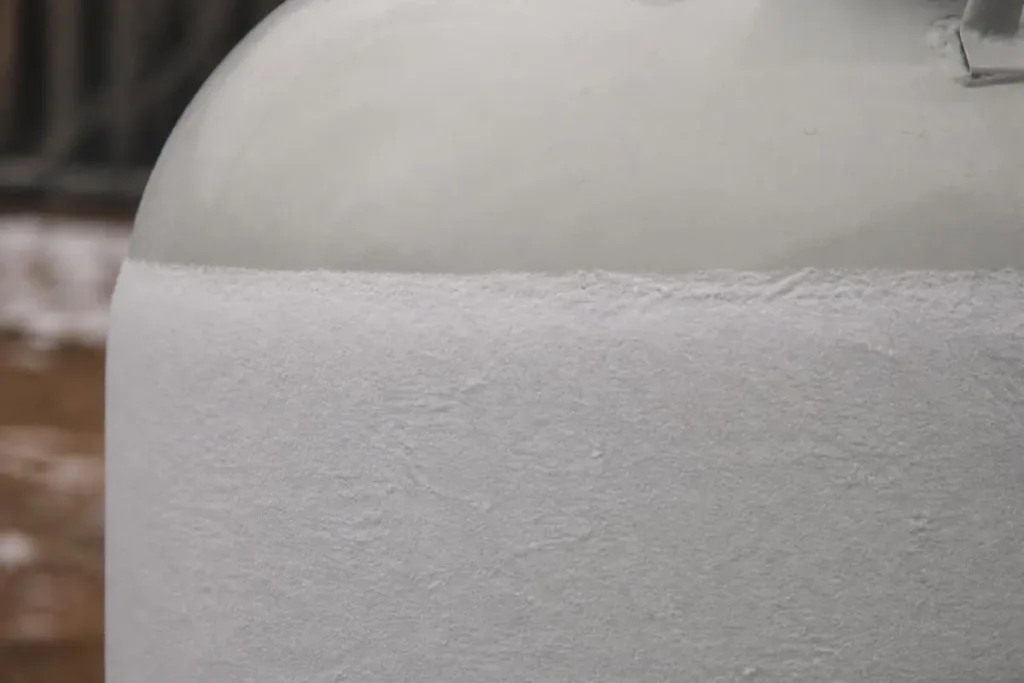
Why does frost form on a propane tank, and why does it stop at a line?
Because the tank is a refrigerator running on its own fuel. RegO’s LP-Gas Serviceman’s Manual (L-545) explains that drawing vapor lowers the pressure, the liquid “boils” to replace it, and the latent heat it spends “causes the temperature of the liquid to drop.” The lost heat comes back from the outside air through the steel, but only through the part RegO calls the “wetted surface,” the wall bathed in liquid. The vapor space above contributes almost nothing, so the chilled steel runs from the bottom up to the liquid level and moist air frosts it. The top edge of the frost is a rough gauge reading.
Frost then makes things worse. The PERC Propane Technical Pocket Guide notes that “tank frosting acts as an insulator, reducing the vaporization rate.” The colder liquid also holds less pressure: RegO’s vapor pressure table drops from 58 psig at 30°F to 28 psig at 0°F and 13.5 psig at −20°F. That is why a furnace or heater runs weak while the tank still holds gallons.
How much vapor can a 120, 250, 500 or 1,000 gallon tank make at 0°F and below?
Less than most owners assume, and the two industry rules of thumb disagree. RegO multiplies outside diameter by length by a fill constant (K = 70 at 30% full) for a 0°F rating, then scales for air temperature, down to 0.5 at −10°F. PERC’s Table 5 assumes a half-full tank under intermittent draw and says to multiply by 0.25 under continuous load, such as a furnace in a cold snap.
| Tank (water gal) | Diameter × length (PERC Table 4) | RegO, 30% full, 0°F | RegO, 30% full, −10°F | RegO, 20% full, −10°F | PERC Table 5, 0°F, × 0.25 continuous |
|---|---|---|---|---|---|
| 120 | 24 in × 66 in | 110,880 | 55,440 | 47,520 | Not listed (150 gal: 33,675) |
| 250 | 30 in × 92 in | 193,200 | 96,600 | 82,800 | 45,150 |
| 500 | 38 in × 120 in | 319,200 | 159,600 | 136,800 | 75,025 |
| 1,000 | 40 in × 200 in | 560,000 | 280,000 | 240,000 | 133,625 |
HVAC Brief calculation: D × L × K × temperature multiplier from RegO L-545 page 8, using PERC Table 4 guidance dimensions (PERC says sizes “vary by manufacturer”); last column is PERC Table 5 at 0°F times its 0.25 continuous factor. Both are aboveground estimates. Script kept with this article.
Read the table against the load. A 100,000 Btu/h furnace burns about 1.09 gallons an hour (RegO’s 91,502 Btu per gallon). On RegO’s numbers a 500 gallon tank at 30% covers it with room at −10°F; on PERC’s continuous figure it does not even at 0°F. Both fall as the level drops. How long that 30% lasts is worked out on our 500 gallon propane tank page; tank sizes and delivery plans are covered under propane heating systems. PERC adds that buried tanks see steadier soil temperatures.
Why does a 20 lb or 1 lb cylinder freeze up on a heater, griddle or torch?
Because a small cylinder has little wetted steel. Blue Rhino’s troubleshooting FAQ gives the textbook case: a 20 lb grill cylinder feeding a weed burner rated “over 150,000 BTUs per hour” will grow a frost line or ice inside the service valve, and the cure is “matching the cylinder size with the appliance BTU rating.” RegO publishes draw limits only for the 100 lb cylinder, and they collapse as it empties:
| Propane left in cylinder | 0°F | 20°F | 40°F |
|---|---|---|---|
| 100 lb (full) | 113,000 | 167,000 | 214,000 |
| 50 lb | 64,000 | 94,000 | 125,000 |
| 20 lb | 36,000 | 51,000 | 68,000 |
| 10 lb | 28,000 | 38,000 | 49,000 |
Where it may reach 0°F, RegO tells installers to assume about 50,000 Btu per hour per 100 lb cylinder. We found no maker table for 20 lb cylinders and do not estimate one. A griddle frosting its cylinder in the cold is the weed burner case at smaller scale: swap to a fuller cylinder or move up to a 100 lb one.
Mr. Heater’s MH9BX Buddy manual states that “runtimes can be significantly reduced when operating continuously at temperatures below 20ºF” on 1 lb cylinders and recommends a 20 lb tank; it lists a minimum ambient of 0°F. Oxygen sensor and thermocouple shutdowns are separate causes, sorted on our page on a Mr. Heater that won’t stay lit. Where any of these heaters may run indoors is covered in using a propane heater indoors.
Can a standby generator freeze up the house propane tank?
Yes, and faster than any other home load. Generac’s spec page for the 22kW model 7042 lists LP consumption of 135 cubic feet an hour at full load and 89 at half load. At RegO’s 2,488 Btu per cubic foot, that is about 335,880 Btu/h and 221,432 Btu/h.
At full load the generator alone wants more than RegO’s 319,200 Btu/h estimate for a 500 gallon tank at 30% and 0°F, and more than four times PERC’s continuous figure of 75,025. Add the furnace and heavy frost during a winter outage means the tank is past its limit. Runtime planning is in keeping a house warm during a power outage.
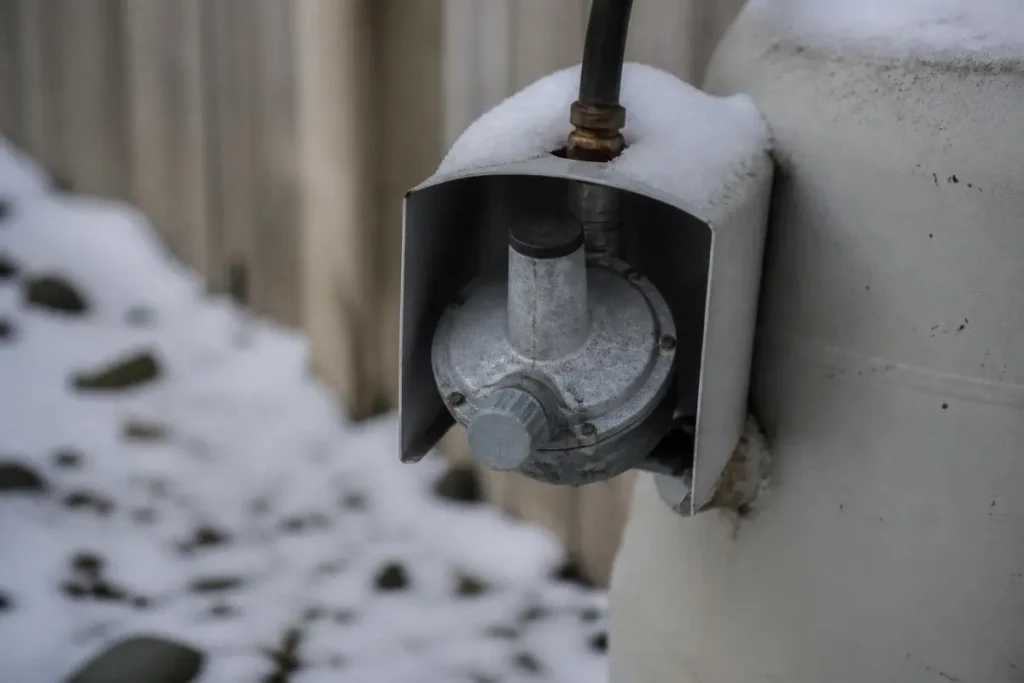
Is an iced propane regulator more serious than a frosted tank?
Yes. Tank frost is physics; an iced regulator can be a failure in progress. RegO’s L-545 names two problems. The first is internal freeze-up: “moisture in the gas condenses and freezes on cold surfaces of the regulator nozzle,” which chills as high pressure gas expands across it. RegO says two-stage systems “greatly reduce” this because the pressure drop is split between two regulators, so recurring freeze-ups on a single-regulator setup are a question for the retailer.
The second is a blocked vent. RegO warns that freezing rain, sleet, snow or ice in the bonnet vent can stop the regulator working and “can result in high pressure gas at the appliances resulting in explosion or fire,” and that regulators “should be installed with the vent facing down or under a protective cover.” RegO’s Reg-102 regulator catalog restates the NFPA 58 rule that outdoor regulators be installed or protected “so their operation will not be affected by the elements.” A vent pointing up, a missing screen or a regulator buried in drift snow is a call to the retailer. Stop line: if burner flames look abnormally large, yellow or roaring, shut the appliances off and call.
How do you unfreeze a propane tank without heating it?
You lower the demand and let the air do the work. The PERC Safety Guide for Propane Users is blunt: “In the event of extreme cold, NEVER try to keep propane storage cylinders or tanks warm by applying an external heat source.” That rules out a torch, a heat gun, a space heater aimed at the tank and kettles of hot water.
OSHA’s 29 CFR 1926.153(h)(13) says blower and radiant heaters “shall not be directed toward any LP-Gas container within 20 feet.” OSHA 1910.110 allows direct-fired tank heaters only as marked equipment showing their “maximum vaporizing capacity in gallons per hour.”
What does work, in order: turn off loads you can spare (fireplace, second heater, all griddle burners but one); get the tank refilled above 30%, since RegO’s K constant rises with every 10% of liquid; sweep snow off the tank, piping and regulator with a broom, as PERC advises, “rather than a shovel”; and swap a frosted small cylinder for a full one. If the furnace locked out on a near-empty tank, see the restart steps for a furnace not working after a propane refill.
Frost on a fitting, a hose end or the valve with the appliances off is a different sign. Mr. Heater’s MH18B manual lists “feel for extreme cold” beside bubbles, hissing and a rotten egg smell as ways to find a leak at a connection. Treat it as a leak and follow PERC’s leak steps from outside.
Frequently asked questions
Is propane tank frost up dangerous?
Frost alone is not. It marks liquid boiling off faster than the air can rewarm the steel, and PERC notes it cuts vaporization further. It is a warning when it sits on a fitting with the appliances off, which Mr. Heater’s MH18B manual treats as a leak sign (“feel for extreme cold”), or when appliance flames turn weak or abnormal.
Why does my propane tank keep freezing up?
The load is larger than the tank’s vaporizing capacity at that temperature and fill. RegO’s rule of thumb rates a 500 gallon tank at 30% full and 0°F near 319,200 Btu/h, falling to 159,600 at −10°F, and PERC says to quarter its own figures under continuous draw. Repeated freeze-ups point to too little liquid, too small a tank, or an added load such as a generator.
What propane tank freezing temperatures cause problems?
Propane boils at −44°F, so it never freezes in a tank, but output drops steadily with the air temperature. RegO’s temperature multiplier falls from 2.00 at 20°F to 0.25 at −15°F, and its vapor pressure table shows 28 psig at 0°F against 58 psig at 30°F. Mr. Heater cautions that 1 lb cylinders lose runtime below 20°F.
Can you put an insulating blanket on a propane tank to stop it freezing?
An unheated blanket works against you. RegO says the heat that vaporizes propane comes from the outside air through the wetted steel, and PERC says even frost “acts as an insulator, reducing the vaporization rate.” PERC’s safety guide also says never to warm a tank with an external heat source. Heated tank equipment exists, but OSHA 1910.110 requires listed, marked units, so that is a retailer decision.
How we researched this
Research date: 26 November 2026. We read RegO’s L-545 manual and Reg-102 catalog, PERC’s Technical Pocket Guide and Safety Guide, Mr. Heater’s MH9BX and MH18B manuals, Generac’s 7042 specifications, Blue Rhino’s FAQ and OSHA 29 CFR 1910.110 and 1926.153. The capacity table is our arithmetic from two rules of thumb that disagree, so we show both. We excluded untraceable retailer blog advice, including a 20% fill target and mounting the regulator above the tank. We found no maker vaporization table for 20 lb cylinders and published none.
Sources
- RegO. “LP-Gas Serviceman’s Manual, L-545” (distributor-hosted copy). https://cdn.shopify.com/s/files/1/1467/2928/files/L-545_Servicemans_Manual.pdf. Accessed November 2026.
- RegO. “Reg-102 LP-Gas Regulators catalog” (distributor-hosted copy). https://cdn.shopify.com/s/files/1/1467/2928/files/Reg-102.pdf. Accessed November 2026.
- Propane Education & Research Council. “The Propane Technical Pocket Guide.” https://cloudinary.propane.com/image/upload/v1664396780/Residential:Commercial/Brochures/4482-BR-21_Technical-Pocket-Guide_v3_HRpg.pdf. Accessed November 2026.
- Propane Education & Research Council. “Safety Guide for Propane Users,” PRC-101063D. https://cloudinary.propane.com/images/v1756137316/website-media/PRC-101063D-Propane-Safety-Booklet_digital-1_144644b80f7/PRC-101063D-Propane-Safety-Booklet_digital-1_144644b80f7.pdf. Accessed November 2026.
- Blue Rhino. “Why do tanks sometimes freeze up when turned on all the way?” https://bluerhino.com/propane-info/faqs/tank-troubleshooting-faqs/why-do-tanks-sometimes-freeze-up-when-turned-on-al. Accessed November 2026.
- Mr. Heater (Enerco). “Portable Buddy Radiant Heater MH9BX operating instructions.” https://pdf.lowes.com/productdocuments/fdce7814-2cae-4231-8f4d-fb3effd56204/76704869.pdf. Accessed November 2026.
- Mr. Heater (Enerco). “Portable Big Buddy Radiant Heater MH18B operating instructions.” https://images.homedepot-static.com/catalog/pdfImages/53/53c06813-2588-49a2-ad28-8bf3eb3a9ae7.pdf. Accessed November 2026.
- Generac. “22kW Standby Generator, model 7042, specifications.” https://www.generac.com/residential-products/standby-generators/gaseous/22kw-standby-generator-wifi-enabled-7042/. Accessed November 2026.
- OSHA. “29 CFR 1926.153, Liquefied petroleum gas (LP-Gas).” https://www.ecfr.gov/current/title-29/subtitle-B/chapter-XVII/part-1926/subpart-J/section-1926.153. Accessed November 2026.
- OSHA. “29 CFR 1910.110, Storage and handling of liquefied petroleum gases.” https://www.ecfr.gov/current/title-29/subtitle-B/chapter-XVII/part-1910/subpart-H/section-1910.110. Accessed November 2026.
Leave a Reply