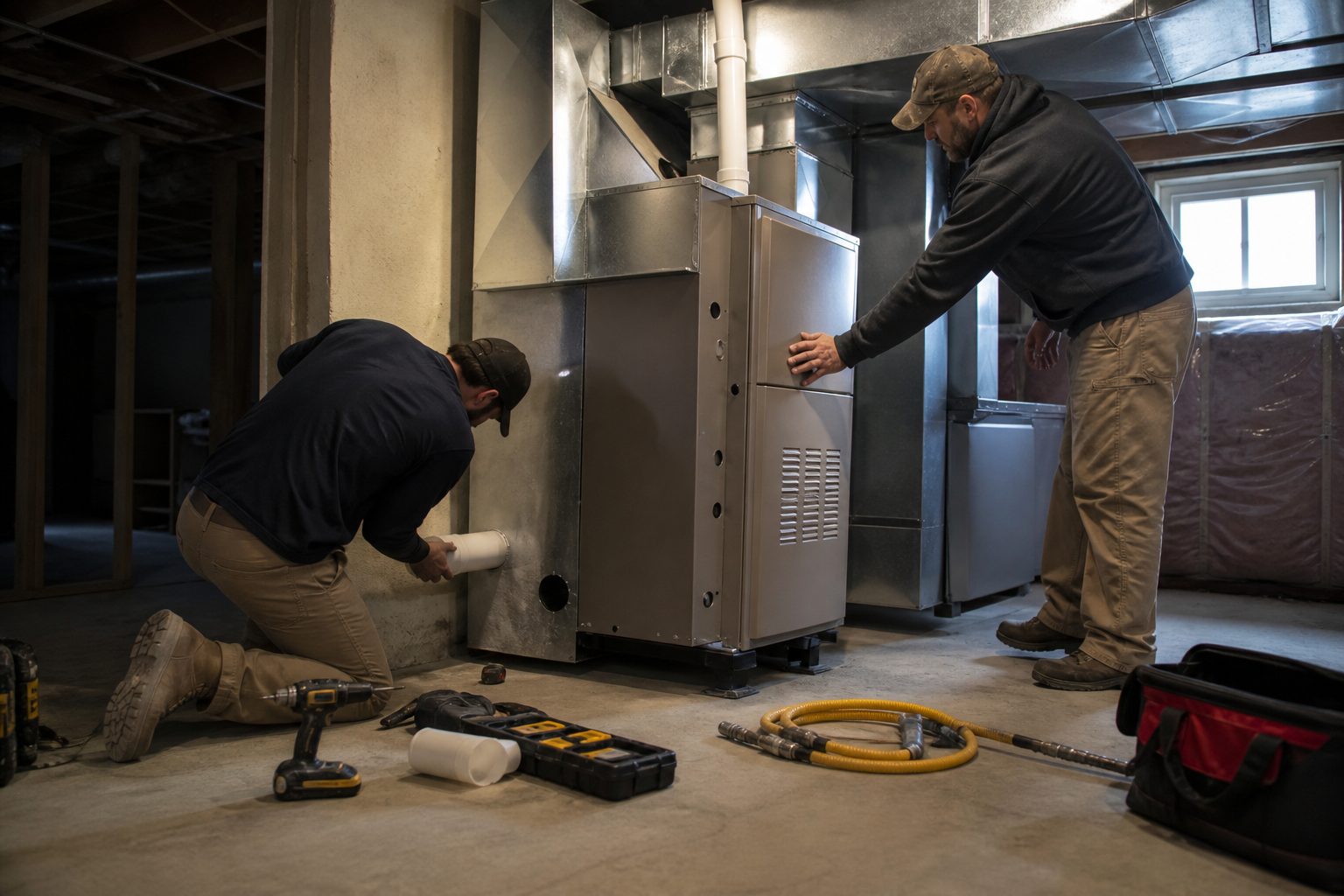
What is the new furnace cost in 2026? No federal agency measures what homeowners pay, but the newest federal estimate we located, from EIA, models an 80,000 Btu/h gas furnace at the 80% AFUE minimum at $3,690 installed in 2022 dollars. A planning figure, not a quote.
Key Takeaways
- EIA models an 80,000 Btu/h gas furnace at $3,690 installed at the 80% AFUE minimum and $4,150 at 95% AFUE, in 2022 dollars (EIA, 2023).
- Installation is 70.7% of that $3,690, so the equipment is the smaller half of the bill (The HVAC Brief, from EIA figures).
- DOE put the factory cost of a 95% AFUE gas furnace at $444 against $335 at the 80% baseline, a gap of $109 in 2022 dollars (88 FR 87502, Table IV.4).
- The 95% AFUE minimum binds gas furnaces manufactured on and after December 18, 2028 (10 CFR 430.32(e)(1)(iii)).
- DOE modelled the average extra installation cost of a condensing gas furnace retrofit at $539 in 2022 dollars, five times the equipment gap (88 FR 87568).
- HVAC equipment producer prices in August 2026 stood 19.0% above their 2022 average (BLS series PCU333415333415).
What is the new furnace cost in federal estimates?
One federal source prices a complete installed gas furnace: EIA’s equipment cost study for the Annual Energy Outlook. It gives $3,690 installed at the 80% AFUE minimum, $4,130 at 90% AFUE, $4,150 at 95% AFUE and $4,320 at 99% AFUE, in 2022 dollars.
Every figure describes the same box: an 80,000 Btu/h non-weatherized furnace. None is a transaction price. EIA’s estimates trace to DOE’s furnace rulemaking spreadsheet, so each is a model output. The job itself is in our walkthrough of what a furnace swap requires.
| 80,000 Btu/h gas furnace, north (2022$) | AFUE | Retail equipment | Total installed |
|---|---|---|---|
| Current federal standard | 80% | $1,080 | $3,690 |
| Typical unit sold | 90% | $1,200 | $4,130 |
| ENERGY STAR V4.1, north | 95% | $1,220 | $4,150 |
| High efficiency | 99% | $1,390 | $4,320 |
How much of the new furnace cost is installation, not equipment?
Most of it. At the 80% AFUE minimum, EIA splits $3,690 into $1,080 of retail equipment and $2,610 of installation, so labor and materials are 70.7% of the bill. At 95% AFUE the split is $1,220 and $2,930, or 70.6% installation.
That ratio is the most useful thing in the dataset. A quote that varies by $1,500 between two contractors is almost never varying on the furnace. It is varying on venting, ductwork and permits.
How does furnace cost change with input capacity?
Less steeply than air conditioner cost does. DOE priced electric furnaces at five capacities and found the factory cost rose from $324 at 40,000 Btu/h to $439 at 120,000 Btu/h, in 2022 dollars. Tripling the capacity added 35.5%.
A furnace is a heat exchanger, a burner and a blower in a steel cabinet, so scaling it up adds metal, not a second compressor. It behaves differently from the cooling side priced in our breakdown of whole-system replacement estimates. Capacity still comes from a load calculation, as our guide to why square footage fails as a sizing input explains.
What will the December 2028 standard do to the entry new furnace cost?
It removes the cheap tier. From December 18, 2028 the lowest-cost gas furnace a manufacturer may build is a condensing one, so EIA’s $3,690 baseline stops being buildable and $4,150 becomes the floor: a $460 shift, or 12.5%.
The rule says it plainly: “Compliance with the amended standards established for the subject consumer furnaces in this final rule is required on and after December 18, 2028.” Table I.1 sets 95.0% AFUE for non-weatherized and mobile home gas furnaces, codified at 10 CFR 430.32(e)(1)(iii). What the rule does and does not ban is in our report on the 95% AFUE standard.
DOE’s estimated manufacturer production cost gap between an 80% AFUE gas furnace and a 95% AFUE one at 80,000 Btu/h: $335 against $444. The equipment is not what makes the 2028 floor expensive.
DOE consumer furnaces final rule, 88 FR 87502, Table IV.4 (2022 dollars)
DOE’s consumer accounting is modestly positive: average life-cycle cost savings of $350 per furnace, and a simple payback of 7.6 years against an estimated 21.5-year average lifetime. Those are modelled national averages.
Why the venting change drives the 2028 new furnace cost, not the box
A condensing furnace cannot use the old flue. It cools exhaust below the dew point, so the vent becomes plastic pipe and the liquid that forms has to be drained. DOE priced that work separately. That is where the money goes.
In DOE’s replacement model, 100% of condensing installations need new PVC flue venting at an average $308, 62% need PVC combustion air venting at $324, and 100% need condensate removal at $92, in 2022 dollars. With the rarer items, the average incremental cost of a condensing retrofit came to $539, five times the $109 equipment gap. The drain side is in our explainer on how condensate is lifted and removed.
| DOE installation cost adder, gas furnace replacement | Share of installs affected | Average cost (2022$) |
|---|---|---|
| New flue venting, PVC (condensing) | 100% | $308 |
| Combustion air venting, PVC (condensing) | 62% | $324 |
| Condensate removal (condensing) | 100% | $92 |
| Updating flue vent (non-condensing) | 8% | $990 |
The orphaned water heater
Where a gas furnace and a gas water heater share one chimney, moving the furnace to PVC leaves the water heater venting alone into a flue now too large for it. DOE modelled that on 7% of condensing replacements at an average $806 in 2022 dollars. It is a safety item, not an upsell.
What is the new furnace cost for oil and propane?
Oil costs more and the published figure is a range, not a point. EIA puts a 105,000 Btu/h oil furnace at the 83% AFUE minimum at $3,250 to $6,520 installed in 2022 dollars, with equipment of $2,620 to $3,450. A condensing oil furnace at 97% AFUE runs $5,140 to $10,110 installed.
DOE’s factory work agrees: a manufacturer selling price of $945.98 at the 83% AFUE baseline and $1,802.05 at 96% AFUE, in 2022 dollars, so condensing costs 1.9 times as much to sell. Fuel cost is tracked in our record of heating oil prices.
Propane has no separate cost estimate. Under 10 CFR 430.2 a furnace is one operating “in conjunction with natural gas, propane, or home heating oil,” so a propane unit sits in the same non-weatherized gas furnace class, faces the same 95% AFUE floor in 2028, and is priced in the same EIA table. DOE modelled propane households inside that class, which propane trade commenters objected to in the record.
Are electric furnaces the cheap answer?
Cheap to buy, expensive to run. EIA models an electric resistance furnace at $1,480 installed with $950 of equipment in 2022 dollars, 40.1% of the 80% AFUE gas figure. No flue, no gas piping, no combustion air, so installation collapses to $530.
Running cost is the catch, and that arithmetic sits in our comparison of electric resistance heating watts and running cost. Delivered heat prices by fuel are in our table of what heat costs by fuel.
The equipment decision itself is set out in our heat pump and gas furnace comparison.
The standard has not moved since January 1, 1992, when the 78% AFUE floor took effect. In a final determination published October 18, 2024, DOE concluded amended standards are not technologically feasible, since a resistance element already converts nearly all input energy to heat. EIA notes these furnaces heat about 17.5 million US homes, roughly 14% of the stock, a share our review of how American homes are heated puts in context.
How stale is the 2022 dollar year, and what is the new furnace cost now?
Four years stale, and the gap is measurable. The BLS producer price index for air conditioning, refrigeration and warm air heating equipment manufacturing averaged 272.893 in 2022 and reached 324.820 in August 2026, a factor of 1.1903 or a 19.0% rise.
Here is the arithmetic, shown so it can be checked. The index measures factory output, not installation labor, so applied to the equipment line only, $1,080 becomes $1,286, the 80% AFUE total moves from $3,690 to $3,896 and the 95% total from $4,150 to $4,382. Applied to the whole installed cost it gives $4,392 and $4,940. We track the index monthly in our note on the August 2026 equipment price record.
The same methods put the electric furnace at $1,661 and $1,762 against its published $1,480. None of those adjusted figures is a federal number. They are our arithmetic on one, labelled that way because the alternative is presenting a 2022 estimate as a 2026 price.
Why no honest national new furnace cost figure exists
Nobody collects the transactions. Census counts contractor receipts, BLS indexes factory prices, DOE models a representative household. No federal survey records what a furnace replacement invoice said.
So modelled figures are all there is, and they describe an average house nobody lives in. DOE’s record lists adders for ductwork upgrades, chimney relining, vent resizing, emergency premiums and zoning, each applied to a fraction of installations. Your house either triggers those or it does not, which is why our guide to what to verify before hiring a contractor leads with paperwork.
How we researched this
Research date: September 29, 2026. Four sources carry every figure: the EIA equipment cost study (March 2023, 2022 dollars, the current edition as of September 2026); the DOE consumer furnaces final rule at 88 FR 87502 (December 2023); the DOE final determination at 89 FR 84028 (October 2024); and BLS series PCU333415333415, retrieved through the BLS public API on September 29, 2026 with August 2026 as the latest month. Freshness: one 2026 monthly series, two rulemakings, one 2023 report in 2022 dollars. The oldest binding number is the 1992 electric furnace standard, still current law.
Excluded: every contractor price survey, marketplace average and retailer estimate. DOE lists several such sites as cross-checks, which is not publishing them as data, so we carried none. We also excluded the AHRI, ACCA and PHCC contractor survey DOE compared against, because the report is not public. Inflation adjustments are our own arithmetic, labelled as such.
Update schedule: the index line is refreshed monthly. The EIA and DOE figures are re-checked each January, and immediately if EIA issues a new edition or DOE amends 10 CFR 430.32(e).
Frequently asked questions
What does a new furnace cost in 2026?
No federal agency publishes a 2026 installed price. EIA’s March 2023 study models an 80,000 Btu/h gas furnace at $3,690 installed at the 80% AFUE minimum and $4,150 at 95% AFUE, in 2022 dollars. Escalating the equipment line by the 19.0% producer price index rise through August 2026 gives $3,896 and $4,382.
Is a 95% AFUE furnace worth the extra money?
DOE’s model says marginally. It projected average life-cycle cost savings of $350 per gas furnace under the 2028 standard, with a simple payback of 7.6 years against an estimated 21.5-year average lifetime. Houses with mild winters or cheap gas fall the other way.
Why does a condensing furnace cost more to install?
It cannot reuse the metal flue. DOE modelled new PVC flue venting on 100% of condensing replacements at an average $308, PVC combustion air venting on 62% at $324, and condensate removal on 100% at $92, in 2022 dollars. The average incremental installation cost came to $539.
Can I still buy an 80% AFUE furnace after 2028?
Manufacturers may not make or import one. The standard at 10 CFR 430.32(e)(1)(iii) applies to gas furnaces manufactured on and after December 18, 2028. Federal appliance standards bind manufacture and import, not resale of existing stock, so remaining inventory is a separate question.
How much more does an oil furnace cost?
More, and EIA publishes a range rather than a point. A 105,000 Btu/h oil furnace at the 83% AFUE minimum is $3,250 to $6,520 installed in 2022 dollars, against $3,690 for gas. A 97% AFUE condensing oil furnace runs $5,140 to $10,110.
Is an electric furnace cheaper than a gas furnace?
To buy, yes. EIA models an electric resistance furnace at $1,480 installed with $950 of equipment in 2022 dollars, 40.1% of the gas figure. Running cost is the trade. The standard has not changed since January 1, 1992, because DOE found amended standards not technologically feasible.
Sources
- US Energy Information Administration. “Updated Buildings Sector Appliance and Equipment Costs and Efficiencies.” https://www.eia.gov/analysis/studies/buildings/equipcosts/pdf/full.pdf. Accessed September 2026.
- US Department of Energy. “Energy Conservation Standards for Consumer Furnaces, Final Rule, 88 FR 87502.” https://www.federalregister.gov/d/2023-25514. Accessed September 2026.
- US Department of Energy. “Energy Conservation Standards for Oil, Electric, and Weatherized Gas Consumer Furnaces, Final Determination, 89 FR 84028.” https://www.federalregister.gov/d/2024-23906. Accessed September 2026.
- Office of the Federal Register. “10 CFR 430.32.” https://www.ecfr.gov/current/title-10/section-430.32. Accessed September 2026.
- Office of the Federal Register. “10 CFR 430.2, Definitions.” https://www.ecfr.gov/current/title-10/section-430.2. Accessed September 2026.
- US Bureau of Labor Statistics. “Producer Price Index by Industry: Air Conditioning, Refrigeration, and Warm Air Heating Equipment Manufacturing, series PCU333415333415.” https://data.bls.gov/timeseries/PCU333415333415. Accessed September 2026.
Leave a Reply