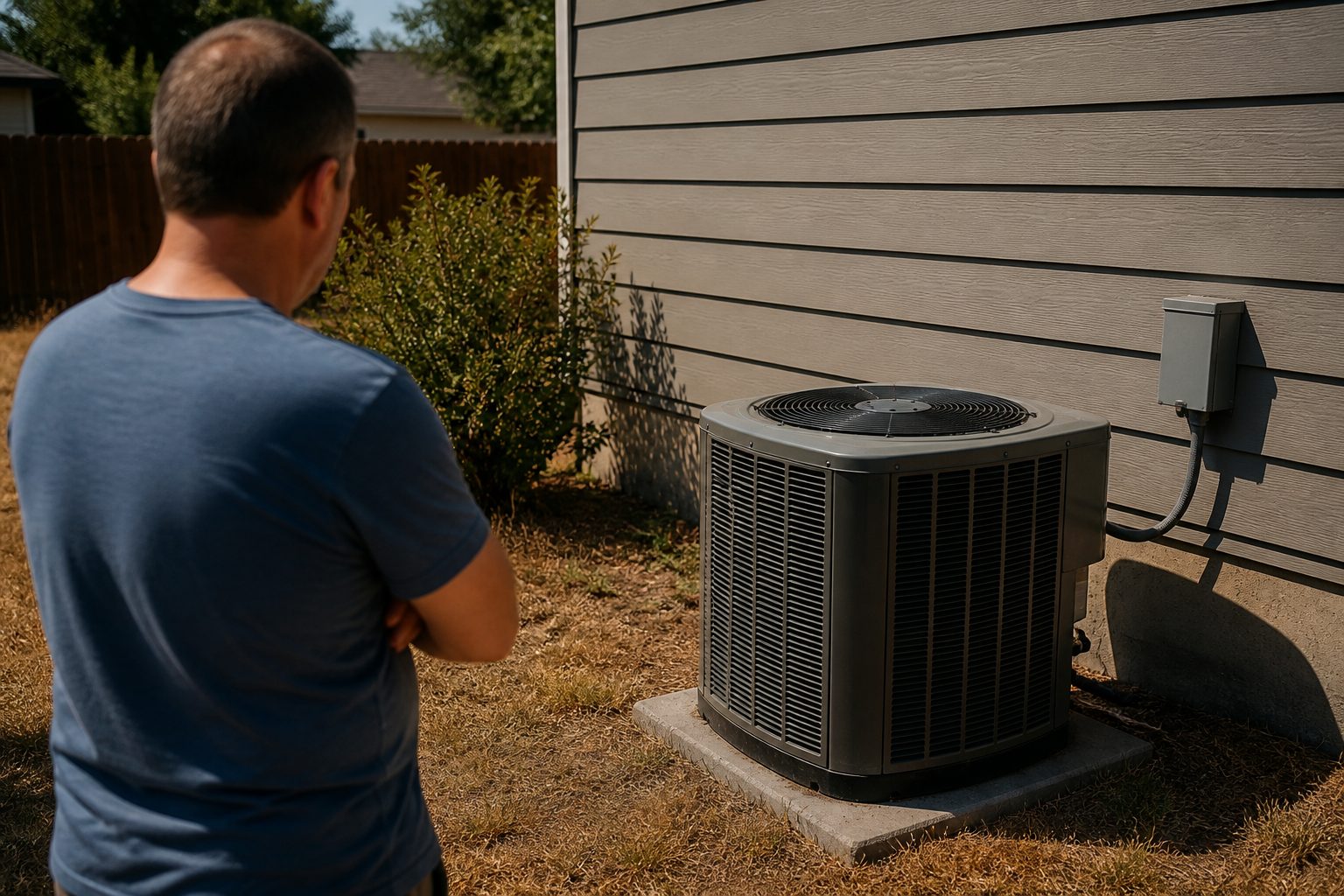
Why is my AC not turning on? In most dead-system calls the cause sits upstream of the refrigerant: thermostat mode, a tripped breaker, a pulled outdoor disconnect, an open blower door switch, a condensate float switch that has cut the control circuit, or a frozen coil behind a clogged filter.
Key Takeaways
- Six owner checks come first, all outside the electrical panel.
- The fastest split: does the indoor blower run while the outdoor unit stays silent?
- Reset a tripped breaker once. OSHA 1910.334(b)(2) says a circuit “may not be manually reenergized until it has been determined that the equipment and circuit can be safely energized.”
- Line voltage stays live at the disconnect and contactor with the thermostat off, and OSHA 1910.333 requires capacitors to be discharged first.
- BLS counted 130 workplace deaths from exposure to electricity in 2024 (CFOI Table 2).
- A float switch is built to “shut off the equipment if the pan is in danger of overflowing” (DOE Building America).
Why is my AC not turning on?
A dead system has lost power, a control signal, or a safety permission. Refrigerant faults rarely stop one cold: a low charge still lets the compressor spin. A unit that runs and blows warm belongs in our walkthrough of a system that runs without cooling.
Think of three stacked circuits. Line voltage at 208 to 230 volts feeds the outdoor unit and air handler. A transformer steps it down to a 24 volt control circuit the thermostat switches. Safety switches inside that circuit can open it silently, and any layer going down looks identical from the hallway.
Does the indoor blower run while the outdoor unit stays silent?
This question halves the fault tree and costs nothing. Set the thermostat to cool, drop the setpoint, listen at a register, then walk outside.
Air indoors with a silent outdoor unit means the control circuit and indoor supply are alive, so the fault is at the outdoor unit or its breaker. Nothing moving anywhere points at the control circuit, the transformer, or an open safety switch. A hum with no start belongs to the parts in our breakdown of what fails on an AC.
What are the safe homeowner checks for an AC not turning on?
Six checks, in order. Each stays outside the electrical compartment.
- Thermostat mode, setpoint, batteries. Confirm cool mode, drop the setpoint, and change the batteries first. A blank screen is a dead thermostat, not a dead air conditioner, as our explainer on what a thermostat actually does sets out.
- The breaker. Find the breakers labelled for the air handler and condenser. Reset a tripped one once; a second trip is a fault report, with causes in our piece on an air conditioner that keeps tripping its breaker.
- The outdoor disconnect. Most outdoor units have a pull out or switched box on the wall beside them. DOE field guidance has technicians “pull the fuse from the panel that powers the outdoor unit” before cleaning a condenser; a block left out afterwards leaves the unit dead. Reseat it and go no further inside the box.
- The furnace or air handler door. The blower access panel holds a spring loaded safety switch closed. A loose or under-screwed panel leaves it open and the blower will not start. Push it home and refit every screw.
- The condensate pan. Look for standing water under the coil. A dead system with a full pan is usually the float switch working, and clearing the blockage is often the whole repair.
- The filter and coil. Pull the filter. If it is grey and matted, the coil behind may have iced over and stopped the system. Switch off, leave the fan running, and let the ice melt for hours.
Where the owner stops
Once a repair needs the electrical compartment opened, it is licensed work in most jurisdictions. Line voltage sits at the disconnect terminals and the line side of the contactor whenever the breaker is on. OSHA 1910.333(a)(1): “Live parts to which an employee may be exposed shall be deenergized before the employee works on or near them.”
Which faults behind an air conditioner will not turn on need a technician?
Four parts cover most dead-system calls, all behind line voltage or stored charge. The DOE Building America Measure Guideline names “faulty components such as contactors, capacitors, condenser fan motors, and compressors.”
The low voltage transformer is the first suspect when nothing responds at all. Goodman specifies a “40VA, 208/230 VAC to 24 VAC transformer” for one wiring scheme. Many boards fuse that circuit with a small blade fuse, which opens when a thermostat wire shorts to sheet metal. Replacing it without finding the short only opens the next one.
The contactor is the relay the thermostat commands to switch line voltage into the compressor and condenser fan. Pitted, welded or coil-burnt, it leaves the outdoor unit silent. Our piece on the relay that switches the outdoor unit explains why one pole type leaves a leg energised.
The run capacitor usually produces a hum with no start, and it holds charge after power is removed, which is why it is not an owner job. See our reference on what a capacitor does and how it fails. A locked compressor is the worst case, and confirming it needs amp readings on a live circuit. The cabinet is mapped in our explainer on what the outdoor condenser does.
Symptom, likely cause, and who can safely check it
This maps what you observe to the likely part, and who can look at it.
| What you observe | Most likely cause | Who can safely check it |
|---|---|---|
| Screen blank, nothing responds | Dead thermostat batteries or an open 24 volt circuit | Owner changes batteries; technician if still blank |
| Breaker tripped, holds after one reset | One-off overload or surge | Owner, once. A second trip is a technician call |
| Blower runs, outdoor unit silent | Disconnect pulled, outdoor breaker off, or contactor not closing | Owner reseats the disconnect; contactor is licensed |
| Outdoor unit hums, will not start | Failed run capacitor or locked compressor | Technician only. Capacitors hold charge |
| Nothing runs, water in the drain pan | Condensate float switch has opened the control circuit | Owner clears the blockage; technician if it holds |
What makes this an electrical safety question rather than a DIY one?
Because the dangerous energy does not switch off with the thermostat, which only interrupts a 24 volt signal. The 208 to 230 volt supply stays live at the disconnect and contactor until the breaker or disconnect is opened, and a run capacitor can hold charge after both are.
Federal law treats stored charge as a hazard separate from the supply. OSHA 1910.147(d)(5)(i) requires that after isolation “all potentially hazardous stored or residual energy shall be relieved, disconnected, restrained, and otherwise rendered safe.” OSHA 1910.333 adds: “Capacitors shall be discharged and high capacitance elements shall be short-circuited and grounded.” It also has a qualified person verify the deenergised state with test equipment.
The condensate side has its own logic. Restating IRC Section M1411.3, the DOE Building America Solution Center notes that condensate “shall be conveyed from the drain pan outlet to an approved place of disposal,” and puts the auxiliary pan minimum depth at 1.5 inches. A shutdown on a full pan is designed behaviour, and systems that lift water uphill add a failure point covered in our guide to how a condensate pump works. On airflow, ENERGY STAR says to “inspect, clean, or change air filters once a month”; see also how often each filter type needs changing.
When is an AC not turning on worth an emergency call?
Usually urgent rather than an emergency. The exceptions are a burning smell, scorching at the disconnect or electrical compartment, a breaker that trips the instant it is reset, or indoor heat that is a medical risk. Our guide to what counts as an HVAC emergency draws that line.
Everything else can wait for a normal appointment. Photograph the outdoor nameplate and breaker labels before you call. If a thawed coil refreezes, the conversation moves toward a leak and possibly replacing the evaporator coil. Treat phone quotes of a national repair average with suspicion, for the reasons in our analysis of why no such figure exists.
How we researched this
Research date: September 2026. The diagnostic order and the owner versus technician split come from OSHA 29 CFR 1910.333, 1910.334 and 1910.147; the DOE Building America Measure Guideline on air conditioner diagnostics (Springer and Dakin, 2013); and DOE Building America Solution Center condensate guidance. Filter guidance is ENERGY STAR.
One manufacturer document is cited and named: the Goodman AVPTC installation instructions (P/N IO-346D, 2012), used only for the transformer rating. Excluded: Reddit and all homeowner forums, because this is an electrical safety topic and anonymous anecdotes were not mined at any stage. Also excluded: contractor and lead generation pages quoting repair averages with no sample basis; and the eCFR text of the OSHA sections, which blocked automated access, so osha.gov was used. No installed prices appear here.
Frequently asked questions
Why is my AC not turning on even though the thermostat has power?
A lit thermostat only proves the 24 volt control circuit is alive on that side. The call can still be blocked downstream by a blower door switch, a condensate float switch, or a breaker off at the outdoor unit. Work the six owner checks in order before blaming the thermostat.
Should I keep resetting the breaker if the AC will not turn on?
No. Reset it once, then stop. OSHA 1910.334(b)(2) states that after a circuit is deenergised by a protective device it “may not be manually reenergized until it has been determined that the equipment and circuit can be safely energized.” Repeated resets can push a real fault toward an arc event.
Can a dirty filter stop an air conditioner from turning on?
Indirectly, yes. A starved evaporator coil can drop below freezing, ice over, and stop moving air. ENERGY STAR advises inspecting, cleaning or changing filters once a month. Thaw the coil with the fan running, fit a clean filter, then watch whether it refreezes.
Can a full condensate pan shut down the whole system?
Yes, by design. The DOE Building America Solution Center states the auxiliary pan “should be equipped with a water-level detection device (also called a float switch) that will shut off the equipment if the pan is in danger of overflowing.” Clearing the drain often restores operation with no parts replaced.
Is it safe to replace an AC capacitor myself?
No. A run capacitor stores charge after power is off. OSHA 1910.333 requires that “Capacitors shall be discharged and high capacitance elements shall be short-circuited and grounded” before exposed work, and has a qualified person verify the deenergised state with test equipment. BLS recorded 130 such workplace deaths in 2024.
Does a dead air conditioner mean the compressor has failed?
Usually not. The DOE Building America Measure Guideline lists contactors, capacitors and condenser fan motors alongside compressors behind low reliability, and the first three cost far less to put right. A compressor diagnosis needs amp readings on a live circuit, so it is a last conclusion, not a first.
Sources
- OSHA. “1910.333 Selection and use of work practices.” https://www.osha.gov/laws-regs/regulations/standardnumber/1910/1910.333. Accessed September 2026.
- OSHA. “1910.334 Use of equipment.” https://www.osha.gov/laws-regs/regulations/standardnumber/1910/1910.334. Accessed September 2026.
- OSHA. “1910.147 The control of hazardous energy.” https://www.osha.gov/laws-regs/regulations/standardnumber/1910/1910.147. Accessed September 2026.
- US Bureau of Labor Statistics. “Table 2. Fatal occupational injuries for selected events or exposures, 2023-24.” https://www.bls.gov/news.release/cfoi.t02.htm. Accessed September 2026.
- DOE Building America Solution Center. “HVAC has Corrosion-Resistant Condensate Drain Pan.” https://basc.pnnl.gov/resource-guides/hvac-has-corrosion-resistant-condensate-drain-pan. Accessed September 2026.
- DOE Building America Solution Center. “Ductless Mini-Split Heat Pumps Code Compliance Brief.” https://basc.pnnl.gov/code-compliance/ductless-mini-split-heat-pumps-code-compliance-brief. Accessed September 2026.
- ENERGY STAR. “Maintenance Checklist.” https://www.energystar.gov/saveathome/heating-cooling/maintenance-checklist. Accessed September 2026.
- Springer, D. and Dakin, B. “Measure Guideline: Air Conditioner Diagnostics, Maintenance, and Replacement.” US DOE, 2013. https://www1.eere.energy.gov/buildings/publications/pdfs/building_america/measure_guide_air_cond_diagnostics.pdf. Accessed September 2026.
- Goodman Manufacturing Company. “AVPTC Air Handler Installation Instructions, P/N IO-346D.” http://igate.northernplumbing.com/manuals/goodman/avptc.pdf. Accessed September 2026.
Leave a Reply