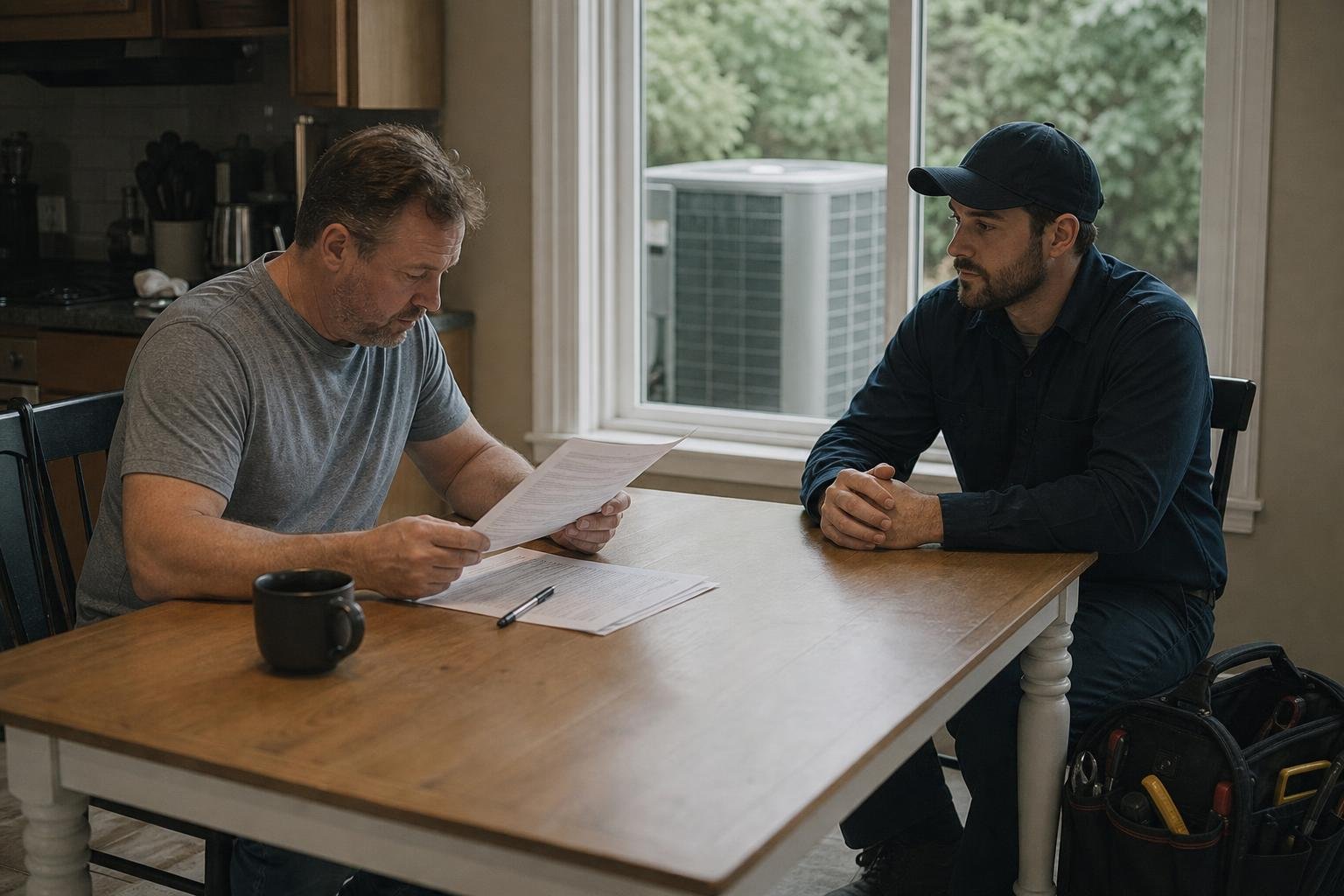
What is an HVAC maintenance plan? An HVAC maintenance plan is a service contract: you prepay a contractor for scheduled visits plus perks such as priority booking and repair discounts. Judge it as a contract. Check what each visit includes, how it renews, and how you cancel.
Key Takeaways
- The ENERGY STAR checklist lists 10 contractor tasks; a plan visit should name them, not just say “inspection”.
- The International Comfort Products warranty requires “proof of yearly service by a qualified service agency”, not proof of a plan.
- FTC warranty guidance bars most tie-ins: coverage generally cannot depend on one named service company unless that service is free.
- The Eighth Circuit vacated the FTC click-to-cancel rule on July 8, 2025; the FTC restarted with a March 2026 advance notice.
- New York law voids a maintenance contract’s auto-renewal clause unless written notice arrives 15 to 30 days before the cancellation deadline.
- California law requires an annual reminder on yearly plans signed or renewed from July 1, 2025.
What does an HVAC maintenance plan actually bundle?
An HVAC maintenance plan usually bundles scheduled visits, booking priority, a repair discount and a waived diagnostic fee. Only the visits are a defined service; the rest are conditional benefits whose value depends on the contract wording. No federal agency tracks plan contents, so check each in your own contract.
| Plan component | What the contract should state, in writing |
|---|---|
| Seasonal visits (often two a year) | The task list for each visit, by system |
| Priority scheduling | A response window in hours, including nights and weekends |
| Repair discount | The percentage and the price list it comes off |
| Waived diagnostic fee | Whether after-hours calls are included |
What should a maintenance plan visit include?
A maintenance plan visit should include at least the check-up tasks ENERGY STAR publishes, and the plan should list them. The ENERGY STAR checklist says “it’s best to check the cooling system in the spring and the heating system in the fall.”
That checklist names 10 contractor tasks: six general (thermostat, electrical connections, lubrication, condensate drain, controls, starting cycle), three for cooling and one for heating. It warns that airflow problems “can reduce your system’s efficiency by up to 15 percent.” We cover each task in our guide to what a real tune-up covers.
Compare the plan’s visit description with that list; if it says only “inspection”, ask for the tasks in writing. Heat pumps and furnaces add their own items, in our heat pump service guide and furnace checklist.
How many visits you need is answered in our piece on service frequency. One job stays yours under any plan: ENERGY STAR says to “inspect, clean, or change air filters once a month”, so pick the right filter and change interval.
Does an HVAC maintenance plan protect your warranty?
A maintenance plan can document the service some warranties require, but it is rarely the only way. Warranties that make yearly service a condition ask for proof of service, not proof of a plan.
The International Comfort Products warranty certificate says “the unit must receive yearly maintenance, as described in the owner’s manual, by a dealer”, and that “you must furnish proof of yearly service by a qualified service agency.” The Carrier condensing unit warranty (ACHPVS-C-02WAR, 07/2023) is softer: maintenance must be “normal and in accordance with instructions” in the owner’s manual. Terms vary by brand; our explainer on what HVAC warranties cover has the rest.
Myth: only the installer’s plan keeps the warranty alive
A dated invoice from a one-off visit by a qualified technician, listing the tasks done, is proof of service too. The FTC’s warranty law guide says a warrantor generally cannot require a particular company’s service unless it is “provided free of charge under the warranty.” Keep every receipt.
How do you work out whether an HVAC maintenance plan pays for itself?
An HVAC maintenance plan pays for itself only if the services you would have bought anyway cost more than the fee. No federal source publishes plan or visit prices, and our review of repair cost data found no reliable national series, so the arithmetic below is ours and the figures are invented.
- Note the yearly plan fee (F).
- Multiply the visits you would really book (n) by the single-visit price (V).
- Add the discount rate (d) times your expected repair spend (R), plus any waived fees.
- If n x V + d x R is more than F, the plan wins.
Hypothetically, F is $180, V is $100, d is 15% and one repair costs $400. Two visits plus that repair are worth $260; two visits alone, $200. One visit is worth $100, so the plan loses $80.
The deciding variable is n: if you would book one visit, the second is a cost.
What do renewal and cancellation laws say about a maintenance plan?
No federal click-to-cancel rule covers an HVAC maintenance plan as of October 2026. Protection comes from state automatic renewal laws, from ROSCA if you enrolled online, and from the FTC Act’s ban on deceptive practices.
On July 8, 2025, the Eighth Circuit vacated the FTC’s 2024 amended Negative Option Rule in Custom Communications, Inc. v. FTC, finding a required preliminary regulatory analysis was skipped. The FTC’s advance notice of proposed rulemaking says the reinstated 1973 rule “applies only to prenotification plans for the sale of goods”. That notice was published March 13, 2026, with comments due April 13, 2026; no later step was listed when we checked in October 2026. It adds that ROSCA “is limited to seller transactions effected on the internet”.
New York’s General Obligations Law § 5-903 covers any “contract for service, maintenance or repair to or for any real or personal property”. An auto-renewal clause is unenforceable unless the contractor gives written notice 15 to 30 days before your cancellation deadline, except for renewal periods of one month or less.
California’s Business and Professions Code § 17602 requires renewal terms “in a clear and conspicuous manner”. For contracts from July 1, 2025, it adds an annual reminder on yearly plans and cancellation in the medium you signed up in. Other states have their own rules.
Which red flags show up in maintenance plan contracts?
Red flags are terms that turn a visit into a sales call or renew silently.
- Routine refrigerant top-ups. DOE (archived copy) ties a low charge to undercharging at installation or leaks and says to “confirm repairs before adding more refrigerant.”
- Vague “inspection” language. DOE’s technician list (archived copy) is specific: “check the refrigerant charge and test for leaks”, measure airflow, check thermostat accuracy.
- Sales targets. Ask whether technicians earn commission on add-ons, and get findings in writing.
- Discounts with no price list. A percentage off an unseen number cannot be checked.
- Silent renewal at a new price. In New York and California that may break state law.
If a technician proposes refrigerant, read why an AC should never need a recharge. If they push replacement, see replacing now or waiting.
When is an HVAC maintenance plan worth it?
An HVAC maintenance plan tends to pay when you would book every visit anyway and the records have value. It rarely pays if you would book only one visit a year.
| Situation | Leans toward | Reason |
|---|---|---|
| Older equipment | Plan | Both visits likely booked; discounts more likely used |
| Two or more systems | Plan, if priced per system | One schedule; check each system has a task list |
| Rental property | Plan | Dated records and a contractor who knows the units |
| Warranty requiring yearly service (International Comfort Products) | Either | Saved invoices do the same job as plan records |
| Newer system, serviced once a year | Pay per visit | The second visit is a cost |
Larger buildings run on different terms; see our piece on commercial service agreements.
What should you ask before signing?
Ask for every promise in writing, with a number attached. Choosing the contractor itself is covered in our guide to vetting an HVAC contractor.
| Question | A good answer |
|---|---|
| What tasks does each visit include? | A written list matching the ENERGY STAR checklist |
| Is refrigerant added routinely? | No; low charge triggers a leak search |
| What is the discount taken from? | A price list you can see |
| What does “priority” mean in hours? | A stated response window |
| How does it renew, at what price? | Written notice and a stated price |
| How do I cancel? Refund for unused visits? | Phone, email or online; pro-rata refund |
| Do I get a dated report per visit? | Yes, usable as warranty proof |
How we researched this
We read the ENERGY STAR checklist, two archived DOE Energy Saver pages, the International Comfort Products and Carrier warranty certificates, four FTC guidance and rulemaking pages, the FTC’s March 2026 advance notice and the statutory text of New York GOL § 5-903 and California BPC § 17602, all in October 2026. All are cited.
Excluded: contractor price pages and vendor surveys, because no federal price series exists; the break-even figures are labelled hypothetical. No Reddit, because the legal points need primary sources. This is general information, not legal advice.
Frequently asked questions
Is an HVAC maintenance plan the same as a home warranty?
No. A maintenance plan prepays a contractor for scheduled visits and perks; a home warranty pays toward covered repairs. The FTC suggests asking whether a service contract can deny coverage if you do not follow routine maintenance instructions, so read both documents.
Do I need a maintenance plan to keep my manufacturer warranty?
Usually not a plan, but sometimes proof of service. The International Comfort Products warranty requires “proof of yearly service by a qualified service agency.” A dated invoice from a paid one-off visit meets that wording as well as a plan record does.
How many visits should an HVAC maintenance plan include?
ENERGY STAR advises annual pre-season check-ups, cooling in spring and heating in fall. A home with both heating and cooling equipment, or a heat pump, therefore points to two visits a year. Whether your system needs more depends on the equipment.
Can a contractor auto-renew my maintenance plan without telling me?
It depends on your state. In New York, GOL § 5-903 makes the auto-renewal clause in a maintenance contract unenforceable unless written notice arrives 15 to 30 days before your cancellation deadline. California requires an annual reminder on yearly plans from July 1, 2025.
Is there a federal click-to-cancel rule for HVAC plans?
Not as of October 2026. The Eighth Circuit vacated the FTC’s 2024 rule on July 8, 2025. The FTC published an advance notice on March 13, 2026, with comments due April 13, 2026. The reinstated 1973 rule covers prenotification plans for goods only.
Should a maintenance visit include adding refrigerant?
Not routinely. The Department of Energy (archived copy) links low refrigerant to undercharging at installation or leaks, and says to “confirm repairs before adding more refrigerant.” A plan listing a top-up as a standard visit item is a red flag.
Sources
- ENERGY STAR. “Maintenance Checklist.” https://www.energystar.gov/saveathome/heating-cooling/maintenance-checklist. Accessed October 2026.
- US Department of Energy, Energy Saver. “Air Conditioner Maintenance (archived copy).” https://web.archive.org/web/2025id_/https://www.energy.gov/energysaver/maintaining-your-air-conditioner. Accessed October 2026.
- US Department of Energy, Energy Saver. “Common Air Conditioner Problems (archived copy).” https://web.archive.org/web/2025id_/https://www.energy.gov/energysaver/common-air-conditioner-problems. Accessed October 2026.
- International Comfort Products. “Limited Warranty Certificate for Cooling and Heating Products.” https://www.shareddocs.com/hvac/docs/1011/Public/00/40106101026_ICP_5288.pdf. Accessed October 2026.
- Carrier Corporation. “Limited Warranty for Air Conditioner and Heat Pump Condensing Units (ACHPVS-C-02WAR, 07/2023).” https://www.shareddocs.com/hvac/docs/1009/Public/06/ACHPVS-C-02WAR.pdf. Accessed October 2026.
- Federal Trade Commission. “Businessperson’s Guide to Federal Warranty Law.” https://www.ftc.gov/business-guidance/resources/businesspersons-guide-federal-warranty-law. Accessed October 2026.
- Federal Trade Commission. “Negative Option Rule: Advance Notice of Proposed Rulemaking (published March 13, 2026).” https://www.ftc.gov/system/files/ftc_gov/pdf/p064202negativeoptionruleanprm.pdf. Accessed October 2026.
- Federal Trade Commission. “Negative Option Rule” (rule page). https://www.ftc.gov/legal-library/browse/rules/negative-option-rule. Accessed October 2026.
- Federal Trade Commission, Business Blog. “Do you have thoughts on negative option-related regulations?” https://www.ftc.gov/business-guidance/blog/2026/03/do-you-have-thoughts-negative-option-related-regulations-share-them-ftc. Accessed October 2026.
- Federal Trade Commission, Consumer Advice. “Extended Warranties and Service Contracts.” https://consumer.ftc.gov/articles/extended-warranties-and-service-contracts. Accessed October 2026.
- New York State Senate. “General Obligations Law § 5-903.” https://www.nysenate.gov/legislation/laws/GOB/5-903. Accessed October 2026.
- California Legislative Information. “Business and Professions Code § 17602.” https://leginfo.legislature.ca.gov/faces/codes_displaySection.xhtml?lawCode=BPC§ionNum=17602. Accessed October 2026.
Leave a Reply