
An electric baseboard heater not working almost always has one of four faults: no 240 volts reaching it (a tripped double pole breaker or loose wire), a line voltage thermostat that never closes, an open high limit, or a broken element. A voltmeter between the two supply wires, then an ohm reading, tells you which.
Start with the start-up test in Marley’s 2500 series baseboard manual: turn the thermostat “to highest position and wait 3 to 5 minutes,” then check that the heater is operating.
Which symptom is it: stone cold, warm but weak, or never shuts off?
Cadet’s troubleshooting chart for its F series groups causes by these 3 symptoms.
| Symptom | Cause named by the maker | Check, and the reading that decides it | Who |
|---|---|---|---|
| Stays cold, other heaters on the circuit also cold | Double pole breaker off or tripped; Cadet also lists “incorrect circuit breaker” | Both handles fully off, then on. Trips again at once: stop | Homeowner, then electrician |
| Stays cold, breaker on | No proper voltage; loose wire connections (Cadet) | Volts between the two supply wires at the heater must match the nameplate, e.g. 240 V | Electrician |
| Stays cold, full voltage present | Defective limit (Cadet); open element | Power off and wires lifted: OL across the element or the limit means open | Electrician |
| Heats a little, then cycles off | Blocked heater tripping the safety limit (Marley) | Clear the front and top; still cycling: electrician (Marley) | Homeowner, then electrician |
| Runs but never warms the room | Room heat loss greater than heater capacity (Cadet) | Nameplate voltage vs supply: a 240 V heater on 208 V gives about 75% | Electrician for voltage; sizing math below |
| Will not shut off | Defective thermostat; wired incorrectly; room colder than the lowest setting (Cadet) | Lowest setting, wait 2 minutes: still heating means replace the thermostat (Cadet) | Electrician |
Compiled by The HVAC Brief from the Cadet F series owner’s guide chart (2012), the Marley 2500 manual and our voltage calculation.
Electric baseboard heater not turning on: is 240 volts reaching it?
A 240 volt baseboard is fed by “2 hot and 1 ground. No neutral needed,” in Cadet’s wording, through a double pole breaker, so start at the panel and look for a handle sitting in the middle rather than fully on. One cold heater while others on the same circuit work points away from the breaker: Marley’s Table 1 allows 12.1 to 16 A of heaters on a 20 A breaker, so two 6 foot heaters at 6.3 A each can share one; our page on leaving baseboard heaters on all the time has the full table.
A breaker that trips again within seconds signals a fault; the amp arithmetic is in our watts and amps explainer. If it holds but the heater stays cold, Cadet’s first check is to “check voltage at the heater between supply wires and make sure it matches required heater voltage,” then to tighten loose connections. Both mean opening a live 240 V wiring compartment: the stop line for most homeowners.
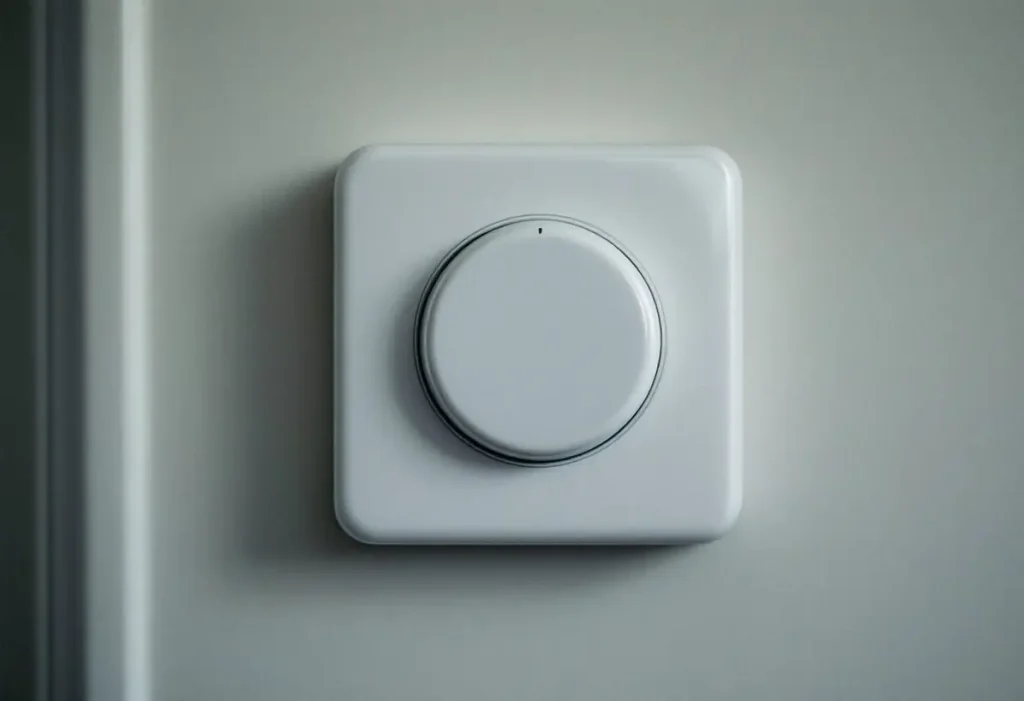
Why does a tester say it has power when the heater still will not work?
Because one hot leg is live whether the heater works or not. A single pole line voltage thermostat breaks only one of the two hots; the LUX instructions say that even on its double pole LV2, “only LINE 1 is broken during normal temperature cycling,” and both lines open only “when the dial is turned to the OFF position.”
That is the situation in a Stack Exchange question: 240 V measured at the wires, thermostat bypassed, still no heat. Full voltage and no heat means the circuit inside the heater is open: a broken element or a failed limit, told apart only by an ohm reading with power off.
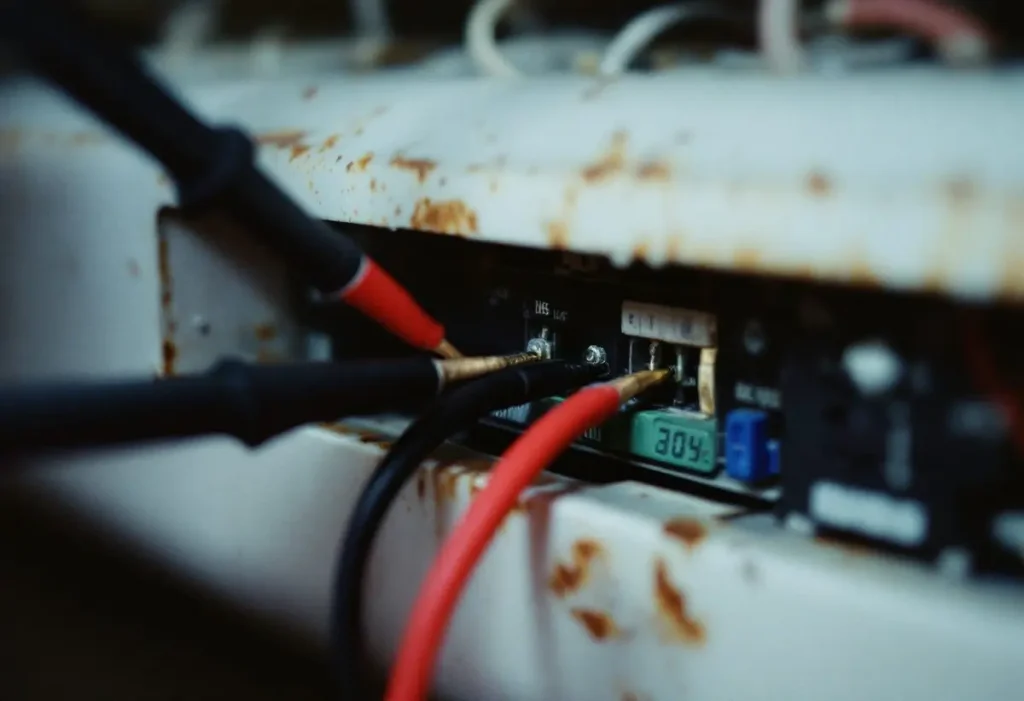
How many ohms should a good baseboard element read?
Roughly 240 squared divided by the rated watts: 38.4 ohms for a 1,500 W heater, 57.6 ohms for 1,000 W. A meter showing OL (infinite resistance) across the element leads means a break. A reading near the table value clears the element.
| Cadet F series model (240/208 V) | Length | Rated watts at 240 V | Expected element ohms | Watts on 208 V (Cadet prints) | Watts on 120 V |
|---|---|---|---|---|---|
| 2F500 | 30 in | 500 | 115.2 | 375 | 125 |
| 3F750 | 36 in | 750 | 76.8 | 563 | 188 |
| 4F1000 | 48 in | 1000 | 57.6 | 750 | 250 |
| 5F1250 | 60 in | 1250 | 46.1 | 937 | 312 |
| 6F1500 | 72 in | 1500 | 38.4 | 1125 | 375 |
| 8F2000 | 96 in | 2000 | 28.8 | 1500 | 500 |
HVAC Brief calculation: R = V² / P at 240 V; output at a lower voltage = V² / R, which is (208/240)² = 75.1% and (120/240)² = 25% of the rating. Lengths, rated watts and 208 V watts from the Cadet F series spec sheet. The QMark submittal specifies 80% nickel, 20% chromium element wire; expect a cold reading near, not exactly at, these values. The test is open vs closed.
One Stack Exchange answer divides 240 V by the breaker rating and gets 4.8 ohms. That is near a dead short, not a heater: use the heater’s own wattage.
Do baseboard heaters have a reset button for the high limit?
Not on the two mainstream series we read: the limit resets itself. Cadet describes an “oversized high temperature limit switch with a full length capillary sensor tube that temporarily shuts the heater off,” and the QMark/Marley 2500 submittal specifies a linear cut-out that will “reactivate heater when temperatures return to normal.” A heater that warms, goes cold and warms again is often the limit doing its job.
Marley’s manual says that “during normal use, this safety control should not operate.” Find what is blocking the heater: the two makers print different clearances, 6 inches in front and above for Marley 2500, and “minimum of 12 inches in front and above, 6 inches on both sides” for Cadet F series. If the limit keeps cycling with the heater clear, Marley’s instruction is to “disconnect power to heater and have it checked and repaired by a qualified electrician,” and Cadet’s chart lists “replace limit.” Never jumper it. A burning smell during these cycles has its own causes in our guide to electric heater burning smells.
Electric baseboard heater not getting hot enough: wrong voltage or too little heater?
Check the voltage first: it can cut output by a quarter or three quarters with nothing broken. Cadet warns that a 240 volt heater on 120 volts “will drastically reduce the heater’s output”: a 6F1500 drops from 1,500 W to 375 W. In apartment buildings with 208 V service, the same heater gives 1,125 W, which Cadet and Marley both list as a second rating.
If the voltage is right, the fins are clean and the element heats, Cadet’s chart names the remaining cause plainly: “heat loss from room is greater than heater capacity.” How many feet a room needs is a heat loss calculation covered in our electric baseboard heater sizing guide, and why insulation comes before more heaters is in insulating before replacing equipment. DOE notes that cheaper baseboards “often give poor temperature control,” so a weak heater on a cheap built-in thermostat may simply be cycling early.
Electric baseboard heater not turning off: stuck contacts or no OFF position?
Cadet gives a 2 minute test: “Adjust thermostat to its lowest setting. If heater continues to run (allow two minutes for the thermostat to respond), replace thermostat.” Contacts that have welded shut keep the element on at any setting. In a cold spare room it may be working correctly: a single pole dial bottoms out at a temperature, not at off (50 F on the LUX LV1), and Cadet’s fix is a “double pole model with positive off.”
Placement matters too. LUX tells installers to avoid “positioning this thermostat in a location which is directly above any baseboard heating components, as this will cause erratic temperature control”; the rest of the placement rules are in our thermostat location guide.
Did a new smart thermostat stop the baseboard heater?
Very likely, if it was a standard 24 volt model built for furnaces, including the ducted kind in electric furnace not heating. Google’s Nest compatibility page says “high voltage systems, such as electric baseboard heaters, aren’t compatible with Nest thermostats,” and describes them as a thermostat “labeled 120 V or 240 V” with “two thick wires with wire nuts.” Reinstall a line voltage thermostat, such as the LUX LV2 (22 amps at 250/277 VAC).
Frequently asked questions
Why is my electric baseboard heater not working in one room only?
Each room usually has its own line voltage thermostat, so a single cold room points to that thermostat, its wiring, the limit or the element rather than the panel. Several heaters can share one breaker: Marley’s Table 1 allows up to 16 A of heaters on a 20 A breaker, enough for two 6 foot heaters at 6.3 A, so check whether the other heater on that circuit still works before resetting anything.
How long do electric baseboard heaters last?
No federal agency publishes a baseboard service life. The makers’ warranties are the hard numbers: Cadet gives F series baseboards a limited lifetime warranty, and Marley warrants 2500 series heating elements for ten years and other parts for one year from installation. Thermostats and connections are the replaceable parts that fail first in both makers’ troubleshooting text.
Can an electric baseboard heater run on 110 volt power?
Only a heater built for it. Marley sells 120 V versions, such as the 2516NW at 1,500 W and 12.6 A, beside the 240 V 2546NW at 6.3 A. A 240 V heater on 120 V gives 25% of its rating, and Cadet warns that hooking a 120 volt heater to a 240 volt supply “will destroy the heater.” Match the nameplate voltage.
Why is my electric baseboard heater thermostat not working?
Line voltage thermostats switch the full heater current (LUX rates its LV models at 22 amps) and fail open (no heat) or stuck closed (no off). Cadet’s built-in BTF1 and BTF2 kits cover 40 F to 85 F, so a room above 85 F or below 40 F is outside the dial’s control. A replacement must match single or double pole and the voltage.
How we researched this
On 19 November 2026 we read the Cadet F series guide and spec sheet, the Marley 2500 manual and submittal, the LUX line voltage thermostat instructions, Google’s Nest compatibility page and DOE’s archived electric resistance page. Ohm and output figures are our calculation from maker ratings. Unsourced blog lifespans and repair prices were excluded; we did not open the NEC or UL 1042.
Sources
- Cadet Manufacturing Co. “Electric Baseboard Owner’s Guide, F Series.” https://pdf.lowes.com/installationguides/027418033604_install.pdf. Accessed November 2026.
- Cadet. “F Series Electric Baseboard Spec Sheet.” https://www.sylvane.com/cdn/shop/files/spec-sheet-cadet-f-series-120v-basebaord-heater.pdf. Accessed November 2026.
- Marley Engineered Products. “2500/C2500 Series Baseboard Instructions.” https://marleymep.com/wp-content/uploads/5200-2194-010_2.pdf. Accessed November 2026.
- QMark (Marley Engineered Products). “2500 Series Submittal Sheet.” https://www.marleymep.com/wp-content/uploads/MEP_2500-Baseboard-Q_Submittal_2023-12-web.pdf. Accessed November 2026.
- LUX Products. “LV1, LV2, LV3 Line Voltage Thermostats” (archive.org copy). https://archive.org/download/manualsonline-id-a9967ac2-5b8c-40a4-8718-354cc0a81be2/a9967ac2-5b8c-40a4-8718-354cc0a81be2.pdf. Accessed November 2026.
- Google. “Nest thermostat compatibility.” https://support.google.com/googlehome/answer/9246656?hl=en. Accessed November 2026.
- U.S. Department of Energy, Energy Saver. “Electric Resistance Heating” (archived copy). https://web.archive.org/web/2025id_/https://www.energy.gov/energysaver/electric-resistance-heating. Accessed November 2026.
- DIY Stack Exchange. “Baseboard heater not working despite measuring voltage”. https://diy.stackexchange.com/questions/284912/baseboard-heater-not-working-despite-measuring-voltage. Accessed November 2026.
Leave a Reply