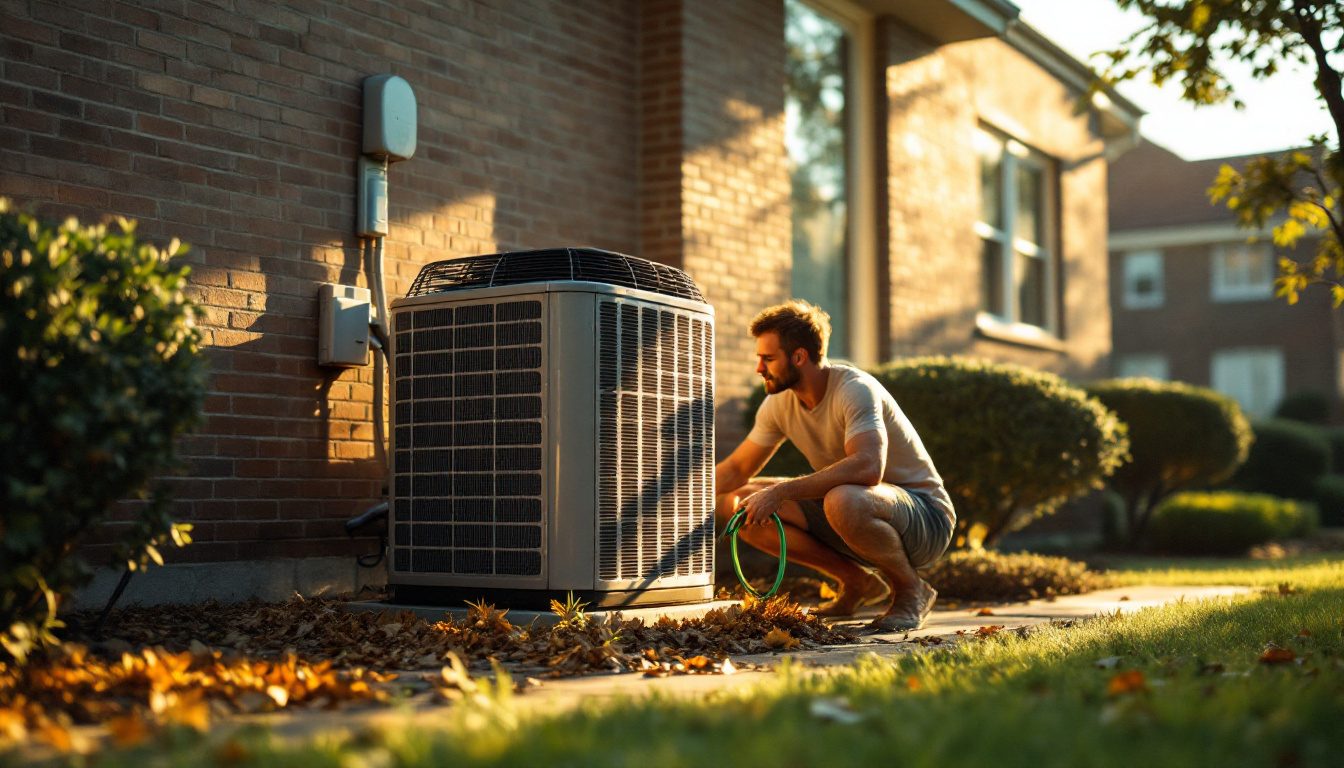
What causes AC short cycling? AC short cycling is a compressor that stops after a few minutes and restarts, over and over. The usual causes are an oversized unit at light load, a pressure safety switch tripping, a frozen coil, a clogged drain, or a misplaced or underpowered thermostat.
Key Takeaways
- The federal efficiency test cycles a single-speed compressor 6 minutes on and 24 minutes off (10 CFR 430, Appendix M1).
- Honeywell defines cycle rate at 50% capacity (Honeywell Home); at the 3 cycles per hour it recommends for most compressors, that is about 10 minutes on and 10 off.
- A restart roughly every five minutes points to a safety switch plus a five minute anti-short-cycle delay.
- NIST measured a 7 to 15 percent efficiency loss at a 30% refrigerant undercharge (NIST TN 1848, 2014).
- ENERGY STAR recommends sizing a single-speed AC at 90 to 115 percent of the calculated load (National HVAC Design Report).
- The “3x more electricity” claim on ranking pages is unsourced; at its default coefficient, the federal SEER2 formula prices half-load cycling at 10 percent.
What is AC short cycling, and how long should an AC run?
AC short cycling is a compressor that shuts off before it settles into steady operation, then restarts soon after. No federal rule defines it in minutes, so judge it against design benchmarks.
The DOE test procedure in 10 CFR 430, Appendix M1 measures cycling losses by running a single-speed compressor 6 minutes on and 24 minutes off. Honeywell’s Pro 3000 installation instructions recommend 3 cycles per hour for most compressors, with a five-minute compressor off time as the default.
Honeywell counts cycle rate at half load, so 3 cycles per hour means a 20 minute cycle with about 10 minutes of compressor run. Shorter runs on a mild evening can be normal. A run of a minute or two followed by a forced wait is not.
How do you read the timing to find the cause?
Time three things: how long the compressor runs, how long it stays off, and whether the indoor fan keeps going. That pattern sorts most causes before a panel comes off.
| What you observe | Likely cause | Owner check | Technician job |
|---|---|---|---|
| Short runs, long rests, clammy house, worst at night | Oversized for the load | Log run times on a mild evening | Load calculation |
| Stops after a few minutes, restarts about 5 minutes later; worst on hot afternoons | High-pressure trip: dirty condenser, dead fan, overcharge | Clear debris around the condenser | Fan, coil and charge checks |
| Short runs, weak cooling, frost on the larger copper line | Low charge, low airflow or a freezing coil | Replace the filter | Leak search and charge check |
| Outdoor unit stops, indoor fan runs, water near the air handler | Condensate float switch | Check the drain pan and line | Clear the trap or pump |
| On and off every minute or two; thermostat screen blanks | Thermostat power or wiring | Check for a C wire | Control wiring and transformer |
| Outdoor unit hums or starts, stops within seconds | Starting fault: capacitor or compressor | Keep the system off | Capacitor and compressor tests |
Why does AC short cycling happen at night or in mild weather?
At night the cooling load drops, so a system with spare capacity reaches setpoint in a few minutes and shuts off. That is AC short cycling caused by size, not by a failed part.
The ENERGY STAR National HVAC Design Report recommends a single-speed system at 90 to 115 percent of the calculated cooling load, allowing up to 130. Variable-speed equipment may go to 160 percent. A room-by-room load calculation, not a square-foot rule, is how a house lands inside those bands.
NIST Technical Note 1848 notes that shorter runs hurt moisture removal, because steady operation becomes a smaller share of each cycle. Our explainer on why a house feels cold but damp covers that side.
Correction: oversizing is not an energy disaster
Ranking pages claim short cycling triples electricity use. In NIST’s 2014 simulations, 100 percent oversizing with resized ducts raised cooling energy 2 to 3 percent; a cited 2007 study put 30 percent oversizing in Miami at 2 percent. Right-sizing four Florida houses gave mixed results. The real costs are humidity and wear.
Why does AC short cycling happen when it is hot outside?
A healthy AC runs nearly nonstop on a hot afternoon. AC short cycling at peak heat usually means a safety device is stopping the compressor, most often on high discharge pressure, and a timer is then holding it off for about five minutes.
Rheem documents both halves. Its Head Pressure Control Kit 913550 switch opens above 425 psig, closes below 350 psig, and starts the 5 minute compressor delay when it opens. Its anti-short-cycle timer kit adds that delay after any break in the cooling call so pressures can equalize. Setpoints vary by model and refrigerant.
Pressure climbs when the outdoor coil cannot reject heat. Typical reasons are a matted coil, which is why cleaning the outdoor coil comes first, a dead condenser fan, or blocked airflow. DOE says to trim foliage back at least two feet. NIST links refrigerant overcharge to increased discharge pressure.
A compressor that hums and quits within seconds is a starting problem instead: see our pages on the run capacitor and the hard start kit.
Can low refrigerant, a frozen coil or the thermostat cause it?
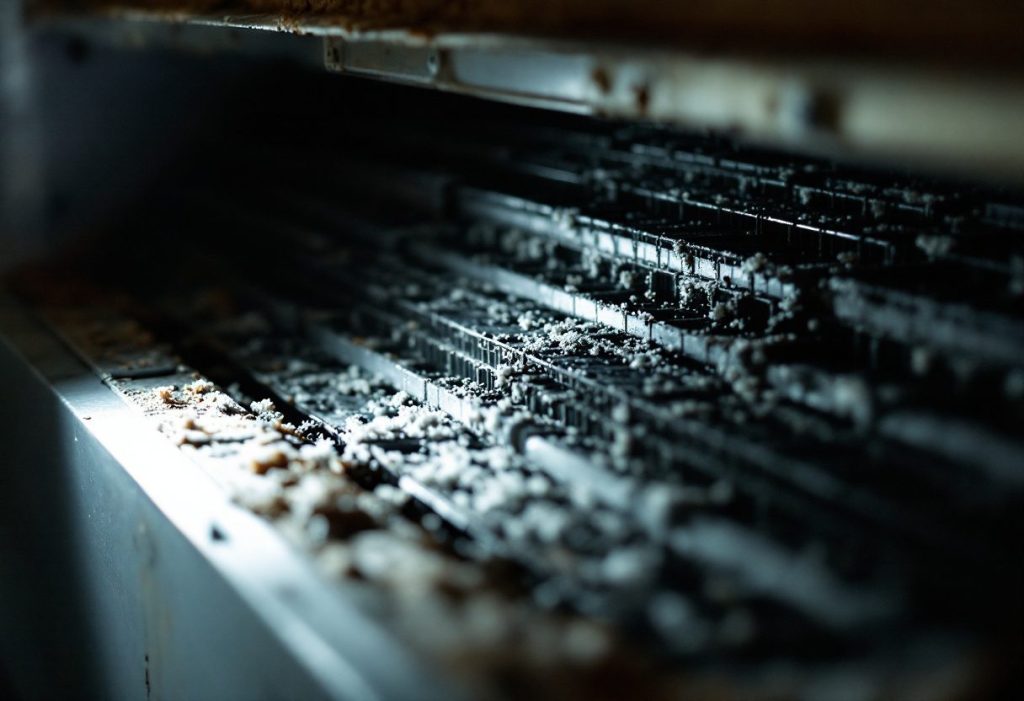
Yes. Low charge and a frozen coil drag suction pressure down until a low-pressure control or the ice stops cooling; a thermostat ends calls early through placement, a fast cycle rate or unstable power.
Undercharge is common. NIST calls a 30% undercharge “a fault level commonly observed during field surveys” and measured it cutting capacity by almost 15 percent and efficiency by 12 percent on average. Charge cannot be judged on a unit that keeps stopping: a Bonneville Power Administration sheet has technicians wait 20 to 25 minutes before temperature-split readings. Charge is verified with superheat and subcooling readings, after ruling out a sticking expansion valve.
If you see ice, shut cooling off and let it thaw; our explainer on an AC that freezes up separates the airflow and charge causes.
For the thermostat, DOE warns that poor placement causes “unnecessary furnace or air conditioner cycling” and wants it on an interior wall, away from sun, drafts, doorways, skylights and windows. For a Nest that clicks on and off, Google points first to a power issue that may need a C wire, the subject of our smart thermostat installation guide.
How do you fix AC short cycling safely?
Fix AC short cycling from the free checks toward the licensed ones: airflow, drain and thermostat first, then a technician for pressures, charge and electrical parts. Do not keep restarting a unit that trips repeatedly.
- Replace or clean the filter. If unsure, DOE says every month or two in the cooling season.
- Open closed registers and clear blocked returns.
- With power off at the outdoor disconnect, clear leaves and cuttings from the condenser.
- Check the condensate drain. DOE notes a clogged drain can make the equipment turn off until the drain has been cleared.
- Check the thermostat: Cool mode, fresh batteries, no lamp, sun or register near it, and wiring seated.
- Time an hour of runs and match the pattern to the table above.
A blocked drain has its own fix, covered in our clogged AC drain line guide. Leave the installer menu alone. Honeywell describes its minimum off timer, up to five minutes, as protection against short cycling, so shortening it trades one problem for another. Pressure switches, refrigerant, capacitors and contactors sit behind line-voltage panels and belong to a licensed technician.
Does short cycling damage the compressor or raise the bill?
It can, but less than ranking pages claim. The federal rating math charges a single-speed unit about 10 percent for cycling at half load, and the larger risk is the compressor restarts themselves.
Appendix M1 computes a single-speed rating as SEER2 = PLF(0.5) × EER at the B test, with PLF(0.5) = 1 minus 0.5 times the degradation coefficient. At the default 0.2, that factor is 0.9, a 10 percent penalty. NIST cites measured coefficients of 0.05 to 0.10 for most systems, a smaller loss still.
Wear is the bigger worry. Honeywell’s T1 Pro user guide warns that “damage can occur if the compressor is restarted too soon after shutdown,” and Rheem’s timer exists so the compressor “does not have to start against high pressures.” Repeated trips wear the costliest part, and replacing a compressor is where that ends.
How we researched this
Research date: October 8, 2026. We opened 19 documents and cite 13. Cycle benchmarks and the part-load formula come from Appendix M1 as in force on January 1, 2024, because the current appendix incorporates AHRI 210/240-2024 by reference. Fault and oversizing effects come from NIST TN 1848; delays and setpoints from named Rheem and Honeywell documents.
Excluded: ranking contractor and AI-generated pages, whose figures (“40% of cases”, “3x more electricity”) carry no source. Pro 3000 settings come from a manual transcription. Reddit was not mined. No prices appear: no federal series covers this repair.
Frequently asked questions
How long should an AC run per cycle?
There is no single number. Honeywell recommends 3 cycles per hour for most compressors, counted at half load, which means about 10 minutes on and 10 off. The DOE cyclic test uses 6 minutes on and 24 off. Minute-long runs with forced waits point to a fault.
Why does my AC turn on and off every 5 minutes?
Usually a safety control is opening and an anti-short-cycle timer is holding the compressor off. Rheem documents a five minute start delay after any break in the cooling call. Check airflow and the condenser, then have a technician read pressures.
Should I turn my AC off if it is short cycling?
If it stops within seconds, hums, or shows ice, yes, and call a technician. Honeywell’s T1 Pro guide warns that damage can occur if the compressor is restarted too soon after shutdown. A slow, regular cycle on a mild night can wait for a service visit.
Can a Nest thermostat cause AC short cycling?
Yes. Google’s Nest help says a system that turns off and on repeatedly may have a power issue and may need a C wire or the Nest Power Connector. DOE adds that poor placement can cause unnecessary air conditioner cycling.
Can a dirty filter cause short cycling?
Indirectly. A clogged filter cuts airflow across the indoor coil, which can freeze it or trip a low-pressure control. DOE says to clean or replace filters every month or two in the cooling season if you are unsure. It is the cheapest check on the list.
Will a bigger AC fix short cycling?
No, it usually makes it worse. ENERGY STAR recommends sizing a single-speed AC at 90 to 115 percent of the calculated load. Variable-speed equipment may go to 160 percent because it slows down instead of switching off. Ask for a Manual J load calculation.
Sources
- eCFR. “10 CFR 430, Subpart B, Appendix M1” (version of January 1, 2024). https://www.ecfr.gov/on/2024-01-01/title-10/chapter-II/subchapter-D/part-430/subpart-B/appendix-Appendix%20M1%20to%20Subpart%20B%20of%20Part%20430. Accessed October 2026.
- NIST. “Sensitivity Analysis of Installation Faults on Heat Pump Performance,” TN 1848, 2014. https://nvlpubs.nist.gov/nistpubs/TechnicalNotes/NIST.TN.1848.pdf. Accessed October 2026.
- ENERGY STAR. “National HVAC Design Report (Rev. 13).” https://www.energystar.gov/sites/default/files/asset/document/National%20HVAC%20Design%20Report_Rev%2013.pdf. Accessed October 2026.
- Rheem. “Anti-Short-Cycle Timer Kit 914096.” https://files.rheem.com/LiteratureArchive/707703.pdf. Accessed October 2026.
- Rheem. “Head Pressure Control Kit 913550.” https://files.rheem.com/LiteratureArchive/707113a.pdf. Accessed October 2026.
- Honeywell Home. “Thermostat display shows wait or flashing cool on.” https://honeywellhome.com/us/en/support/my-thermostat-display-shows-wait-or-waiting-for-equipment-or-has-a-flashing-cool-on-in-display. Accessed October 2026.
- Honeywell Home. “Wi-Fi 7-Day Programmable Thermostat Install.” https://honeywellhome.com/us/en/support/wi-fi-7-day-programmable-thermostat-install-7. Accessed October 2026.
- Honeywell Home. “Pro 3000 Installation Instructions” (transcription). https://thermostat.guide/honeywell-home/honeywell-home-pro-3000-non-programmable-digital-thermostat-installation-instructions/. Accessed October 2026.
- Honeywell Home. “T1 Pro User Guide.” https://resource.bakerdist.com/is/content/Watscocom/Gemaire/honeywell-pl_th1110d2009ain_article_59877126393377_en_uci.pdf. Accessed October 2026.
- DOE Energy Saver. “Thermostats” (archived copy). https://web.archive.org/web/2025id_/https://www.energy.gov/energysaver/thermostats. Accessed October 2026.
- DOE Energy Saver. “Maintaining Your Air Conditioner” (archived copy). https://web.archive.org/web/2025id_/https://www.energy.gov/energysaver/maintaining-your-air-conditioner. Accessed October 2026.
- Google Nest Help. “Learn to fix strange heating or cooling issues.” https://support.google.com/googlenest/answer/9235232?hl=en. Accessed October 2026.
- Bonneville Power Administration. “PTCS Thermostat Support Sheet: Honeywell T6 Pro.” https://www.bpa.gov/-/media/Aep/energy-efficiency/residential/residential-ptcs-essentials/honeywell-t6-pro-new.pdf. Accessed October 2026.
Leave a Reply