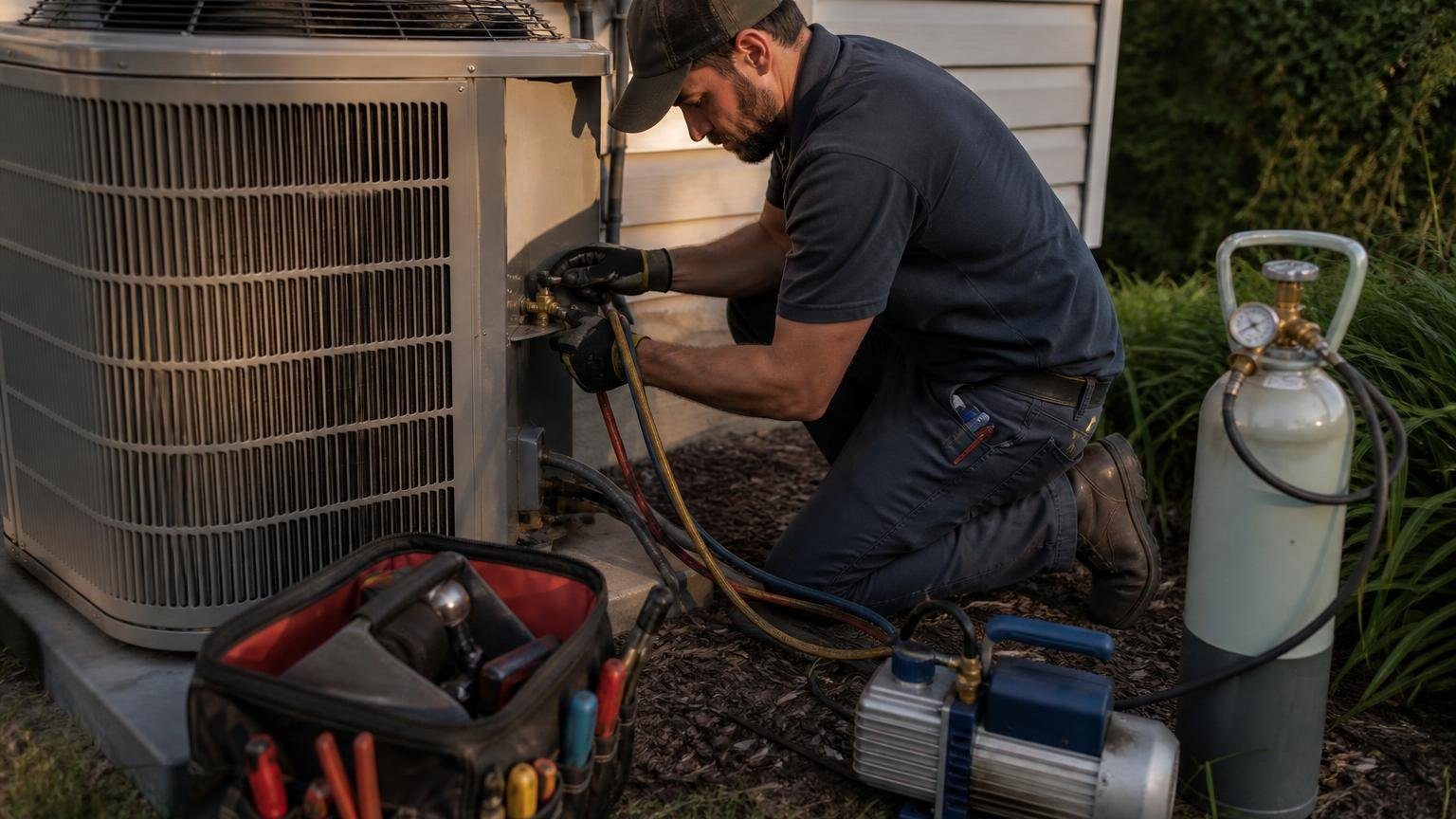
What HVAC tools do you need? HVAC tools fall into six kits: hand tools, a rated meter with lockout gear, gauges and temperature probes, evacuation gear, recovery equipment, and gas and combustion instruments. Federal rules name only a few outright; manufacturer manuals set the rest.
Key Takeaways
- Before opening a system, 40 CFR 82.156 requires recovery with a machine certified under 82.158.
- Recovery machines for flammable refrigerants made since January 1, 2017 are certified to UL 1963 plus AHRI 740-2016 (40 CFR 82.158).
- A Rheem R-454B manual calls for evacuation to 500 microns, held for at least 15 minutes, after a nitrogen pressure hold of 60 minutes (Rheem).
- The same manual specifies an A2L leak detector sensitive to 0.2 oz/year.
- OSHA 29 CFR 1910.333 requires a lock and a tag on the disconnect and a test that proves the circuit dead.
- BLS counted 440,900 HVAC mechanic and installer jobs in 2025 (BLS OOH).
What makes an HVAC tool essential?
An HVAC tool is essential when a rule or a manufacturer procedure cannot be met without it. Everything else is preference.
The federal floor is EPA’s refrigerant rules and OSHA’s electrical rules. Installation manuals then set numeric targets, such as a vacuum level or a gas pressure, that need a specific instrument. BLS notes that apprentices learn to use a variety of tools over programs that usually last several years, so the kit grows with the job.
HVAC tools list: the tiered table
The HVAC tools list below gives each core tool, its job, the document that makes it necessary, and its skill tier. Who buys which tool varies by employer, so the tier is a skill level, not a purchase rule.
| Tool | What it is for | Required by | Tier |
|---|---|---|---|
| Screwdrivers, nut drivers, pliers, wrenches, hex keys | Panels, terminals, fittings | Trade practice | Apprentice |
| Tape measure, level, flashlight | Layout, pitch, inspection | Trade practice | Apprentice |
| Multimeter with clamp | Volts, amps, continuity, proving a circuit dead | OSHA 1910.333, 1910.334 | Apprentice |
| Lock and tag | Holding the disconnect open | OSHA 1910.333(b)(2)(iii) | Apprentice |
| Rubber insulating gloves, Class 00 | Work near live parts up to 500 V AC | OSHA 1910.137, tested every 6 months | Journeyman |
| Manifold gauges and hoses | System pressures while charging | Rheem: 800 psig high side and hoses | Apprentice |
| Clamp-on temperature probes | Superheat, subcooling, temperature rise | Rheem; Goodman | Apprentice |
| Nitrogen cylinder and regulator | Brazing purge, pressure test | Rheem: hold design pressure 60 minutes | Journeyman |
| Vacuum pump and micron gauge | Evacuation and vacuum hold | Rheem: 500 microns, 15 minutes | Journeyman |
| Refrigerant scale | Weighing in charge for line length | Rheem: accurate to 1 oz | Journeyman |
| Certified recovery machine | Removing refrigerant before opening | 40 CFR 82.156 and 82.158 | Journeyman |
| Recovery cylinders | Holding recovered refrigerant | Rheem: DOT 4BA400 or 4BW400, 400 psig | Journeyman |
| A2L-rated electronic leak detector | Checking field joints | Rheem: 0.2 oz/year or better | Journeyman |
| Manometer | Gas inlet and manifold pressure | Goodman furnace manual | Journeyman |
| Combustion analyzer | O2, CO2 and CO in flue gas | Many modulating boiler manuals (Rinnai TB-160) | Journeyman |
Which refrigerant tools does federal law require?
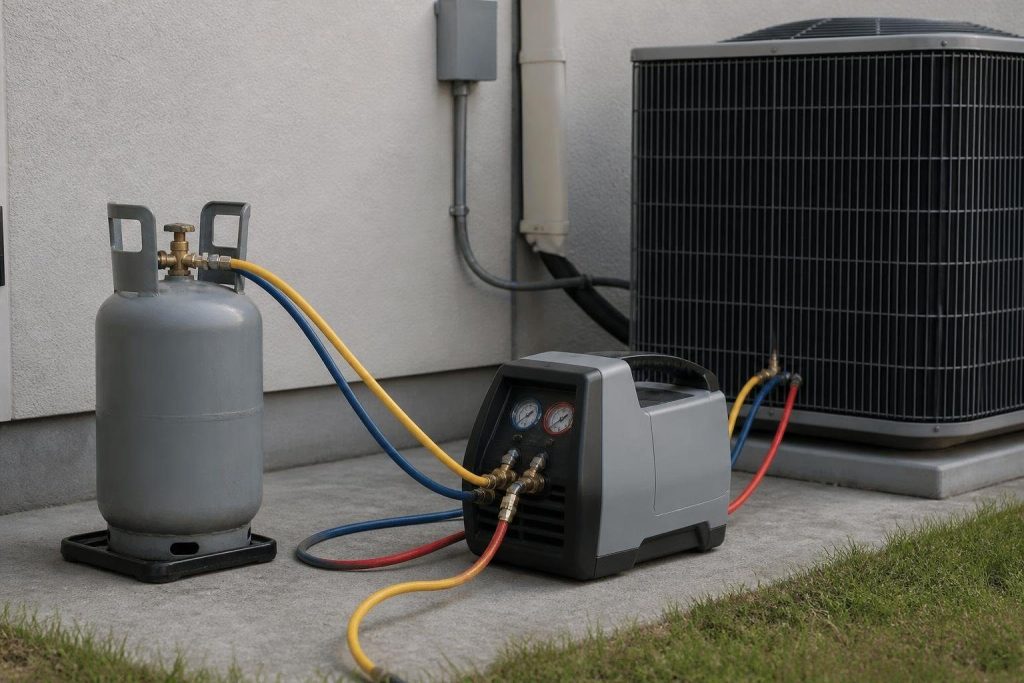
Federal law requires a certified recovery machine and proof of the evacuation level. Under 40 CFR 82.156(a), technicians must recover refrigerant to the Table 1 level with a machine certified under 82.158 and verify that level before opening the system.
For a high-pressure appliance holding under 200 pounds, such as a typical split system, Table 1 sets the level at 0 inches of mercury vacuum. The machine itself must be certified to reach 10 inches of mercury on that class, per 82.158 Table 2. Certified machines carry a permanent label with the date of manufacture and must have low-loss fittings on all hoses.
System-dependent recovery, which relies on the appliance’s own compressor, is barred above 15 pounds of charge unless it is a permanently attached pump-out unit. Our explainer on recovering refrigerant step by step walks the procedure, and the guide to which EPA 608 certification type you need covers who may run it.
What do manufacturer manuals require on an install?
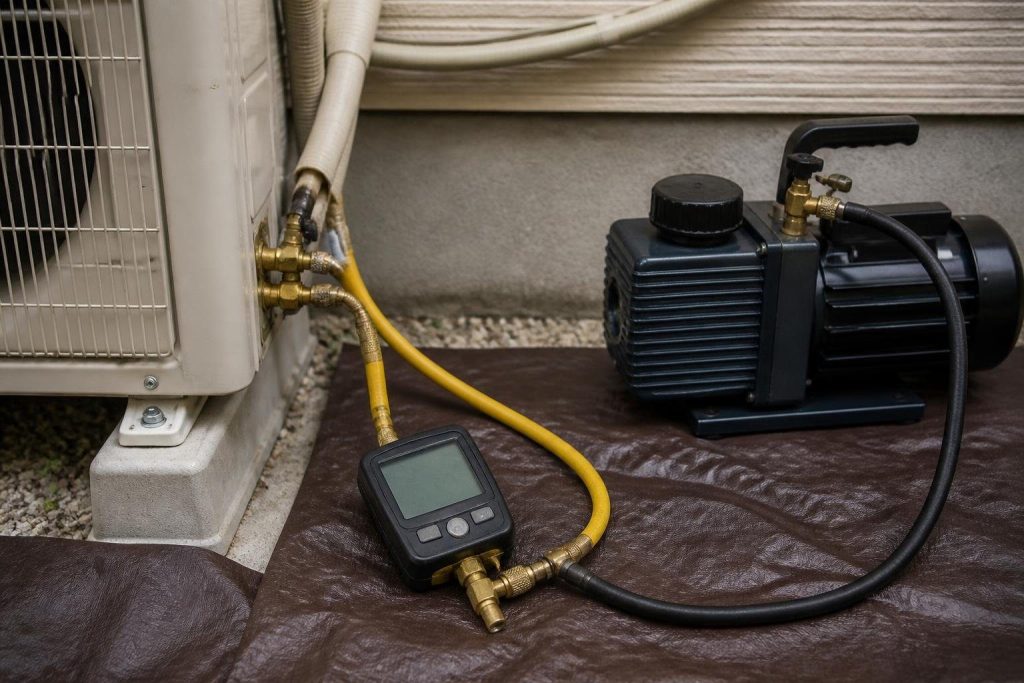
Manufacturer manuals require a nitrogen kit, a micron gauge, a scale and calibrated temperature probes. A Rheem R-454B heat pump manual says to pressurize the line set and coil with dry nitrogen to nameplate design pressure and let it sit for 60 minutes. Then evacuate to 500 microns and hold 500 microns or less for at least 15 minutes, with the pump on both service ports.
That target is read on a micron gauge, so the gauge, not the pump, is the tool the spec depends on. Rheem adds that the filter drier only holds enough moisture if the system is properly evacuated. Our guide to line set sizing, brazing and evacuation covers the full sequence.
- Purge with flowing nitrogen while brazing.
- Pressure test with nitrogen and watch for a drop over 60 minutes.
- Evacuate to 500 microns and hold for 15 minutes.
- Weigh in the line-length charge on a scale accurate to 1 oz.
- Confirm charge with clamp-on probes against the charging chart.
Rheem calls charging by weight a starting point only. Final charge is set by readings, explained in our superheat and subcooling worked examples.
Do A2L refrigerants need new HVAC tools?
A2L refrigerants need A2L-rated powered equipment, not new hand tools. Rheem tells installers to verify that service equipment and instruments are certified for group A2L refrigerants, and in particular R-454B, the mildly flammable replacement for R-410A. Manifold sets must read up to 800 psig high side and 250 psig low side with a 550 psig low-side retard.
The manual also requires recovery equipment suitable for the A2L refrigerant, recovery cylinders rated 400 psig (DOT 4BA400 or 4BW400), and no mixing of refrigerants in recovery units or cylinders. Federally, recovery machines for flammable refrigerants are certified under appendix B4, which adds UL 1963 Supplement SB to AHRI 740-2016.
Field joints get an A2L-compatible detector with 0.2 oz/year sensitivity or better; detectors must be non-sparking, sealed or intrinsically safe, set at no more than 25 % of the lower flammability limit, and halide torches are banned. Our comparison of leak detection methods and A2L sensors covers the trade-offs.
Myth: A2L work needs spark-proof hand tools
AHRI’s Safe Refrigerant Transition Task Force says no. Its FAQ (archived copy) states A2L installation uses the same types of tools as A1, because ignition needs far more energy than a static spark. The upgrade is in powered gear: A2L-suitable recovery equipment and leak detectors, with the vacuum pump outlet kept away from ignition sources, per Rheem.
Which electrical tools and PPE does OSHA require?
OSHA requires a lock and tag, a rated tester, and insulating protection matched to the voltage. Under 29 CFR 1910.333(b)(2), a lock and a tag go on each disconnecting means, and a qualified person must use test equipment to verify the parts are deenergized, including against backfeed. That test is the job a multimeter does before anyone touches a run capacitor or contactor.
The meter itself is regulated too. 29 CFR 1910.334(c) says test instruments and their accessories shall be rated for the circuits they connect to, and leads and probes must be visually inspected before use. OSHA names no meter category; the rating has to cover the circuit.
For gloves, 29 CFR 1910.137 Table I-4 rates Class 00 rubber insulating gloves for a maximum use voltage of 500 V AC and Class 0 for 1,000 V. Table I-5 requires gloves to be tested before first issue and every 6 months thereafter. BLS says HVAC technicians have one of the highest rates of injuries and illnesses of all occupations.
What heating and airflow tools does a technician need?
Heating work adds a manometer and, on many boilers, a combustion analyzer. A Goodman *MES80 furnace installation manual has the installer attach a manometer to the gas valve and confirm natural gas inlet pressure of 4.5 to 10.0 inches w.c. and manifold pressure of 3.2 to 3.8 inches w.c. with burners firing.
The same manual requires temperature rise to fall within the rating plate range, since an incorrect rise can cause condensing in or overheating of the heat exchanger; supply and return probes measure it. Airflow checks then lean on the CFM-per-ton airflow rule.
A combustion analyzer reads O2, CO2 and CO in flue gas. Rinnai’s Technical Bulletin TB-160 notes that many modulating condensing boilers require a combustion analysis at installation or commissioning, with O2/CO2 set to a factory value, while its own I-Series does not. Our heat exchanger testing guide explains what a combustion reading can and cannot prove.
HVAC tools for beginners: what does an apprentice buy first?
An apprentice’s first HVAC tools are the ones the first week demands: hand tools, a rated meter with clamp, a personal lock and tag, gauges and temperature clamps. Those cover electrical diagnosis and reading a running system. Our guide to how HVAC apprenticeships are structured covers the schedule.
Tier 2 and 3 tools follow the work. Nitrogen, vacuum and scale arrive with installs; recovery equipment arrives with opening systems, which requires EPA certification, and the HVAC certification options explain which credential comes first.
How we researched this
Researched October 8 to 9, 2026. We read eight eCFR sections plus EPA, AHRI, Rheem, Goodman, Rinnai and BLS documents; ten sources are cited. 1910.147 was set aside because its scope sends electrical hazards to subpart S. Excluded: prices and brand picks (no federal series), vendor tool lists, and Reddit (safety topic).
Frequently asked questions
What tools does an HVAC apprentice need?
Start with hand tools, a multimeter with clamp rated for the circuits you will test, a personal lock and tag, manifold gauges and clamp-on temperature probes. OSHA 29 CFR 1910.333 requires the lock, tag and a dead-circuit test before electrical work, so those come first.
What is a micron gauge used for in HVAC?
It reads deep vacuum during evacuation. Rheem’s R-454B manual requires evacuation to 500 microns, held at 500 microns or less for at least 15 minutes, after a nitrogen pressure test. The micron gauge is the instrument that proves the target was met.
Do I need a special recovery machine for R-454B?
Use one certified for flammable refrigerants. Under 40 CFR 82.158, equipment made since January 1, 2017 for flammable refrigerants is certified under appendix B4, and Rheem requires recovery equipment suitable for the A2L refrigerant, with cylinders rated 400 psig.
Can I use R-410A gauges on R-454B?
Only if they meet the ratings. Rheem specifies manifold sets reading up to 800 psig high side and 250 psig low side with a 550 psig retard, hoses rated 800 psig, and instruments certified for A2L refrigerants. Check the gauge maker’s A2L listing.
What multimeter rating does an HVAC technician need?
OSHA 29 CFR 1910.334 requires test instruments and accessories to be rated for the circuits they connect to, and leads to be inspected before use. It names no category, so match the meter’s marked rating to the highest voltage on the job.
Do HVAC technicians need a combustion analyzer?
For many boilers, yes. Rinnai’s TB-160 notes that many modulating condensing boilers require a combustion analysis at installation or commissioning, with O2/CO2 set to a factory value.
Sources
- eCFR. “40 CFR 82.156, Proper evacuation of refrigerant from appliances.” https://www.ecfr.gov/current/title-40/chapter-I/subchapter-C/part-82/subpart-F/section-82.156. Accessed October 2026.
- eCFR. “40 CFR 82.158, Standards for recovery and/or recycling equipment.” https://www.ecfr.gov/current/title-40/chapter-I/subchapter-C/part-82/subpart-F/section-82.158. Accessed October 2026.
- eCFR. “29 CFR 1910.333, Selection and use of work practices.” https://www.ecfr.gov/current/title-29/section-1910.333. Accessed October 2026.
- eCFR. “29 CFR 1910.334, Use of equipment.” https://www.ecfr.gov/current/title-29/section-1910.334. Accessed October 2026.
- eCFR. “29 CFR 1910.137, Electrical protective equipment.” https://www.ecfr.gov/current/title-29/section-1910.137. Accessed October 2026.
- Rheem Manufacturing. “R-454B Heat Pump Outdoor Units Installation Instructions, (-)P14AY and (-)P15AY.” https://www.budgetheating.com/content/files/downloadables/rp14ay%20wp14ay%20rp15ay%20installation%20instructions.pdf. Accessed October 2026.
- Goodman Manufacturing. “*MES80/*CES80 Gas Furnace Installation Instructions.” https://www.budgetheating.com/content/files/downloadables/gmes80%20gces80%20-%20installation%20manual.pdf. Accessed October 2026.
- Rinnai. “Technical Bulletin 160, I-Series Boiler Combustion Analysis.” https://media.rinnai.us/salsify_asset/s-fb0eb41f-1056-4821-9cd5-1e8c531511fe/TB-160%20I-Series%20Boiler%20Combustion%20Analysis.pdf. Accessed October 2026.
- AHRI Safe Refrigerant Transition Task Force. “Low-GWP Refrigerants FAQs (archived copy).” https://web.archive.org/web/2024id_/https://www.ahrinet.org/system/files/2023-06/AHRI_SRTTF_Low_GWP_Refrigerants_FAQs.pdf. Accessed October 2026.
- U.S. Bureau of Labor Statistics. “Occupational Outlook Handbook: Heating, Air Conditioning, and Refrigeration Mechanics and Installers.” https://www.bls.gov/ooh/installation-maintenance-and-repair/heating-air-conditioning-and-refrigeration-mechanics-and-installers.htm. Accessed October 2026.
Leave a Reply