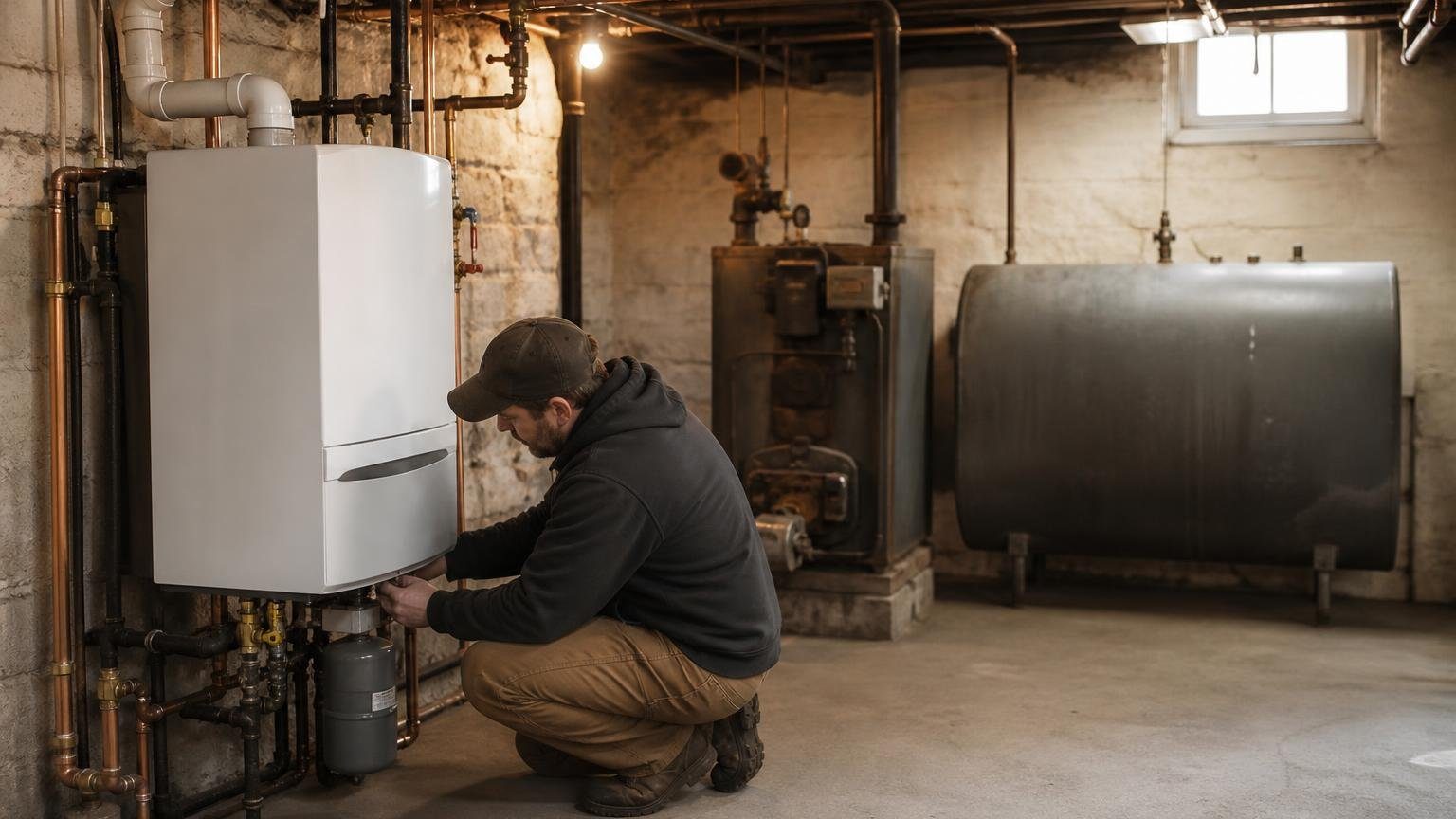
Can you convert oil heat to gas? Yes, if a gas main reaches your street. The utility runs a service line and meter, an installer replaces the oil appliance and fixes the venting, and the oil tank is closed. At EIA’s October 2026 forecast, gas heat costs $14.55 per million Btu against $45.55 from an oil boiler.
Key Takeaways
- Residential heating oil opened the 2026/27 season at $6.04 a gallon on October 5, 2026 (EIA weekly series).
- At EIA’s October 2026 outlook, heat costs $45.55 per million Btu from an 86% oil boiler and $14.55 from a 95% gas furnace.
- A new service line takes 8 to 12 weeks when gas is on your street, 12 to 14 when a main is needed (National Grid).
- An 80% gas furnace needs a lined chimney unless it shares the flue with a draft hood appliance (Goodman manual IO-359J).
- New York’s all-electric law exempts existing buildings (Energy Law 11-104).
- No federal credit in 2026: the IRS limits 25C to improvements made through December 31, 2025.
Can you convert oil heat to gas in your house?
Yes, if the gas utility can reach the house. Most conversions replace the oil furnace or boiler outright and keep the existing ducts or radiators, and both utilities we checked start with an availability check.
The candidates are concentrated in one region. EIA’s 2020 Residential Energy Consumption Survey counted 4.93 million homes heating mainly with fuel oil or kerosene, 4.07 million of them in the Northeast. How those systems work is covered in our guide to oil heat.
How do you convert oil heat to gas, step by step?
To convert oil heat to gas, follow six steps in order. National Grid tells owners not to remove existing equipment until the gas line is installed, so the house is never without heat.
- Check availability. Call the gas utility with your address. National Grid’s New York City guide (October 2024) includes up to 100 feet of main and 100 feet of service line free, quotes anything longer, and requires a signed Non-Fossil Alternatives Acknowledgment first.
- Size and choose the equipment. Ducted homes take a furnace; radiator homes take a boiler, or a combi boiler that also heats tap water. Size it with a heat load analysis.
- Apply for service. Your installer submits the Btu input of every gas appliance; PSE&G uses it to decide whether a main extension or service upgrade is needed and estimates the cost.
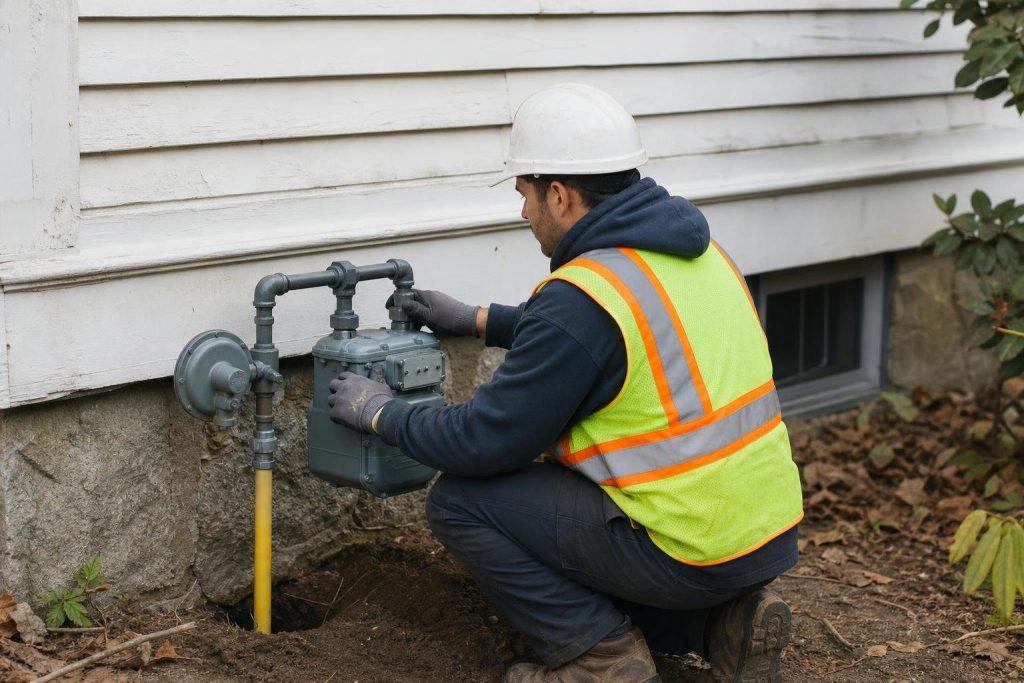
- The utility lays the line and sets the meter. National Grid quotes 8 to 12 weeks when gas is on your road, 12 to 14 with a new main, plus 4 to 6 on a state or county road.
- Install the appliance, piping and venting, including the chimney work below.
- Inspect, then close out the oil. The plumber schedules the municipal inspection; in New York City, meters are not set until the Department of Buildings approves gas authorization. Then cancel oil deliveries.
Do you need a chimney liner after converting oil heat to gas?
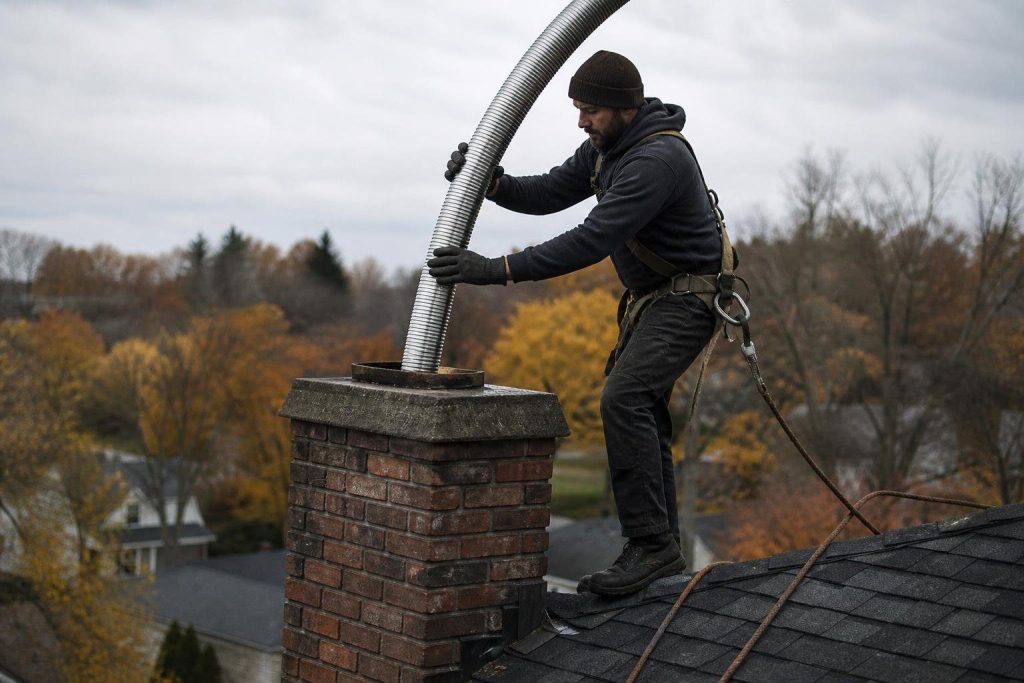
Usually, if the new appliance vents into the old masonry chimney. Goodman’s 80% furnace manual (IO-359J) says not to connect one to a masonry chimney unless it is common vented with a draft hood appliance or the chimney has a metal liner or Type B vent.
Even then, it warns of condensation damage in extreme cold or exterior chimneys, best avoided with a liner. Sizing follows the National Fuel Gas Code (NFPA 54) tables.
Safety point: the orphaned water heater
The manual warns that removing a furnace from a shared vent can leave it too large for the remaining appliances, such as a water heater. Ask the installer to show vent sizing for every appliance left on the chimney, and check your carbon monoxide alarm placement.
What happens to the oil tank?
It stays in service until the gas is on, then it is emptied and either removed or closed in place under state rules. In New York, NYSDEC says state law requires home tanks above and below ground to be emptied, cleaned and purged of vapors, and calls removal the best choice because it allows a soil check.
Most home tanks fall under New York’s 1,100 gallon bulk storage threshold, but Nassau, Suffolk and Westchester counties add their own rules. Tank sizes, leak signs and other states’ rules are in our heating oil tank guide.
Is converting oil heat to gas worth it at 2026 prices?
On fuel cost, yes, by a wide margin. EIA’s October 2026 outlook averages $5.43 a gallon for oil and $14.32 per thousand cubic feet for gas this winter: $45.55 per million Btu delivered from an 86% oil boiler against $14.55 from a 95% gas furnace.
| System (federal minimum efficiency) | 2025/26 season, actual | 2026/27 winter, EIA forecast |
|---|---|---|
| Oil furnace, 83% AFUE | $34.89 | $47.20 |
| Oil hot water boiler, 86% AFUE | $33.68 | $45.55 |
| Heat pump, HSPF2 7.5 (seasonal COP about 2.20) | $23.70 | $24.37 |
| Gas hot water boiler, 84% AFUE | $17.92 | $16.45 |
| Gas furnace, 95% AFUE | $15.85 | $14.55 |
Dollars per million Btu delivered: price divided by EIA heat content (138,500 Btu per gallon, 1,036 Btu per cubic foot, 3,412 Btu per kWh), then by efficiency. Actuals use $4.01 oil and $15.60 gas season averages; the forecast uses 18.28 cents per kWh. Efficiencies are floors in 10 CFR 430.32; the 95% gas furnace floor starts with the December 2028 standard.
Per home: RECS 2020 puts a Northeast oil home at 74.5 million Btu, about 538 gallons, or $2,919 at the forecast price. The same heat (at 86%) from a 95% gas furnace costs near $932; from an 84% gas boiler, near $1,054. Trends are in our heating oil price series and gas prices by state.
What does it cost to convert oil heat to gas, and are there rebates?
No federal series publishes installed conversion costs, so we report only utility and state figures. PSE&G puts the new gas furnace alone at an average of $6,000 to $12,000, with line, piping, service upgrade and permits on top. Connecticut’s 2012 energy strategy used $7,500 per home heating conversion plus $4,283 for service line and meter, in 2012 dollars.
Who pays for the line is changing. New York’s S8417, signed December 19, 2025, ends the 100-foot rule: new residential applicants pay full material and installation cost, effective 12 months after signing, per the governor’s office. In Massachusetts, Acadia Center reports DPU Order 20-80-E (August 8, 2025) ended line extension allowances where alternatives are technically feasible.
New York’s All-Electric Buildings Act does not block conversions. Energy Law 11-104 bars fossil fuel equipment in new buildings of seven stories or fewer from December 31, 2025, and all new buildings after December 31, 2028, but not in existing buildings. The Second Circuit upheld it on June 30, 2026.
Correction: no federal tax credit in 2026
The IRS limits 25C to improvements made through December 31, 2025, so nothing installed in 2026 qualifies, gas or heat pump. See our analysis of the expired 25C credit.
When is a heat pump the better conversion?
When the main is far away, when you want cooling too, or when line costs fall on you. At forecast prices a heat pump beats an 86% oil boiler once its seasonal COP passes 1.18, but beating a 95% gas furnace takes a COP above 3.68 (our arithmetic).
Hence hybrids: a dual fuel system uses a furnace only in deep cold, and a cold climate heat pump is rated for output at 5°F.
State running costs are in our heat pump versus gas furnace comparison; all fuels are ranked in what heat costs by fuel.
How we researched this
Researched October 9, 2026. We read the ranking pages, then cited primary sources: EIA prices and outlook, RECS 2020, 10 CFR 430.32, National Grid and PSE&G guides, a Goodman manual, New York statute and NYSDEC. Cost per million Btu and the household example are our arithmetic. Excluded: vendor installed-cost ranges (no federal series), unsourced savings percentages, and Reddit (gas combustion topic). Massachusetts DPU pages blocked our fetches, so that point is attributed to Acadia Center.
Frequently asked questions
Can an oil boiler be converted to gas with a conversion burner?
Sometimes. National Grid’s conversion guide lists “Is a Conversion Burner an option?” among the questions to ask your plumber, so utilities treat it as a case-by-case choice. Most conversions replace the whole appliance, partly because a new gas boiler must meet the 84% AFUE federal floor for gas hot water boilers made since January 15, 2021.
How long does an oil to gas conversion take?
Plan on two to four months. National Grid’s New York City guide quotes 8 to 12 weeks for a service line when gas is already on your road and 12 to 14 weeks when a main must be laid, plus 4 to 6 weeks on a state or county road.
Who pays for the gas line to my house?
It depends on the state and utility. National Grid’s NYC guide (October 2024) covered up to 100 feet of main and 100 feet of service line. New York’s S8417, signed December 19, 2025, shifts the full material and installation cost to new residential applicants once it takes effect. Ask your utility for a written estimate before you buy equipment.
Is there a tax credit for converting oil to gas in 2026?
No. The IRS says the 25C energy efficient home improvement credit covers improvements made through December 31, 2025. A gas furnace, gas boiler or heat pump installed in 2026 earns no federal credit. Some state or utility programs may still apply, so check with your utility and state energy office before signing a contract.
Does New York ban gas heat in existing homes?
No. New York Energy Law 11-104 bars fossil fuel equipment in new buildings of seven stories or fewer from December 31, 2025, and in all new buildings after December 31, 2028. It states that it shall not be construed as applying to buildings that existed before those dates, including alterations and new fossil fuel equipment in them.
Should I remove the oil tank before the gas is turned on?
No. National Grid tells customers not to remove existing equipment until the gas line is installed, so keep the tank until the new system runs. Then close it properly: in New York, NYSDEC says state law requires home heating oil tanks to be emptied, cleaned and purged of all vapors, and it recommends removal.
Sources
- U.S. Energy Information Administration. “Weekly U.S. No. 2 Heating Oil Residential Price.” https://www.eia.gov/dnav/pet/hist/LeafHandler.ashx?n=PET&s=W_EPD2F_PRS_NUS_DPG&f=W Accessed October 2026.
- U.S. Energy Information Administration. “Short-Term Energy Outlook, October 2026, Table 2.” https://www.eia.gov/outlooks/steo/xls/STEO_m.xlsx Accessed October 2026.
- U.S. Energy Information Administration. “British thermal units (Btu).” https://www.eia.gov/energyexplained/units-and-calculators/british-thermal-units.php Accessed October 2026.
- U.S. Energy Information Administration. “RECS 2020, Tables HC6.7 and CE2.1.” https://www.eia.gov/consumption/residential/data/2020/ Accessed October 2026.
- eCFR. “10 CFR 430.32.” https://www.ecfr.gov/current/title-10/chapter-II/subchapter-D/part-430/subpart-C/section-430.32 Accessed October 2026.
- National Grid. “NYC gas conversion guide, EE7671.” https://www.nationalgridus.com/media/pdfs/resi-ways-to-save/ee7671-nyc-gas-conversion-guide-non-fossil-gas-load.pdf Accessed October 2026.
- PSE&G. “Converting from Oil to Natural Gas.” https://nj.pseg.com/saveenergyandmoney/switchingtonaturalgaspage/naturalgasconversionprocess Accessed October 2026.
- Goodman. “Gas furnace installation instructions, IO-359J.” https://mobile.goodmanmfg.com/mobileapp/stellent/pdf/infoPdf/Lit/IO-359J.pdf Accessed October 2026.
- New York State DEC. “Underground Heating Oil Tanks: A Homeowner’s Guide” (archived copy). https://web.archive.org/web/2025id_/https://dec.ny.gov/environmental-protection/hazardous-substance-bulk-storage/underground-heating-oil-tanks-homeowner-guide Accessed October 2026.
- New York State Senate. “Energy Law 11-104.” https://www.nysenate.gov/legislation/laws/ENG/11-104 Accessed October 2026.
- New York State Senate. “Senate Bill S8417 (2025).” https://www.nysenate.gov/legislation/bills/2025/S8417 Accessed October 2026.
- Governor of New York. “Hochul signs legislation to eliminate unfair utility subsidy.” https://www.governor.ny.gov/news/governor-hochul-signs-legislation-eliminate-unfair-utility-subsidy-passes-buck-new-residential Accessed October 2026.
- Connecticut DEEP. “2012 Energy Strategy, Appendix C.” https://portal.ct.gov/-/media/deep/energy/cep/appendixcnaturalgaspdf.pdf Accessed October 2026.
- Acadia Center. “DPU halts gas line extension subsidies.” https://acadiacenter.org/advocacy-win-dpu-halts-gas-line-extension-subsidies-saving-customers-millions/ Accessed October 2026.
- Earthjustice. “Court of Appeals upholds New York’s All-Electric Building Act.” https://earthjustice.org/press/2026/us-court-of-appeals-upholds-new-yorks-all-electric-building-act Accessed October 2026.
- Internal Revenue Service. “Energy efficient home improvement credit.” https://www.irs.gov/credits-deductions/energy-efficient-home-improvement-credit Accessed October 2026.
Leave a Reply