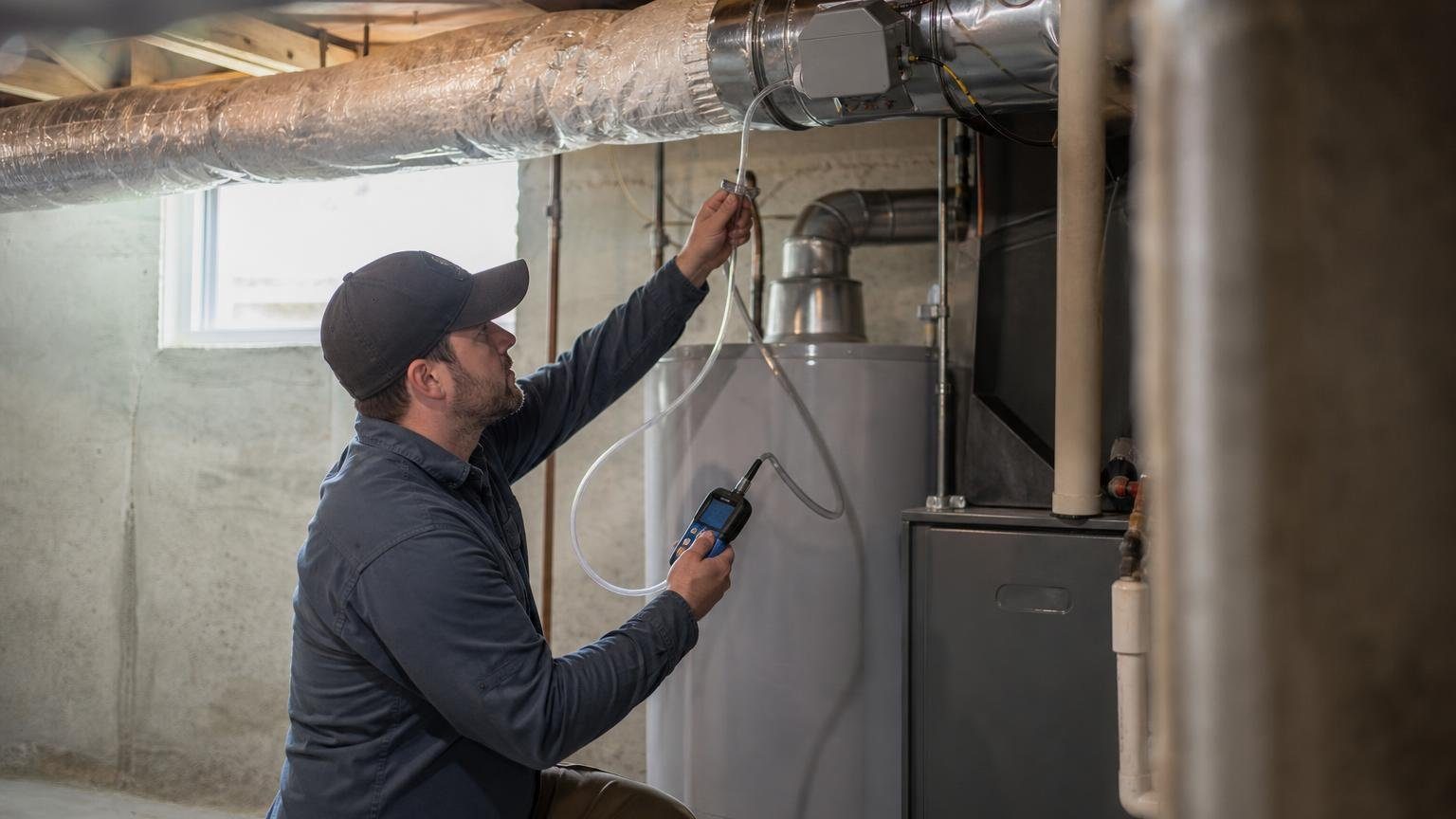
What is make up air? Make up air is outdoor air brought in to replace what exhaust fans, dryers and burners remove, so the house does not go negative. Under IRC M1503.6, a hood over 400 cfm needs it only when a natural draft appliance sits inside the air barrier.
Key Takeaways
- IRC M1503.6 requires makeup air over 400 cfm only with a natural draft fuel appliance inside the air barrier (IRC M1503.6, Seattle adoption).
- The 2009 and 2015 IRC required it for every hood over 400 cfm (Penn State PHRC).
- North Carolina allows 600 cfm when every appliance is direct-vent, power-vent, unvented or electric (NC OSFM, 2018).
- Gas dryer installations exhausting more than 200 cfm need makeup air (IRC G2439.5, IFGC 614.7).
- DOE depressurization limits run from -2 Pa for an orphaned natural draft water heater to -15 Pa for direct-vent appliances (PNNL).
- Heating 600 cfm of 20°F air to 70°F takes 32,400 Btu per hour, about $0.50 of gas at EIA’s 2025 average residential price.
What is make up air?
Make up air is outdoor air let in on purpose to replace mechanically exhausted air. Every cubic foot a hood, bath fan or dryer pushes out comes back in somewhere; makeup air decides where, and keeps indoor pressure from dropping far enough to pull flue gases backward.
That is the hazard. A DOE Building America combustion safety fact sheet says appliances with atmospheric vents are “most susceptible to backdrafting,” and that the risk rises when several fans run simultaneously. Spilled flue gas includes carbon monoxide; see our guide to where CO alarms belong.
It comes as a passive duct with a damper, a powered damper or fan interlocked with the exhaust, or a make up air unit that filters and heats the air. Fresh air for breathing is a separate job; see balanced ventilation with an ERV or HRV.
When does code require makeup air?
Makeup air requirements come from five places in the model codes. Text below is quoted from Seattle’s adoption of the 2021 IRC and IMC, which reprints model language; local amendments can change any row.
| Situation | Code section | Trigger | What is required |
|---|---|---|---|
| Any exhaust system in a house | IRC M1503.6 | Over 400 cfm, with a natural draft fuel appliance inside the air barrier | “Approximately equal to the exhaust air rate,” with a damper |
| Kitchen hood in North Carolina | NC Mechanical Code 505.2, amended | Over 400 cfm; 600 cfm if all appliances are direct-vent, power-vent, unvented or electric | Airflow above 400 or 600 cfm |
| Domestic hood in a building under the IMC | IMC 505.4 | Over 400 cfm, no appliance condition | Equal to exhaust, interlocked with the fan |
| Gas clothes dryer | IRC G2439.5 (IFGC 614.7) | Exhausting more than 200 cfm | Makeup air; closets need 100 square inches |
| Natural draft gas appliance | IRC G2407 (IFGC 304) | Every installation | Combustion air by room volume or outdoor openings |
| Commercial kitchen | IMC 508.1 | Commercial cooking exhaust | Makeup air whenever the hood runs |
M1503.6 covers “each exhaust system” over 400 cfm, not only range hoods. It exempts systems “for the exclusive purpose of space cooling” run only with windows open, which is how a whole house fan avoids it.
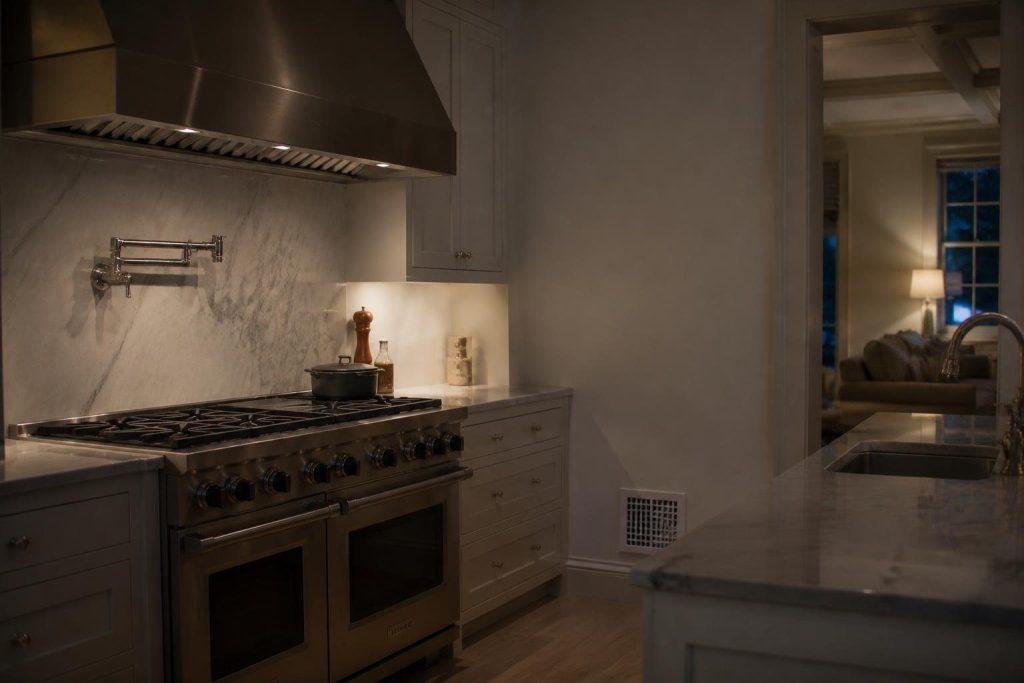
Does every range hood over 400 cfm need makeup air?
No, not under the current IRC. M1503.6 applies only “where one or more gas, liquid or solid fuel-burning appliance that is neither direct-vent nor uses a mechanical draft venting system is located within a dwelling unit’s air barrier.” An all-electric house, or one with only direct-vent or power-vent appliances, has no IRC trigger at any hood size.
Correction: the blanket 400 cfm rule is old code
Most pages say any hood over 400 cfm needs makeup air. That was the 2009 and 2015 IRC wording, which Penn State’s PHRC reprints: “Exhaust hood systems capable of exhausting in excess of 400 cubic feet per minute” needed makeup air, with no appliance condition. It still applies where those editions are in force, and IMC 505.4 keeps it for buildings outside the IRC.
North Carolina’s amended Mechanical Code 505.2 counts only airflow above the threshold, and the Office of State Fire Marshal’s 2018 interpretation works the math: an 800 cfm hood needs 400 cfm of makeup air with a natural draft appliance present, and 200 cfm when every appliance qualifies for the 600 cfm exception. A site-built masonry fireplace counts as natural draft. Hood sizing and ducting are in our range hood ventilation guide.
How is combustion air different from make up air?
Combustion air feeds a burner; make up air replaces exhausted air. The IRC fuel gas chapter, Section G2407 (IFGC 304), sizes combustion air for natural draft appliances, and G2407.4 links the two: “Where exhaust fans, clothes dryers and kitchen ventilation systems interfere with the operation of appliances, makeup air shall be provided.”
The standard method needs 50 cubic feet of room volume per 1,000 Btu/h of input; houses known to leak under 0.40 air changes per hour must use a known-infiltration calculation instead. A worked example:
- Add the inputs. An 80,000 Btu/h furnace plus a 40,000 Btu/h water heater is 120,000 Btu/h.
- Check room volume. 120 x 50 = 6,000 cubic feet must connect to the appliances.
- Combine rooms if short. Indoor openings need 1 square inch per 1,000 Btu/h, at least 100 square inches each.
- Or go outdoors. Two openings, direct or via vertical ducts, need 1 square inch per 4,000 Btu/h each: 30 square inches here. Horizontal ducts need 1 per 2,000 Btu/h; one opening needs 1 per 3,000 Btu/h.
Direct-vent and other non natural draft appliances follow the maker’s instructions. Replacing an atmospheric water heater with a power-vent or direct-vent model removes the M1503.6 trigger; our water heater replacement guide and the furnace vent pipe explainer cover those vent types.
Do I need make up air in a tight house?
Possibly, even below 400 cfm, if a natural draft appliance shares the house. DOE’s Building America Depressurization Analysis tool (PNNL) models depressurization from shell leakage with a pressure exponent of 0.67; its example is a 300 cfm hood creating -5 Pa in a 1,405 CFM50 house.
A 2021 IECC compliance form from Burleson, Texas caps prescriptive leakage at 3 ACH50 in Climate Zone 3. We ran the equation for a 2,400 square foot house with 8 foot ceilings:
| House leakage | -2 Pa: orphaned natural draft water heater | -5 Pa: Category I furnace or boiler | -15 Pa: direct-vent appliance |
|---|---|---|---|
| 3 ACH50 (960 CFM50) | 111 cfm | 205 cfm | 428 cfm |
| 5 ACH50 (1,600 CFM50) | 185 cfm | 342 cfm | 714 cfm |
| 7 ACH50 (2,240 CFM50) | 259 cfm | 479 cfm | 1,000 cfm |
Total exhaust counts, not just the hood: the DOE example adds an 80 cfm bath fan and a 200 cfm dryer, so a blocked dryer vent or an extra bathroom exhaust fan changes the result. Real fans lose flow as pressure rises, so confirm with a worst-case combustion appliance zone (CAZ) test.
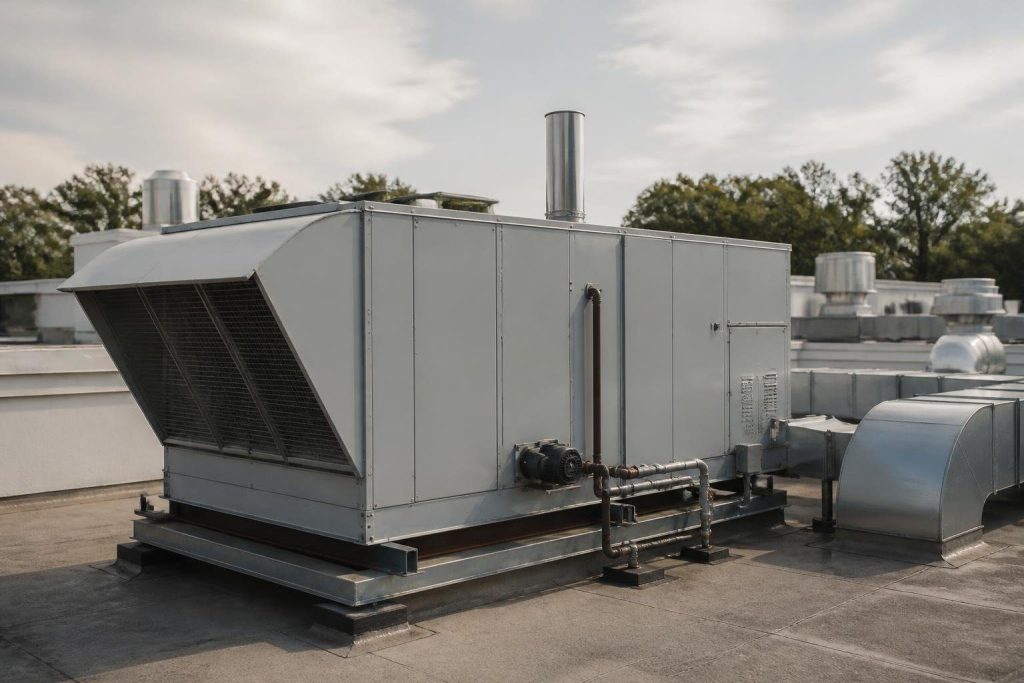
What do a makeup air damper and a make up air unit do?
A makeup air damper opens the outdoor air path while the exhaust runs; a make up air unit is a powered, usually heated, supply fan. M1503.6.2 allows “a gravity damper or an electrically operated damper that automatically opens when the exhaust system operates,” accessible without removing permanent construction.
The catch for passive systems: gravity or barometric dampers are allowed only if rated to pass the design airflow at 0.01 in. w.c. (3 Pa) or less. Under M1503.6.1 the air must enter the same room as the exhaust or a connected room.
For commercial kitchens, the model IMC 508.1 requires makeup air whenever the hood runs, “approximately equal to the amount of exhaust air” for the building. Section 508.1.1 limits makeup air to within 10°F of room temperature where supply exceeds 2,500 cfm per space, unless the HVAC system can carry the load. For shops and plants, see our industrial ventilation.
How much does it cost to heat make up air?
About 50 cents an hour for a 600 cfm hood on a 20°F day with gas heat. The sensible heat equation, Btu/h = 1.08 x cfm x temperature difference, gives 1.08 x 600 x 50 = 32,400 Btu per hour to reach 70°F.
EIA’s 2025 average residential natural gas price was $15.34 per thousand cubic feet, and EIA puts 2025 heat content at about 1,037 Btu per cubic foot. That is $14.79 per million Btu, or roughly $0.50 per hour at 95% efficiency. Local rates vary; see natural gas prices by state table.
The exhaust fan creates this load, not the makeup air: without a makeup path, the same air leaks in unheated. No federal source publishes installed prices for makeup air kits, so we quote none.
How we researched this
Researched October 9 to 11, 2026. After reading the ranking vendor pages, we quoted code text from Seattle’s 2021 Residential and Mechanical Codes, which reprint the IRC and IMC with amendments marked (codes.iccsafe.org blocked fetches). Older IRC wording is from Penn State PHRC, North Carolina’s rule from its Fire Marshal, limits from DOE/PNNL, prices from EIA. The pressure table and costs are our arithmetic. Excluded: vendor prices (no federal series) and Reddit (combustion safety).
Frequently asked questions
Do you need make up air for a 600 cfm hood?
Under the 2021 IRC, only if a natural draft fuel appliance sits inside the air barrier; then M1503.6 calls for makeup air approximately equal to 600 cfm. North Carolina counts only the excess: 200 cfm with a natural draft appliance, none when all appliances qualify for its exception.
Does a gas range count as a natural draft appliance?
The IRC text does not say. M1503.6 names any fuel-burning appliance that is neither direct-vent nor mechanical draft, and does not exempt unvented ones by name. North Carolina’s Fire Marshal treats a listed gas range as unvented, and PNNL notes unvented appliances are unaffected by house pressure. Ask your building department.
Does a clothes dryer need makeup air?
A gas dryer installation exhausting more than 200 cfm does, under IRC G2439.5 (IFGC 614.7), and a dryer closet needs a 100 square inch opening or another approved means. The general dryer section, M1502, sets duct rules such as a 35 foot maximum length but no makeup air rule.
How much does make up air cost?
No federal source publishes installed prices for makeup air dampers or units. Operating cost is calculable: tempering 600 cfm from 20°F to 70°F takes 32,400 Btu per hour, about $0.50 of gas at EIA’s 2025 average residential price.
Can makeup air be ducted into my furnace?
Code allows it in principle. M1503.6.1 lets kitchen makeup air discharge into “rooms or duct systems” that communicate with the hood’s room through permanent openings at least as large as the makeup air openings. The damper must still open automatically with the exhaust under M1503.6.2.
Do bath fans and dryers count toward the 400 cfm?
M1503.6 is written per exhaust system, so not there. They do count toward depressurization: PNNL’s example sums an 80 cfm bath fan, a 120 cfm kitchen fan and a 200 cfm dryer to 400 cfm. With a natural draft water heater limited to -2 Pa, that house must leak about 3,500 CFM50 or more.
Sources
- City of Seattle SDCI. “2021 Seattle Residential Code, Chapter 15.” https://www.seattle.gov/documents/Departments/SDCI/Codes/SeattleResidentialCode/2021SRCChapter15.pdf Accessed October 2026.
- City of Seattle SDCI. “2021 Seattle Residential Code, Chapter 24.” https://www.seattle.gov/documents/Departments/SDCI/Codes/SeattleResidentialCode/2021SRCChapter24.pdf Accessed October 2026.
- City of Seattle SDCI. “2021 Seattle Mechanical Code, Chapter 5.” https://www.seattle.gov/documents/Departments/SDCI/Codes/MechanicalCode/2021SMCChapter5.pdf Accessed October 2026.
- Penn State PHRC. “Makeup Air webinar handouts.” https://www.phrc.psu.edu/assets/docs/webinars/MakeupAir_HANDOUTS.pdf Accessed October 2026.
- NC Office of State Fire Marshal. “Kitchen Exhaust Makeup Air Exceptions,” 2018. https://ncosfm.gov/mechanical/05052-kitchen-exhaust-makeup-air-exceptions/open Accessed October 2026.
- DOE Building America Solution Center (PNNL). “Depressurization Analysis.” https://basc.pnnl.gov/redcalc/tool/depressurization-analysis Accessed October 2026.
- DOE Building America. “Combustion Equipment Safety.” https://www1.eere.energy.gov/buildings/publications/pdfs/building_america/26464.pdf Accessed October 2026.
- City of Burleson, TX. “2021 IECC Energy Testing Compliance.” https://www.burlesontx.com/DocumentCenter/View/31041/2021-IECC-Residential-Energy-Testing-Compliance Accessed October 2026.
- EIA. “Natural Gas Residential Price.” https://www.eia.gov/dnav/ng/hist/n3010us3a.htm Accessed October 2026.
- EIA. “Heat content of natural gas.” https://www.eia.gov/tools/faqs/faq.php?id=45&t=8 Accessed October 2026.
- Coalinga College, LibreTexts. “Conversions and Formulas in HVAC.” https://workforce.libretexts.org/Courses/Coalinga_College/Introduction_to_Residential_HVAC_Level_1/07%3A_Trade_Mathematics/7.06%3A_Conversions_and_Formulas_in_HVAC Accessed October 2026.
Leave a Reply