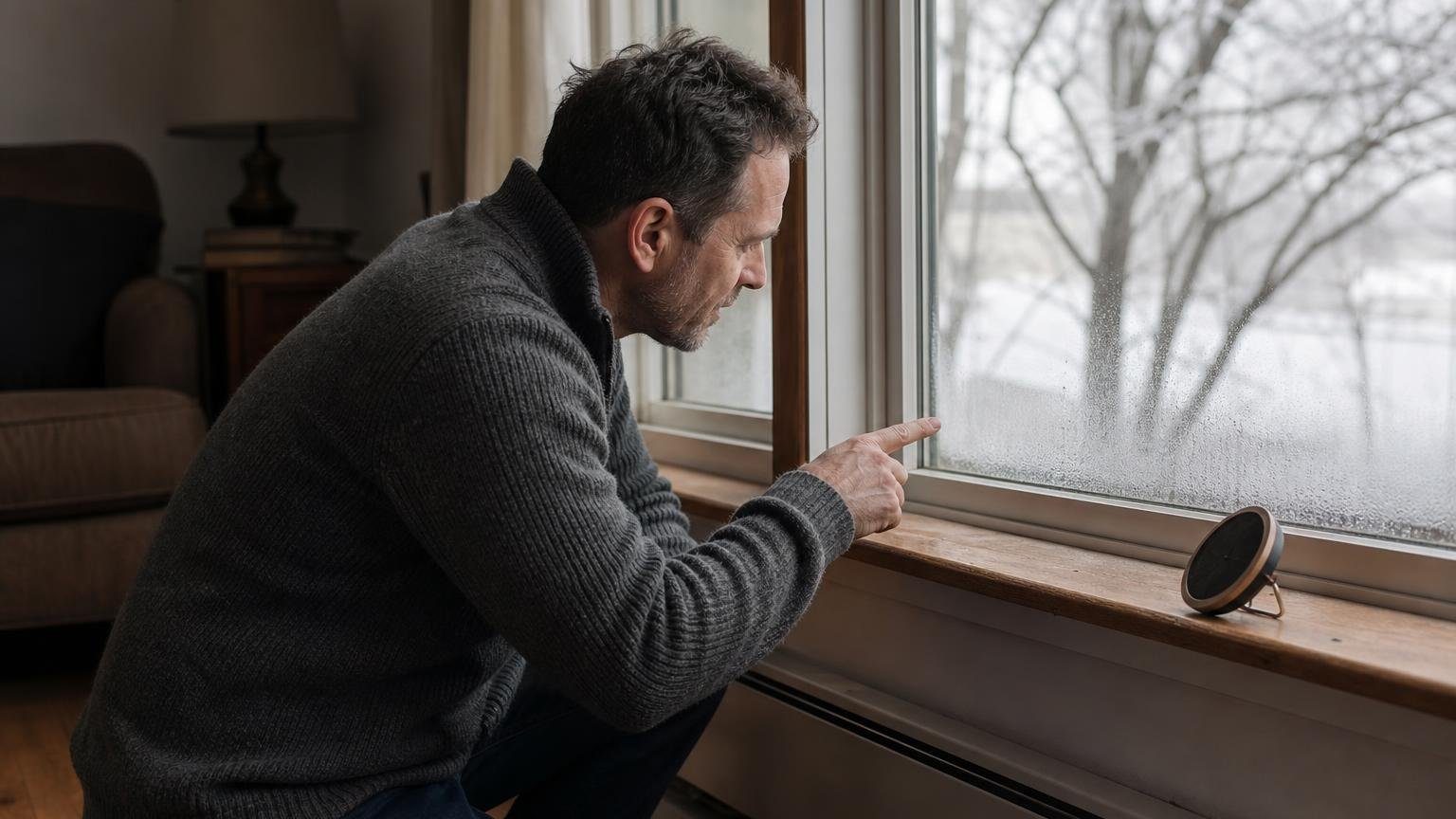
What is the ideal indoor humidity? Between 30 and 50 percent relative humidity, and always below 60 percent, is the EPA target for most homes. In cold weather run lower: under 40 percent at 20 to 40 F outdoors and under 30 percent near 0 F, or the windows start to sweat.
Key Takeaways
- The EPA mold guide says keep indoor humidity below 60 percent, ideally 30 to 50 percent.
- ASHRAE Standard 55-2017 sets an upper humidity ratio of 0.012 and no lower humidity limit at all.
- The winter ceiling falls with outdoor temperature: under 40% at 20 to 40 F, down to under 15% at -20 F or below, per MNCEE.
- A near identical table appears in a 1974 University of Minnesota Extension fact sheet that assumed double windows.
- In a CDC NIOSH study, coughed influenza kept 70.6 to 77.3% infectivity at 23% RH or lower, but only 14.6 to 22.2% at 43% or higher.
- Homes held below 51% RH for 17 months cut live dust mites from 401 to 8 per gram of dust, per a 2001 allergy journal study.
What is the ideal indoor humidity?
The ideal indoor humidity for most homes is 30 to 50 percent relative humidity (RH), with 60 percent as the hard ceiling. That is the EPA number. Other bodies publish different numbers for different purposes.
Relative humidity is water vapor as a share of what the air could hold at its temperature, so the same moisture reads higher against a cold window.
| Who says it | Humidity guidance | Purpose |
|---|---|---|
| US EPA, mold guide | Below 60%, ideally 30 to 50% | Mold and moisture control in homes |
| ASHRAE Standard 55-2017 | Humidity ratio at or below 0.012; no lower limit | Thermal comfort |
| ASHRAE Standard 62.1-2016 | Below 65% in occupied spaces | Microbial growth (commercial standard) |
| ACCA Manual J, per DOE Building America | 75 F and 50% RH indoor cooling design condition | Sizing air conditioners |
| DOE Building America Solution Center | Below 60% in warm, humid climates | Dehumidification design |
| Arundel and others, 1986 review | 40 to 60% | Health effects literature (dated) |
Correction
Several manufacturer pages say ASHRAE recommends 30 to 60 percent. ASHRAE’s own Technical FAQ 92 says Standard 55 sets only an upper humidity ratio of 0.012 and “does not specify a lower humidity limit.” The 40 to 60 percent band traces to a 1986 literature review, often drawn as the “Sterling chart,” which predates most current research.
What is the ideal humidity in winter?
The ideal humidity in winter is the highest level your coldest window takes without sweating, usually 30 to 40 percent. The colder it is outside, the lower that ceiling: the Minnesota Center for Energy and Environment lists under 40 percent at 20 to 40 F and under 15 percent at -20 F or below.
| Outdoor temperature (F) | Indoor RH, MNCEE (current) | Indoor RH, UMN Extension (1974) |
|---|---|---|
| 20 to 40 | Under 40% | 35 to 40% at +20 |
| 10 to 20 | Under 35% | 30 to 35% at +10 |
| 0 to 10 | Under 30% | 25 to 30% at 0 |
| -10 to 0 | Under 25% | 20 to 25% at -10 |
| -20 to -10 | Under 20% | 15 to 20% at -20 |
| -20 or below | Under 15% | Not listed |
Sources: MNCEE; University of Minnesota Extension Fact Sheet AE 19 (1974), Table 1.
A near identical table appears in a 1974 University of Minnesota fact sheet by H. A. Cloud and D. W. Bates, written for homes “equipped with double windows.” Window condensation, not the gauge, they wrote, “must be your measure of a tolerable moisture level.”
The physics is the dew point. By our Magnus formula calculation, 70 F air at 40 percent RH condenses on surfaces below about 44.6 F, and at 30 percent below about 37.1 F. The lower edge of the glass is the coldest inside surface, the 1974 authors noted. That is why drafty, poorly insulated homes need the lower figure and tight homes with modern glass can hold more.
If a humidifier pushes you past the table, turn it down. Our whole house humidifier guide covers the hardware, setpoints and upkeep.
What is the ideal indoor humidity in summer?
The ideal indoor humidity in summer is about 50 percent, and never above 60. Air conditioners are sized for it: the DOE Building America Solution Center notes that ACCA Manual J uses an indoor design condition of 75 F and 50 percent RH.
The same DOE guide warns that in hot, humid climates “the air conditioner alone may not be able to remove enough latent heat” to stay under 60 percent. An oversized unit reaches the set point “before moisture can condense on the coil,” DOE says, so the temperature drops while RH climbs; we cover that in why a house feels cold but clammy. Blower settings matter; see fan ON vs AUTO.
Climate changes the target more than season does. This table is our synthesis of the sources above.
| Climate | Winter target | Summer target | Main risk |
|---|---|---|---|
| Cold (Minnesota, Maine) | 15 to 40%, set by the outdoor table | 30 to 50% | Window condensation |
| Mixed humid (Ohio, Virginia) | 30 to 40% | About 50%, under 60% | Summer basement dampness |
| Hot humid (Florida, Gulf Texas) | Rarely needs added moisture | About 50%, under 60% | AC cannot remove enough latent heat |
| Hot dry (Arizona, Nevada) | 30% or more if comfortable | 30% or more if comfortable | Dry air irritation |
Basis: EPA; MNCEE and UMN winter tables; DOE Building America; ACCA Manual J. ASHRAE 55 sets no lower limit.
Is 40 percent humidity too low, and is 70 percent too high?
No. 40 percent sits inside the EPA’s 30 to 50 percent range, and 70 percent is too high: it is above the EPA’s 60 percent ceiling and ASHRAE 62.1’s 65 percent cap for occupied spaces. The health research supports the middle, with limits.
The NIOSH influenza study used coughing manikins in a simulated exam room, not homes, and tested one virus. Its authors concluded that indoor RH above 40 percent “will significantly reduce the infectivity of aerosolized virus.”
The dust mite study followed 23 low humidity homes in a humid temperate climate through two summers. Most used a dehumidifier plus air conditioning, and allergen ended more than 10 times lower than in humid homes. For mite allergy, that is the case for the 50 percent line.
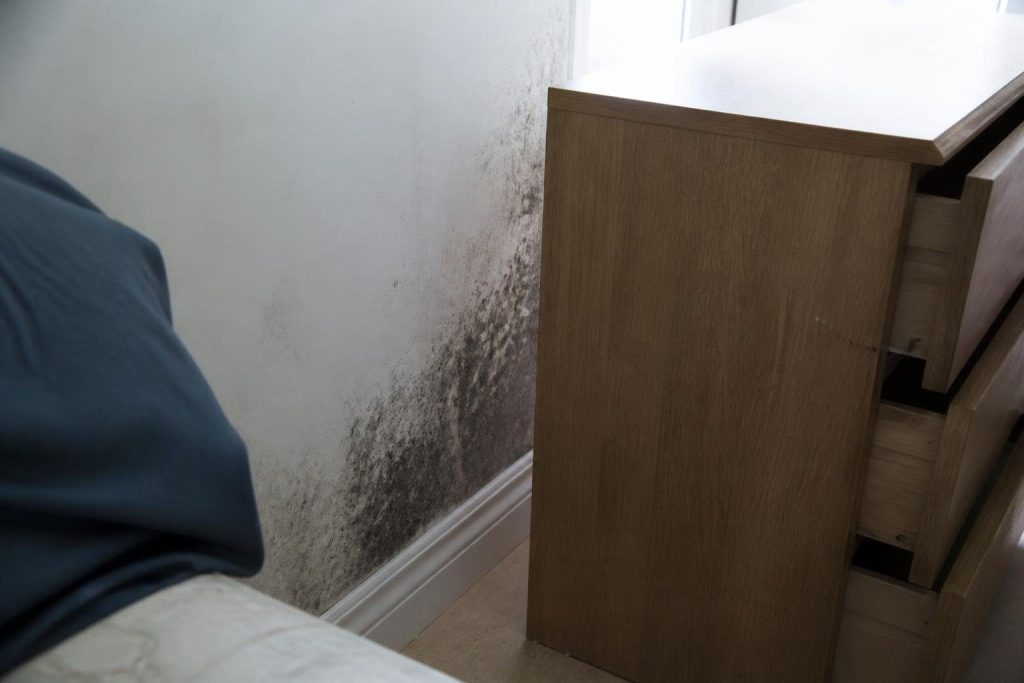
Will mold grow at 55 percent humidity?
It can, on cold surfaces. A room at 55 percent is under the EPA ceiling, but RH rises wherever air cools. By our Magnus formula calculation, 70 F air at 55 percent RH reaches about 78 percent RH against a 60 F closet wall or basement corner.
The EPA ceiling is 60 percent, and the 1986 review found most fungi cannot grow unless RH exceeds 60 percent. So 55 percent is fine in a living room; in a cool basement, check the corners. Our basement ventilation guide covers the fixes.
How do you measure and correct indoor humidity?
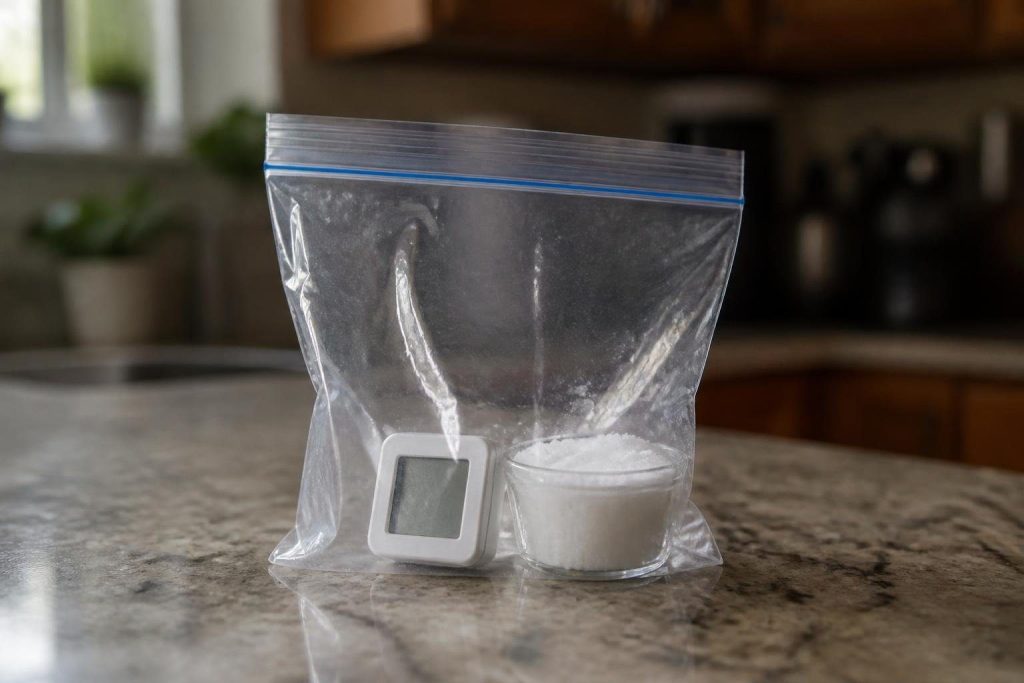
Measure with a hygrometer, check it with a salt test, then fix the cause before buying equipment. The EPA says a humidity meter costs about $10 to $50. A gauge a few points off can make 48 percent look like 55.
- Mix table salt with a few drops of water into a damp slurry, not a solution, in a bottle cap.
- Seal the cap and hygrometer in a zip bag at room temperature for several hours.
- Read the gauge. Saturated sodium chloride holds 75.47 percent RH at 20 C (68 F), per the National Bureau of Standards humidity fixed points, so the gap from 75 is your correction.
If humidity is too high, remove moisture at the source. DOE’s restatement of ASHRAE 62.2 and IRC M1507 calls for bathroom fans of at least 50 cfm run intermittently or 20 cfm continuously; our bathroom exhaust fan guide covers sizing. A basement that stays damp needs a properly sized dehumidifier, and a tight house may need balanced mechanical ventilation.
If humidity is too low in winter, air leaks are usually the cause: the 1974 Minnesota authors noted that “high infiltration rates will usually result in low relative humidities.” Seal drafts before buying a humidifier. Lower winter thermostat settings also raise RH slightly, because cooler air holds less vapor.
How we researched this
Research date: October 11, 2026. We read the EPA mold guide, ASHRAE Technical FAQ 92 (an archived copy, because the live ashrae.org file returned 404), the 1974 University of Minnesota Extension fact sheet, the current MNCEE table, two DOE Building America Solution Center guides, the NBS salt fixed point tables and three PubMed abstracts, and cited all of them.
Dew point and surface RH figures are our Magnus formula calculations. The climate table is our synthesis, labeled as such. Excluded: manufacturer ranges with no named basis, Reddit and forum threads (questions only, never numbers) and product listing accuracy claims. ASHRAE 55 and 62.2 are paywalled, so we used ASHRAE’s FAQ and DOE restatements.
Frequently asked questions
Is a humidity level of 40 too low for a home?
No. 40 percent is inside the EPA’s ideal range of 30 to 50 percent. A CDC NIOSH study also found airborne influenza lost most of its infectivity at 43 percent RH or higher. In very cold weather it can be too high for your windows: MNCEE allows 40 percent only at 20 to 40 F outside.
What is the healthiest humidity for a home?
The middle: 30 to 50 percent, as the EPA advises. A 2001 study found homes held below 51 percent RH cut live dust mites from 401 to 8 per gram of dust over 17 months. A dated 1986 review suggested 40 to 60 percent; ASHRAE 55 sets no lower limit.
Is 70% humidity in a house high?
Yes. 70 percent is well above the EPA’s 60 percent ceiling and above the 65 percent cap that ASHRAE Standard 62.1 sets for occupied spaces to limit microbial growth. Find the source first, then run exhaust fans or a dehumidifier.
What is the best humidity level for sleeping?
No federal agency publishes a separate bedroom number, so the EPA’s 30 to 50 percent applies at night too. In winter, keep the bedroom under the outdoor temperature ceiling. ASHRAE notes very dry air can cause dry eyes, skin drying and irritated mucous membranes.
Why is my indoor humidity too high in winter?
Usually because moisture sources outpace air leakage. A 1974 University of Minnesota fact sheet estimated a family of four exhales 8 to 12 pounds of water vapor in 24 hours, and a shower adds about half a pound. Tight homes keep it in, so run bath and kitchen fans and turn any humidifier down.
What should I set a dehumidifier to?
MNCEE suggests 55 percent for a basement dehumidifier, under the EPA’s 60 percent ceiling, and says to go lower if the air still feels damp. In living spaces, 50 percent matches the ACCA Manual J cooling design condition that DOE’s Building America program cites.
Sources
- US EPA. “A Brief Guide to Mold, Moisture and Your Home.” https://www.epa.gov/mold/brief-guide-mold-moisture-and-your-home. Accessed October 2026.
- ASHRAE. “Technical FAQ 92: Recommended indoor temperature and humidity (archived copy).” https://web.archive.org/web/2025/https://www.ashrae.org/File%20Library/Technical%20Resources/Technical%20FAQs/TC-02.01-FAQ-92.pdf. Accessed October 2026.
- University of Minnesota Agricultural Extension Service. “Controlling Household Humidity, Agricultural Engineering No. 19 (1974).” https://conservancy.umn.edu/server/api/core/bitstreams/14403b46-9687-4f62-9fab-8c0f16ae9e59/content. Accessed October 2026.
- Minnesota Center for Energy and Environment. “Managing humidity levels.” https://www.mncee.org/managing-humidity-levels. Accessed October 2026.
- DOE Building America Solution Center. “Whole-House Dehumidification.” https://basc.pnnl.gov/resource-guides/whole-house-dehumidification. Accessed October 2026.
- DOE Building America Solution Center. “Bathroom Exhaust Fans.” https://basc.pnnl.gov/resource-guides/bathroom-exhaust-fans. Accessed October 2026.
- Noti JD et al., PLoS One. “High humidity leads to loss of infectious influenza virus from simulated coughs (2013).” https://pubmed.ncbi.nlm.nih.gov/23460865/. Accessed October 2026.
- Arlian LG et al., J Allergy Clin Immunol. “Reducing relative humidity is a practical way to control dust mites and their allergens (2001).” https://pubmed.ncbi.nlm.nih.gov/11149998/. Accessed October 2026.
- Arundel AV et al., Environ Health Perspect. “Indirect health effects of relative humidity in indoor environments (1986).” https://pubmed.ncbi.nlm.nih.gov/3709462/. Accessed October 2026.
- Greenspan L., J. Res. National Bureau of Standards. “Humidity Fixed Points of Binary Saturated Aqueous Solutions (1977).” https://nvlpubs.nist.gov/nistpubs/jres/81A/jresv81An1p89_A1b.pdf. Accessed October 2026.
Leave a Reply