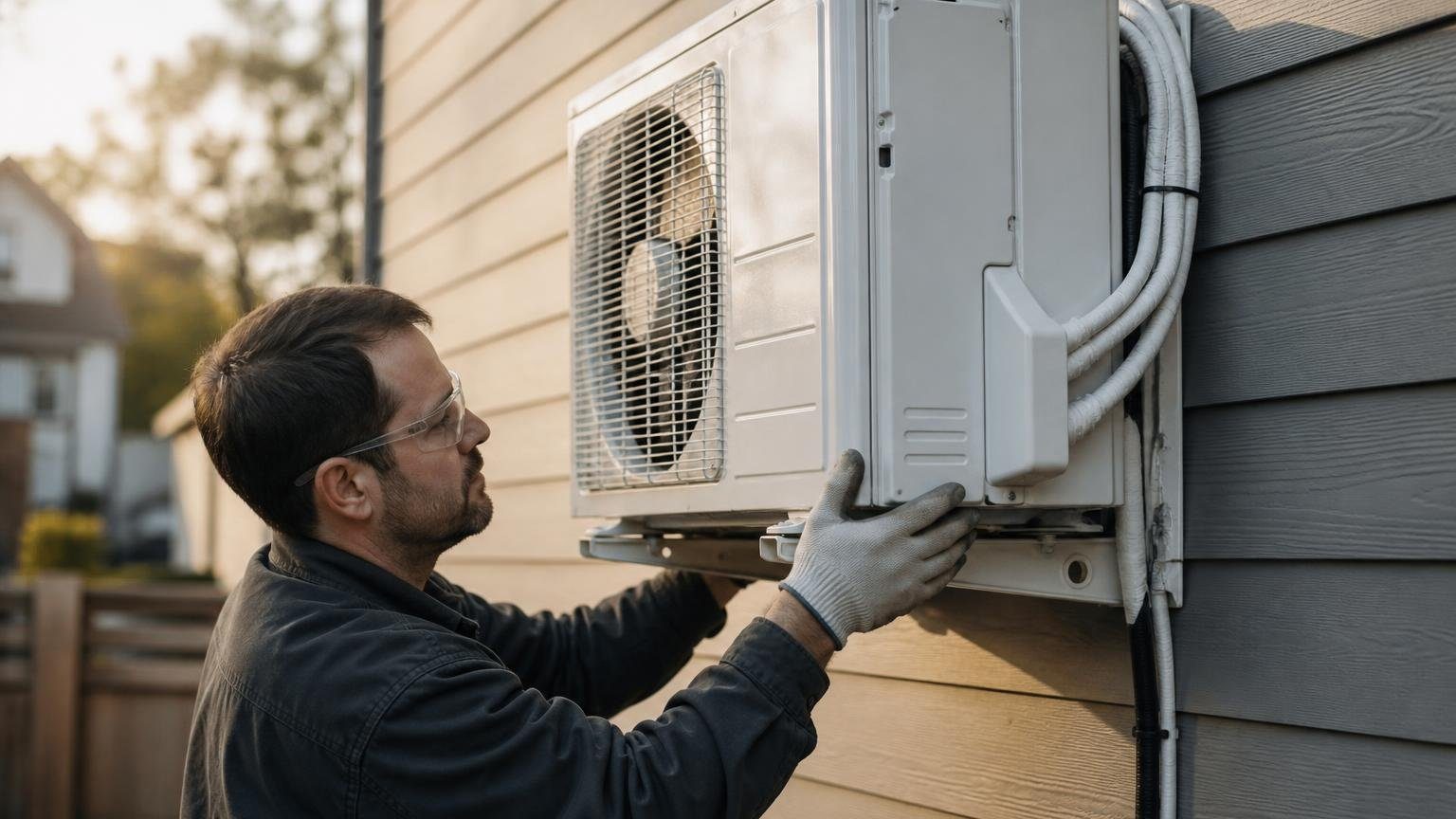
What is R32 refrigerant? R32 refrigerant is difluoromethane (HFC-32), a single compound with a global warming potential of 675 and an A2L, mildly flammable, safety class. It sits under the 700 GWP cap on new US home air conditioners and heat pumps, so it is legal for new systems, not banned.
Key Takeaways
- HFC-32 carries an exchange value (GWP) of 675 in 40 CFR Part 84, Appendix A, against 3,500 for HFC-125.
- Since January 1, 2025, new self-contained residential AC and heat pump products must use refrigerant under a GWP of 700, per 40 CFR 84.54(a)(1).
- EPA’s SNAP table lists HFC-32 as ASHRAE class A2L, ODP 0, acceptable with use conditions in new equipment only.
- R-32 is 68.9% by weight of R-454B, according to the Chemours R-454B safety data sheet.
- The ENERGY STAR heat pump list holds 5,630 R-32 combinations on 1,939 outdoor models, October 2026.
- Daikin Comfort Technologies certified 1,671 of the 2,277 R-32 ducted split combinations (73%); Carrier and Trane list none.
What is R-32 refrigerant?
R-32 is difluoromethane, CH2F2, a single hydrofluorocarbon rather than a blend. Federal rules list it as HFC-32 with an exchange value, its 100-year global warming potential, of 675. Daikin’s R-32 safety data sheet gives CAS number 75-10-5, 100% purity and a boiling point of -51.7°C, or about -61°F.
Because it is one compound, R-32 has no temperature glide: at a given pressure it boils and condenses at one temperature. It is the shared ingredient on both sides of the transition: roughly half of R-410A and 68.9% of R-454B by weight, which is why our guide to the R-454B blend and this page overlap on chemistry but not on equipment.
Is R32 refrigerant flammable?
Yes. R-32 is mildly flammable: EPA lists it as ASHRAE class A2L, where A means lower toxicity and 2L means lower flammability. That is a step below propane, which EPA lists as A3, but above R-410A, listed A1.
The 2L class exists because these gases burn slowly. The North Carolina Office of State Fire Marshal, summarizing ASHRAE 34-2022, notes that class 2L shares class 2 flammability properties except for a slower burning velocity. NIST researchers put typical laminar burning velocities for these refrigerants below 10 cm/s.
Ignition needs three things at once, per the same fire marshal guidance: a leak, a concentration that reaches the lower flammability limit, and an ignition source with enough energy. A static spark or a toaster would not ignite an A2L refrigerant; an open flame could. The office also estimates a 15-pound A2L charge adds about 66,000 BTU to an outside fire, against 42,000 BTU for 15 pounds of R-410A.
Data sheets add confusion: Daikin’s R-32 sheet carries GHS hazard statement H220, “extremely flammable gas,” beside ISO 817 class A2L. The labels answer different questions; US equipment rules are written around the A2L class.
Safety point: what EPA requires of R-32 equipment
The SNAP use conditions in Appendix W to 40 CFR Part 82, Subpart G require R-32 air conditioners to meet the 3rd edition of UL 60335-2-40, cap the charge by the room size, mark service ports in red PMS #185, and carry fire warnings in letters at least 1/4 inch high. If refrigerant in the surrounding air rises above one fourth of the lower flammability limit, the space should be evacuated. Finding small leaks early matters, which is what our comparison of leak detection methods covers.
Is R-32 being phased out or banned in the US?
No. R-32 is legal in new US residential air conditioners and heat pumps because its GWP of 675 sits under the 700 cap that 40 CFR 84.54(a)(1) applies from January 1, 2025. R-410A, at about 2,088, is the refrigerant that rule pushed out of new production, not R-32.
The arithmetic uses the Appendix A values. R-410A is about half HFC-32 and half HFC-125, so 0.5 × 675 + 0.5 × 3,500 = 2,087.5, or 2,088. In R-454B, the R-32 share alone contributes 0.689 × 675 = 465; EPA’s SNAP table rounds the whole blend to 470.
What is phased down is supply. As an HFC, R-32 counts against the AIM Act cap, which drops from 60% of baseline to 30% in 2029 under 40 CFR 84.7. Pre-2025 R-410A stock can still be installed under 84.54(c)(1), as our reading of the R-410A installation rule explains, and our A2L transition status report tracks the service side. We found no US rule in 40 CFR Parts 82 or 84 that bans R-32 in home equipment.
R32 vs R410A vs R454B: how do they compare?
R-32 runs at slightly higher pressure than R-410A with about one third of its GWP; R-454B has a lower GWP still and slightly lower pressure. All three need equipment designed for them, and neither A2L refrigerant is a drop-in for R-410A.
| Property | R-32 | R-410A | R-454B |
|---|---|---|---|
| Make-up | 100% difluoromethane | R-32 48.5 to 50.5%, R-125 49.5 to 51.5% | R-32 68.9%, R-1234yf balance |
| GWP | 675 | 2,088 (calculated); EPA SNAP 2,090 | 470 (EPA SNAP) |
| ASHRAE safety class | A2L | A1 | A2L |
| Vapor pressure, 77°F | 1.69 MPa (about 245 psia) | 1.65 MPa (about 239 psia) | 1.59 MPa (about 230 psia) |
| Boiling point | -61°F | -63°F | -59.6°F |
| New home AC made or imported from Jan 1, 2025 | Allowed | Not allowed | Allowed |
The pressure gap is the one technicians notice. At 77°F, Daikin’s data sheets put R-32 at 1.69 MPa, about 2% above R-410A at 1.65 MPa, so an R-410A pressure and temperature chart will not read R-32 correctly. Our R-410A pressure chart and manifold gauge guide cover reading them.
Which is better depends on the job. R-32 is a single compound, so a leak cannot shift a blend’s make-up. R-454B has the lower GWP and is the refrigerant most large ducted makers certified.
Which brands use R-32 refrigerant in the US?
In the ENERGY STAR certified heat pump list, R-32 appears under 108 outdoor brand names from 80 ENERGY STAR partners. One group dominates ducted systems: Daikin Comfort Technologies, which makes Daikin, Goodman and Amana equipment, certified 1,671 of the 2,277 R-32 split-system combinations, or 73%.
Carrier, Trane, Mitsubishi Electric and Bosch list no R-32 heat pumps. Carrier’s 10,431 R-454B combinations and Trane’s 7,585 show where most large ducted makers went. R-32 is strongest in ductless: 2,906 mini or multi split combinations on 1,528 outdoor models.
| Outdoor brand | R-32 combinations | Where R-32 appears |
|---|---|---|
| Daikin | 614 | Split systems, mini splits, packaged |
| Goodman | 568 | Split systems, mini splits |
| Amana | 559 | Split systems |
| TOSOT | 509 | Mostly mini splits |
| GREE | 470 | Mostly mini splits |
| LG | 219 | Mini splits, split systems |
| Hitachi | 148 | Mini splits |
| Samsung | 145 | Mini splits |
| Fujitsu | 144 | Mini splits |
| Lennox | 109 | Mini splits |
| Carrier, Trane, Mitsubishi Electric, Bosch | 0 | None listed |
Overall, R-32 is 5,630 of 284,895 certified combinations, or 2.0%, but 1,939 of 8,615 outdoor models, or 22.5%. The gap exists because a ductless outdoor unit pairs with few indoor units, a counting effect our refrigerant share analysis explains in full. Certification shows what makers can sell, not what was installed.
Can you put R-32 in an R-410A system?
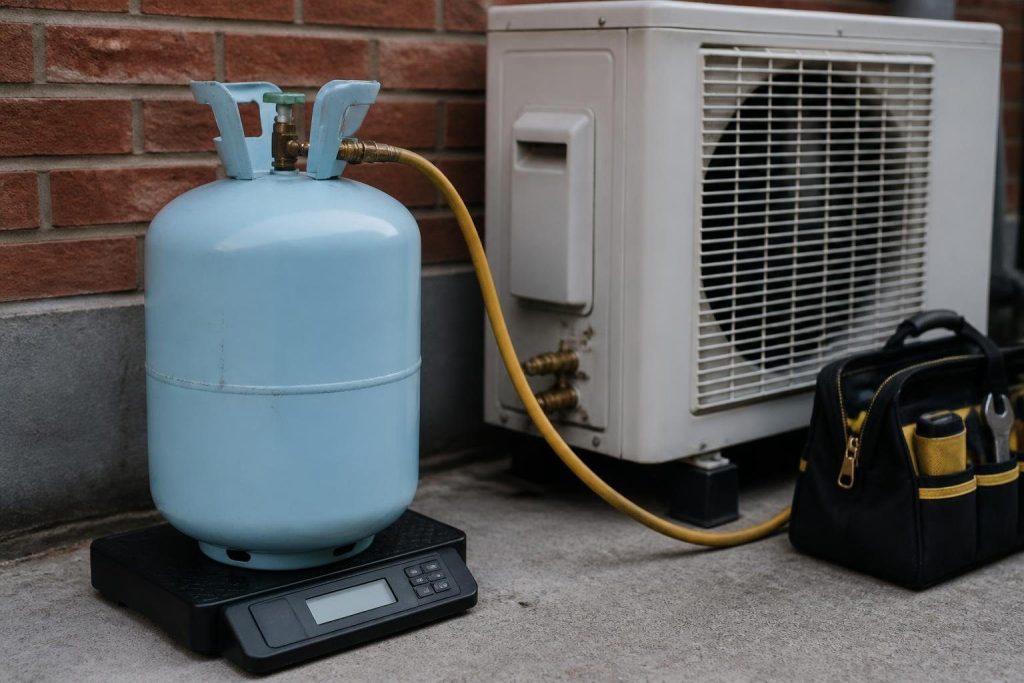
No. EPA’s SNAP listing allows R-32 only in new equipment specifically designed and clearly identified for it, and bars its use as a conversion or retrofit refrigerant for equipment designed for other refrigerants. That rules out topping up or converting an R-410A system with R-32.
Close pressures are why the question comes up, but what makes A2L equipment legal is the UL 60335-2-40 listing, the room-size charge limit and the labels, not the gas. There is no “R32 equivalent” that can legally go into R-410A equipment.
What does R-32 change for service, tools and price?
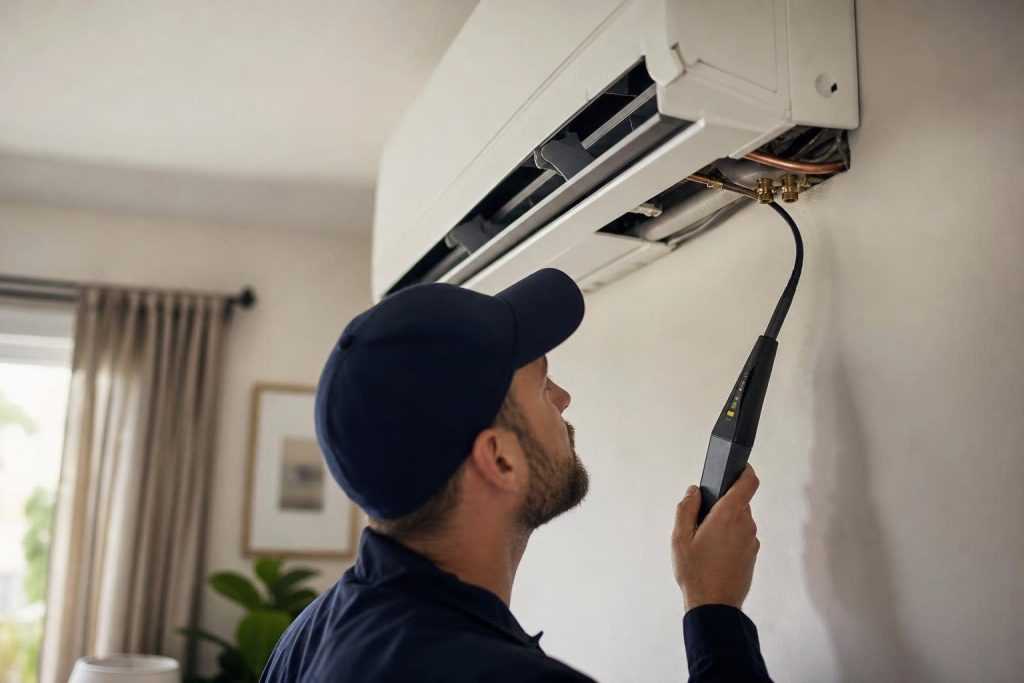
The federal service rules are the same as for any HFC: no venting, recovery on every job, and sales limited to certified technicians. What changes is the kit, which must be rated for A2L service, and the supply outlook.
- Buy: since January 1, 2018, 40 CFR 82.154(c)(1) has limited sales of non-exempt substitutes such as R-32 to Section 608 certified technicians or their employers, with narrow exceptions.
- Recover: 40 CFR 82.154(a)(1) bars knowingly venting any refrigerant during service, and R-32 is not on the exempt list.
- Tool up: use a recovery machine, cylinders and leak detector rated for A2L refrigerants, and follow the unit’s installation manual on ignition sources.
- Charge: weigh in the charge on the nameplate, which the listing caps by room size.
The two-pound can exception in 82.154(c)(1)(ix) covers motor vehicle air conditioning, not the DIY R-32 cans sold for home systems. Our pages on which 608 certification a technician needs and on recovery machines and cylinders cover the rest.
We publish no per-pound R-32 price because no federal series tracks it and retail listings are not data. Federal documents do show supply pressure: Commerce kept antidumping duties on Chinese R-32 in August 2026, and the HFC cap halves in 2029. Our federal refrigerant price index is the nearest public gauge.
How we researched this
We read 40 CFR Parts 82 and 84, EPA’s SNAP table and three maker safety data sheets, and queried the ENERGY STAR heat pump dataset on October 13, 2026. We consulted 16 sources and cite 12. Retail cylinder prices, Australian standards and vendor market-share figures were excluded. Flammability is a safety topic, so no Reddit or forum material was used.
Frequently asked questions
Why is R32 being phased out?
It is not being phased out of new US home air conditioners. Its GWP of 675 is under the 700 cap in 40 CFR 84.54(a)(1). What is shrinking is supply of all HFCs, including R-32: the production and consumption cap drops from 60% of baseline to 30% in 2029 under 40 CFR 84.7.
Which is better, R32 or R410A?
For new equipment, only R-32 is an option: R-410A’s GWP of about 2,088 is over the 700 cap for products made from January 1, 2025. R-32 runs about 2% higher in pressure at 77°F and is A2L, so it needs equipment and tools designed for it.
Can I buy R32 refrigerant in the USA?
Only if you hold Section 608 certification or work for someone who does, with narrow exceptions. Since January 1, 2018, 40 CFR 82.154(c)(1) has restricted sales of non-exempt substitutes such as R-32. The two-pound can exception applies to motor vehicle air conditioning, not home systems.
Is R32 refrigerant illegal?
No. EPA’s SNAP program lists HFC-32 as acceptable with use conditions in new residential and light commercial air conditioners and heat pumps. Those conditions require UL 60335-2-40 compliance and bar using R-32 to retrofit equipment designed for another refrigerant.
Is R32 the same as R454B?
No. R-454B is a blend that is 68.9% R-32 by weight, with R-1234yf making up the rest, per the Chemours safety data sheet. Both are A2L, but EPA lists R-454B at a GWP of 470 against 675 for R-32, and the two are not interchangeable in equipment.
Is R32 propane?
No. R-32 is difluoromethane, a hydrofluorocarbon with a GWP of 675 and an A2L class. Propane is R-290, a hydrocarbon that EPA’s SNAP table lists at a GWP of 3 and ASHRAE class A3, the highest flammability class, against A2L for R-32.
Sources
- eCFR. “40 CFR Part 84, Appendix A, Regulated Substances.” https://www.ecfr.gov/current/title-40/chapter-I/subchapter-C/part-84/appendix-Appendix%20A%20to%20Part%2084. Accessed October 2026.
- eCFR. “40 CFR 84.54, Restrictions on the use of hydrofluorocarbons.” https://www.ecfr.gov/current/title-40/chapter-I/subchapter-C/part-84/subpart-B/section-84.54. Accessed October 2026.
- eCFR. “40 CFR 84.7, Phasedown schedule.” https://www.ecfr.gov/current/title-40/chapter-I/subchapter-C/part-84/subpart-A/section-84.7. Accessed October 2026.
- eCFR. “40 CFR Part 82, Subpart G, Appendix W.” https://www.ecfr.gov/current/title-40/chapter-I/subchapter-C/part-82/subpart-G/appendix-Appendix%20W%20to%20Subpart%20G%20of%20Part%2082. Accessed October 2026.
- eCFR. “40 CFR 82.154, Prohibitions.” https://www.ecfr.gov/current/title-40/chapter-I/subchapter-C/part-82/subpart-F/section-82.154. Accessed October 2026.
- US EPA. “Substitutes in Residential and Light Commercial Air Conditioning and Heat Pumps.” https://www.epa.gov/snap/substitutes-residential-and-light-commercial-air-conditioning-and-heat-pumps. Accessed October 2026.
- ENERGY STAR. “Certified Air-Source Heat Pumps” dataset. https://data.energystar.gov/Active-Specifications/ENERGY-STAR-Certified-Air-Source-Heat-Pumps/w7cv-9xjt. Accessed October 2026.
- Daikin Industries. “R-32 Safety Data Sheet” (2019). https://www.hudsontech.com/pdfs/SDS/R-32/Daikin-R-32.pdf. Accessed October 2026.
- Daikin Industries. “R-410A Safety Data Sheet” (2023). https://www.daikinchemicals.com/library/pb_common/pdf/sds/Refrigerants/sds-R-410A-E_20230323.pdf. Accessed October 2026.
- Chemours. “R-454B Safety Data Sheet” (2024). https://www.hudsontech.com/pdfs/SDS/R-454B/R-454B_Chemours.pdf. Accessed October 2026.
- North Carolina Office of State Fire Marshal. “Engineering Newsletter, June 2024, A2L Edition.” https://ncosfm.gov/engineering-newsletter-june-2024-a2l-edition/open. Accessed October 2026.
- NIST. “Low global-warming-potential refrigerant CH2F2 (R-32)” (Linteris et al., 2020). https://www.nist.gov/node/1705771. Accessed October 2026.
Leave a Reply