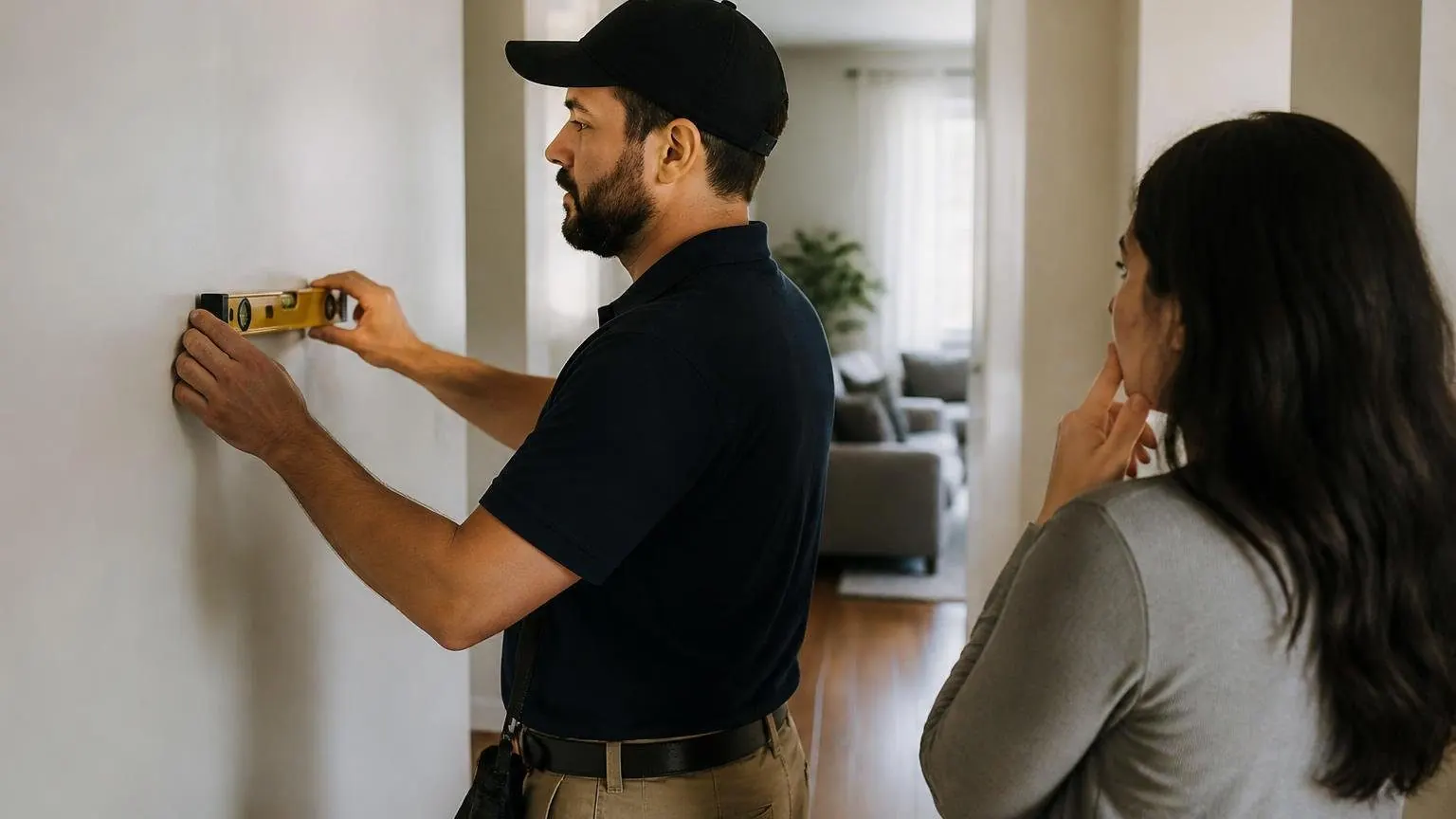
Where to put a thermostat? On an interior wall in your main living area, about 5 feet up per maker manuals (48 inches or lower where accessibility rules apply), out of direct sun and away from supply vents, exterior doors, kitchens and outside walls.
Key Takeaways
- The US Department of Energy says a thermostat must be on an interior wall away from direct sunlight, drafts, doorways, skylights and windows, or it risks “ghost readings.”
- Resideo’s T2 Pro fan coil thermostat instructions say about 5 ft (1.5 m) above the floor and at least 10 ft (3 m) from any direct vent.
- Sections 308 and 309 of the 2010 ADA Standards put controls in public and commercial spaces between 15 and 48 inches above the floor.
- 24 CFR 100.205 requires thermostats in accessible locations in covered apartments first occupied after March 13, 1991.
- Google says a Nest Temperature Sensor works within 50 feet (15 m) of the thermostat, which fixes a bad wall without moving wires.
Where is the best place to put a thermostat in a house?
The best place to put a thermostat is an interior wall in the main living area, where room air circulates at average temperature and nothing heats or cools the sensor directly. DOE’s Energy Saver guidance says it “must be on an interior wall away from direct sunlight, drafts, doorways, skylights, and windows.”
A thermostat only knows the air at its own sensor; as our explainer on what a thermostat can and cannot sense shows, that one reading runs the whole system.
Run any candidate wall through five checks:
- Interior wall, with conditioned space on the other side.
- No direct sun, and no lamp or other heat source near it.
- Out of the airstream of supply registers; Resideo asks for at least 10 ft from any direct vent.
- Away from doorways, windows, kitchens and other humid rooms.
- Open circulation: DOE says not to place furniture “in front of or below” the thermostat.
What height should you put a thermostat at?
Thermostat height comes from the installation manual, not from one national code for houses. Resideo’s instructions for its T2 Pro THECC11060MX, a 120 volt fan coil thermostat, say “about 5 ft (1.5 m) above the floor,” and an ecobee Smart Thermostat manual says “approximately five feet (1.5m) above floor level in the main living area.” Both are maker instructions, not law.
The 48 inch figure comes from accessibility rules. Section 308.2.1 of the 2010 ADA Standards sets an unobstructed reach of 15 to 48 inches, 309.3 puts operable parts inside it, and the 205.1 advisory names “environmental and appliance controls.” The part of a private home “used exclusively as a residence” is not covered.
Apartments differ. Under 24 CFR 100.205, covered multifamily units (buildings of 4 or more units with an elevator, and ground floor units in other buildings of 4 or more) need thermostats in accessible locations. HUD’s Fair Housing Act Design Manual says thermostats “that must be read are mounted at or lower than 48 inches above the floor.”
| Source | Applies to | Height figure | Status |
|---|---|---|---|
| Resideo T2 Pro instructions | That thermostat | About 5 ft (1.5 m) | Maker instruction |
| ecobee Smart Thermostat manual | That thermostat | Approximately five feet | Maker instruction |
| Resideo T9/T10 room sensor guide | Wireless room sensors | About 5 feet | Maker instruction |
| Google Nest sensor help | Nest Temperature Sensor | About chest high | Maker instruction |
| 2010 ADA Standards 308, 309 | Public and commercial spaces | 15 to 48 in. | Federal standard |
| HUD Design Manual, 24 CFR 100.205 | Covered multifamily units | At or below 48 in. | Federal rule and guidance |
Our arithmetic: 5 ft is 60 inches, 12 inches above the accessible maximum. In a private house, follow the manual unless a wheelchair user needs the controls; then mount at 48 inches or lower.
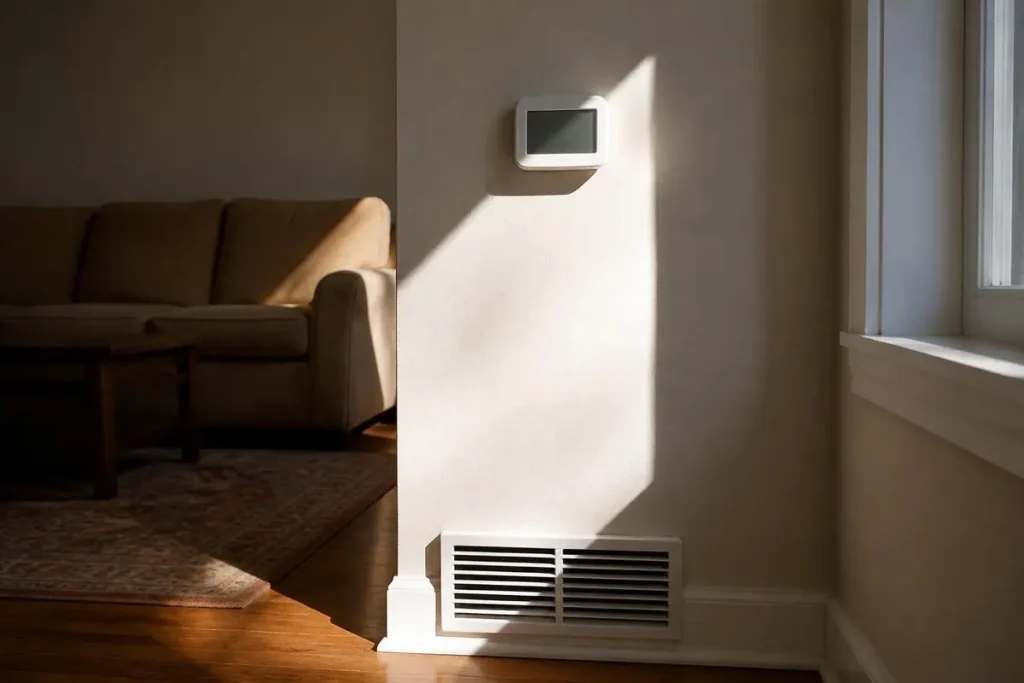
Where should you not put a thermostat?
Do not put a thermostat anywhere something other than room air sets its temperature: sun, supply air, an outside wall, a kitchen, a draft or a heat-producing appliance. DOE warns that a poor spot causes “ghost readings” or unnecessary furnace or air conditioner cycling.
The mechanism matters for diagnosis. A sensor warmed by sun or a lamp tells the furnace the house is warm, so heat stops early while the air conditioner runs long. A sensor washed by supply air reaches setpoint early, one cause on our list for a furnace that shuts off after a few minutes and for an air conditioner that cycles too often.
| Location to avoid | What skews the reading | Named by |
|---|---|---|
| Direct sunlight | Sensor reads warmer than the room | DOE, Resideo, ecobee |
| In the airstream of a supply register | Conditioned air satisfies the call early | Resideo, ecobee |
| Exterior or poorly insulated wall | Wall surface tracks outdoor temperature | Resideo, ecobee |
| Kitchen | Cooking heat and humidity | ecobee |
| Near doorways, windows, skylights | Drafts | DOE |
| Behind a door or furniture | Blocked air circulation | DOE, Resideo |
| Above incandescent lights or appliances | Local heat source | ecobee |
Can a thermostat go on an exterior wall or near a supply vent?
Not on an exterior wall, according to the manuals we read, and not in the airstream of a supply vent. Resideo specifies an interior wall “not one where the other side is outside,” and the ecobee manual lists “exterior, non-insulated or poorly insulated walls” among places not to install.
If your thermostat already sits on an outside wall and reads wrong, a remote sensor in the main room is usually less work than moving it.
Near a supply vent, airflow matters more than the wall: Resideo asks for at least 10 ft (3 m) from any direct vent and says “the thermostat and vent can be on the same wall.” A return pulls room air in rather than blowing conditioned air out, and none of the manuals we read sets a distance from one; see our guide to supply and return vents.
Why are thermostats placed in hallways, and is that wrong?
Hallway walls are usually interior walls with open air movement, which fits Resideo’s call for “good air circulation at average temperature.” A hallway is not wrong by itself; the rules name conditions, not rooms.
A central hallway open to the main rooms, with no register blowing on the wall and no exterior door nearby, passes every check above. A dead-end hallway behind closed bedroom doors fails.
Two myths, corrected
“Code says 5 feet.” No federal source we read sets a thermostat height for a private house; 5 ft is a maker instruction, and federal accessibility rules point lower, to 48 inches. “Never in a hallway.” The rules exclude sun, drafts, supply air and exterior walls, not hallways.
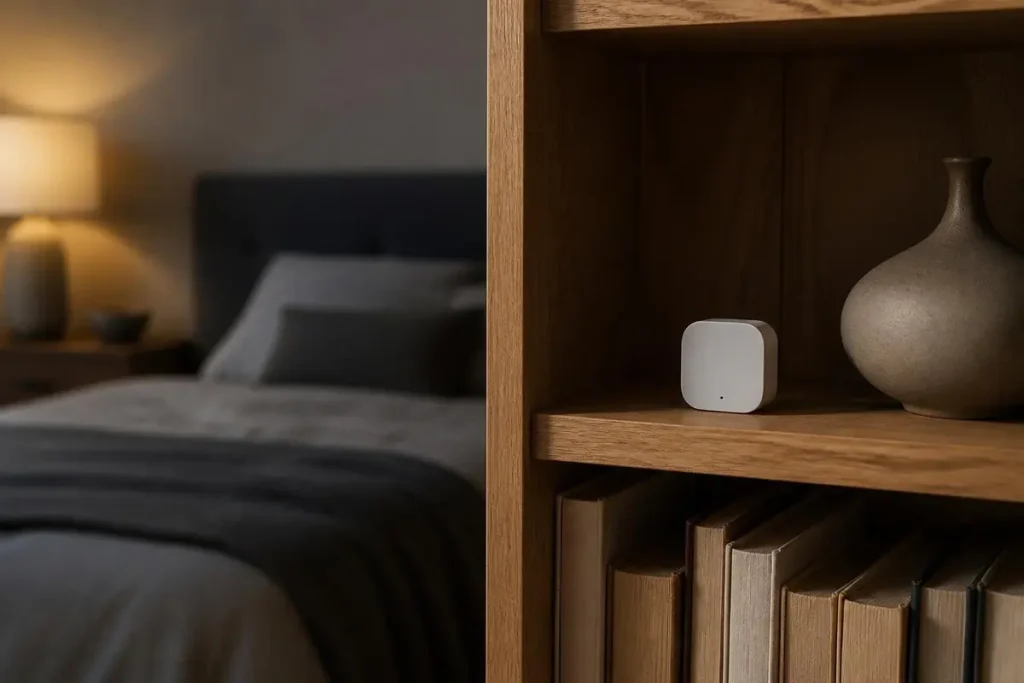
What do remote sensors fix when the thermostat location is wrong?
Remote room sensors move the measuring point without moving the wires: a battery sensor in the room you care about reports the temperature the thermostat acts on. The ecobee SmartSensor tech sheet claims up to 50 feet of range and up to 5 years of battery life; Google gives the Nest Temperature Sensor 50 feet (15 m).
Sensor placement follows the thermostat rules. Resideo’s T9 and T10 room sensor guide says about 5 feet above the floor, on inside walls, and not “above air vents.” Google says about chest high, out of direct sun and never inside a closet or behind books, because “air is generally warmer near the ceiling and cooler near the floor.”
Sensors also answer the two story question: a sensor upstairs lets a downstairs thermostat weigh both floors. When one system cannot close the gap, HVAC zoning is the structural fix, and smart vents are a different approach.
How do you move a thermostat, and where do you put the new one?
Moving a thermostat is a low voltage wiring job, and the new wall must pass the same five checks as the first.
- Turn the power off; Resideo’s T6 Pro instructions open with “turn the power off at the breaker box or switch.”
- Photograph the wiring and label each conductor by terminal; our terminal by terminal wiring guide explains why color alone misleads.
- Check for a C wire. Resideo’s T6 Pro Smart guide lists 24 VAC power through a C (common) wire as required.
- Fish the cable to the new wall, patch the old hole, and level the new base.
- If the old unit holds mercury in a sealed tube, Resideo says not to put it in the trash; ask your local waste authority.
Our smart thermostat setup guide covers compatibility. If the new spot still misbehaves, work through thermostat faults by symptom.
How we researched this
Researched October 15 to 18, 2026. We read the top three ranking articles, seven maker documents (Resideo, ecobee, Google Nest), the 2010 ADA Standards, 24 CFR 100.201 and 100.205, HUD’s design manual, DOE Energy Saver and the American Red Cross. Every figure traces to those sources except the 12 inch gap, our labeled arithmetic.
Excluded: contractor and maker blog heights with no installation document behind them, and all prices (no federal series). Reddit was not used because moving a thermostat is electrical work.
Frequently asked questions
How high should a thermostat be from the floor?
About 5 ft (1.5 m), or 60 inches, in the Resideo T2 Pro and ecobee manuals we read. Where accessibility rules apply, the 2010 ADA Standards and HUD’s design manual put controls you must read at 48 inches or lower.
How far should a thermostat be from a supply vent or return?
Resideo’s T2 Pro instructions ask for at least 10 ft (3 m) from any direct vent and allow the vent on the same wall. None of the manuals we read sets a distance from a return grille; Resideo’s sensor guide says not to place sensors above air vents.
Is it bad to put a thermostat on an exterior wall?
Yes, per the manuals. Resideo specifies an interior wall, “not one where the other side is outside,” and ecobee lists exterior or poorly insulated walls as places not to install. A remote sensor on an inside wall is the usual fix.
Where should a thermostat go in a two story house?
The same rules apply: an interior wall in the main living area, per the ecobee manual. Then add a wireless sensor upstairs; Google rates the Nest Temperature Sensor at up to 50 feet (15 m) from the thermostat. If floors still differ, consider zoning.
What is the lowest safe temperature for a house?
For frozen pipe risk, the American Red Cross says that if you go away in cold weather, leave the heat on and set no lower than 55°F. A thermostat on a warm wall reads high, so colder rooms can drop below what it shows.
Where should the thermostat be set in winter?
DOE says you can save as much as 10% a year by turning the thermostat back 7 to 10°F for 8 hours a day from its normal setting. Our guide to winter and summer setpoints covers schedules in more detail.
Sources
- US Department of Energy, Energy Saver. “Programmable Thermostats” (archived copy). https://web.archive.org/web/2025id_/https://www.energy.gov/energysaver/programmable-thermostats. Accessed October 2026.
- Resideo. “T2 Pro THECC11060MX Installation Instructions” (33-00404ES). https://customer.resideo.com/resources/Techlit/TechLitDocuments/33-00000s/33-00404ES.pdf. Accessed October 2026.
- Resideo. “T6 Pro Programmable Thermostat Installation Instructions” (33-00181EFS). https://customer.resideo.com/resources/Techlit/TechLitDocuments/33-00000s/33-00181EFS.pdf. Accessed October 2026.
- Resideo. “T6 Pro Smart Thermostat User Guide” (33-00410EFS). https://customer.resideo.com/resources/Techlit/TechLitDocuments/33-00000s/33-00410EFS.pdf. Accessed October 2026.
- Resideo. “Wireless Room Sensors for T9 and T10 Pro Smart Thermostats” (33-00429EFS). https://res.cloudinary.com/dzhpkjoqj/Resideo/33-00429EFS.pdf. Accessed October 2026.
- ecobee. “Smart Thermostat Installation Manual IM-STAT-203-R1” (third party copy). https://thermostat.guide/ecobee/ecobee-im-stat-203-r1-smart-thermostat-installation-manual/. Accessed October 2026.
- ecobee. “SmartSensor Tech Sheet” (distributor copy). https://lit.stromquist.com/docs/ECOBEE/SmartSensor-Tech-Sheet.pdf. Accessed October 2026.
- Google Nest Help. “How to set up and install the Nest Temperature Sensor.” https://support.google.com/googlenest/answer/9207485?hl=en. Accessed October 2026.
- US Department of Justice. “2010 ADA Standards for Accessible Design.” https://www.ada.gov/law-and-regs/design-standards/2010-stds/. Accessed October 2026.
- eCFR. “24 CFR 100.201 and 100.205.” https://www.ecfr.gov/current/title-24/subtitle-B/chapter-I/subchapter-A/part-100/subpart-D. Accessed October 2026.
- HUD. “Fair Housing Act Design Manual” (WBDG copy). https://www.wbdg.org/FFC/HUD/fairhousing.pdf. Accessed October 2026.
- American Red Cross. “Frozen Pipes.” https://www.redcross.org/get-help/how-to-prepare-for-emergencies/types-of-emergencies/winter-storm/frozen-pipes.html. Accessed October 2026.
Leave a Reply