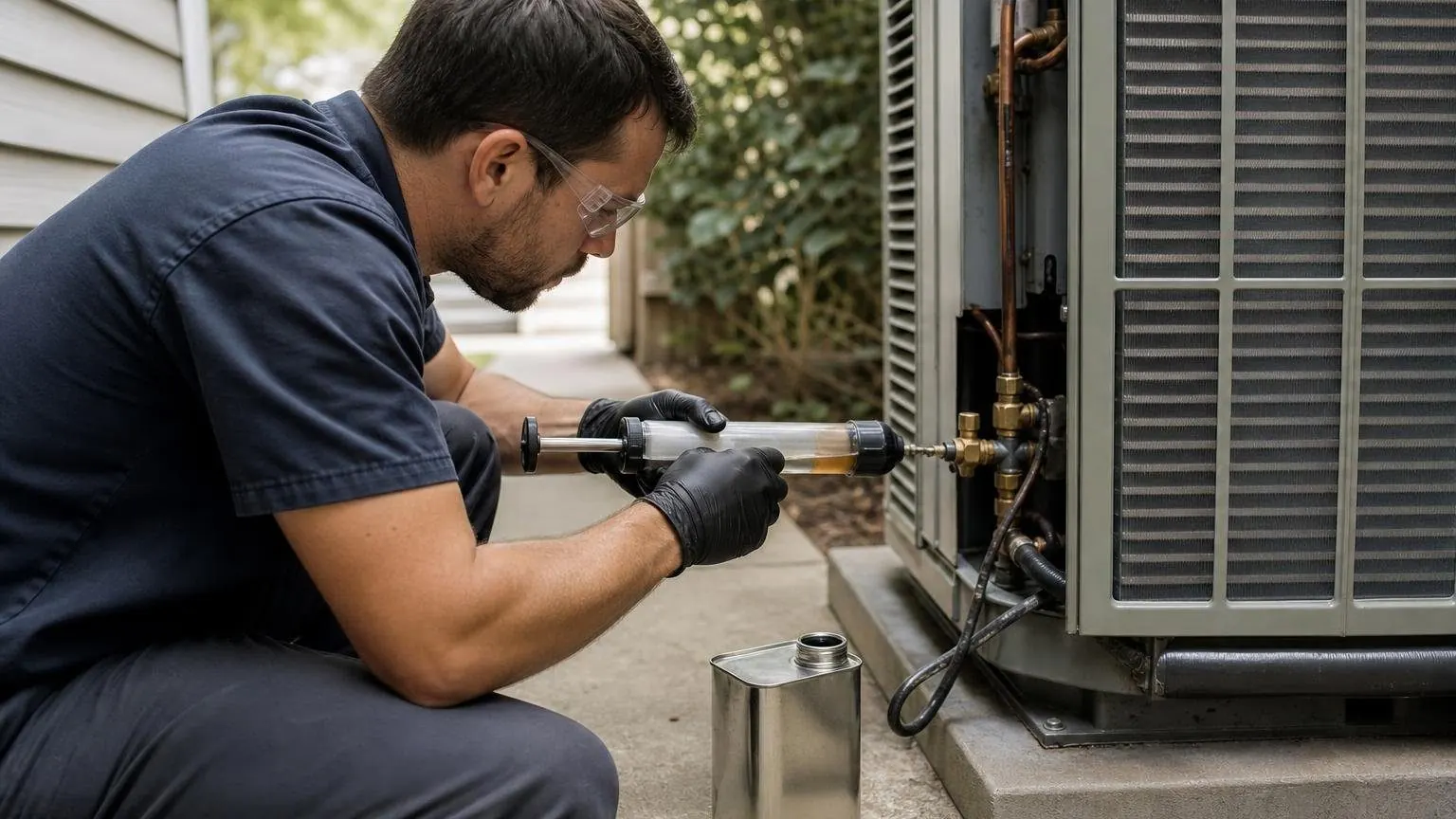
What is refrigerant oil? Refrigerant oil is the compressor lubricant that travels around the circuit with the refrigerant, and the refrigerant sets the type: mineral or alkylbenzene oil for R-22, polyol ester (POE) or polyvinyl ether (PVE) for R-410A, and POE for R-454B and R-32 in the maker documents we checked.
Key Takeaways
- Copeland calls POE oil “extremely hygroscopic” and says water hydrolyzes it into acids (AE11-1297 R7, October 2024).
- R-454B “is only compatible with POE oils,” and vacuum pumps will not remove moisture from that oil, per Rheem’s RP17AY installation instructions.
- Mineral or alkylbenzene oil and an HFC are “mutually immiscible,” perNu-Calgon Product Bulletin 3-68.
- On R-22, POE and mineral oil can be mixed: Copeland now ships R-22 compressors with POE, per a Trane service note (archived copy).
- Danfoss wants operating moisture at 20 to 50 ppm and an opened POE compressor exposed to air no more than 20 minutes (DSH application guide, 2025).
- For an oil change, 40 CFR 82.156 sets a 5 psig ceiling before the appliance is opened.
What is refrigerant oil?
Refrigerant oil is the lubricant inside a refrigeration or air conditioning compressor. Some of it always leaves with the discharge gas, so Nu-Calgon’s Emkarate bulletin says oil and refrigerant must be “fully miscible and soluble with one another” at every system temperature, so the oil returns and the evaporator keeps its heat transfer.
So the oil follows the refrigerant. R-22 mixes with mineral or alkylbenzene oil, but those oils and an HFC separate into two phases, coat the evaporator tubes and can starve the compressor. Car AC oils such as PAG are outside this page.
What are the types of refrigerant oil?
Building HVAC/R uses four refrigerant oil types in two groups: the older mineral and alkylbenzene (AB) oils for CFC and HCFC refrigerants, and the synthetic POE and PVE oils for HFCs and HFO blends.
| Oil type | Pairs with | Moisture behavior | Example grade (maker data) |
|---|---|---|---|
| Mineral (naphthenic) | CFC and HCFC, including R-22 (Suniso GS brochure) | Absorbs water more slowly than POE | Suniso 3GS, 30 cSt at 40°C |
| Alkylbenzene (AB) | R-22 and HCFC service blends (Zerol label) | Absorbs water more slowly than POE | Zerol 200TD, ISO 46 |
| Polyol ester (POE) | HFCs and HFO/HFC blends: R-410A, R-407C, R-454B, R-32; also POE-approved R-22 compressors | “Extremely hygroscopic”; hydrolyzes into acids | Emkarate RL32-3MAF, 31.2 cSt; Mobil EAL Arctic 22 CC, 23.6 cSt |
| Polyvinyl ether (PVE) | All HFC refrigerants, per Nu-Calgon, including R-410A | Does not hydrolyze in moisture | Nu-Calgon FVC32D (ISO 32), FVC68D (ISO 68) |
POE also runs on R-22. Copeland’s AE4-1374 R2 (June 2024) says its ZR*K5E scrolls, marked by an “E” in the seventh place of the model number, use POE and are approved for R-22 and R-407C. The ZR*K5 models use mineral oil such as Suniso 3GS.
Nu-Calgon’s PVE bulletin lists Daikin, Mitsubishi, LG and Samsung among OEMs that approved Idemitsu PVE oils, so anyone servicing VRF equipment should read the nameplate before adding oil.
What oil does R-410A use, and do R-32 and R-454B use the same oil?
R-410A uses POE oil: Copeland’s AE4-1331 R9 (September 2024) says R-410A may only be used with compressors approved for it that contain POE. R-454B and R-32 equipment also uses POE, but grades are compressor-specific.
For ZP scrolls, Copeland names Ultra 32-3MAF or Emkarate RL32-3MAF for top-ups, with Mobil EAL Arctic 22 CC as an acceptable alternative. Danfoss DSH scrolls, rated for R-410A, R-454B and R-452B, take only original POE 160SZ from new cans.
Rheem says R-454B is only compatible with POE, and that an old R-410A or R-22 indoor coil may hold PVE or POE oil incompatible with the POE in an R-454B system. Daikin’s DVH service instructions say the POE in its R-32 units is “extremely susceptible to moisture absorption.”
Grade matters: the 2025 Suniso brochure lists its SL POE line as compatible with R-454B but incompatible with R-32. Use the oil the compressor maker names.
Why does POE oil absorb moisture, and why does it matter?
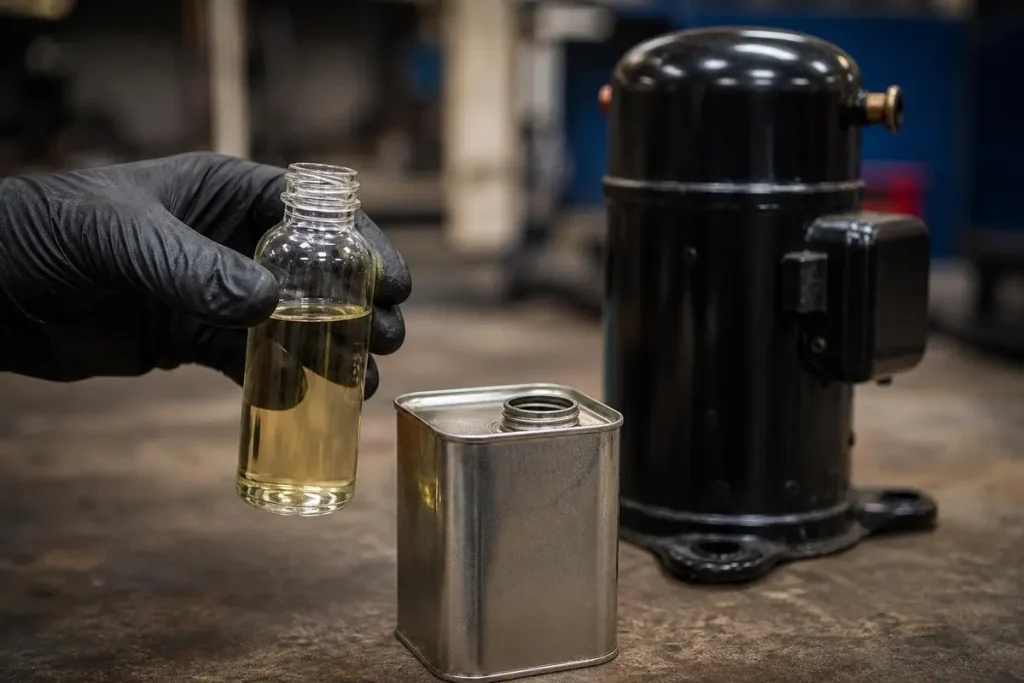
POE is hygroscopic and polar: Copeland says it absorbs moisture “much more rapidly than mineral oils” and hydrolyzes in water, creating acids. Polarity also keeps wear particles circulating instead of settling.
Danfoss says excess moisture can create acid, cause copper plating and destroy the oil’s lubricating properties. Its DSH compressors ship below 100 ppm moisture, and the drier must bring the system lower in operation.
A vacuum pump is not a cure. Rheem says vacuum pumps will not remove moisture from POE oil in R-454B systems, yet still requires evacuation to 500 microns, held for at least 15 minutes. See our guides to pulling a deep vacuum and the POE-rated filter drier. Nu-Calgon adds that unused POE in a metal container, tightly sealed after each use, should take on no serious moisture.
Can you mix refrigerant oils when converting R-22 to R-410A?
No. R-22 equipment is not converted to R-410A: Copeland allows R-410A only in compressors approved for it, and Rheem says R-454B cannot be retrofitted into R-410A or R-22 heat pumps. Mixing comes up when topping up R-22, reusing a line set, or retrofitting R-22 to a blend such as R-407C.
Myth: any contact between POE and mineral oil ruins a system
Not on R-22. Trane’s service note says Copeland now ships R-22 compressors with POE, and that with R-22, POE and mineral oil can be mixed. The failure case is mineral or AB oil with an HFC. Between approved POE brands, Nu-Calgon calls blending “most acceptable,” though formulated POEs may carry up to 3% additives that get diluted.
When an R-22 or R-410A system is replaced with R-454B and the line set stays, Rheem says to blow the lines out with nitrogen to remove as much remaining mineral oil as possible and drain oil from low spots. A nitrogen pressure test follows the brazing.
For an R-22 retrofit to R-407C, Trane’s PART-SLB005-EN says replacement refrigerants “are NOT ‘drop-ins’” and the change requires POE. The oil steps from Trane and Arkema’s retrofit sheet are below; the R-22 phaseout is what drives these jobs.
- Record baseline data, then recover and weigh the R-22 charge.
- Drain and measure the oil from the compressor, oil separator, suction accumulator and liquid receiver.
- Refill with the same volume of POE. Trane says “a limited amount of mineral oil can remain”; Arkema says extra flushes may be needed.
- Replace filter driers and suction filters with POE-compatible parts, plus O-rings and Schrader valves.
- Leak check, evacuate below 500 microns, charge, and label the refrigerant and lubricant type and amount.

How do you check refrigerant oil for acid?
Draw an oil sample and check it with an appropriate acid test kit, then retest after cleanup. As a baseline, new Emkarate POE lists an acid value below 0.05 mgKOH/g and Mobil EAL Arctic 22 CC lists 0.03, both typical maker data.
J&E Hall’s burnout procedure (R-080) says heat from a hermetic burnout breaks oil and refrigerant into acids and sludge that will probably attack the replacement motor. It fits a suction line drier, renews the liquid line drier and replaces the oil. After 24 to 48 hours the suction drier comes out and the oil is tested; acidic oil is changed, run another day or so, and retested. That cleanup belongs in any compressor replacement after a burnout.
Copeland’s AE28-1282 R2 says it “generally does not recommend use of any additives” for bearing losses “or for any other purpose,” and untested additives may void the warranty.
Under 40 CFR 82.156, an appliance opened for an oil change must first be evacuated or pressurized to no higher than 5 psig, or the oil drained into a system receiver. 40 CFR 82.161 requires EPA 608 certification for anyone who could reasonably be expected to violate the integrity of the refrigerant circuit, and charge removed goes through refrigerant recovery.
Which refrigerant oil viscosity grade goes in the compressor?
Use the grade on the compressor nameplate or in the maker’s bulletin. Nu-Calgon’s Emkarate POE line alone runs from 7 cSt to 220 cSt, and oil data sheets print each grade beside its measured viscosity at 40°C.
Nu-Calgon’s approval chart pairs grades with compressors: RL32-3MAF for Copeland scrolls, RL32H for Danfoss Maneurop scrolls, RL68H for Bitzer (H) reciprocating models and RL22H for Tecumseh reciprocating models.
Quantity follows the same bulletins. Copeland says a complete recharge should be about four fluid ounces (118 ml) less than the nameplate value, and systems holding more than 20 pounds of refrigerant get one fluid ounce of oil per 5 pounds over that amount.
How we researched this
Researched October 18, 2026. We read 25 documents, including three ranking competitor pages, and cite 18: four Copeland bulletins, Danfoss, Daikin, Rheem, Trane, Arkema and J&E Hall documents, oil data sheets for Emkarate, Mobil EAL Arctic, Suniso, Zerol and Nu-Calgon PVE, and 40 CFR 82.156 and 82.161. Oil properties are typical maker data, not specifications.
Excluded: acid test kit thresholds and residual mineral oil percentages found only in secondary write-ups, and retail prices, which no federal series covers. Reddit was not used.
Frequently asked questions
Do R-32 and R-410A use the same oil?
Both use POE, but not always the same grade. Copeland’s R-410A ZP scrolls take Ultra 32-3MAF or Emkarate RL32-3MAF, and Daikin’s R-32 units use POE too. The Suniso brochure lists its SL POE line as incompatible with R-32, so follow the compressor maker.
Can you put POE oil in an R-22 system?
Yes, in approved compressors. Copeland’s ZR*K5E scrolls use POE and are approved for R-22 and R-407C, and a Trane service note says Copeland now ships R-22 compressors with POE. With R-22, POE and mineral oil can be mixed.
Can you use mineral oil with R-410A?
No. Nu-Calgon says mineral or alkylbenzene oil and an HFC are mutually immiscible and separate in the evaporator. Copeland says R-410A may only be used with approved compressors that contain POE.
How long can POE oil be exposed to air?
As briefly as possible. Danfoss says an opened compressor must not be exposed to air for more than 20 minutes, and Copeland’s assembly-line limit is 5 minutes.
Is POE oil harmful to skin or plastics?
It can be. Copeland warns that POE can harm certain polymers, such as PVC/CPVC and polycarbonate, and may cause an allergic skin reaction on bare skin. It calls for gloves and eye protection.
Do you need EPA 608 certification to add refrigerant oil?
In most cases, yes. 40 CFR 82.161 requires certification for anyone who could reasonably be expected to violate the integrity of the refrigerant circuit, and 40 CFR 82.156 sets a 5 psig limit before an appliance is opened for an oil change.
Sources
- Copeland. “AE11-1297 R7: Liquid Line Filter Driers (October 2024).” https://webapps.copeland.com/online-product-information/Publication/LaunchPDF?Index=AEB&PDF=1297. Accessed October 2026.
- Copeland. “AE4-1374 R2: ZR*K5E R-22 and R-407C Scrolls (June 2024).” https://webapps.copeland.com/online-product-information/Publication/LaunchPDF?Index=AEB&PDF=1374. Accessed October 2026.
- Copeland. “AE4-1331 R9: ZP R-410A Scroll Compressors (September 2024).” https://webapps.copeland.com/online-product-information/Publication/LaunchPDF?Index=AEB&PDF=1331. Accessed October 2026.
- Copeland. “AE28-1282 R2: Oil Additives (August 2024).” https://webapps.copeland.com/online-product-information/Publication/LaunchPDF?Index=AEB&PDF=1282. Accessed October 2026.
- Danfoss. “Application Guide, Scroll compressors DSH090 to DSH600 (2025.01).” https://assets.danfoss.com/documents/461327/AB288965961751en-001701.pdf. Accessed October 2026.
- Daikin Comfort. “DVH Service Instructions RSD6432301.” https://daikincomfort.com/docs/default-source/nexiomax/sm-rsd6432301.pdf. Accessed October 2026.
- Rheem. “RP17AY R-454B Installation Instructions (distributor copy).” https://www.budgetheating.com/content/files/downloadables/rp17ay_installation_instructions.pdf. Accessed October 2026.
- Trane. “R-22 Replacement Policies, PART-SLB005-EN (June 2020).” https://elibrary.tranetechnologies.com/public/trane-history-b/Literature/Sales/PART-SLB005-EN_06012020.pdf. Accessed October 2026.
- Trane. “Replacement R-22 Compressor Shipped with POE Oil, DOC-116673 (archived copy).” https://web.archive.org/web/20250708042220/https://support.trane.com/hc/en-us/articles/28674621675277-Replacement-R-22-Compressor-Shipped-with-POE-Oil-Is-this-correct. Accessed October 2026.
- Arkema. “Forane Retrofit Data Sheet.” https://forane.arkema.com/files/live/sites/shared_arkema/files/downloads/investorrelations/literature/retrofit-data-sheet.pdf. Accessed October 2026.
- J&E Hall. “R-080: System Clean Up After Compressor Motor Burn Out (2019).” https://jehall.com/files/ww/HSQE/r-080-system-clean-up-after-compressor-motor-burn-out.pdf. Accessed October 2026.
- Nu-Calgon. “Bulletin 3-68: Emkarate RL Lubricants (distributor copy).” https://resource.bakerdist.com/is/content/Watscocom/Gemaire/nu-calgon_4314-64_article_1372691419658_en_ss.pdf?fmt=pdf. Accessed October 2026.
- Nu-Calgon. “Bulletin 3-88: PVE Lubricants (archived copy).” https://web.archive.org/web/2025/https://nucalgon.com/media/3809/3-88_pveoil.pdf. Accessed October 2026.
- Petro-Canada Lubricants. “Suniso brochure, LUB4427E (2025, archived copy).” https://web.archive.org/web/20251203163306/https://petrocanadalubricants.com/-/media/suniso/pdf/sunisobrochure.ashx. Accessed October 2026.
- Nu-Calgon. “Zerol 200TD label 4308-05 (archived copy).” https://web.archive.org/web/20251107055815/https://www.nucalgon.com/media/3725/4308-05_label-819.pdf. Accessed October 2026.
- ExxonMobil. “Mobil EAL Arctic 22 product page.” https://www.mobil.com/en/sap/our-products/products/mobil-eal-arctic-22. Accessed October 2026.
- eCFR. “40 CFR 82.156.” https://www.ecfr.gov/current/title-40/chapter-I/subchapter-C/part-82/subpart-F/section-82.156. Accessed October 2026.
- eCFR. “40 CFR 82.161.” https://www.ecfr.gov/current/title-40/chapter-I/subchapter-C/part-82/subpart-F/section-82.161. Accessed October 2026.
Leave a Reply