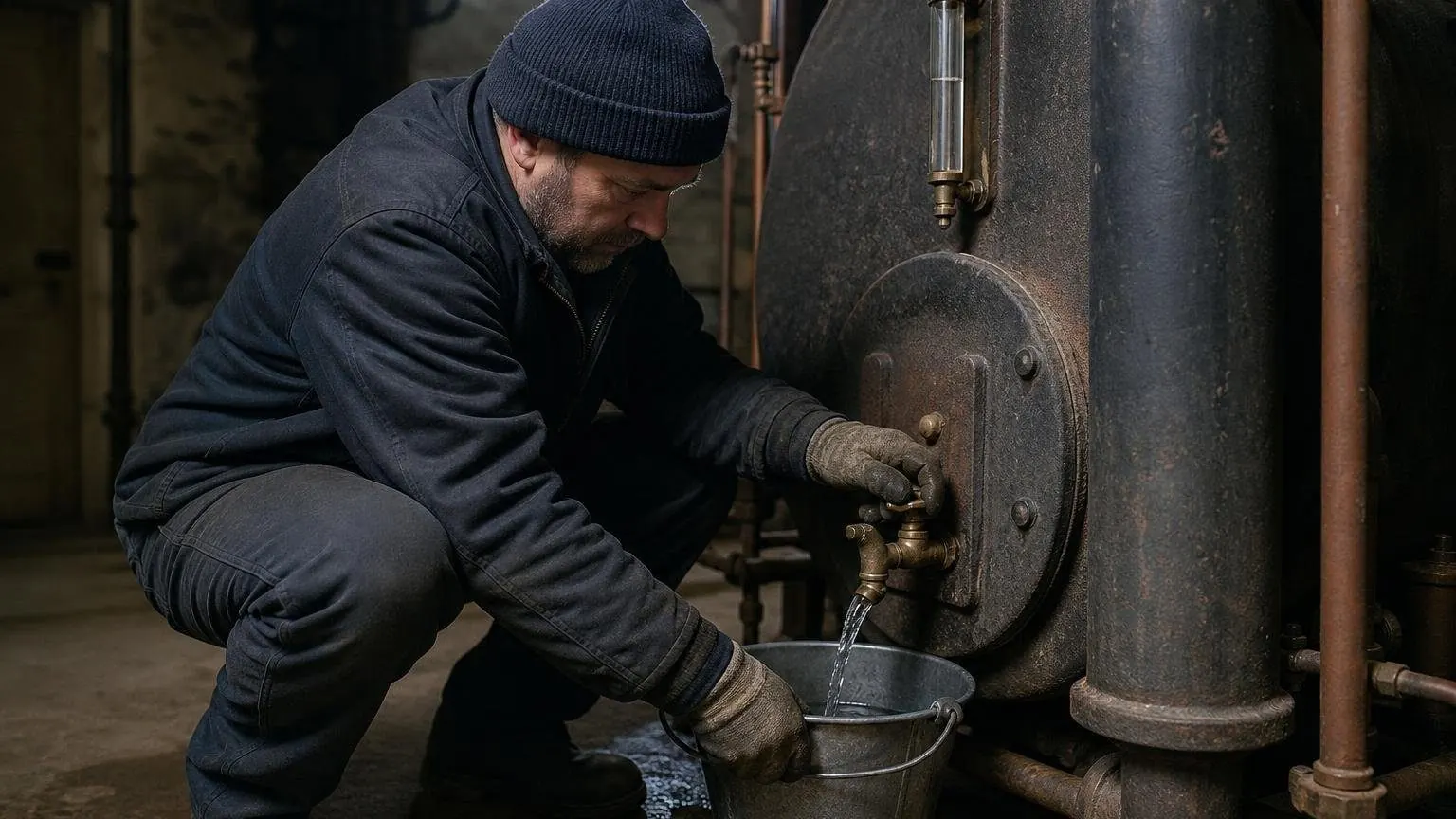
What does a low water cutoff do? A low water cutoff (LWCO) is a boiler safety control that shuts the burner off when water drops below the lowest safe level set by the boiler maker, so the boiler cannot dry fire. Every automatically fired steam boiler needs one, and many codes require one on hot water boilers too.
Key Takeaways
- Low water was the leading cause of boiler accidents in the National Board’s 2002 Incident Report: 592 of 1,663 (National Board Bulletin).
- The 2018 IRC, Section M2002.5, requires a cutoff on steam and hot water boilers, with a flow switch exception (code text).
- McDonnell & Miller: blow down a Series 67 float cutoff weekly, test it annually, replace it within 10 years (MM-825 catalog).
- Probe cutoffs use boiler water as a conductor; the Hydrolevel Safgard 400 trips after 15 seconds of low water (Hydrolevel).
- Washington requires two LWCOs on low pressure steam boilers, one with manual reset (WAC 296-104-302).
- Scale lets a float hang up and can make a probe read water that is not there (National Board, archived).
What does a low water cutoff do?
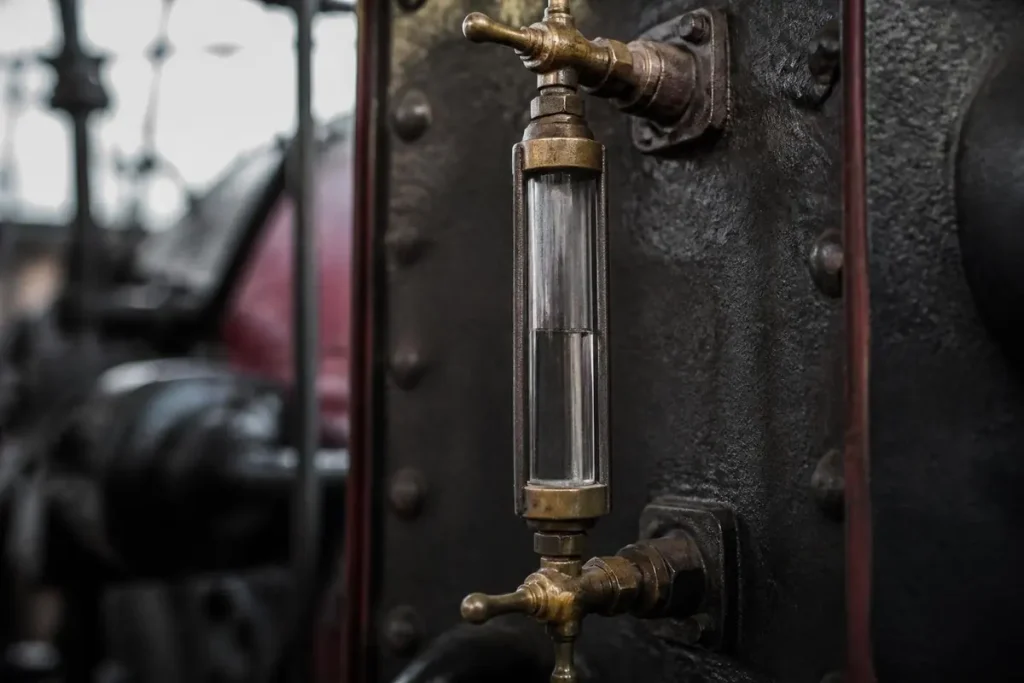
A low water cutoff opens the burner circuit when water falls below the boiler maker’s minimum safe level. It is a safety limit, not an operating control. On steam boilers it usually sits just below the gauge glass, per McDonnell & Miller.
It prevents dry fire, which McDonnell & Miller says “results in cracked cast iron sections, and melted fire tubes.” An aquastat senses temperature and a boiler pressure gauge reads pressure; neither proves the boiler is full. Nor does a fill valve: “Feed valves are not a substitute for low water cut-offs,” the same catalog says.
How does a low water cutoff work: float vs probe?
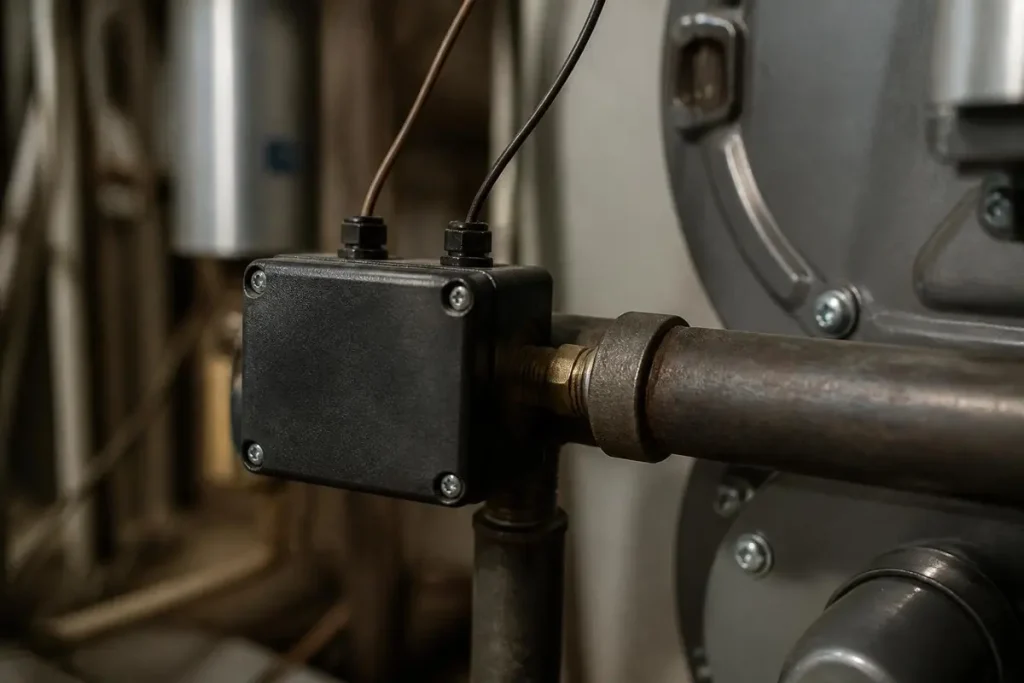
A float low water cutoff has a float in a chamber that drops with the water and mechanically opens a switch. A probe low water cutoff uses the water as a conductor: when water leaves the probe tip, the circuit opens and the burner stops. Some forced circulation boilers use a flow switch instead.
A 1999 National Board Bulletin article by Ian Oldfield of cutoff maker Gestra calls the float type the most widely used in residential, institutional and commercial heating boilers.
| Type | How it senses | Example | Weak point |
|---|---|---|---|
| Float | Float drops in a chamber; linkage opens the switch | McDonnell & Miller Series 67, steam, 20 psi max | Scale lets the float hang up as water falls |
| Probe (electrode) | Water conducts from probe tip to boiler shell | Hydrolevel Safgard 400, steam, 24 VAC; M&M Series 750, 20,000 ohms sensitivity | Scale bridging, or a tip touching metal, fakes “water present” |
| Flow switch | Proves circulation, not level | Forced circulation coil and water tube boilers | Allowed only where code permits |
Hydrolevel sells probes as having “no float bowl so sediment cannot collect,” a maker claim. The National Board article shows probes scale up too, and a tip touching the pot wall “will never trip on low water.”
Is a low water cutoff required on a hot water boiler?
Often, yes, depending on the code your jurisdiction adopted. The model International Residential Code requires a low water cutoff on hot water and steam boilers alike. The ASME boiler code, as McDonnell & Miller restates it, requires one on hot water boilers only at 400,000 Btu/h input or more.
Section M2002.5 of the 2018 IRC (Seattle printing) reads: “Steam and hot water boilers shall be protected with a low-water cutoff control.” Section M2002.6 requires it to stop combustion below the maker’s lowest safe level. For steam, McDonnell & Miller quotes ASME Section IV: every “automatically fired steam or vapor steam boiler” needs one.
| Rule | Steam | Hot water |
|---|---|---|
| IRC M2002.5 (2018) | Required | Required; flow switch option for forced circulation coil and water tube boilers |
| IMC 1007.1 (per Bell & Gossett) | Required | Required |
| ASME Section IV (per McDonnell & Miller) | Required, any size | 400,000 Btu/h input or more |
| ASME CSD-1 (per Bell & Gossett) | At least one, CW-120a | Residential exception |
| Minnesota 1346.1007 | General rule | 400,000 Btu/h or more, radiation below the boiler, or maker requires; testable without draining |
| Washington WAC 296-104-302 | Two LWCOs, one manual reset | One, manual reset; testable without draining since December 2004 |
| Alaska 8 AAC 80.070 | Required, manual reset | Over 400,000 Btu/h: cutoff or loss of flow switch |
| New York City MC 1007.1 (2014) | Dual cutoffs | Dual; one allowed for an in-unit boiler under 350,000 Btu/h |
Also cited: Minnesota rule, Alaska rule, Bell & Gossett, 2019.
The myth to retire
“Small hot water boilers never need a low water cutoff” holds only under ASME’s size threshold. The model IRC disagrees, and Minnesota requires one at any size when all radiation sits below the boiler. Confirm your adopted code during the permit process.
Adding one to a hydronic heating system? Hydrolevel’s Model 1100 must sit at or above the maker’s minimum safe water level, and can go in a 3/4 inch tee on the boiler side of the circulator.
How often should a boiler low water cutoff be tested and blown down?
Follow the maker’s schedule. McDonnell & Miller says to blow down its Series 67 steam float cutoff weekly and inspect and test it annually; its large commercial floats get blown down and tested daily. Probe cutoffs generally skip blowdown but need annual tests and probe cleaning.
| Control (type) | Maker maintenance | Replace by |
|---|---|---|
| M&M 67, 767 (float, steam) | Blow down weekly. Inspect and test annually. | 10 years |
| M&M 150S, 157S, 158S, 159S (float, commercial) | Blow down and test daily, inspect annually | 15 years |
| M&M 750, PSE-800, RB-122E (probe) | Inspect and test annually; probes, inspect 5 yrs | 15 years |
| M&M RB-24 (probe) | Inspect and test annually | 10 years |
| Hydrolevel Safgard 400 (probe, steam) | Remove, inspect and clean probe annually | Not stated |
| Hydrolevel Model 1100 (probe, hot water) | Press TEST annually; clean every five years | 10 years |
The catalog also quotes ASME Section VI, paragraph 7.07 G: cutoffs “should be dismantled annually, by qualified personnel.” Put that on the annual boiler service list.
Weekly blowdown matters most on a steam heating system, which loses some water in normal operation. Dirty vents, leaking wet returns and faulty steam traps add to it, per McDonnell & Miller.
How do you test a low water cutoff?
Prove it trips with the burner running. Lower the water the cutoff senses, by blowing down a float chamber or slowly draining below a probe, and confirm the burner stops. For its Model 1100 hot water probe, Hydrolevel accepts pressing TEST for the annual check.
- Start with normal water level and the burner firing.
- Float type: open the cutoff’s blowdown valve to a drain. The float should drop and stop the burner. Close the valve.
- Probe type on steam: per Hydrolevel’s Safgard 400 instructions, slowly lower the water until the amber light glows steadily, never below a visible point in the gauge glass. The boiler should shut down within 15 seconds.
- Probe type on hot water: press TEST. The burner should stop.
- If the burner keeps firing, shut the boiler down until repaired.
Do not trust a look. “Visual examination is not reliable,” the National Board article warns.
How do you reset a low water cutoff after it trips?
Find out why it tripped first. If the gauge glass shows no water, the boiler may be overheated: cut burner power and let it cool rather than adding cold water. If the level is normal, press reset once on a manual reset cutoff. A second trip means a fault.
Hydrolevel warns that cold water fed into “overheated tubes or plates” can “cause explosive results.” McDonnell & Miller’s CSD-1 manual reset models stay tripped after a power cut until the water is back above the probe and reset is pressed.
Automatic reset models restart once water returns; the Safgard 400 fires after a 30 second delay. Never jumper one: the National Board article says a cutoff that trips often “should not be overridden because it is a safety device!” Our boiler not working guide lists safe owner checks.
Why do low water cutoffs fail?
Mostly through neglect, not design. In the National Board’s 2002 Incident Report, the latest cause breakdown we could open as a primary document, low water was the leading cause at 592 of 1,663 accidents. Steam heating boilers were hit hardest: 359 of 733, or 49%, by our arithmetic.
Hot water heating boilers logged 96 of 472 (20%) and power boilers 137 of 282 (49%); the overall share was 36%. Low water incidents fell 32 percent from 2001. The survey drew a 63 percent response rate, so treat the counts as a floor and the year as old.
The National Board article lists the culprits: scale that leaves a float “hanging up,” scale bridging on a probe tip, wiring shorts and jumpers left in place.
How we researched this
Research date: October 18, 2026. We consulted 18 sources and cite 10: two National Board documents, IRC text, three state rules, and four maker documents labeled as maker data. ASME Section IV, CSD-1 and the IMC are paywalled or block automated reading, so we cite named restatements. Reddit was skipped because this is a boiler safety topic. Product listings and contractor blogs were excluded.
Frequently asked questions
What does water cut-off mean on a boiler?
It is short for low water fuel cutoff, a control that cuts fuel to the burner when boiler water falls too low. Washington’s rule requires one, with manual reset, on automatically fired hot water heating boilers. It is separate from the feeder that adds water.
What is the difference between a primary and secondary low water cutoff?
The primary is the main low water limit; a secondary is an independent backup wired in series. McDonnell & Miller recommends a secondary on steam boilers above 400,000 Btu/h input or 15 psi. Washington requires two on automatically fired low pressure steam boilers, one with manual reset.
Can I bypass or jumper a low water cutoff that keeps tripping?
No. Repeated trips report a real water loss or a control fault. The 1999 National Board article says jumpering causes many low water conditions and a frequently tripping cutoff should not be overridden. Find the leak instead.
Do modern high efficiency boilers need a low water cutoff?
Not always as a float or probe. The 2018 IRC exempts forced circulation coil-type and water tube boilers protected by a flow-sensing control. Whether yours qualifies depends on its listing and the maker’s instructions, which every boiler installation must follow.
How long does a low water cutoff last?
McDonnell & Miller lists a 10 year maximum for its Series 67 float and RB-24 probe, and 15 years for its 750, PSE-800 and RB-122E probe controls. Hydrolevel says to replace its Model 1100 ten years from installation. McDonnell & Miller adds: replace any control with no date stamp.
Is pressing the test button enough to test a low water cutoff?
For some hot water probe controls, yes: Hydrolevel’s Model 1100 calls for pressing TEST annually and confirming the burner stops. Steam float cutoffs differ; McDonnell & Miller calls for weekly blowdown of its Series 67, which drains the float chamber and proves the float can drop.
Sources
- National Board. “2002 Incident Report,” Bulletin, Summer 2003. https://www.nationalboard.org/SiteDocuments/Bulletins/SU03.pdf. Accessed October 2026.
- National Board. “Low Water Cut-Off Technology,” I. Oldfield, Bulletin, Winter 1999 (archived copy). https://web.archive.org/web/20201029102052/https://www.nationalboard.org/PrintPage.aspx?pageID=164&ID=237. Accessed October 2026.
- City of Seattle. “2018 Seattle Residential Code, Chapter 20” (IRC M2002.5, M2002.6). https://www.seattle.gov/documents/Departments/SDCI/Codes/SeattleResidentialCode/2018SRCChapter20.pdf. Accessed October 2026.
- Minnesota. “Minn. R. 1346.1007,” via Cornell LII. https://www.law.cornell.edu/regulations/minnesota/Minn-R-1346-1007. Accessed October 2026.
- Washington. “WAC 296-104-302,” via Cornell LII. https://www.law.cornell.edu/regulations/washington/WAC-296-104-302. Accessed October 2026.
- Alaska. “8 AAC 80.070,” via Cornell LII. https://www.law.cornell.edu/regulations/alaska/8-AAC-80.070. Accessed October 2026.
- McDonnell & Miller (Xylem). “General Catalog MM-825 Rev I.” https://res.cloudinary.com/consolidated-supply/resource/raw/xylem_126400_catalog.pdf. Accessed October 2026.
- Xylem Bell & Gossett. “Why residential hot water boilers need LWCO’s?” August 2019. https://www.xylem.com/en-us/brands/bell-gossett/bg-steam-team-home/why-residential-hot-water-boilers-need-lwcos/. Accessed October 2026.
- Hydrolevel. “Safgard 400 Series instructions.” https://pexuniverse.com/uploads/literature/hl-safgard-400-ins.pdf. Accessed October 2026.
- Hydrolevel. “Model 1100 instructions.” https://s3.amazonaws.com/s3.supplyhouse.com/product_files/Hydrolevel-45-1103-Install-Instructions.pdf. Accessed October 2026.
Leave a Reply