Does a radiant barrier actually work? Yes, a radiant barrier works in hot, sunny climates, mostly by shielding attic ductwork: eight retrofitted Florida homes used about 9% less cooling energy. With no attic ducts, modeled savings fall to $15 a year or less, and in cool climates DOE says more insulation usually pays better.
Key Takeaways
- FSEC’s 2000 retrofit of eight central Florida homes cut cooling energy about 9% and summer peak demand about 16% (FSEC-CR-1231-01).
- DOE says studies show 5% to 10% lower cooling costs in warm, sunny climates (DOE Energy Saver, archived copy).
- ORNL’s model puts annual savings at $140 in Miami with leaky attic ducts, but $15 with no attic ducts and code-level insulation, at 2008 prices (ORNL fact sheet).
- The product label should show emittance less than 0.1, measured by ASTM C1371, per the ORNL Radiant Barrier Fact Sheet.
- Foil laid on the attic floor loses about half its effect to dust after one to ten years, and DOE strongly recommends against that placement (DOE, archived copy).
- Under 16 CFR 460.5, a single-sheet reflective product’s R-value must be read for a specific emittance, air space and heat-flow direction (eCFR).
What is a radiant barrier, and how does it work?
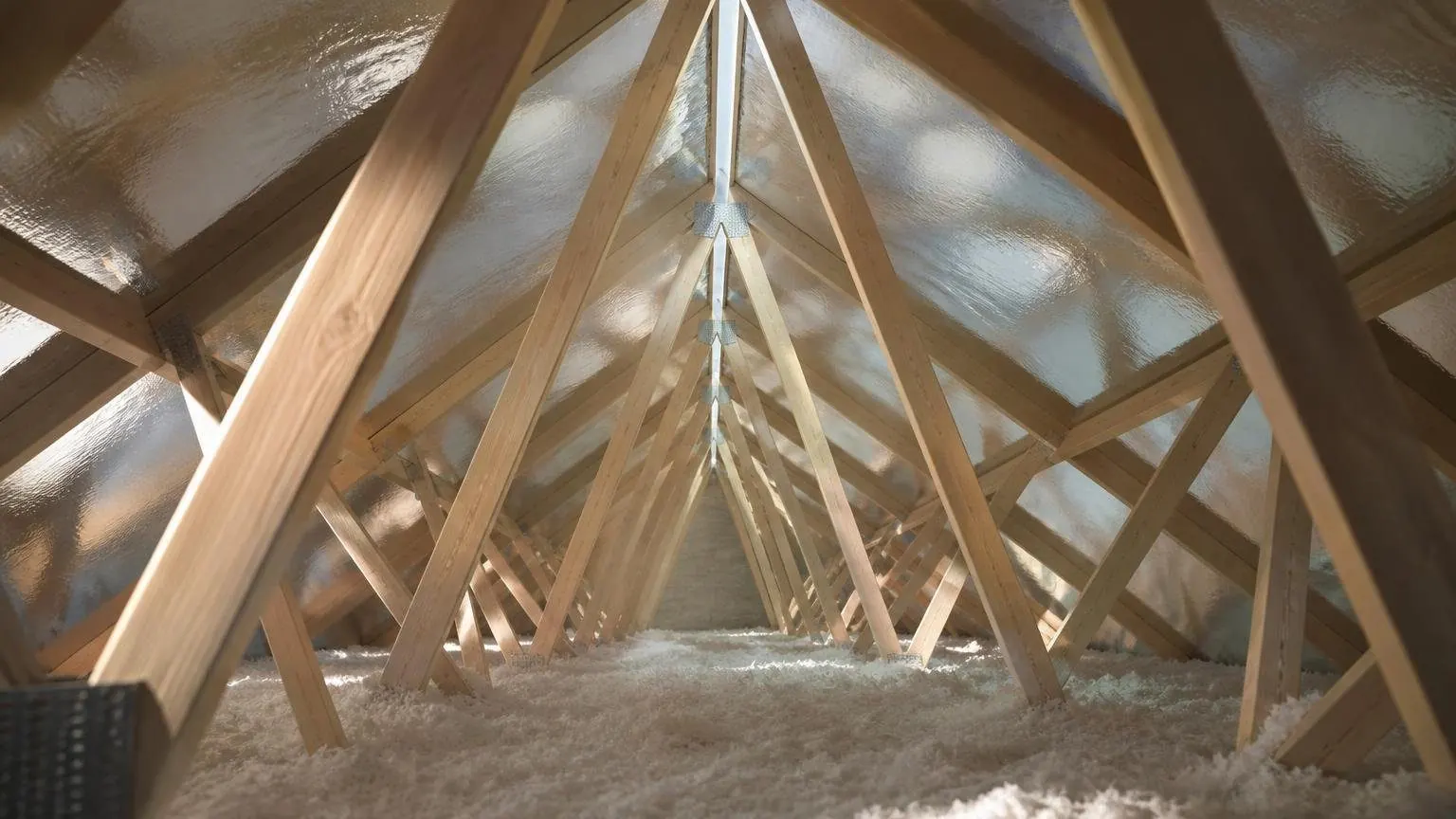
A radiant barrier is a thin, highly reflective layer, usually aluminum foil, applied to kraft paper, plastic film, OSB or plywood and installed in the attic. It cuts the infrared heat that a sun-baked roof deck radiates down onto the insulation and ducts. It does not slow conduction like insulation.
The property that matters is emittance, a number from 0 to 1 where lower is better. ORNL’s fact sheet says the label should show emittance less than 0.1, measured by ASTM C1371, and that you cannot always judge emittance by how shiny a product looks. The foil also has to face an open air space, because it works by reducing heat radiated across that space.
Do radiant barriers really work? What field tests measured
Yes, in hot climates, by a modest margin. The Florida Solar Energy Center retrofitted foil into nine monitored shingle-roof homes in 2000 and analyzed eight. Average cooling energy fell 3.6 kWh/day, about 9%, and afternoon peak demand fell 420 watts, about 16%.
For comparison, homes with R-30 used 3.4 kWh/day less for cooling than homes with R-19, but cut peak demand only 130 watts. FSEC attributed part of the foil’s bigger peak effect to reduced heat gain to attic ducts.
In FSEC’s 1997 test cells at its Flexible Roof Facility, a truss-mounted radiant barrier under black shingles cut summer ceiling heat flux 26% with 1:300 attic venting and 36% with 1:150 venting. A white tile roof cut it 75.9%, a reminder that a well-vented attic and a reflective roof surface matter too.
How much can a radiant barrier save in your climate?
Savings depend first on climate, then on attic ductwork. ORNL modeled a 1,540 sq ft house in eight cities with AtticSim and EnergyPlus, using 2008 EIA state average prices. With leaky, uninsulated attic ducts, adding foil alone was modeled to save $140 a year in Miami; with no attic ducts and code-level insulation, the modeled saving was $15.
| City (zone) | Leaky ducts, R-19 attic | Leaky ducts, code attic | Sealed ducts, code attic | No attic ducts, code attic |
|---|---|---|---|---|
| Miami (1) | $140 | $120 | $40 | $15 |
| Austin (2) | $150 | $120 | $40 | $15 |
| Atlanta (3) | $80 | $70 | $25 | $10 |
| Baltimore (4) | $80 | $60 | $20 | $5 |
| Chicago (5) | $60 | $40 | $15 | $5 |
| Minneapolis (6) | $45 | $25 | $10 | $0 |
| Fargo (7) | $35 | $15 | $10 | $0 |
Annual savings from adding a radiant barrier only, 1,540 sq ft house, 2008 state average prices. Source: ORNL Radiant Barrier Fact Sheet, 2010.
This matches DOE’s line that foil is “more effective in hot climates than in cool climates, especially when cooling air ducts are located in the attic.” PNNL’s Building America Solution Center flags air conditioners and ducts in an uninsulated attic. If yours sit there, sealing and insulating the ducts is worth pricing first.
Myth check: “blocks 97%” is not a 97% bill cut
LP’s maker literature says TechShield sheathing “blocks up to 97% of the radiant heat transfer through roof sheathing” and lowers attic temperatures “by up to 30° F.” Those are surface claims. Measured in Florida homes: about 9% less cooling energy and an 8 degree drop in average peak attic temperature.
Does a radiant barrier need an air gap?
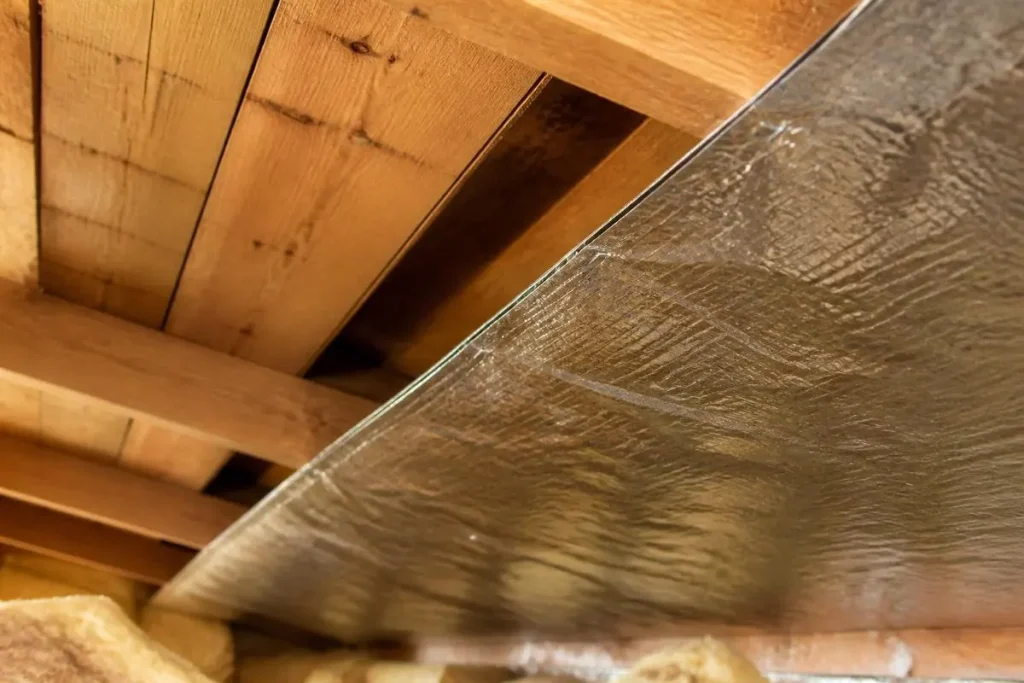
Yes. DOE says “to be effective, the reflective surface must face an air space.” ORNL adds that a one-sided product must face the main attic space whether it hangs at the rafters or lies on the floor, and that a sheet laid reflective side down, touching the insulation, loses most of its effectiveness.
The published spacing:
- DOE: let stapled foil droop to leave at least a 1.0 inch air space below the roof deck.
- ORNL: foil draped over rafters before sheathing should droop 1-1/2 to 3 inches between rafters.
- ORNL: leave about 3 inches between a roof-mounted barrier and the floor insulation, and at least 6 inches near the ridge, for airflow.
- ORNL: cover the gable ends too, but never the gable vents.
That air channel is also why marketing R-values mislead. Under 16 CFR 460.5, single-sheet reflective products are tested for emittance, and any R-value must be read for “a specific emittance, air space, and direction of heat flow.” For real R-value, see our attic R-value guide by climate zone.
Where should a radiant barrier go in the attic?
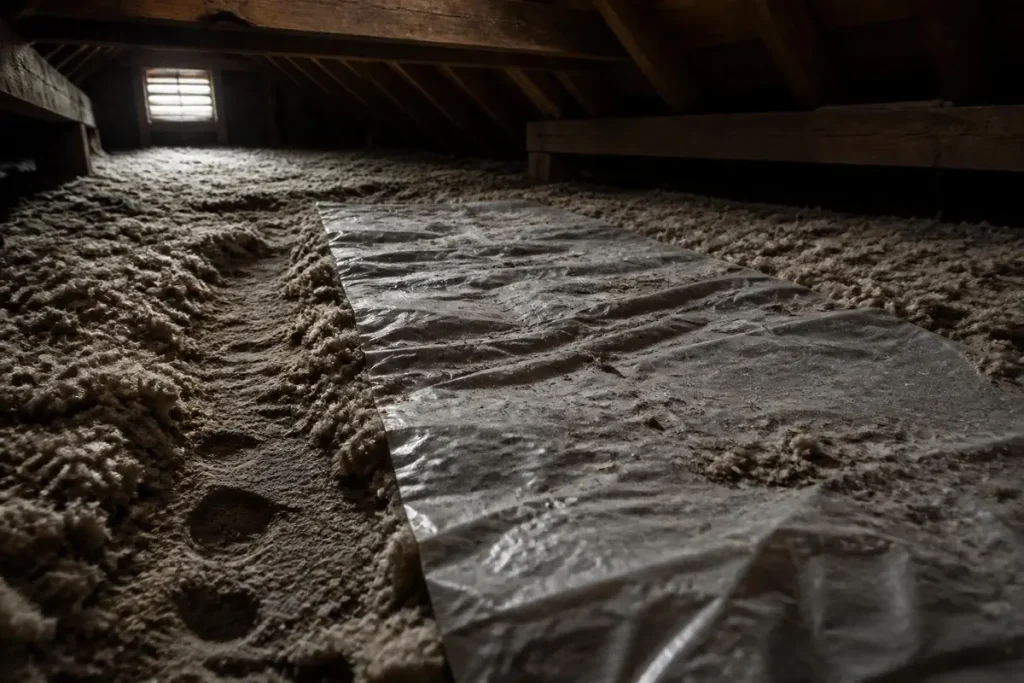
On the roof side, facing down. ORNL lists five locations: foil-faced decking, foil draped over rafters before sheathing, foil on the faces of rafters, foil on the bottoms of rafters, and foil laid on the attic floor. Downward-facing foil stays clean; floor foil collects dust and, by ORNL’s modeling, loses about half its effect after one to ten years.
DOE goes further: it is “strongly recommended that you NOT apply radiant barriers directly on top of the attic floor insulation,” because floor foil gathers dust and may trap moisture. Floor sheets must pass vapor and must not cover recessed lights or vents. Foil also conducts electricity, so keep it off bare wiring.
Radiant barrier vs spray foam vs more insulation: which comes first?
Our reading of ORNL’s numbers: air seal first, then fix attic ducts, then insulate, then add foil. ORNL calls attic air sealing “the first step in any attic improvement effort.” DOE adds that in cool climates “it’s usually more cost-effective to install more thermal insulation than to add a radiant barrier.” A blower door audit shows where leaks are, and our attic insulation cost review covers pricing.
| Your attic | Radiant barrier | More floor insulation | Spray foam at roofline |
|---|---|---|---|
| Zones 1 to 3, leaky ducts in attic | Strong case after duct sealing | Worth it below R-30 | Moves ducts into conditioned space |
| Zones 1 to 3, no attic ducts | $10 to $15 a year at code insulation | Usually first | Rarely justified for this alone |
| Zones 4 to 8, any ducts | Small; $0 to $80 a year | Usually first | Case by case |
| Shallow attic, no room for insulation | ORNL: may be best choice | Not possible | Possible option |
Foam on the underside of the roof deck converts the attic to an unvented conditioned attic, per PNNL, which removes the hot attic that foil is meant to fight; our spray foam explainer covers that route. Powered vents are a different question, covered in whether attic fans pay off.
How expensive is a radiant barrier, and will it pay back?
No federal or national-lab source publishes current installed prices, so we quote none. ORNL gives a break-even test instead: multiply its annual savings per sq ft by your attic floor area, then by about 15. That product approximates the present value of 20 years of savings at a 2% to 3% real return.
- Find your case: Miami, R-19, leaky ducts, foil only saves $0.09 per sq ft per year.
- Multiply by attic area: $0.09 x 1,540 sq ft is about $139 a year.
- Multiply by 15: about $2,080 is the most the job is worth.
- Repeat for Miami with code insulation and no attic ducts: $0.01 per sq ft gives about $230.
- Scale to today: ORNL used 11.65 cents per kWh for Florida, so multiply by your current rate divided by that.
Compare quotes with that ceiling. Current rates are in our state-by-state electricity rate tracker, and the annual cost of running AC shows how small a slice 9% can be.
How we researched this
Research date: October 28, 2026. We read eleven sources and cite eight: DOE Energy Saver (archived copy, the live page returns 404), the ORNL Radiant Barrier Fact Sheet (2010), two FSEC field and test-cell reports, 16 CFR 460.5 via the eCFR API, two PNNL Building America Solution Center pages, and one maker brochure, labeled as maker data. Contractor blogs, lead-gen cost pages and vendor price surveys were excluded; no federal installed-price series exists. ORNL dollars are 2008 prices. Reddit was not used, and we did no testing.
Frequently asked questions
Is a radiant barrier worth it in a cold climate?
Rarely on energy alone. In ORNL’s model, foil in a code-insulated Minneapolis attic with leaky ducts saved about $25 a year, and $15 in Fargo, at 2008 prices. DOE says more insulation is usually more cost-effective in cool climates, and ORNL says the net winter effect can be positive or negative.
Does a radiant barrier on the attic floor need to be perforated?
Yes. ORNL says a floor-laid barrier must let water vapor pass, through perforations or a permeable material, because house vapor can condense and even freeze on its underside in cold weather. A Climate Zone 4 winter test of perforated sheets at high indoor humidity found no significant condensation.
Will a radiant barrier damage my roof shingles?
Field tests summarized by ORNL found roof-mounted radiant barriers may raise shingle temperatures 2 to 10 degrees F, and floor-laid barriers 2 degrees F or less. ORNL says any effect on roof life is not known. Some shingle makers will not warrant shingles over a radiant barrier and others will, so check the warranty before reroofing.
Is radiant barrier paint as good as foil?
It can come close if it meets spec. ORNL says a radiation control coating label should show emittance less than 0.25, measured by ASTM C1371, and the coating must cover all roof framing tied to the deck. Savings “may be a little less” due to higher emittance, and many paints only sound like these coatings.
Is foil-faced roof sheathing better than foil stapled to rafters?
Roughly equal. ORNL found savings for emittance from 0.05 to 0.2 were very similar, so foil-faced sheathing, low-emittance coatings and foil stapled under rafters should save about the same. Sheathing suits new builds or reroofs that replace decking; rafter foil suits retrofits.
Does a radiant barrier have an R-value?
Not on its own. Under the FTC R-value Rule, 16 CFR 460.5, single-sheet reflective products are tested for emittance under ASTM E408 or C1371, and any R-value is read from ASHRAE tables for a specific emittance, air space and heat-flow direction. ORNL says simple R-value ratings do not apply to radiant barriers.
Sources
- U.S. Department of Energy, Energy Saver. “Radiant Barriers.” Archived copy. https://web.archive.org/web/20260101015315/https://www.energy.gov/energysaver/radiant-barriers. Accessed October 2026.
- Oak Ridge National Laboratory for U.S. DOE. “Radiant Barrier Fact Sheet” (2010). Archived copy. https://web.archive.org/web/20241003101915/https://www.dnr.louisiana.gov/assets/tad/pdfs/radiant_barrier_factsheet2010.pdf. Accessed October 2026.
- Florida Solar Energy Center. “FPC Residential Monitoring Project: New Technology Development, Radiant Barrier Pilot Project,” FSEC-CR-1231-01 (2001). https://www.fsec.ucf.edu/en/publications/html/FSEC-CR-1231-01/index.htm. Accessed October 2026.
- Florida Solar Energy Center. “Comparative Summer Attic Thermal Performance of Six Roof Constructions,” FSEC-PF-336-98 (1998). https://www.fsec.ucf.edu/en/publications/html/FSEC-PF-337-98/. Accessed October 2026.
- eCFR. “16 CFR 460.5, R-value tests.” https://www.ecfr.gov/current/title-16/chapter-I/subchapter-D/part-460/section-460.5. Accessed October 2026.
- PNNL, Building America Solution Center. “Radiant Barrier.” https://basc.pnnl.gov/building-science-measures/radiant-barrier. Accessed October 2026.
- PNNL, Building America Solution Center. “Below Deck Spray Foam Insulation, Existing Roofs.” https://basc.pnnl.gov/resource-guides/below-deck-spray-foam-insulation-existing-roofs. Accessed October 2026.
- LP Building Solutions (maker literature). “LP TechShield: Top 10 Reasons to Install.” https://lpcorp.com/resources/product-literature/techshield/brochures-and-sales-sheets/lp-techshield-top-10-reasons-to-install. Accessed October 2026.
Leave a Reply