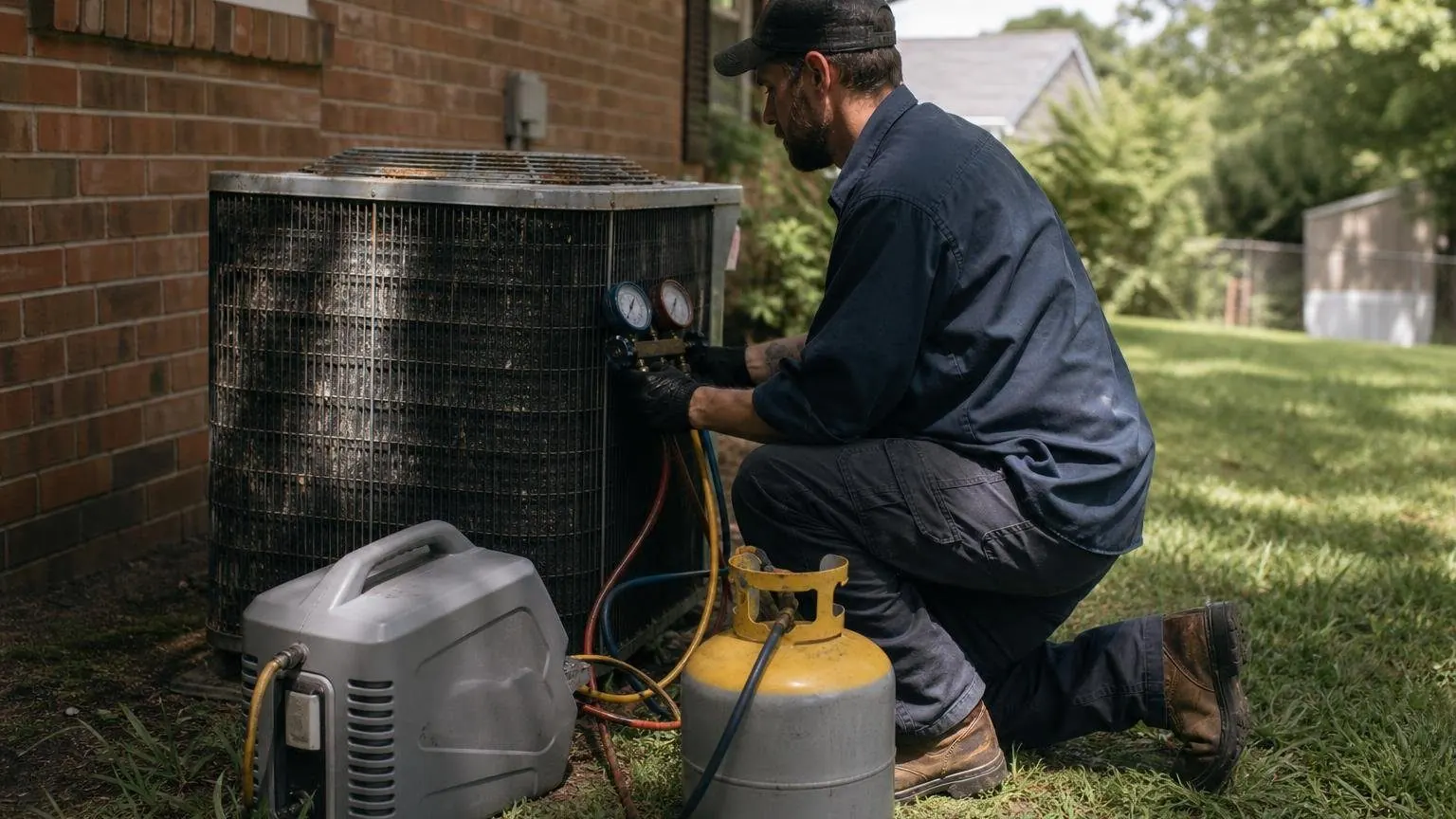
What is the best R22 replacement? There is no drop-in. EPA says every alternative needs component changes. Among blends that can keep mineral oil, R-427A and R-438A (MO99) post the smallest maker-reported capacity losses; R-407C matches capacity but needs POE oil, and R-410A is not approved for retrofit at all.
Key Takeaways
- EPA: “There are no ‘drop in’ replacements for HCFC-22,” and alternatives “will not work well without making changes to system components” (EPA homeowner FAQ).
- Chemours calorimeter data puts MO99 at 7% less capacity than R-22, R-422D at 8% and R-422B and R-421A at 12% (Chemours C-10846).
- Arkema rates R-427A at about 3% less capacity at a 45°F evaporator (Arkema 427A Q&A).
- R-407C matches R-22 capacity in Chemours cycle data but works only with POE oil and has an 8.9°F glide (Chemours 407C bulletin).
- EPA’s SNAP table lists R-410A for new residential AC only, with no retrofit listing (EPA SNAP).
- No blend may be used to top off R-22: recover the old charge first, then convert (Arkema retrofit guidelines).
Is there a drop-in R22 replacement?
No. EPA’s homeowner guidance says there are no drop-in replacements for HCFC-22 and that a retrofit is allowed only with a refrigerant found acceptable under its SNAP program. “Drop-in” survives as a sales term because some blends keep the existing mineral oil, which makes for a smaller job, not a no-change job.
The producers say the same thing in technical settings. A 2010 Arkema retrofit presentation, hosted on epa.gov, lists “None are ‘Drop-Ins’” and “None will work in every R-22 system.” Whether you can still buy R-22 itself is a separate question, covered in our guide to R-22 supply and legality.
How do the R22 replacement refrigerants compare?
All six blends below are listed as acceptable for retrofit in residential and light commercial AC on EPA’s SNAP table. The performance columns are maker data, and each maker tests under its own conditions, so treat cross-maker gaps of a few points as noise.
| Refrigerant (brand) | Makeup, weight % | Oil, per maker | Capacity vs R-22 | Efficiency vs R-22 | Glide | EPA GWP |
|---|---|---|---|---|---|---|
| R-438A (Freon MO99) | R-32/125/134a/600/601a, 8.5/45/44.2/1.7/0.6 | Mineral, AB or POE (Chemours) | 7% lower (Chemours) | COP 2% lower | 7°F | 2,270 |
| R-422D (MO29, Genetron 422D) | R-125/134a/600a, 65.1/31.5/3.4 | No oil change in most installs (Honeywell) | 8% lower (Chemours) | COP 4% lower | 5°F | 2,730 |
| R-422B (NU-22B) | R-125/134a/600a, 55/42/3 | “No oil change” group (Arkema, 2010) | 12% lower (Chemours) | COP 3% lower | 6°F | 2,530 |
| R-421A (Choice) | R-125/134a, 58/42 | POE change typically recommended (Chemours) | 12% lower (Chemours) | COP 5% lower | 6°F | 2,630 |
| R-427A (Forane 427A) | R-32/125/143a/134a | Mineral or AB; add 20% POE or switch where oil return is hard (Arkema) | About 3% lower at 45°F evaporator (Arkema) | Up to 3% lower (Arkema) | 9°, unit not stated (Arkema) | 2,140 |
| R-407C | R-32/125/134a, 23/25/52 | POE only (Chemours) | Equal in theoretical cycle (Chemours) | COP 6.27 vs 6.43 | 8.9°F | 1,770 |
Chemours figures in the first four rows are calorimeter results at AHRI Standard 540 conditions (45°F evaporator, 115°F condenser); the R-407C row is a Chemours theoretical cycle at a 45°F evaporator and 110°F condenser. The same Chemours table puts R-424A (RS-44) at 15% less capacity. EPA’s list also carries Bluon’s R-458A as a retrofit option at GWP 1,650; we could not open a Bluon data sheet, so it is not in the table.
Is R-407C a good replacement for R-22?
On performance, yes; on labor, it is the heaviest retrofit here. Chemours’ cycle comparison at a 45°F evaporator shows R-407C with the same capacity as R-22 and a COP of 6.27 against 6.43, and Chemours says it is compatible only with POE oil.
How much mineral oil must come out is where makers split. Honeywell’s retrofit sheet recommends a change to POE and says close-coupled AC needs at least 20% POE. Chemours, which sells the competing MO99, says most major compressor makers require removing more than 99% of the mineral oil. The compressor maker’s bulletin settles it, and our guide to POE and mineral oil explains why the two behave differently.
The 8.9°F glide changes how the system is read. Chemours says to use the dew point column for superheat and the bubble point column for subcooling, the method in our superheat and subcooling explainer.
Which R22 replacements keep the mineral oil?
MO99, R-422D, R-422B and R-427A are sold to run on existing mineral oil in many systems. Chemours says the small hydrocarbon share in MO99 dissolves in mineral oil, thinning it so it returns from cold evaporators. Every maker still lists exceptions:
- Chemours: add about 20% POE where oil return is difficult, such as a receiver with no oil separator or a complex line set, and change the sump oil in Trane 3-D and Danfoss SM scrolls.
- Arkema: add 20% POE or switch fully when the compressor sits more than 5 feet above the evaporator or the line set is long.
- Honeywell: R-422D’s mass flow is higher than R-22’s, so evaluate the expansion device.
Mass flow is the hidden variable. Chemours measures MO99 at 12% more mass flow than R-22 and R-422D at 32% more. Chemours says MO99 will likely work with an R-22 capillary tube but recommends a TXV for best results, while Arkema says R-427A rarely needs an expansion device change. Our TXV explainer covers how metering devices respond to a new refrigerant.
Can you top off R-22 with a different refrigerant?
No. Chemours states that MO99 “should not be used to top off R-22 systems,” and Arkema gives three reasons not to mix: the field mixture “is not SNAP approved,” it contaminates the R-22, and gauge readings may match neither pressure chart. EPA’s FAQ says a Section 608 certified technician should recover any remaining HCFC-22 before adding the alternative.
EPA also asks technicians to find and repair leaks instead of topping off. After a conversion, blends are charged as liquid. Arkema allows topping off a system already on R-427A, but if a large share has leaked it says to recover the rest and weigh in a new charge. Our explainer on the 2026 federal leak repair rules covers what applies to home systems.
Safety: R-22a is not R-22
EPA warns that R-22a has been falsely marketed as R-22 or a replacement. It is a hydrocarbon blend of flammable substances such as propane and butane, and EPA says it is not an acceptable alternative for a home AC system.
Can you put R-410A in an R-22 system?
No. EPA’s SNAP table lists R-410A for new equipment only, and EPA’s technician brochure says it “can be used in new, not retrofitted, residential air conditioners.” The pressure gap shows why.
On Arkema’s pressure chart, built from NIST REFPROP, R-410A saturates at 318.6 psig at 100°F against 195.9 psig for R-22, about 63% higher. At 45°F the figures are 130.6 and 76.1 psig. Moving to R-410A means new equipment, and new installs face their own limits, covered in whether R-410A can still be installed in 2026. Lower-GWP options such as R-290 refrigerant belong to new equipment, not R-22 retrofits.
Should you retrofit or replace an R-22 system?
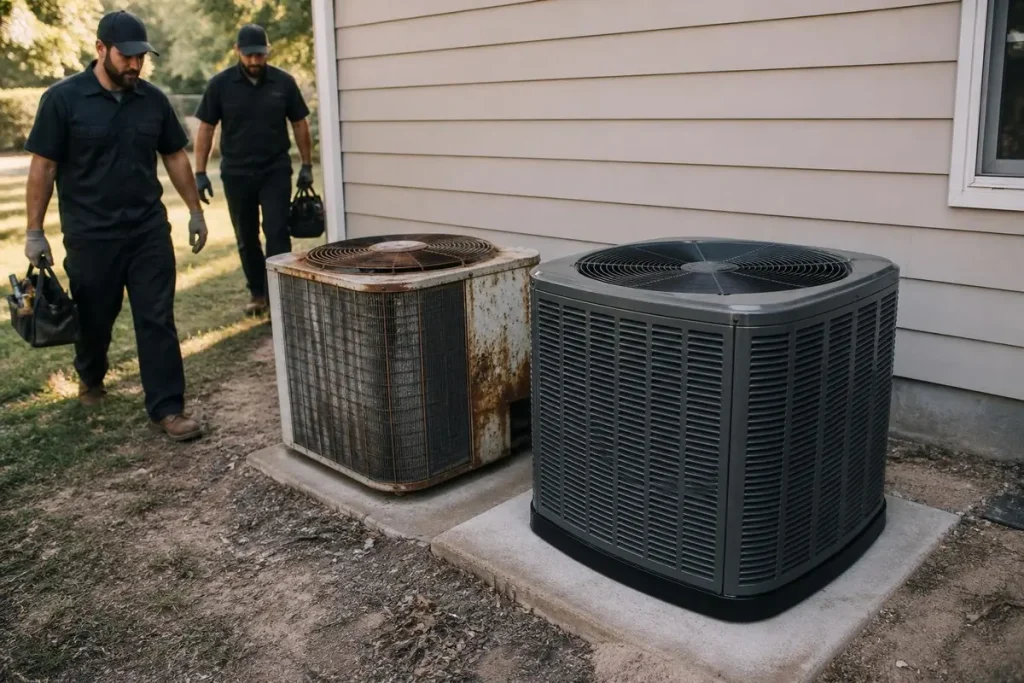
Retrofit only a system that already runs well, with the leak found and fixed. Arkema warns that systems not running properly on R-22 will most likely not perform any better on another refrigerant, and EPA notes equipment generally runs most efficiently on the refrigerant it was designed for.
Age is the other input. EPA’s brochure dates the ban on new HCFC-22 use, except servicing of existing equipment, to January 1, 2010, and EPA recommends a professional evaluation for any HVAC equipment more than 10 years old. Our repair or replace analysis works through that decision, and federal refrigerant price data shows what the gas side costs. If you retrofit, the Arkema and Chemours guides converge on this order:
- Record how the system runs on R-22: pressures, superheat, subcooling and amps.
- Recover the entire R-22 charge.
- Set the oil plan with the compressor maker, then replace the filter drier and critical seals such as Schrader cores.
- Evacuate to 500 microns and leak check.
- Charge liquid at about 90% of the R-22 weight, run 20 minutes, then trim to target superheat or subcooling.
How we researched this
On October 28, 2026 we opened EPA’s homeowner FAQ, its SNAP substitutes table (last updated March 19, 2026) and its technician brochure, plus producer documents from Chemours, Arkema and Honeywell. We consulted 17 government and producer documents and cite 10. Chemours documents are distributor-hosted copies because freon.com blocked automated access. Performance figures are maker data under each maker’s test conditions, not independent tests. Excluded: retailer and contractor guides with unsourced numbers, a Bluon FAQ we could not open, and all prices, because no federal series covers retrofit refrigerants. Questions came from Google’s People Also Ask box, not Reddit.
Frequently asked questions
Is R-407C a drop-in replacement for R-22?
No. Chemours says R-407C is compatible only with POE oil, so a mineral oil R-22 system needs an oil change, and Honeywell requires at least 20% POE even in close-coupled AC. EPA says no alternative works well without component changes.
Can I replace my R-22 with R-410A?
Not in the same equipment. EPA’s SNAP table lists R-410A for new systems only. At 100°F it runs at 318.6 psig against 195.9 psig for R-22 on Arkema’s chart, so switching to R-410A means installing new equipment designed for it.
Can R-134a replace R-22?
EPA’s SNAP table lists HFC-134a as acceptable for residential AC, including retrofit, but Arkema’s 2010 component data put its volumetric capacity 38% below R-22 at a 25°F evaporator and 105°F condenser. That gap makes it a poor match for a system sized on R-22.
Can I add refrigerant to my R-22 system myself?
No. EPA says Section 608 certification is required to recharge appliances, and refrigerant for stationary appliances is sold only to certified technicians or the companies that employ them. Venting refrigerant while servicing equipment is also illegal under the Clean Air Act.
Can I use my R-22 gauges on a MO99 system?
Yes, according to Chemours, because MO99 and R-22 have very similar pressure characteristics. Read the blend’s own pressure chart, though: Chemours lists a 7°F glide for MO99 in its calorimeter table, so superheat uses the dew point column and subcooling the bubble point column.
Will a retrofit void my equipment warranty?
It can. Chemours says not all equipment makers approve R-22 retrofit refrigerants and recommends asking the maker before converting. It also notes that on many systems old enough to be retrofitted, the original warranty has already expired.
Sources
- U.S. EPA. “Homeowners and Consumers: Frequently Asked Questions.” https://www.epa.gov/ods-phaseout/homeowners-and-consumers-frequently-asked-questions. Accessed October 2026.
- U.S. EPA. “Substitutes in Residential and Light Commercial Air Conditioning and Heat Pumps.” https://www.epa.gov/snap/substitutes-residential-and-light-commercial-air-conditioning-and-heat-pumps. Accessed October 2026.
- U.S. EPA. “What Technicians and Contractors Need to Know About Phasing Out HCFC Refrigerants” (EPA-430-F-09-081). https://www.epa.gov/sites/production/files/2015-07/documents/what_technicians_and_contractors_need_to_know_about_phasing_out_hcfc_refrigerants_to_protect_the_ozone_layer.pdf. Accessed October 2026.
- Arkema, hosted by U.S. EPA. “Choosing the Right R-22 Retrofit” (2010). https://www.epa.gov/sites/production/files/documents/Choosing_Right_R22_Retrofit.pdf. Accessed October 2026.
- Chemours. “Freon MO99 Refrigerant (R-438A) Frequently Asked Questions” (C-10846, 2016), distributor copy. https://www.firstsupply.com/UserFiles/Documents/inRiver/Original/191468_R-438A%20FAQ.pdf. Accessed October 2026.
- Chemours. “Freon 407C Informações de Produto” (2021, Portuguese). https://pages.chemours.com/rs/509-VCL-038/images/Freon_407C_boletim_tecnico.pdf. Accessed October 2026.
- Arkema. “Forane R22 to 427A Q&A Sheet” (2022). https://forane.arkema.com/files/live/sites/shared_arkema/files/downloads/fluorochemicals/forane-427a/Forane%20%20R22-427A%20Q%26A%20Sheet-1-2022.pdf. Accessed October 2026.
- Arkema. “Retrofitting R-22 Systems with Forane 427A Guidelines” (2022). https://forane.arkema.com/files/live/sites/shared_arkema/files/downloads/fluorochemicals/Forane%20Retrofit%20Guidelines-4-2022.pdf. Accessed October 2026.
- Arkema. “Retrofitting with Forane Refrigerants Quick Reference Guide” (2013). https://forane.arkema.com/files/live/sites/fluorogases_forane_arkema/files/downloads/literature/retrofitting-with-forane-refrigerants.pdf. Accessed October 2026.
- Honeywell. “Retrofitting R-22 Systems: Refrigerant Options” (G525-605, 2012), distributor copy. https://www.rhs1.com/Documents/Honeywell-R22-Retrofit-Options.pdf. Accessed October 2026.
Leave a Reply