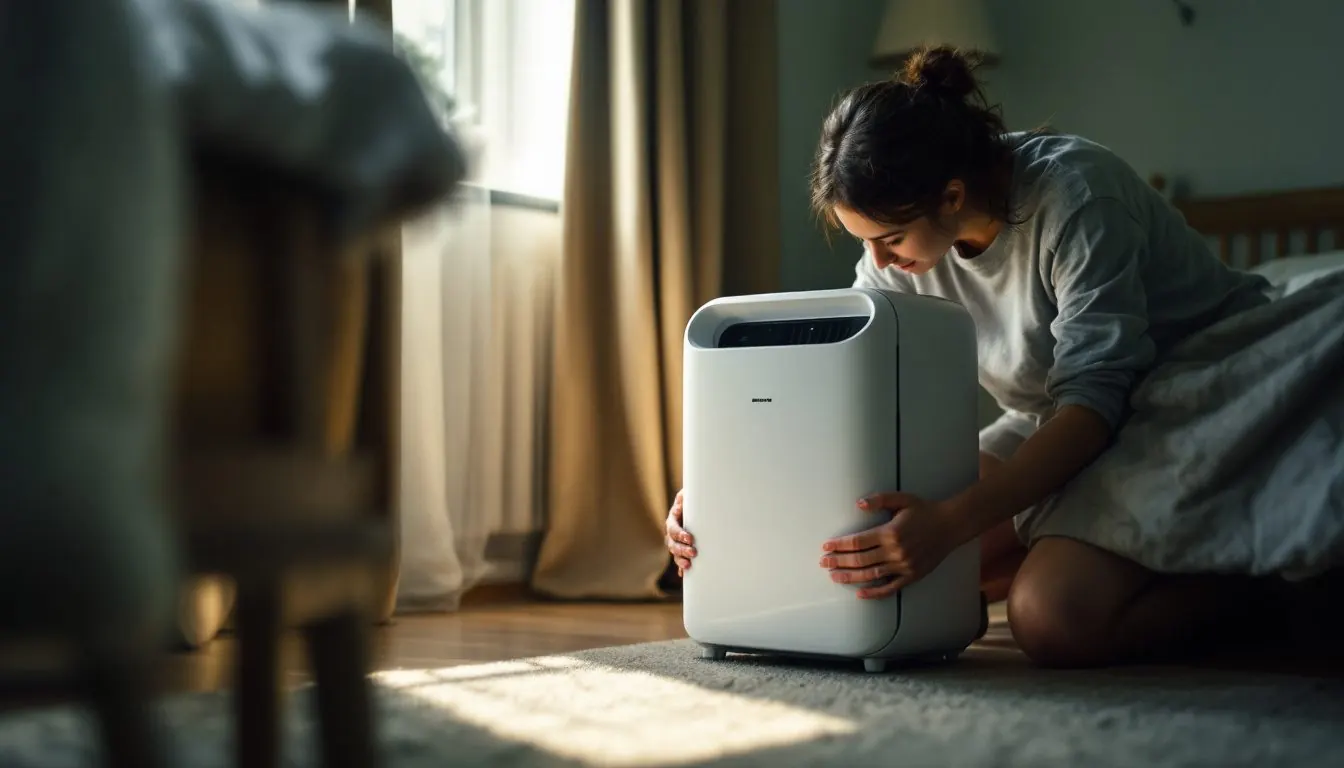
What does an air purifier do, and does it work? An air purifier pushes room air through a filter. Sized to the room, a HEPA unit cuts indoor particles by roughly half in home studies, but EPA rates the health gains as small, and it does little for gases without a thick carbon bed.
Key Takeaways
- Portable HEPA cleaners cut home particle exposure by roughly 50 percent or more in most studies (EPA, technical summary).
- A 2023 meta-analysis of 17 studies found real filtration lowered systolic blood pressure by 2.35 mmHg (Faridi et al.).
- A 225-child asthma trial saw 42 fewer unscheduled asthma visits but no significant change in reported symptoms (Lanphear et al., 2011).
- Size by smoke CADR of at least two-thirds of floor area: about 120 cfm for a 12 by 15 foot room (AHAM Verifide).
- Units built since December 31, 2025 must meet federal efficiency floors of 1.9 to 2.9 CADR per watt (10 CFR 430.32(ee)).
- California caps electronic air cleaner ozone at 0.050 ppm; certification does not rate cleaning (CARB).
What does an air purifier do, and what can it remove?
An air purifier, which EPA calls a portable air cleaner, is a fan that pulls room air through a filter, sometimes with a sorbent stage for gases. EPA’s Guide to Air Cleaners in the Home says these units filter a single room and “cannot remove all pollutants from the air.”
The clean air delivery rate (CADR) on the box covers particles only; EPA says no widely used rating exists for gas removal. Smoke, dust, pollen and dander are particles a HEPA stage handles well; formaldehyde and other volatile organic compounds from finishes and products need activated carbon, which works only with a large amount of media, “the thicker the better.” For dust on shelves, see our dusty house diagnosis.
Do air purifiers work? What the controlled trials show
For particles, yes. EPA’s technical summary reports that most home studies of portable HEPA cleaners cut particle exposure by “approximately 50 percent or higher.” Health gains are small: EPA says they “were typically modest.”
| Study | Who and where | Particle reduction | Health result |
|---|---|---|---|
| Lanphear et al., 2011 | 225 children with asthma, smoking homes, double-blind | 25% (particles over 0.3 µm) vs 5% in controls | 42 fewer unscheduled asthma visits; reported symptoms unchanged |
| Faridi et al., 2023 meta-analysis | 17 studies, about 880 people, true vs sham filtration | 59.8% mean PM2.5 efficiency (23% to 82%) | Systolic pressure down 2.35 mmHg; diastolic change not significant |
| Allen et al., 2011 (EPA summary) | 45 adults, wood smoke area, Canada | 60% mean PM2.5 | C-reactive protein down 32.6%; endothelial function up 9.4% |
| Sulser et al., 2009 (EPA summary) | 30 children with asthma sensitized to cats or dogs | No change in allergen in house dust | No significant change in lung function or medication use |
In the Lanphear trial, 215 of 225 children finished, and its authors said routine medical use needs more research. EPA’s 2018 table lists the visit drop as 25 percent; the abstract gives 18.5 percent for visits and 25 percent for particles, and we use the abstract.
The Faridi meta-analysis found the systolic benefit grew to 3.62 mmHg after dropping studies at high risk of bias. EPA’s consumer guide answers its health and allergy questions with one word: “Possibly.”
Which air purifier technologies work, and which make byproducts?
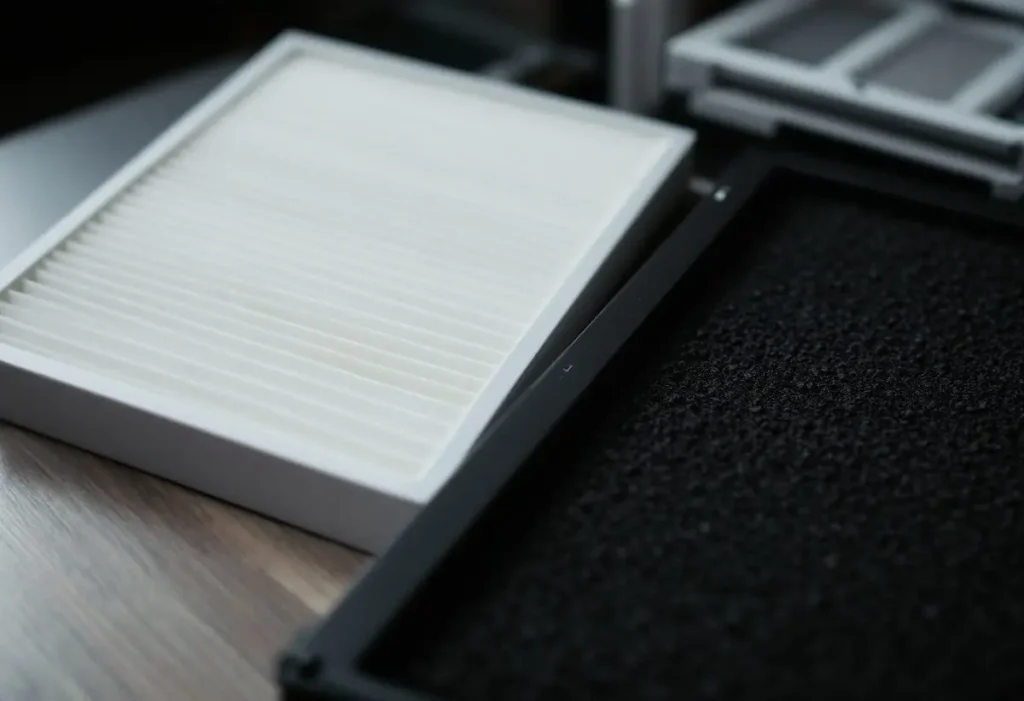
HEPA filters and activated carbon are the two technologies EPA describes without byproducts. Ionizers, electrostatic precipitators, photocatalytic oxidation (PCO), plasma and uncoated UV lamps can emit ozone or other byproducts.
| Technology | Targets | What EPA reports | Byproduct risk |
|---|---|---|---|
| HEPA filter | Particles | At least 99.97% at 0.3 µm; common route to a high CADR | None from the filter; used filters can smell |
| Activated carbon | Gases | Works with enough media; capacity runs out | No byproduct formation |
| Ionizer | Particles | Typically low effectiveness from very low CADR | Generates ozone |
| Electrostatic precipitator | Particles | Can remove many sizes; efficiency falls as plates load | Sometimes high ozone and nitrogen oxides |
| PCO | Gases | Often low removal for many indoor gases | Formaldehyde, acetaldehyde, ozone |
| UV lamp (UVGI) | Microbes | Inactivates but does not remove; home lamp intensity typically low | Uncoated lamps can make ozone |
| Ozone generator | Gases | No federal agency approves use in occupied spaces | High ozone output |
EPA’s review found no studies that “systematically investigated” whether sorbent, PCO, plasma or ionizer cleaners improve occupant health in homes. See our pages on the whole-house electronic air cleaner and bipolar ionization claims.
In-duct lamps are covered in our look at UV lights sold for HVAC systems, and ozone machines in our ozone generator evidence review.
What size air purifier do you need? A worked 12 by 15 foot example
AHAM’s rule is a smoke CADR of at least two-thirds of the floor area in square feet, about 5 air changes per hour at an 8 foot ceiling. A 12 by 15 foot bedroom needs about 120 cfm.
- Floor area: 12 x 15 = 180 square feet.
- Two-thirds rule: 180 x 2/3 = 120 cfm of smoke CADR. EPA’s chart ratio of 65 cfm per 100 square feet gives 117 cfm.
- Room volume: 180 x 8 = 1,440 cubic feet.
- Air changes: 120 cfm x 60 / 1,440 = 5.0 ACH. AHAM Verifide sizes rooms at 4.8 ACH, which here means 1,440 x 4.8 / 60 = 115.2 cfm.
- Adjust: for wildfire smoke, AHAM recommends a smoke CADR equal to the floor area, 180 cfm or 7.5 ACH. With a 10 foot ceiling the volume is 1,800 cubic feet, and 4.8 ACH needs 144 cfm.
The same math drives our air changes per hour calculator and applies to a homemade Corsi-Rosenthal box. EPA says the AHAM room size targets an 80 percent reduction in particle levels at equilibrium, and CADR is measured at the highest speed, so a unit on low delivers less.
| Room area (sq ft) | Minimum CADR, 8 ft ceiling (cfm) |
|---|---|
| 100 | 65 |
| 200 | 130 |
| 300 | 195 |
| 400 | 260 |
| 500 | 325 |
| 600 | 390 |
What do HEPA, CADR, ENERGY STAR and CARB labels certify on an air purifier?
Each label certifies one thing: HEPA is filter efficiency, CADR is particle delivery, ENERGY STAR is energy use, and CARB is electrical safety plus an ozone cap. Neither ENERGY STAR nor CARB rates cleaning.
Correction: 0.3 micron is not a size cutoff
AHAM’s consumer page says HEPA filters remove 99.97 percent of pollutants “0.3 microns or larger.” EPA explains that 0.3 microns is the most penetrating particle size, the worst case, and that “particles that are larger or smaller are trapped with even higher efficiency.”
EPA’s guide says the ENERGY STAR label “does not refer to its air-cleaning effectiveness in any way.” CARB says its certification “does not reflect air cleaner effectiveness.” Furnace filters use a different scale, explained in our MERV rating guide; EPA says MERV 13 and above must show at least 50 percent removal of the smallest particles tested.
How much electricity does an air purifier use?
A standard room air cleaner running nonstop uses about 394 kWh a year, according to ENERGY STAR. At EIA’s August 2026 US residential average of 18.16 cents per kWh, that is about $71.55 a year; certified models save about 211 kWh, or $38.32.
Under 10 CFR 430.32(ee), room air cleaners rated 10 to 600 cfm and made on or after December 31, 2025 must meet a minimum integrated energy factor (IEF) in PM2.5 CADR per watt. ENERGY STAR’s criteria, effective October 9, 2025, set higher floors and a 50 ppb ozone limit.
| PM2.5 CADR bin | Federal minimum IEF | ENERGY STAR minimum smoke IEF |
|---|---|---|
| Under 100 cfm | 1.9 (from 10 cfm) | 4.4 (from 30 cfm) |
| 100 to under 150 cfm | 2.4 | 5.4 |
| 150 cfm and up | 2.9 | 5.6 |
For a unit with 120 cfm of PM2.5 CADR, the federal 2.4 floor works out to about 50 watts and the ENERGY STAR floor to about 22, rough ceilings because IEF includes standby power. The price is from EIA Table 5.6.A; your rate will differ.
Where should you put an air purifier, and how long should it run?
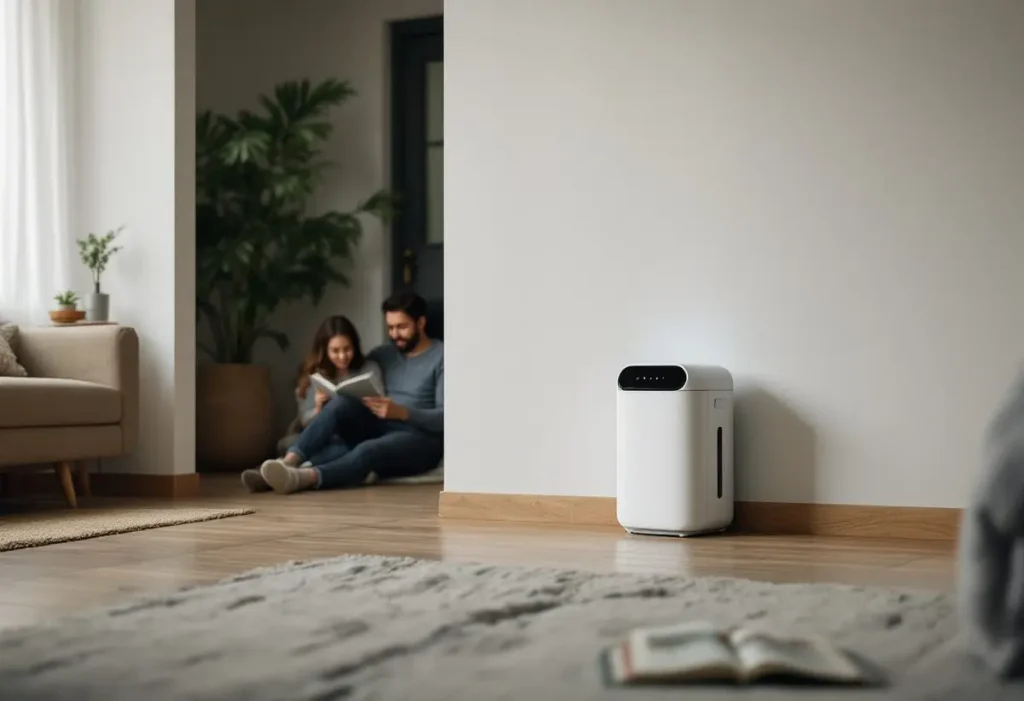
Put it where people spend the most time, usually a bedroom, clear of curtains, and run it as long and fast as you can tolerate. EPA says higher fan speeds and longer run times both filter more air.
Noise gets units switched off: occupants in the Sulser trial cited it for turning cleaners off at night, and EPA puts a 50 decibel rating near a modern refrigerator. Replace filters on schedule.
A PM2.5 air quality monitor shows whether the unit moves the numbers. EPA says filtration “does not replace the need to control pollutants and ventilate,” which our page on indoor CO2 levels covers.
How we researched this
On October 31, 2026 we read EPA’s air cleaner guide and 3rd edition technical summary in full, EPA’s HEPA page, three AHAM Verifide pages, two ENERGY STAR pages, 10 CFR 430.32(ee), CARB’s certification page, EIA Table 5.6.A and the Lanphear and Faridi abstracts, plus the top three ranking articles. Allen and Sulser figures come from EPA’s summary. Maker claims and retail price surveys were excluded; Reddit was skipped because this is a health topic.
Frequently asked questions
Do air purifiers help with allergies?
Sometimes, and modestly. EPA says several portable HEPA studies found improvement in one or more allergy or asthma symptoms, but not in all. In one trial EPA summarizes, 30 children with pet allergies showed no significant change in lung function or medication use.
Do air purifiers remove odors and VOCs?
Only with a gas filter. CADR covers particles only. Activated carbon can work when the filter holds a large amount of media, and EPA says research has not shown that plasma, PCO or UV light remove gases effectively in portable home units.
What size air purifier do I need for wildfire smoke?
Go bigger. AHAM recommends a smoke CADR equal to the floor area for wildfire smoke, against two-thirds for everyday use. A 12 by 15 foot room then needs 180 cfm instead of 120, about 7.5 air changes per hour at an 8 foot ceiling.
Should an air purifier run all the time?
For steady particle control, yes; EPA says longer run times filter more air. ENERGY STAR puts a standard unit running nonstop at about 394 kWh a year, about $71.55 at EIA’s August 2026 residential average of 18.16 cents per kWh.
Are ionizer air purifiers safe?
Choose with care. EPA lists ozone as an ionizer byproduct and rates their effectiveness typically low because of very low CADR. California requires electronic air cleaners sold there to meet a 0.050 ppm ozone limit, so a CARB-certified model is the safer pick.
Will an air purifier fix a mold problem?
No. EPA says portable air cleaners do not address the cause of mold, which is moisture in the building. They may catch some mold particles and odors, but the fix is removing the moisture source and cleaning up the growth.
Is an air purifier better than a MERV 13 furnace filter?
They do different jobs. EPA notes HVAC systems usually run less than 25% of the time in heating and cooling seasons, and a furnace filter cleans only while the fan runs. EPA recommends MERV 13 or the highest rating your system can accept.
Sources
- US EPA. “Guide to Air Cleaners in the Home, 2nd edition.” https://www.epa.gov/sites/default/files/2018-07/documents/guide_to_air_cleaners_in_the_home_2nd_edition.pdf. Accessed October 2026.
- US EPA. “Residential Air Cleaners: A Technical Summary, 3rd edition.” https://www.epa.gov/sites/default/files/2018-07/documents/residential_air_cleaners_-_a_technical_summary_3rd_edition.pdf. Accessed October 2026.
- US EPA. “What is a HEPA filter?” https://www.epa.gov/indoor-air-quality-iaq/what-hepa-filter. Accessed October 2026.
- Lanphear BP et al. “Effects of HEPA air cleaners on unscheduled asthma visits.” Pediatrics (2011). https://pubmed.ncbi.nlm.nih.gov/21149427/. Accessed October 2026.
- Faridi S et al. “Portable air cleaners and blood pressure: meta-analysis.” Ecotoxicology and Environmental Safety (2023). https://pubmed.ncbi.nlm.nih.gov/37421892/. Accessed October 2026.
- AHAM Verifide. “Air Filtration Standards.” https://ahamverifide.org/ahams-air-filtration-standards/. Accessed October 2026.
- AHAM Verifide. “Air Changes per Hour FAQ.” https://ahamverifide.org/ach-faq/. Accessed October 2026.
- AHAM Verifide. “About Air Cleaners.” https://ahamverifide.org/about-air-cleaners/. Accessed October 2026.
- ENERGY STAR. “Air Cleaners.” https://www.energystar.gov/products/air_purifiers_cleaners. Accessed October 2026.
- ENERGY STAR. “Room Air Cleaners Key Product Criteria.” https://www.energystar.gov/products/air_purifiers_cleaners/key_product_criteria. Accessed October 2026.
- US DOE. “10 CFR 430.32(ee) Energy conservation standards: air cleaners.” https://www.ecfr.gov/current/title-10/section-430.32. Accessed October 2026.
- California Air Resources Board. “List of CARB-Certified Air Cleaning Devices.” https://ww2.arb.ca.gov/our-work/programs/air-cleaners-ozone-products/california-certified-air-cleaning-devices. Accessed October 2026.
- US EIA. “Electric Power Monthly, Table 5.6.A.” https://www.eia.gov/electricity/monthly/epm_table_grapher.php?t=epmt_5_6_a. Accessed October 2026.
Leave a Reply