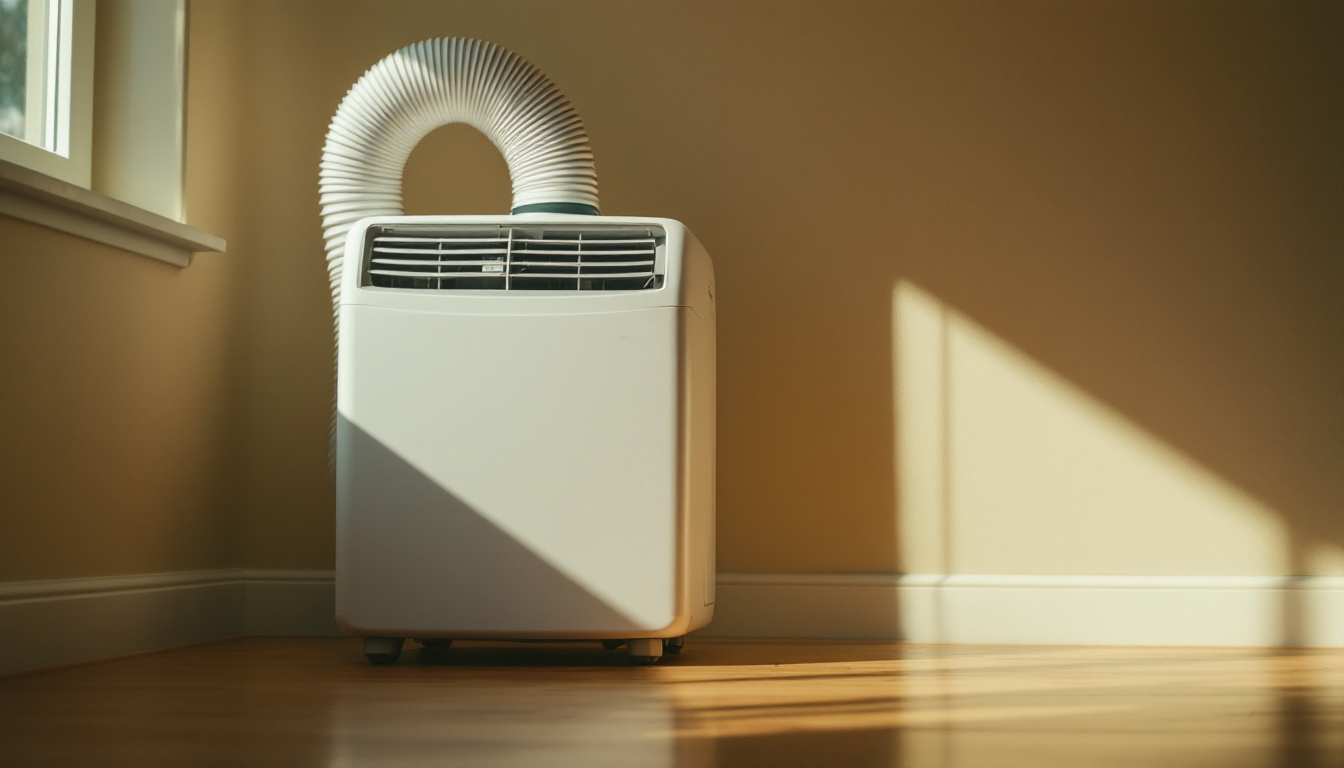
Does a portable air conditioner without hose exhaust actually cool a room? No. Every refrigerant air conditioner moves heat, so it needs a hose or duct to push that heat outdoors. Units sold as “ventless” or “hoseless” are evaporative coolers or fans, which add moisture instead of removing heat.
Key Takeaways
- An air conditioner works by transferring heat from inside the home to the outside through its condenser coil (DOE Energy Saver, archived copy).
- DOE says refrigerant units that blow condenser heat back into the room “do not provide net cooling to a space” (88 FR 31107, 2023).
- Portable air conditioners made on or after January 10, 2025 must meet the federal efficiency floor in 10 CFR 430.32(cc).
- DOE says portable evaporative coolers on wheels “provide only a slight cooling effect” (archived copy).
- EPA advises keeping indoor humidity below 60 percent, ideally 30 to 50 percent.
- In 2020, 2.68 million US homes cooled mainly with a portable air conditioner and 0.95 million with an evaporative cooler (EIA RECS table HC7.9).
Can a portable air conditioner work without a hose?
A portable air conditioner without hose exhaust cannot cool a closed room, because the heat it removes from the air has nowhere to go but back into that room. The hose is the path that carries that heat, plus the heat from the compressor motor, outdoors.
Search results for “ventless” split into two products: refrigerant units that still need an exhaust path, and evaporative coolers or fans that never remove heat. If your hosed unit struggles, the hose design is the usual culprit, covered in our look at why single-hose portables lose capacity.
Where does the heat go in a portable air conditioner?
The heat goes out the exhaust hose. DOE’s Energy Saver guidance explains that a cold evaporator coil absorbs heat from indoor air and a hot condenser coil “releases the absorbed heat outside” (archived copy).
A window unit keeps its condenser outdoors. A portable puts both coils in one box on your floor, so the duct is the only way out for the heat, the same condenser job described in our explainer on what an AC condenser does.
If condenser air blows back into the room, the room gains that heat plus the electricity the unit used. DOE’s May 15, 2023 test procedure rule described “spot coolers” as configurations “that do not provide net cooling to a space, but rather move heat from one area to another in a space (i.e., they reject the heated condenser air to the cooled space)” (88 FR 31102, page 31107).
What are hoseless portable air conditioners actually selling?
Most products marketed as a hoseless or ventless portable air conditioner are evaporative coolers: a fan, a water reservoir and a wetted pad. Some are fans with an ice tray. Neither has a compressor and refrigerant.
That matters legally too. Under 10 CFR 430.2, a portable air conditioner “includes a source of refrigeration.” A pad and a fan are not one.
| Product type | How it cools | Where the heat goes | Federal status |
|---|---|---|---|
| Single-duct portable AC | Refrigerant cycle | Out one window duct | Defined in 10 CFR 430.2 |
| Dual-duct portable AC | Refrigerant cycle | Out a window duct; some or all intake air from outside | Defined in 10 CFR 430.2 |
| Spot cooler | Refrigerant cycle | Back into the same space | Not covered by the portable AC test procedure (DOE, 2023) |
| Portable evaporative cooler | Water evaporating off a pad | Stays in the room, plus added moisture | No refrigeration source |
| Fan with ice or water tank | Air moving over skin | Stays in the room | No refrigeration source |
Myth: “ventless AC”
No refrigerant air conditioner cools a closed room without exhausting heat somewhere. Both federal portable AC definitions describe condenser air discharged “outside the conditioned space” through a duct on an adjustable window bracket.
What does DOE count as a portable air conditioner without a hose?
DOE has no hoseless category. Its single-duct and dual-duct definitions both require a window duct, and its test procedure subtracts heat gained through the duct and through outside air drawn into the room.
The standard in 10 CFR 430.32(cc) covers units “manufactured on or after January 10, 2025,” setting a minimum combined energy efficiency ratio (CEER) that scales with capacity. Capacity means seasonally adjusted cooling capacity (SACC), which Appendix CC to Subpart B of Part 430 defines as “the amount of cooling provided to the indoor conditioned space, measured under the specified ambient conditions, in Btu/h.”
The test holds indoor air at 80°F dry bulb and 67°F wet bulb. For single-speed units, SACC weights a 95°F outdoor condition by 0.2 and an 83°F condition by 0.8. Room units follow a separate rule, explained in our note on the new window AC efficiency minimums.
One caveat: on May 16, 2025, DOE proposed withdrawing portable ACs’ covered product status (90 FR 20876), with comments due July 15, 2025. In eCFR text current through September 15, 2026, the standard remains in the regulation.
When does a hoseless evaporative cooler actually help?
Only in dry air, and only a little. DOE says evaporative coolers “are only suitable for areas with low humidity,” and portable units on wheels “provide only a slight cooling effect and are limited by the humidity within your home” (archived copy).
The larger drop DOE cites, “15° to 40°F,” describes outdoor air pulled over wet pads while windows stay partly open so warm air escapes. That whole-house setup is covered in our guide to where swamp coolers work. A small unit in a closed bedroom has no such exit, so its moisture stays put.
Why can a portable air conditioner without a hose make a humid room worse?
In a humid room, an evaporative unit trades a small temperature drop for more moisture. DOE says evaporative coolers “should not be used in humid climates because they add humidity to the air in your home” (archived copy).
EPA recommends keeping indoor humidity “below 60 percent (ideally between 30 and 50 percent) relative humidity.” DOE’s hot, humid climate guidance adds that without adequate dehumidification “the air will feel uncomfortably damp even if the temperature is cool,” the same effect behind a house that feels cold but humid.
What are the real alternatives to a portable air conditioner without a hose?
The real alternatives send heat outdoors by design: a ducted portable, a window unit, a through-the-wall unit or a ductless mini split. If a window will not take a hose kit, the fix is a different exhaust path.
| Option | Heat exhaust path | Best fit | Main limit |
|---|---|---|---|
| Dual-duct portable AC | Window bracket, two ducts | Renters | Bulky window kit |
| Window AC | Condenser side outdoors | Rooms with a usable window | Blocks part of the window |
| Through-the-wall AC | Condenser side through a wall sleeve | Rooms where the window is unusable | Wall opening, subject to local code and lease terms |
| Ductless mini split | Separate outdoor unit | Long-term cooling | Line set and electrical work |
| Ceiling fan | None; cools people, not air | Mild weather or with an AC | Does not lower room temperature |
Where the window is the obstacle, a through-the-wall air conditioner keeps the condenser outside. For a permanent fix, a ductless mini split puts it in a separate outdoor unit.
Fans help alongside any of these. DOE’s fan guidance says a ceiling fan lets you raise the thermostat setting by about 4°F without reducing comfort. Size the room first with our BTU sizing lookup, or compare the main types of air conditioning for a bigger change.
How can you tell if a portable air conditioner needs a hose?
A real portable air conditioner lists a refrigerant, a compressor and a window kit. A water tank, ice packs or a cooling pad mean an evaporative cooler or fan. A cheap hoseless box saves nothing if it cools nothing, as our look at what air conditioning costs to run makes clear.
- Find the refrigerant type on the spec sheet or nameplate.
- Confirm a window kit and exhaust duct are in the box.
- Look for an SACC rating in Btu/h, which DOE’s test produces.
- Treat “add water” or “add ice” instructions as evaporative, and check room humidity first.
How we researched this
We consulted 15 sources and cited 11. Regulatory text came from eCFR (10 CFR 430.2, 430.32(cc) and Appendix CC, current through September 15, 2026) and the Federal Register rules of May 15, 2023 and May 16, 2025. Guidance came from archived DOE Energy Saver pages and EPA; household counts from EIA’s 2020 RECS, released March 2023.
Excluded: “ventless” product marketing, retailer listings and contractor blogs, none of which is primary data. We found no final action on the 2025 withdrawal proposal. A Reddit search returned no usable threads, so none was used. Research date: September 17, 2026.
Frequently asked questions
Is there a portable air conditioner with no vent at all?
Not one that cools a closed room. DOE’s 2023 test procedure rule says refrigerant units that reject condenser air into the cooled space “do not provide net cooling to a space.” Both federal portable AC definitions in 10 CFR 430.2 describe a duct attached to an adjustable window bracket.
Do ventless portable air conditioners work?
Products sold as ventless are usually evaporative coolers, and they work only in dry air. DOE says portable evaporative coolers on wheels “provide only a slight cooling effect and are limited by the humidity within your home.” In a humid room they add moisture.
Can I run a portable AC without the hose attached?
It will run, but the room will not cool. DOE explains that the condenser coil “releases the absorbed heat outside.” Without the hose, that heat and the compressor’s electricity stay in the room you are trying to cool, so the room ends up warmer overall.
What humidity is too high for an evaporative cooler?
DOE publishes no single cutoff but says evaporative coolers “are only suitable for areas with low humidity.” EPA recommends indoor humidity below 60 percent, ideally 30 to 50 percent. A room that already reads near 60 percent on a hygrometer is a poor fit for any cooler that works by evaporating water.
What is SACC on a portable air conditioner?
SACC is seasonally adjusted cooling capacity, which DOE’s Appendix CC defines as “the amount of cooling provided to the indoor conditioned space, measured under the specified ambient conditions, in Btu/h.” Single-speed units weight a 95°F test by 0.2 and an 83°F test by 0.8.
Are portable air conditioners still federally regulated?
Yes, as of September 2026. The eCFR text of 10 CFR 430.32(cc) still covers units made on or after January 10, 2025. DOE proposed withdrawing portable ACs’ covered product status on May 16, 2025, and we found no final action.
Sources
- U.S. Department of Energy. “Air Conditioning” (Energy Saver, archived copy). https://web.archive.org/web/2025id_/https://www.energy.gov/energysaver/air-conditioning. Accessed September 2026.
- U.S. Department of Energy. “Energy Conservation Program: Test Procedure for Portable Air Conditioners,” 88 FR 31102. https://www.federalregister.gov/documents/2023/05/15/2023-09755/energy-conservation-program-test-procedure-for-portable-air-conditioners. Accessed September 2026.
- eCFR. “10 CFR 430.32 Energy and water conservation standards and their compliance dates.” https://www.ecfr.gov/current/title-10/chapter-II/subchapter-D/part-430/subpart-C/section-430.32. Accessed September 2026.
- eCFR. “10 CFR 430.2 Definitions.” https://www.ecfr.gov/current/title-10/chapter-II/subchapter-D/part-430/subpart-A/section-430.2. Accessed September 2026.
- eCFR. “Appendix CC to Subpart B of Part 430, Uniform Test Method for Measuring the Energy Consumption of Portable Air Conditioners.” https://www.ecfr.gov/current/title-10/chapter-II/subchapter-D/part-430/subpart-B/appendix-Appendix%20CC%20to%20Subpart%20B%20of%20Part%20430. Accessed September 2026.
- U.S. Department of Energy. “Energy Conservation Program: Proposed Withdrawal of Determination of Portable Air Conditioners as a Covered Consumer Product,” 90 FR 20876. https://www.federalregister.gov/documents/2025/05/16/2025-08577/energy-conservation-program-proposed-withdrawal-of-determination-of-portable-air-conditioners-as-a. Accessed September 2026.
- U.S. Department of Energy. “Evaporative Coolers” (Energy Saver, archived copy). https://web.archive.org/web/2025id_/https://www.energy.gov/energysaver/evaporative-coolers. Accessed September 2026.
- U.S. Environmental Protection Agency. “A Brief Guide to Mold, Moisture and Your Home.” https://www.epa.gov/mold/brief-guide-mold-moisture-and-your-home. Accessed September 2026.
- U.S. Department of Energy. “Efficient Cooling for Hot, Humid Climates” (Energy Saver, archived copy). https://web.archive.org/web/2025id_/https://www.energy.gov/energysaver/efficient-cooling-hot-humid-climates. Accessed September 2026.
- U.S. Department of Energy. “Fans for Cooling” (Energy Saver, archived copy). https://web.archive.org/web/2025id_/https://www.energy.gov/energysaver/fans-cooling. Accessed September 2026.
- U.S. Energy Information Administration. “Table HC7.9 Air conditioning in U.S. homes, by home size, 2020.” https://www.eia.gov/consumption/residential/data/2020/hc/pdf/HC%207.9.pdf. Accessed September 2026.
Leave a Reply