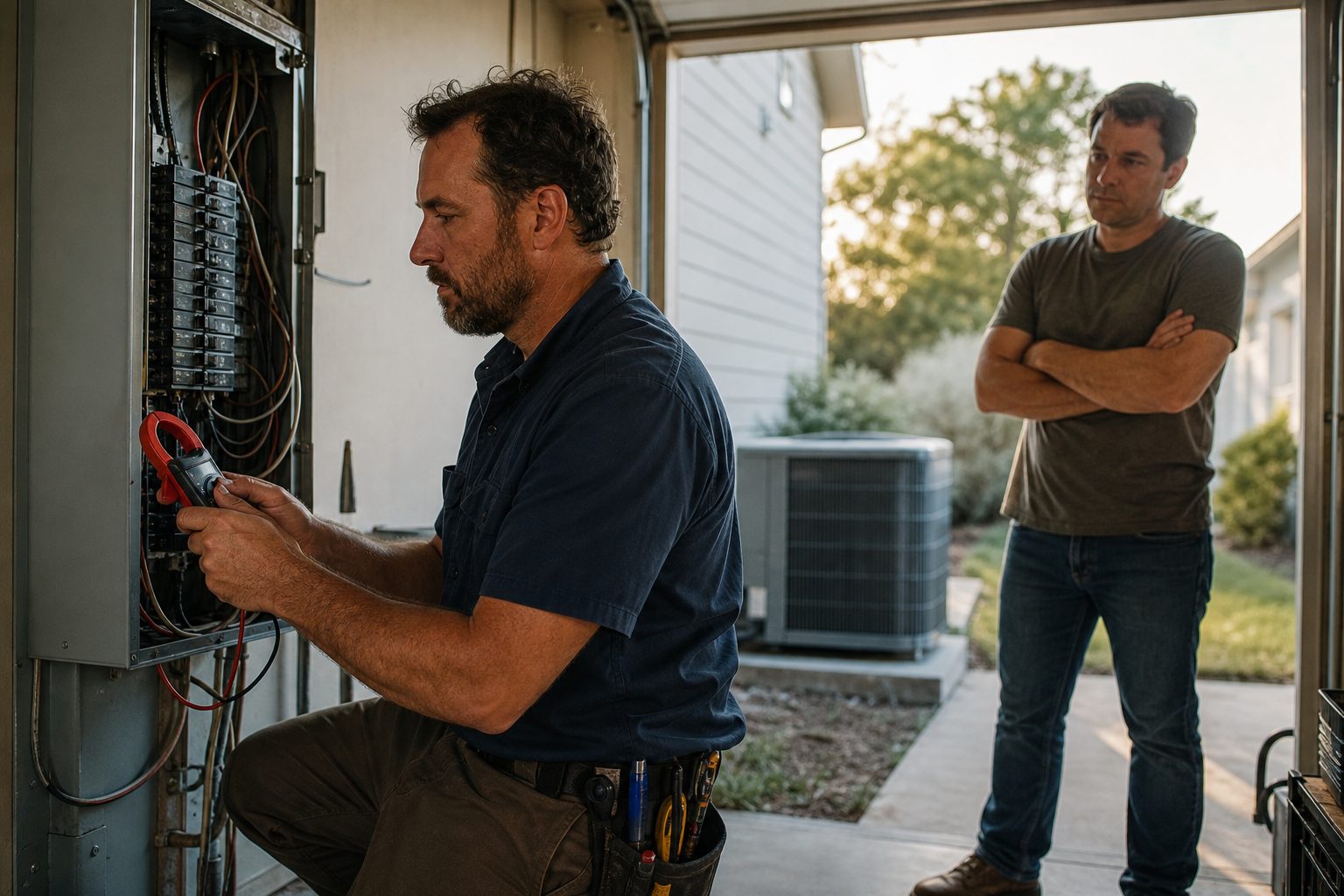
How many watts does an air conditioner use? A certified 8,000 Btu/h window air conditioner draws about 533 watts, and a 3 ton central split system about 3,077 watts while cooling. Both are our arithmetic from federally certified ratings.
Key Takeaways
- The median certified 8,000 Btu/h room air conditioner posts a CEER of 15.0: about 533 running watts, or 4.6 amps at 115 volts (our arithmetic from the ENERGY STAR room air conditioner list, 515 models).
- The median 3 ton ducted split heat pump posts an EER2 of 11.7: about 3,077 watts and 12.8 amps at 240 volts, across 9,710 certified models.
- A gas furnace fan in the largest product class may not exceed a fan energy rating of 0.044 times maximum airflow plus 182 watts per 1,000 cfm under 10 CFR 430.32(y).
- Households that cool used 7.9 million Btu each for cooling in 2020, about 2,315 kWh, per EIA RECS 2020 Table CE3.1.
- Residential electricity averaged 18.34 cents per kWh in June 2026, against 17.47 cents a year earlier, per EIA Electric Power Monthly.
- A motor can need 100 to 300 percent more power to start than to run, per the DOE Building America Solution Center.
- Variable speed compressors account for 159,914 of 284,057 certified heat pump records, or 56 percent.
How many watts does an air conditioner use?
An air conditioner uses roughly 350 to 3,900 watts while running, depending on capacity and efficiency. The spread is wide because a 5,000 Btu/h bedroom unit and a 5 ton central system are both air conditioners.
Every running figure here is derived the same way: certified cooling capacity in Btu per hour divided by certified efficiency in Btu per watt hour. That division is our arithmetic. Federal programs publish capacity and efficiency, not watts, so any watt figure for a class of equipment came from this division somewhere.
Watts, amps and volts: what is the arithmetic?
Watts measure power, amps measure current, volts measure electrical pressure. For a resistive load the three are linked by watts equals volts times amps. The Department of Energy uses that form in its Building America Solution Center guidance, where a refrigerator listed at 3.5 amps on 120 volts is described as drawing about 420 watts.
Motors complicate it. A compressor is an inductive load, so the true relationship is watts equals volts times amps times power factor, and power factor on a running compressor sits below 1. Dividing watts by volts therefore understates the amps a clamp meter reads. We show the unity power factor result because that is what certified data supports, and we flag it rather than hide it.
Voltage matters as much as wattage. The same 3,077 watt system pulls 12.8 amps at 240 volts and would pull 25.3 amps at 120 volts, which is why central equipment is wired at 240 volts and small single zone ductless systems can live on a 120 volt branch circuit.
How many watts does an air conditioner use next to other HVAC equipment?
The table gives running watts for eight classes of home HVAC equipment, with the amps that follow at each class’s usual voltage. Efficiency figures are medians. Amps are watts divided by volts at unity power factor, so treat them as a floor, not a meter reading.
| Equipment class | Running watts | Amps at volts | Source of the row |
|---|---|---|---|
| Window air conditioner, 8,000 Btu/h | 533 W | 4.6 A at 115 V | ENERGY STAR room AC list, CEER 15.0, 108 models |
| Window air conditioner, 12,000 Btu/h | 800 W | 7.0 A at 115 V | ENERGY STAR room AC list, CEER 15.0, 130 models |
| Window air conditioner, general band | 500 to 1,000 W | 4.3 to 8.7 A at 115 V | DOE Building America Solution Center |
| Ductless mini split, 12,000 Btu/h | 945 W | 7.9 A at 120 V | ENERGY STAR heat pump list, EER2 12.7, 395 models |
| Central split system, 2 ton | 1,920 W | 8.0 A at 240 V | ENERGY STAR heat pump list, EER2 12.5, 18,421 models |
| Central split system, 3 ton | 3,077 W | 12.8 A at 240 V | ENERGY STAR heat pump list, EER2 11.7, 9,710 models |
| Gas furnace fan, 1,200 cfm maximum airflow | 282 W ceiling | 2.3 A at 120 V | 10 CFR 430.32(y), NWG-NC class |
| Portable dehumidifier, 29 pints per day | 287 W | 2.4 A at 120 V | ENERGY STAR dehumidifier list, IEF 2.01 L/kWh, 526 models |
Two rows deserve a note. The DOE window unit band is a stated range, not a derivation, and it brackets our derived rows. The furnace fan row is a legal ceiling, because the standard caps the fan energy rating, not the wattage. The airflow per ton convention explains where 1,200 cfm comes from.
Certified room air conditioners run mostly on 115 volt cords, 417 of 515 models, with 94 at 230 volts. That split is why a large window unit can need its own receptacle, covered in our guide to powering a window unit. Dehumidifier sizing matters more than its wattage.
How many amps does an air conditioner use when the compressor starts?
Several times its running draw. A compressor motor pulls its heaviest current in the instant before the rotor turns, when no back electromotive force limits it. The Department of Energy’s Building America Solution Center puts the penalty plainly: a motor “often needs 100% to 300% more power to start than the average demand indicated using the listed maximum amperage.”
The nameplate value for that surge is locked rotor amperes. Keith Lofland of the International Association of Electrical Inspectors defines LRA as “the maximum current flowing to the motor when it is locked or is not turning.” You will never measure it in normal operation, and it does not size your energy bill. It decides whether a generator or a weak service survives the moment the contactor closes.
Single speed compressors take that hit every cycle. Inverter driven compressors ramp frequency up from zero, so the surge largely disappears. Of 284,057 ENERGY STAR certified heat pump records, 159,914 use continuously variable compressors, 73,238 are two stage and 50,905 single stage: 56 percent variable speed against 18 percent single stage. On single speed equipment, start assist hardware carries the load, which is where a failing start or run capacitor shows up first.
What does an air conditioner cost to run per month at 18.34 cents?
Multiply kilowatts by hours, then by the price. A 533 watt window unit running 8 hours a day for 30 days uses 0.533 times 8 times 30, or 128 kWh. At the June 2026 US average of 18.34 cents per kWh, that is $23.46 for the month. The RECS cooling average of 2,315 kWh gives $424.57 a year.
Those are illustrations, not forecasts. Run hours, climate and rate structure move the answer more than wattage does, which is why the full treatment sits in our piece on what cooling costs to run, the price side in state rates.
Why nameplate maximum amps are not running amps
The amps printed on an outdoor unit are design limits, not operating readings. Minimum circuit ampacity is rated load amps times 1.25 plus other loads, and the maximum overcurrent device runs up to 175 percent of rated load amps, per Lofland’s summary of the marking rules for hermetic compressors. Both exist to size wire and breakers with margin.
A nameplate reading 22 amps minimum circuit ampacity and 35 amps maximum breaker does not describe a unit that pulls 22 amps, let alone 35. Our 3 ton example runs near 12.8 amps. The same gap applies indoors, where a blower motor rated for a peak speed tap rarely runs there.
The correction
Reading a breaker size back into an energy bill is the commonest error here. A 35 amp breaker at 240 volts does not mean 8,400 watts of consumption. It means the circuit is protected to that level. Use certified capacity and efficiency for consumption, the nameplate only for wiring.
How many watts does an air conditioner use on a generator?
Size a generator on starting watts. The DOE guide recommends 1,500 to 3,000 watts for a refrigerator plus a small air conditioner, and 3,000 to 6,000 watts for a refrigerator, fans and a window or mini split. It notes window units “tend to be 500 to 1,000 Watts” and a 9,000 Btu/h mini split at 350 to 500 watts.
Electric resistance loads are the trap. They have no inrush worth planning for but are enormous in steady state, which is why backup strip heat and resistance baseboard swamp a generator that handles a compressor. Start from the capacity the room needs and work back.
How we researched this
Research date: September 22, 2026. Watt figures are medians from three ENERGY STAR certified product lists queried that day: 515 room air conditioners, 284,057 heat pump records, 550 dehumidifiers. Standards come from 10 CFR 430.32 via govinfo, because eCFR blocks automated access. Excluded: contractor blog wattage charts and generator vendor sizing tables, which publish no method or sample. No installed prices appear, because no federal series measures them. Reddit was skipped: this topic touches household electrical safety.
Frequently asked questions
How many watts does a 3 ton air conditioner use?
About 3,077 watts while cooling: 36,000 Btu/h divided by the median certified EER2 of 11.7 across 9,710 ducted split models in the ENERGY STAR list. At 240 volts and unity power factor that is 12.8 amps. Measured amps run higher, because compressor power factor is below 1.
How many amps does a window air conditioner draw?
A median certified 8,000 Btu/h unit draws about 4.6 amps at 115 volts, and a 12,000 Btu/h unit about 7.0 amps, from a median CEER of 15.0 in both bands. Of 515 certified room air conditioners in September 2026, 417 are rated at 115 volts.
What are locked rotor amps and do they matter for a generator?
Locked rotor amperes is the maximum current flowing to a motor when the rotor is not turning. It matters for generators because the Department of Energy notes a motor can need 100 to 300 percent more power to start than to run. Inverter compressors ramp from zero and avoid the surge.
How many watts does a furnace blower use?
Federal standards cap the fan energy rating rather than the wattage. A non weatherized non condensing gas furnace fan may not exceed 0.044 times maximum airflow plus 182 watts per 1,000 cfm. At 1,200 cfm that ceiling works out to about 282 watts, or 2.3 amps at 120 volts.
Can I work out my bill from the breaker size?
No. A breaker rating is a protection limit, not a consumption figure. A 35 amp breaker at 240 volts protects the circuit at that level but says nothing about draw. Use certified capacity divided by certified efficiency for watts, then multiply kilowatt hours by your rate to get dollars.
How much does cooling add to a monthly electricity bill?
A 533 watt window unit running 8 hours a day for 30 days uses 128 kWh, or $23.46 at the June 2026 US average of 18.34 cents per kWh. Households that cool averaged 2,315 kWh a year in EIA RECS 2020, which is $424.57 at that price.
Sources
- U.S. Government Publishing Office. “10 CFR 430.32.” https://www.govinfo.gov/content/pkg/CFR-2024-title10-vol3/xml/CFR-2024-title10-vol3-sec430-32.xml. Accessed September 2026.
- ENERGY STAR. “ENERGY STAR Certified Room Air Conditioners.” https://data.energystar.gov/resource/5xn2-dv4h.json. Accessed September 2026.
- ENERGY STAR. “ENERGY STAR Certified Heat Pumps.” https://data.energystar.gov/resource/83eb-xbyy.json. Accessed September 2026.
- ENERGY STAR. “ENERGY STAR Certified Dehumidifiers.” https://data.energystar.gov/resource/mgiu-hu4z.json. Accessed September 2026.
- U.S. Energy Information Administration. “RECS 2020, Table CE3.1.” https://www.eia.gov/consumption/residential/data/2020/. Accessed September 2026.
- U.S. Energy Information Administration. “Electric Power Monthly, Table 5.3.” https://www.eia.gov/electricity/monthly/epm_table_grapher.php?t=epmt_5_3. Accessed September 2026.
- DOE Building America Solution Center. “Emergency Air Conditioning and Food Refrigeration.” https://basc.pnnl.gov/resource-guides/emergency-air-conditioning-and-food-refrigeration. Accessed September 2026.
- DOE Building America Solution Center. “Ductless (Mini-Split) Heat Pumps.” https://basc.pnnl.gov/resource-guides/ductless-mini-split-heat-pumps. Accessed September 2026.
- Lofland, Keith. “Air-Conditioning Equipment Installations.” IAEI Magazine. https://iaeimagazine.org/2017/julyaugust-2017/air-conditioning-equipment-installations/. Accessed September 2026.
Leave a Reply